
Michael Behe is very thrilled that a PNAS paper published this year "confirms a key inference I made in 2007 in The Edge of Evolution." The Discovery Institute is also thrilled, enough so to reprint Behe's
July 14, 2014 op-ed on ENV as this
year's #4 in the top-story countdown.
Says Behe, regarding what he describes as "the need for multiple, specific changes in a particular malarial protein (called PfCRT) for the development of resistance to chloroquine" :
... thanks to Summers et al. 2014...One of their conclusions is that a minimum of two specific mutations are indeed required for the protein to be able to transport chloroquine. ... The need for multiple mutations neatly accounts for why the development of spontaneous resistance to chloroquine is an event of extremely low probability -- approximately one in a hundred billion billion (1 in 1020) malarial cell replications -- as the distinguished Oxford University malariologist Nicholas White deduced years ago. The bottom line is that the need for an organism to acquire multiple mutations in some situations before a relevant selectable function appears is now an established experimental fact.

No where does either Discovery Institute piece make any mention of Brown biologist Ken Miller's
epic takedown of Behe's new claims of vindication. More below the fold.
Miller says
Directly contradicting Behe's central thesis, the PNAS study also showed that once the K76T mutation appears, there are multiple mutational pathways to drug resistance. In most of these, each additional mutation is either neutral or beneficial to the parasite, allowing cumulative natural selection to gradually refine and improve the parasite's ability to tolerate chloroquine. One of those routes involves a total of seven mutations, three neutral and four beneficial, to produce a high level of resistance to the drug. Figure 4, taken from the Summers et al PNAS paper, makes this point in graphic fashion, showing the multiple mutational routes to high levels of transport, which confer resistance to chloroquine.
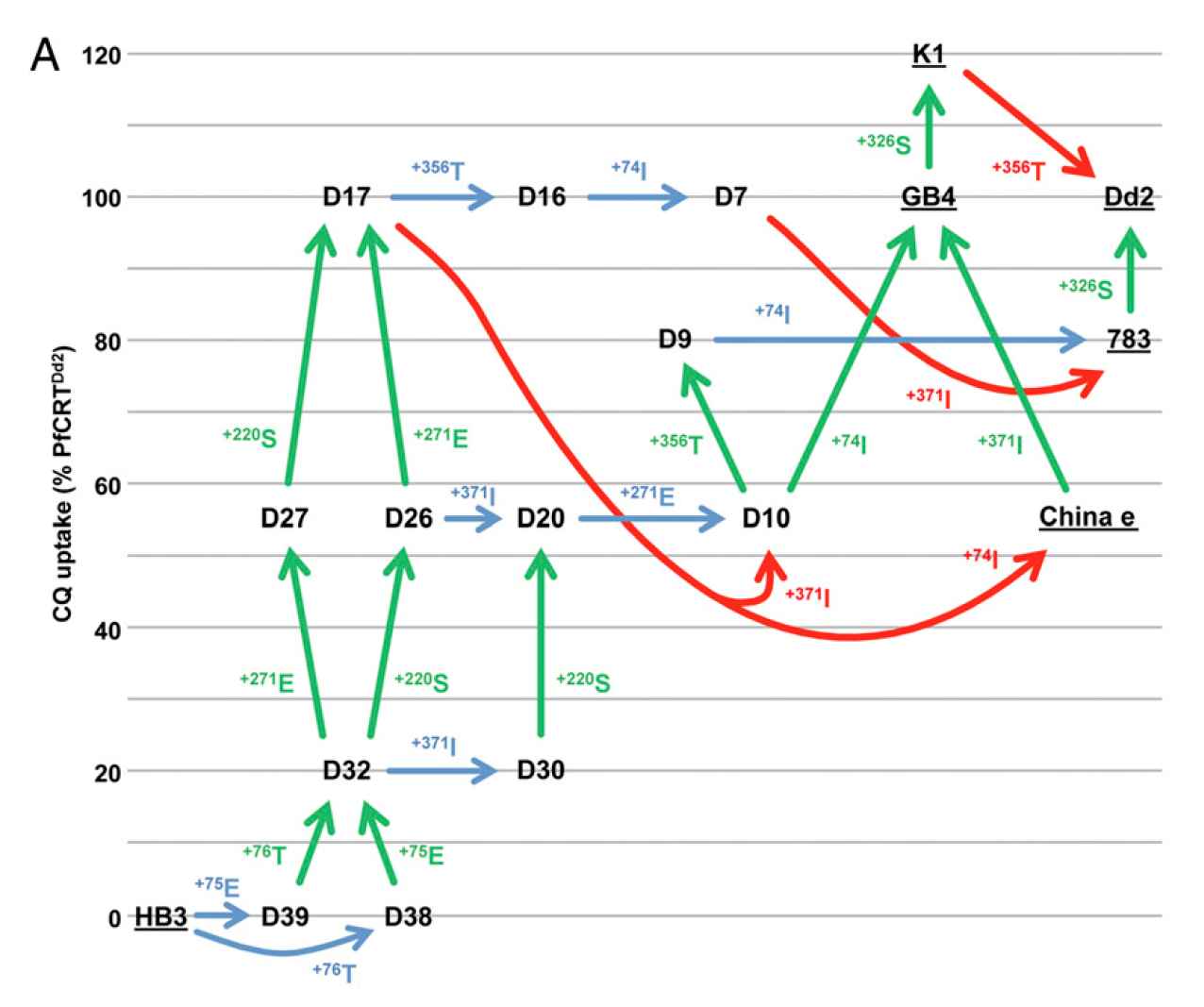
True to form, Miller keeps nailng Behe again and again:
Needless to say, nothing in the PNAS study supports Behe's mistaken view of how new protein binding sites must evolve. Behe insists that each such site must include five or six specific amino acids, which is not correct, and calculates his probabilities by insisting on predetermined results, which unrealistically stacks the deck.
Far from offering vindication, the PNAS paper actually cuts the legs out from under Behe's claims about evolution and the malaria parasite. How could he and his supporters get it so wrong? It may help to know that this is not the first time they've done something like this.
In a 2012 interview with Nature, Thornton expressed weariness with the way in which ID proponents continue to take issue with the clear implications of his work. "I'm sort of bored with them," he told the journal. In truth, I am, too. Time after time, they take work that devastates their key claims, like the PNAS study on drug resistance in malaria, and pretend to their willing adherents that science is trending their way. As it misrepresents one study after another, the ID movement continues on its steady and certain downward slide to irrelevance.
Miller's entire opus is also
available as a single PDF file.
Discuss.
160 Comments
TomS · 31 December 2014
I never understood how Behe thought that he was making a point by contrasting the strength of nature, including evolution by natural selection, with the weaknesses demonstrated by human-designed drugs. Every time a new designed drug is introduced which shows effectiveness against the malaria parasite, evolution of the parasite makes the drug ineffective. (Isn't it true that the evolution of sickle-cell trait has remained effective?) To me, this is an example of Orgel's Second Law: Evolution is smarter than you are.
Hardly an example of how intelligent design is necessary.
harold · 31 December 2014
This is a favor for science supporters. In my experience what little appeal evolution denial has for the general public is solely based on "humans are special" arguments.
"God creates malaria drug resistance by a miracle, but bothers to use normal molecules for his miracle" has no appeal except as a bizarre dead end obsessive pseudo-legalistic word game for the rare weirdos who post at UD. This type of crap made an initially sympathetic crowd in the Dover courtroom laugh at ID.
DS · 31 December 2014
This has got to be the dumbest thing Behe has ever done and that's saying a lot. He is claiming that resistance cannot evolve. But it has, repeatedly. This is like saying that a bumble bee cannot fly, it is obviously wrong.
Or maybe he trying to say that god intelligently designed and produced the resistant parasites. NIce god you got there Mikey. You better hope this is natural evolution. Then we at least have a chance of intelligently designing effective strategies for dealing with it. But if the magic sky pixie wants millions of people to die for no apparent reason, then we might as well give up and just let them all die. Sure seems like an awfully inefficient way of killing people though. Why not just strike them all dead at once? WHy give them the chance to develop drugs that can save their lives? If Behe is claiming that some god really is behind all this, then he has shown the limits of his god, not evolution.
harold · 31 December 2014
TomS · 31 December 2014
Just Bob · 31 December 2014
gdavidson418 · 31 December 2014
Well, it's there if there ever is a Dover II, or Scopes V (not sure what the count would be, actually), or whatever they want to call it.
Edging Toward Irrelevance, though? Regarding science, there never was any relevance, and flatly claiming victory for ID whenever the evidence goes (even more) against them is them being about as PR relevant as ever. Still, it's fun to see Behe's whole last book go down the drain, not just for unwarranted speculations and claimed knowledge of God's mind and doings (how did he know where and when design left off anyway, so that he "knew" God didn't design chloroquine resistance?), but for being quite wrong on the facts.
They've got the true believers who'll swallow any nonsense said against "godless evolution," and I guess they're happy to stick with them. Behe's just showing that he can be even more pathetic than he was at Dover. For the tribe, that's proof of loyalty, with the added benefit that "I was wrong" is conveniently off of the table (he seems allergic to it).
Glen Davidson
scienceavenger · 31 December 2014
John Harshman · 31 December 2014
mattdance18 · 31 December 2014
As this sorry episode well indicates, when it comes to evolution, Michael Behe is intellectually dishonest. But then, we've known that since even before Dover. This is merely the most recent example of his penchant for lying.
For sheer dishonesty, no creationist can top Philip Johnson. But Behe comes close.
harold · 31 December 2014
mattdance18 · 31 December 2014
DS · 31 December 2014
It seems to me that Behe is claiming that the probability of resistance evolving is so low that it couldn't happen naturally. But it has evolved multiple times in different species. Therefore his probability calculations are irrelevant. Resistance did evolve, many times, so no matter what he claims evolution cannot do, he has already been proven to be wrong about that. So he could be wrong about anything else he claims evolution cannot do as well.
Even if he is only trying to claim that it is extremely unlikely for resistance to evolve, he has still been proven wrong. Unlikely things happen all the time. Even if his calculations did somehow accurately represent reality, the only possible conclusion would be that there are orders of magnitude more than enough parasites for resistance to evolve in a fairly short period of time. So, even if he refuses to say what his point is, he still loses. His resistance to evolution is futile.
Now if he had a step by step, miracle by miracle account of exactly how the resistance came about by supernatural means, that pathetic level of detail might be something to look at. Until then, all he has is personal incredulity, a specious probability calculation and a fundamentally flawed understanding of biology.
mattdance18 · 31 December 2014
Doc Bill · 31 December 2014
I thought that what Behe wrote in Edge was that resistance required two SIMULTANEOUS mutations and that was beyond the edge of evolution, therefore the malaria plasmodium was designed. Didn't Behe argue as well that SEQUENTIAL mutations were essentially impossible leading again, ta da, to design.
Thus, I was mystified (and still dazed and confused) how a paper which describes a series and multiple pathways of SEQUENTIAL mutations conferring resistance is in any way supportive of his thesis in Edge.
I can only surmise that if you're an IDiot shouting "Victory!" loud enough is all you need to do, because certainly the IDiot minions aren't going to read the paper.
burllamb · 31 December 2014
Good Lord - all these science-y arguments being made! The Discovery Institute laughs at your logic, for it matters not. The people who send the DI money - boatloads and boatloads of green crisp delicious money - don't read your science-y replies. They don't actually understand or even care about the science. And neither does the Discovery Institute.
The Discovery Institute is about all that cabbage, that kale. The Cheddar, the clams, the lettuce, the bread. It's about simoleons, not science; loot, not logic; Benjamins, not biology. It's a multimillion dollar-a-year enterprise with hardly any real expenses, and just a few employees. It's a legal permit to print money, and the more time, effort, and electronic ink you spend attacking it rationally on its scientific merits, the happier, wealthier, and more legitimate-looking do you make its beneficiaries.
Mike Elzinga · 31 December 2014
It seems to me that it is the general structure of the thought processes of ID/creationists that leads them to make such dumb mistakes. They all have a sectarian, preconceived notion of how the world was built and should be working; and every one of them, throughout their entire educations - those that actually got an education - have been systematically bending and breaking scientific concepts and evidence to fit their sectarian world view. It has become locked-in behavior; they simply can't think any other way.
ID/creationists misconceptions have pedagogical implications for those who have the responsibilities for teaching science to the general public. ID/creationist memes are common in our culture because of fifty years of intense socio/political effort on the part of the leaders of the ID/creationist movement. Depending on the part of the US in which one lives, instructors are very likely to encounter them in at least a few of their students.
ID/creationist misconceptions aren't confined to biological evolution - the original motivation for the genesis of the ID/creationist movement back in the 1970s. They now have to get even basic probability and statistics wrong; to say nothing of how they mangle basic physics and chemistry.
But certainly one thing has become clear in the fifty years ID/creationists have been spreading their memes, despite repeated attempts by members of the scientific community to correct them; ID/creationism is dishonest to its core, and the leaders of this movement know it.
TomS · 31 December 2014
It has been a long time since I read "Edge of Evolution".
Does Behe expect the reader to think that all of the changes to the malaria parasite in response to each new human-designed treatment to be "Intelligently Designed" or to have occurred by natural causes (that is, evolution)?
Is the sickle cell trait still effective against malaria? Does Behe expect the reader to think that the sickle cell trait to have evolved, or to be "Intelligently Designed"?
I understand that B. has suggested that modern organisms have had their traits in latent form back to long ago. Would that be the explanation, according to B., for the modern appearance of resistance? That maybe the "Intelligent Designers" anticipated modern human designs of treatments, and designed the original malaria parasites so that they could respond to our treatments?
Is it possible to make a consistent account of B.'s. Is there any account which someone could describe with a straight face?
gdavidson418 · 31 December 2014
On the matter of whether or not Behe thinks chloroquine resistance evolved, there this. Note that Hoppe corrects his claim that Behe thought that chloroquine resistance couldn't evolve, and links to a couple of posts.
Beyond a bit of googling, I wasn't about to enact the labor, since it's baseless BS anyway. Still, no point in making basically incorrect claims about what Behe himself has declared.
Glen Davidson
gdavidson418 · 31 December 2014
This should have been the link, because Hoppe's correction shows at the top here. Still in the previous link, but you have to scroll up to find it. I didn't realize that it had linked to one of the linked comments.
Glen Davidson
Jose Fly · 31 December 2014
I've actually had creationists, in their zeal to oppose evolution no matter what, state that they believe God deliberately designs the biochemical pathways and biological structures pathogens use to inflict disease. IOW, they'd rather believe in a bio-terrorist god than evolution.
Now that's dedication! Or delusion.....
Doc Bill · 31 December 2014
gdavidson418 · 31 December 2014
Carl Drews · 31 December 2014
SLC · 31 December 2014
TomS · 31 December 2014
harold · 31 December 2014
Ron Okimoto · 31 December 2014
http://en.wikipedia.org/wiki/The_Edge_of_Evolution
Wiki seems to indicate that Behe is ambiguous in his intent. It sounds like Behe wants it both ways in terms of evolution or design. Apparently in the book he does claim that the designer is responsible for putting mutations into organisms, but he doesn't seem to be clear on what mutations these are. Behe seems to believe that malarial resistance is some type of edge of evolution. He probably understands that two mutations could occur naturally, and that may be his maximum expected, so his prediction would be that malarial resistance is not due to the designer and that only two mutations would be found to be necessary. This would be Behe's "edge." There would be no reason to crow about the results if this were the case. Behe's reaction to the findings indicates that he thinks that even though two mutations are a possibility that they are so improbable that Design is more probable. Behe had to admit that his own simulation determined that his double mutation was expected to occur in a single generation of the number of organisms found in a reasonable amount of pond mud. He would be claiming that his designer was helping the malarial parasite to continue to be a plague on the designer's human creations. So either way Behe's argument seems to be stupid. Either nature would have been expected to be responsible, or for some reason even though two mutations could occur naturally the designer would have some reason to help the malarial parasite in multiple instances where the same mutations have occurred in different populations.
Pretty much only Behe knows that he meant. Malarial resistance seems to be a null result for ID no matter what interpretation is put forward.
John Harshman · 31 December 2014
I'm fairly depressed that so few people commenting seem to have any idea of what Behe claims. Apparently nobody has actually read Ken Miller's analysis, which should have made everything clear. Chloroquine resistance is Behe's "edge of evolution" precisely because he thinks it's the very most that evolution can ever do. (And this only in a huge population with short generations.) Can't anyone else here read?
It's a "double CC" that he thinks is impossible: two simultaneous events equivalent to the evolution of chloroquine resistance.
Further, what Behe thinks the evolution of resistance entails is two simultaneous mutations, each of which would be deleterious on its own. This he agrees can happen in the Plasmodium population, around once every 20 years. What Miller shows is that Behe's imagined double-mutation mechanism wasn't required and in fact didn't happen, which demolishes his argument.
TomS · 31 December 2014
I think that you underestimate self-deception.
harold · 1 January 2015
Joel Eissenberg · 1 January 2015
Ron Okimoto · 1 January 2015
harold · 1 January 2015
DS · 1 January 2015
Well if Behe wants to do a probability calculation, why doesn't he do one using the multiple pathway model? If he thinks that this paper is evidence in favor of his version of reality, whatever that may be, then why hasn't he learned anything from it? It proves that two simultaneous mutations are not required. It proves that new functions can evolve. It proves that mutations can be beneficial. It proves that sitting around doing fallacious math to try to prove that reality conforms to your preconceptions is a worthless endeavor.
You are really talking out both sides of your ass if you claim that the odds are against something happening even once in the entire history of life on earth and then saying that it could happen in the existing population of one species. And you are just plain lying about it in either case, since it demonstrably happened multiple times in the recent past. At the very least this guy is telling two different lies to two different audiences. No one expects anything different. But crowing about how a paper supports one of your lies when it actually demolishes both of them goes beyond mere dishonesty and duplicity.
DS · 1 January 2015
Actually, multiple times in the very recent past in much smaller subpopulations and in more than one species.
gdavidson418 · 1 January 2015
gdavidson418 · 1 January 2015
DS · 1 January 2015
gdavidson418 · 1 January 2015
gdavidson418 · 1 January 2015
As long as we're on the subject, one thing that always annoyed me about Behe's chloroquine resistance as an "example" is that it appears to require at least two (now there's another problem with Behe's calculations, never has it been shown that only two are needed) on the same gene. Then he uses his calculations where at least two mutations are needed on the same gene to "argue" that any time three or more "simultaneous mutations" are needed ("simultaneous" being from a rectal extraction of his) that the same odds obtain.
Complete BS, because in many cases these would involve mutations on different genes, which sexual reproduction shuffles around using crossing-over and chromosome exchanges. That, presumably, is at least one reason for sexual reproduction, to get around the problem of needing more than one mutation in the same DNA length. I'm not aware of anywhere in his book that he acknowledged that two mutations in different genes would have very different odds of ending up in the same organism than two mutations in the same gene. I'm not saying that only chloroquine resistance needs the two mutations in the same gene, since that would be ridiculous, just that Behe conflates the situation of chloroquine resistance with any and all "simultaneous mutations" (in his prejudicial term), even those where sexual reproduction would assist in bringing two mutational changes into one organism.
Glen davidson
gdavidson418 · 1 January 2015
gdavidson418 · 1 January 2015
gdavidson418 · 1 January 2015
harold · 1 January 2015
Joel Eissenberg · 1 January 2015
The more I read this thread, the more I find myself wondering whether Behe understands the genetics of populations. There is no such thing as a unique, perfectly adapted "wild type" polypeptide sequence. In the living world, there is extensive polymorphism, with several different isoforms possessing no discernible selective advantage or disadvantage under measurable conditions. The steps between a given coding sequence and a new property may be many or few, depending on which isoform we're talking about. As for "deleterious" polymorphism, Sue Lindquist has published several excellent studies supporting a role for protein chaperones as capacitors for evolution. In her recent PNAS paper, she even provides evidence for chaperones as capacitors for the evolution of chemotherapy resistance in breast tumor cells.
harold · 1 January 2015
Robert Byers · 1 January 2015
The best takedown!! ID took down and is presently holding same as any audience should note.
I don't follow these intimates of how many mutations on a head of a pin will rearrange , successfully, enduring reproducing biology.
Yet it is still all about ID thinkers squeezing out the evidence that evolutionary biology demands very coorperating mutations to be going on at the same time to make the glory of complexity and diversity found in biology.
If any errors are made by iD thinkers they still they got the theme right. JUst fine tune the criticism of mutational cohabitants in genetics.
TomS · 1 January 2015
Ron Okimoto · 1 January 2015
Most people do not have the stomach for being a scam artist.
DS · 1 January 2015
John Harshman · 1 January 2015
Just Bob · 1 January 2015
gdavidson418 · 1 January 2015
gdavidson418 · 1 January 2015
Dave Luckett · 2 January 2015
Mr Thomas would no doubt prefer comments on Byers to be taken to the Bathroom Wall.
AltairIV · 2 January 2015
Tristan Miller · 2 January 2015
eric · 2 January 2015
DS · 2 January 2015
"The bottom line is that the need for an organism to acquire multiple mutations in some situations before a relevant selectable function appears is now an established experimental fact."
Excuse me, but that fact was established long ago. For example, the Lenski experiments demonstrate the importance of historical contingency. Now why do you suppose they did't cite that paper as evidence that their hypothesis was correct? Oh wait, that's because evolution actually worked, even in a small; population in the laboratory. Funny thing, resistance actually evolved in the malaria parasites as well. I guess they haven't discovered the edge of evolution after all, just the edge of their own knowledge.
harold · 2 January 2015
harold · 2 January 2015
mattdance18 · 2 January 2015
TomS · 2 January 2015
I wonder whether maverick scientists receive discreet overtures from the ID-ers. "Your contributions to science will receive the recognition that they deserve ...".
stevaroni · 2 January 2015
harold · 2 January 2015
John Harshman · 2 January 2015
The main point I'm trying to establish here is that when confronting Behe's bogus arguments it is important to confront the bogus arguments he actually makes rather than bogus arguments you might imagine he might make.
harold · 2 January 2015
Ron Okimoto · 3 January 2015
DS · 3 January 2015
John Harshman · 3 January 2015
harold · 3 January 2015
harold · 3 January 2015
harold · 3 January 2015
However, I will forgo direct jokes about the designer magically creating chloroquine resistance in the future.
John Harshman · 3 January 2015
Harold, I'm assuming you haven't read the book. True?
mattdance18 · 3 January 2015
mattdance18 · 3 January 2015
TomS · 3 January 2015
Scott F · 3 January 2015
Robert Byers · 3 January 2015
This comment has been moved to The Bathroom Wall.
John Harshman · 4 January 2015
harold · 4 January 2015
harold · 4 January 2015
Ron Okimoto · 4 January 2015
John Harshman · 4 January 2015
harold · 4 January 2015
Mike Elzinga · 4 January 2015
Before Edwards vs. Aguillard, the "scientific" creationists argued, "What good is a half a wing?"
After Edwards vs. Aguillard, the reconstituted ID/creationists argued, "What good is a half a molecule?"
Rather than learn the real science, they just tried to get around the law by word-gaming.
AltairIV · 4 January 2015
AltairIV · 4 January 2015
If I may also put my 2¢ into the Behe debate (which is probably more than its worth) ...
I can't claim to know anything more about what Behe says than what I've read in these blogs, but the impression I get is that he's simply playing the micro-/macro- evolution angle for all that it's worth. I mean "The Edge Of Evolution" is a dead giveaway, isn't it?
This means that he can play both sides with impunity. When the changes are small, and/or the evidence for the evolution of something is impossible to deny, he can state that it's natural, "micro" evolution, but whenever he can spin the numbers in a way to cast doubt, it goes "over the edge" and becomes impossible without some form of intelligent intervention (hint, hint, wink, wink). And best of all, he can simply place the line wherever it is most useful for him at the moment.
So yes, Behe's whole shtick is that he can accept that some things "evolve", while still casting doubt on evolution as a whole.
harold · 5 January 2015
John Harshman -
Apologies if my last comment is a bit frustrated in tone.
YOU WERE RIGHT that Behe does not claim that chloroquine resistance did not evolve.
To put those words in Behe's mouth is wrong.
I think what may be frustrating you is that you don't see a comment that just says that.
Even this one won't be "pure". I stand by everything I said about Behe in this thread, except that I retract any suggestion that Behe says that particular resistance didn't evolve.
However, yes, you were clearly right about that. Having read the Miller piece, I should not have made that error in the first place. Basically, I was biased by the desire to see Behe look extra foolish.
Frank J · 5 January 2015
John Harshman · 5 January 2015
TomS · 5 January 2015
John Harshman · 5 January 2015
TomS · 5 January 2015
lclane2 · 5 January 2015
Behe has never grasped cumulative selection. He treats mutation as if it's like organic synthesis.
Frank J · 6 January 2015
harold · 6 January 2015
Frank J · 7 January 2015
Frank J · 7 January 2015
harold · 7 January 2015
TomS · 7 January 2015
Mike Elzinga · 7 January 2015
harold · 8 January 2015
Frank J · 8 January 2015
TomS · 8 January 2015
The mathematical concepts qualified with almost are discussed in Wikipedia articles. The idea that something has a probability 0 (or 1) is not the same as it being impossible (or certain). It is based on the measure of the set. For example, the probability of a real number being an integer is 0. Wikipedia uses the example of the probability of a dart thrown at a target will hit a particular point being 0. Yet the dart will hit one point. So, wherever a dart hit, it was almost impossible. (They don't take into account that the target and the dart are not infinitely divisible. There are only a finite number of atoms. The atoms are in thermal motion. Let alone quantum effects.)
It is difficult to think that a person could earn a Ph.D. in mathematics without coming across the distinction between "impossible" and "probability 0".
Henry J · 8 January 2015
But if you're randomly selecting a point from an infinity of points, doesn't the probability need to be expressed in a form that allows infinitesimals in the value?
Mike Elzinga · 8 January 2015
Mike Elzinga · 8 January 2015
Karen S. · 8 January 2015
And for 2015, the DI is doing even more wonderful work! Here's a great
takedown of an ID "paper" by scientist Jennifer Raff, who has a blog called "Violent Metaphors." It seems that the Disco Tute's Casey Luskin challenged her to take an ID research paper as seriously as she would any other scientific paper. 2015 is off to a great start for the ID movement!
Frank J · 8 January 2015
gnome de net · 8 January 2015
Mike Elzinga · 8 January 2015
Mike Elzinga · 8 January 2015
Karen S. · 8 January 2015
Usually Jennifer Raff goes after the anti-vax folks. She has a good facebook page. Any pseudo-science is fair game.
Karen S. · 8 January 2015
Mike Elzinga · 8 January 2015
gnome de net · 9 January 2015
harold · 9 January 2015
TomS · 9 January 2015
Frank J · 10 January 2015
Rolf · 10 January 2015
Rolf · 10 January 2015
Maybe we should be more aware of the effect of religious bias. Isn't that what we find reflected in the statistics:
link
Frank J · 10 January 2015
harold · 10 January 2015
Frank J · 10 January 2015
Frank J · 10 January 2015
To clarify the quiz "guessing average." Had the 1000 respondents all guessed (mix of T/F and multiple choice), the mean would have been ~5. The actual was only ~8.
harold · 10 January 2015
Frank J · 10 January 2015
Frank J · 10 January 2015
Frank J · 10 January 2015
Mike Elzinga · 10 January 2015
Frank J · 10 January 2015
TomS · 10 January 2015
I think that we should expect something out of people who are suggesting that there is something fatally flawed in evolutionary biology.
Some of this is what we expect of people who are speaking in public about any subject, whether it's science or anything else.
Some are peculiar to science.
I think that if one is going to suggest that the standard approach to a topic is fatally flawed, that one ought to have the outlines of a replacement. It seems to be a standard that is universally accepted. People who say that Shakespeare didn't write "Hamlet" always have a suggestion for who did write it. UFO-logists have some ideas of what they really are. There are those people who think that they have something to offer about Elvis being alive. In the more serious cases, Copernicus felt the need to work out an alternative theory. It was generally known that there were difficulties with Ptolomy's model, but that was not enough. Likewise, the phlogiston theory or ether-wave theory of light or caloric.
It seems to be taken for granted that the "reigning paradigm" is going to have some difficulties. Whether in science or history or music or literature. And the "rebels" take it upon themselves to make an alternative.
To the best of my knowledge, no one has made an alternative suggestion to the basic idea that there is a great deal of common descent within the world of life on Earth. I'm not going to count variations on the Omphalos Hypothesis, that things just happen to look like they have evolved over vast stretches of time.
To me, this is the number one problem shared among YEC, OEC, ID. It was pointed out in the 19th century. And ID is the worst violator. Almost as if the proponents of ID realized the depth and rigor and obviousness of the the evolutionary account for the variety of life, and how much work it would be to mount a challenge. (It would be a digression to remark on the causes of lack of a demand for an alternative. And digressions are the bane of the support for evolutionary biology.)
:Lacking an alternative, all that can be done is to attack evolutionary biology. But the only attacks that anyone can think of are:
1) There are genuine puzzles about the "details" or the "fringes".
2) There are simply denial about vast amounts of human knowledge. "Were you there?" This is unwitting testimony to the overwhelming evidence and logic for evolutionary biology - that the only way to respond to it is nihilism, solipsism, cynicism.
3) The straw man version of evolution
4) Personal attacks on the morals of those who accept evolutionary biology.
IMHO, as bad as are the attacks on evolutionary biology, to respond to them can be a distraction from the primary fault: What is the alternative?
TomS · 10 January 2015
Am I absolutely sure about common descent in the world of life?
I am not an expert on biology, science, or anything else.
The most I can do is to go along with the experts insofar as they make sense to me.
And there are some ideas that are so much integrated in an understanding of the world that they, to me, pass the standard, "Nothing in such-and-such makes sense except in the light of thus-and-so."
I would count a few of the really important ones as: (1) atomic theory of matter (2) heliocentric model of the Solar System (3) common descent as an explanation of variety of life (4) plate tectonics over deep time (5) germ theory of infectious disease.
Among those ideas, the one that I am closest to having direct experience of the evidence is common descent.
To be a little romantic about things, I look at some of the vast effort over ages of dedicated persons and I feel an obligation not to let their sacrifices go to waste (and I count also the lifetimes of those who went off on what are now recognized as dead ends).
That expresses, as best I can, how confident I am in common descent.
Frank J · 10 January 2015
harold · 11 January 2015
TomS · 11 January 2015
Frank J · 11 January 2015
bigdakine · 13 January 2015
Frank J · 13 January 2015
TomS · 13 January 2015
FL · 14 January 2015
phhht · 14 January 2015
Mike Elzinga · 14 January 2015
DS · 14 January 2015
Frank J · 15 January 2015
Tristan Miller · 16 January 2015
Behe has posted a response to Miller's reply here
Mike Elzinga · 16 January 2015
mattdance18 · 16 January 2015
Wow, Behe is an intellectually lazy asshole. And wow, Floyd is gullible. The lazy asshole doubles down on his lazily reached conclusion -- it's the same bullshit Miller already refuted -- then projectively accuses his opponent of being the insufficiently rigorous thinker... and Floyd falls for it.
Bravo, Floyd! You're an idiot.
Frank J · 19 January 2015
C'mon now. Behe fully understands Miller's math, and even if he hasn't kept up with the science, understands it at least well enough to know that Miller is not making stuff up. But he is so invested in peddling evolution denial that he has no choice but to sound like he doesn't understand it. As a "lawyer" hell-bent on promoting unreasonable doubt, he is anything but "intellectually lazy."
sciencedefeated · 23 January 2015
Here is a place where an ID-defender argues with a biology person about the Behe/Miller exchange. Perhaps people here are eager to participate:
http://bilbos1.blogspot.com/2015/01/behes-latest-replies-to-miller.html
Cheers,
NS
Mike Elzinga · 23 January 2015
There is no way anybody is going to argue probabilities of molecular assemblies or mutations based on the pseudo mathematics of ID/creationism.
One has to have some inkling of the work that got the 2013 Nobel Prize in chemistry in order to understand probabilities of molecular assemblies. And even then, one has to know something about the environments in which specific molecular assemblies evolved and mutated.
As long as Behe remains locked up in ID/creationist thinking about biomolecules, his assessments of any scientific evidence about their evolution is irrelevant. Behe is a has been at best; but more likely a never was.
TomS · 23 January 2015
Mike Elzinga · 23 January 2015
sciencedefeated · 24 January 2015
Is everyone busy reading the discussion in the link I posted?
Dave Luckett · 24 January 2015
Keelyn · 24 January 2015
sciencedefeated · 24 January 2015
Sylvilagus · 24 January 2015