Delicious sex chromosomes

Posted 4 November 2014 by

Plants have sex? Yes, they totally do.

A brief overview: 
Plants have female reproductive organs (carpels) and male reproductive organs (stamens), but several different ways of determining sex. There are two main groups of seed-producing plants.

Gymnosperms are plants without covered seeds, and include those that produce cones. Gymnosperms and are split with about 75% exhibiting monoecy (having male and female sex organs on the same plant), and 25% exhibiting dioecy (having separate male plants and female plants).
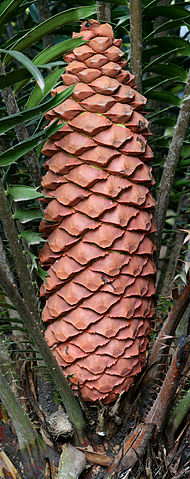
Photo by Muhammad Mahdi Karim, via Wikimedia Commons
Alternatively,  Angiosperms, the flowering plants, have only a small subgroup that exhibit either separate male and female flowers or separate male and female plants, and instead most angiosperms are hermaphrodites, meaning all of their flowers contain both male and female sex organs.

Photo by Derek Ramsey, at Chanticleer Garden, via Wikimedia Commons
One thing that is fairly common among vertebrates (found in mammals, birds, frogs, reptiles, and fish), but rare among plants is sex chromosomes. But, as we look more and more, we are finding sex chromosomes in the most delicious places. All of the following plants have sex chromosomes:

Persimmon
A Y-chromosome-encoded small RNA acts as a sex determinant in persimmons
Takashi Akagi1,2,  Isabelle M. Henry1,  Ryutaro Tao2,*,  Luca Comai1,*

Photo by Î£64, via Wikimedia Commons
Asparagus
Identification of molecular markers for selection of supermale (YY) asparagus plants.
Gebler P, Wolko Ł, Knaflewski M.

Photo by Rasbak, via Wikimedia Commons
Wild strawberry
Sex-determining chromosomes and sexual dimorphism: insights from genetic mapping of sex expression in a natural hybrid Fragaria × ananassa subsp. cuneifolia.
Govindarajulu R, Liston A, Ashman TL.

Photo via Walter Siegmund, via Wikimedia Commons
Papaya
Accumulation of interspersed and sex-specific repeats in the non-recombining region of papaya sex chromosomes.
Na JK, Wang J, Ming R.

Photo by Sakurai Midori, via Wikimedia Commons
Wild grapes
A small XY chromosomal region explains sex determination in wild dioecious V. vinifera and the reversal to hermaphroditism in domesticated grapevines.
Picq S, Santoni S, Lacombe T, Latreille M, Weber A, Ardisson M, Ivorra S, Maghradze D, Arroyo-Garcia R, Chatelet P, This P, Terral JF, Bacilieri R.

Photo by Bangin, via Wikimedia Commons

So, yes, plants have sex, and some even have sex chromosomes. Just something to keep in mind as you work towards fulfilling your daily servings of fruits and veggies. 

19 Comments

John Harshman · 4 November 2014

Just wondering about the last reference. Do domesticated grapevines have sex chromosomes, or do they have a small sex-determining region (though apparently bigger than a single locus) on a pair of autosomes? For that matter, what's the dividing line between sex chromosomes with pseudo-autosomal regions and autosomes with sex-determining regions?

M. Wilson Sayres · 4 November 2014

Great questions, John.

To my understanding of the paper, domesticated grapevines, as far as we know, do not have whole sex chromosomes, but sex-determining regions. The wild grape ancestor has somewhat differentiated sex chromosomes, and exhibits dioecy (separate male and female plants), whereas the domesticated grapes are hermaphrodites, where flowers have male and female parts. Generally, separate sex chromosomes are only observed in species where separate male and female individuals are common (although this doesn't mean that hermaphrodites cannot also be common, just not exclusive).

The transition between an autosome with a sex determining region, and a sex chromosome can be fuzzy, as with most of biology, but would occur when one of the two chromosomes, the one with the sex-determining allele, starts to be found exclusively in one sex, AND where the sex determining region becomes linked to other genes. Likely these other genes are sexually antagonistic genes (beneficial in one sex, and harmful in the other). Until the sex-determining allele becomes linked to other alleles, there isn't any differentiation between the ancestral autosomes other than the sex-determining region, and so it is not any different that any other allelic variation. Once it becomes linked to other alleles, and starts being inherited in a sex-specific fashion, it is a sex chromosome.

gdavidson418 · 4 November 2014

OMG those plants are shameless.

Glen Davidson

John Harshman · 4 November 2014

I guess the question would be how much of a chromosome pair has to be non-recombining before you decide they're separate chromosomes, i.e. sex chromosomes. How big a pseudo-autosomal fraction can you have before it's just a pair of autosomes?

Joe Felsenstein · 4 November 2014

M. Wilson Sayres said: Great questions, John. To my understanding of the paper, domesticated grapevines, as far as we know, do not have whole sex chromosomes, but sex-determining regions. The wild grape ancestor has somewhat differentiated sex chromosomes, and exhibits dioecy (separate male and female plants), whereas the domesticated grapes are hermaphrodites, where flowers have male and female parts. ...
I don't get it. In a hermaphroditic domesticated grape, don't all individuals have the same "sex determining region"? Surely the male and female parts of the same plant don't have different sex-determining regions.

Jim Thomerson · 4 November 2014

Why do flowering plants have dual fertilization?

Just Bob · 4 November 2014

gdavidson418 said: OMG those plants are shameless. Glen Davidson
Hell, that's nothin'! What do you think 'orchid' means? Plants are of the Devil, and no Christian should have any truck with them!

Henry J · 4 November 2014

Plants are of the Devil, and no Christian should have any truck with them!

But then how would they ever get to market?

Identification of molecular markers for selection of supermale (YY) asparagus plants.

It is the dawning of the age of asparagus...

M. Wilson Sayres · 5 November 2014

Jim Thomerson said: Why do flowering plants have dual fertilization?
What do you mean by "dual" fertilization? Google didn't help me understand this phrase.

M. Wilson Sayres · 5 November 2014

John Harshman said: I guess the question would be how much of a chromosome pair has to be non-recombining before you decide they're separate chromosomes, i.e. sex chromosomes. How big a pseudo-autosomal fraction can you have before it's just a pair of autosomes?
I'm not sure there is a huge consensus on this. To me, I would call them separate sex chromosomes when the non-recombining region becomes fixed in the population (and appears only in one sex), no matter how large or small it is.

M. Wilson Sayres · 5 November 2014

Joe Felsenstein said:
M. Wilson Sayres said: Great questions, John. To my understanding of the paper, domesticated grapevines, as far as we know, do not have whole sex chromosomes, but sex-determining regions. The wild grape ancestor has somewhat differentiated sex chromosomes, and exhibits dioecy (separate male and female plants), whereas the domesticated grapes are hermaphrodites, where flowers have male and female parts. ...
I don't get it. In a hermaphroditic domesticated grape, don't all individuals have the same "sex determining region"? Surely the male and female parts of the same plant don't have different sex-determining regions.
Joe, you're right. I don't think the separate male or female parts have different sex determining regions. I was thinking that there are sets of genes that are likely separately involved in forming male-gamete producing parts and female-gamete producing parts. For more about unisexual and bisexual flowers I found this 1993 paper by Dellaporta and Calderon-Urrea (http://barleyworld.org/sites/default/files/dellaporta.pdf), including discussion of sex determination in maize (a plant without sex chromosomes).

M. Wilson Sayres · 5 November 2014

Just Bob said: What do you think 'orchid' means?
For inquiring minds who don't want to google it: http://dictionary.reference.com/browse/orchis: "C16: via Latin from Greek orkhis testicle; so called from the shape of its roots"

John Harshman · 5 November 2014

M. Wilson Sayres said: What do you mean by "dual" fertilization? Google didn't help me understand this phrase.
The more usual term is "double fertilization". And Google likes that one just fine.

M. Wilson Sayres · 5 November 2014

John Harshman said:
M. Wilson Sayres said: What do you mean by "dual" fertilization? Google didn't help me understand this phrase.
The more usual term is "double fertilization". And Google likes that one just fine.
Got it. Thanks, John. I do not know why many plants undergo double fertilization. It could serve no purpose. Other hypotheses (http://www.madsci.org/posts/archives/2004-01/1073524356.Bt.r.html): "Arthur Cronquist (1971) considered double fertilization a "mere evolutionary happenstance." One possible advantage of double fertilization is that the plant does not invest energy in seed nutritive tissue until after an egg has been fertilized. Another possible advantage is that the endosperm nucleus is very active and divides rapidly. It forms the nutritive tissue very quickly. Rapid seed development has obvious advantages. "

Rikki_Tikki_Taalik · 5 November 2014

Just Bob said:
gdavidson418 said: OMG those plants are shameless. Glen Davidson
Hell, that's nothin'! What do you think 'orchid' means? Plants are of the Devil, and no Christian should have any truck with them!
It gets worse. They even drag other species into their sordid behavior. Thanks, Obama Eve!

kencareygti · 5 November 2014

And, of course, the seed plants (gymnosperms and angiosperms) are not even all plants. There's also other vascular plants (ferns and horsetails, e.g.), bryophytes (mosses and liverworts), and algae of various sorts. Unlike animals, all of these plants (even the seed plants) have alternating multicellular haploid (gametophyte) and diploid (sporophyte) generations, and the sex determination can apply to the gametophytes as the sporophytes. In some plants (bryophytes, some algae) the haploid gametophyte is the independent freeliving "plant" and the sporophyte is a dependent stage.

And if that's not complicated enough for you, lots of plants with all sorts of life histories have various mating systems on top of the male/female component that control inbreeding, outbreeding, etc.

Never a dull moment for someone interested in plant reproduction! :)

Just Bob · 5 November 2014

kencareygti said: And if that's not complicated enough for you, lots of plants ...have various mating systems on top of the male/female component that control inbreeding, outbreeding, etc.
Like I said: they're of the Devil. If it ain't one man and one woman, with the woman on the bottom, it's SIN. Who knows what depravity our kids are tempted to try after learning about plant abominations in straight-from-the-pit-of-Hell biology classes!

M. Wilson Sayres · 6 November 2014

kencareygti said: Never a dull moment for someone interested in plant reproduction! :)
Absolutely! I wish I could "like" your comment. Or up-rank it. I didn't even mention the UV sex chromosome system. It totally blew my mind when I first learned about it.

Scott F · 16 November 2014

M. Wilson Sayres said: Great questions, John. To my understanding of the paper, domesticated grapevines, as far as we know, do not have whole sex chromosomes, but sex-determining regions. The wild grape ancestor has somewhat differentiated sex chromosomes, and exhibits dioecy (separate male and female plants), whereas the domesticated grapes are hermaphrodites, where flowers have male and female parts. Generally, separate sex chromosomes are only observed in species where separate male and female individuals are common (although this doesn't mean that hermaphrodites cannot also be common, just not exclusive). The transition between an autosome with a sex determining region, and a sex chromosome can be fuzzy, as with most of biology, but would occur when one of the two chromosomes, the one with the sex-determining allele, starts to be found exclusively in one sex, AND where the sex determining region becomes linked to other genes. Likely these other genes are sexually antagonistic genes (beneficial in one sex, and harmful in the other). Until the sex-determining allele becomes linked to other alleles, there isn't any differentiation between the ancestral autosomes other than the sex-determining region, and so it is not any different that any other allelic variation. Once it becomes linked to other alleles, and starts being inherited in a sex-specific fashion, it is a sex chromosome.
I had been under the (poorly informed) impression that the origin of sexual differentiation was still a "mystery". This strongly suggests a plausible gradual pathway for the initial evolution of "sex". Certain genes become "linked" to a "sex determining region" on a single gene in a single-sex organism, which eventually diverge into physically separate male and female phenotypes.