Lisle: I've seen this criticism [observable gravity field] but I haven't responded yet. It is very easy to refute. I plan on doing a series on this blog on the topic of ASC, in which I will refute this and other criticisms made by those who have not studied the topic. [Jason Lisle, comment September 11, 2012 at 6:18 pm]Uh huh. Sure you will Jason. Two years later, we're still waiting. His comment has no content beyond the usual creationist combination of genetic fallacy plus ad hominem attack: ignore the math because it was "made by those who have not studied the topic"-- as if Lisle's toy model is so friggin' hard! (For other entertaining examples of creationists who respond to the demolition of their faked evidence and/or terrible math with the very mature, "Wah, it don't count because you're all ignorant of my genius, ignorant ignorant!!", without ever actually employing their superior intellects to show what's wrong with the maths, you can peruse IDer William Dembski's ad hominem "refutation" of Felsenstein and Shallit's demolitions of his pseudomath, and creationist Jeffrey Tomkins' infantile mental meltdown presented by him as a "refutation" of AceofSpades' exposure of Tompkins' incompetent huge overestimate of the genetic difference between humans and chimps.)
So on Sept. 11 of this year and every year, let's celebrate not just the genius of Dr. Jason Lisle of the ICR, but the genius of all the YECs over the years who've said they could explain how starlight can get here from galaxies millions of light years away in a mere 6,000 years-- all of whom subsequently crashed and burned, including Lisle, as we'll see below.
In this blog post, I'll review the math that shows why Lisle's model is dead, dead, dead, and why his cosmogony is absurd on several levels, because contradicts Lisle's assumptions. But first, for your entertainment, let's review some previous, disastrous, failed attempts by YECs to "solve" the starlight problem.
Background: Previous YEC Attempts to Solve the Starlight Problem
The "Starlight Problem" has vexed Young Earth creationists for as long as there have been Young Earth creationists. Simply put, the universe cannot be 6,000 years old if we can see galaxies millions of light years away, and if light travels at the speed of 186,000 miles per second-- not unless God is tricking us with phony light shows in the sky. Here are four dead proposals.
1. "Omphalos", aka "Appearance of Age": the Deceiver-God is tricking us with phony light shows in the sky that didn't really come from stars. You might think that this argument is an evolutionist spoof of a creationist argument, but in fact it was promoted for decades by none other the most famous creationist in American history, Henry Morris, the "Godfather" of modern YEC, author of the influential The Genesis Flood (1961), and founder of the ICR where Jason Lisle now works. Morris never backed down over several decades but aggressively defended the idea of deceptive light shows in the sky, along with his ICR lieutenant and "star debater", Duane Gish. These light shows must be extremely complex and highly contrived by Deceiver-God, due to the complexity of many observed astronomical events and structures. For example, from time to time a supernova comes into the news, and astronomers can detect both photons and neutrinos from the exploding star, and in years afterward they observed the expansion of the gas and dust clouds thrown off in a shell around it, e.g SN 1987A that exploded in 1987. All fake, all an illusion, according to the ICR when Morris and Gish were alive-- fake photons, fake neutrinos, fake dust, fake clouds... if the object is more than 6,000 light years away. If it's closer than that, it might be real. Some large astronomical structures are light-years across and in principle could cross the 6,000 light-year boundary, a topic the YECs discreetly avoid discussing, but in principle structures like large nebula could be half real and half make-believe, like Fox News.
Henry Morris used Deceiver-God to explain away both the starlight problem and also radiometric dating: In The Genesis Flood Morris said God just created rocks with a high ratio of daughter isotopes to parent isotopes, making them appear old by radiometric dating, because the Bible says "a thousand years is as a day to the Lord." Morris never explained why God made deeper rocks appear older than rocks near the surface, or why volcanic intrusions appear younger than the strata they intrude into. In a debate against Ken Miller in 1981, Morris defended his "fake photons" argument for starlight but in a comical/pitiful performance, he seems embarrassed by it. In the Q and A session afterward, an audience member asks him, "[C]ould we not equally accept that the universe was created a millisecond ago with prepackaged memories of your two-and-a-half-hour debate implanted in our minds?" [a philosophy called Last Thursdayism]. Morris' 1981 answer is still amazing.
[Henry Morris]: ...obviously when you suggest the creator could create things with the appearance of built-in memories... yes, in principle of course as the creator he could do that, and if there is a creator then you can't say 'No.' ...But when we suggest that there is creation, then the only way to say that there is no possibility of creation with an appearance of maturity, or completeness or appearance of age, or whatever, is to say that creation is impossible. And that's to say that there is no creator, which is tantamount to atheism. [Henry Morris vs. Ken Miller debate, 1981]So you have to like Morris' Deceiver-God and his fake photons, fake supernovae, fake nebulae, fake light shows in the sky, fake geological evidence etc., or else you're an atheist. This is the classical defense of Omphalos, still used by Jason Lisle today: flip the burden of proof onto the other guy by demanding, "Where is your evidence that my all-powerful God can't trick me?"
2. The Speed of Light is Slowing Down. This terrible idea was the go-to answer in the 1970's and 1980's. Do I have to say that the method to "prove" this was a hoax, and that energy is converted into mass by the equation E = mc^2, so when creationists say that the speed of light c could have been, say, a hundred million times (10^8) faster in the past, that means that the energy released by nuclear fusion in stars would have been ten quadrillion times (10^16) greater back in the old days and the universe would blow up? Likewise all the radioactive uranium, thorium and radium in the whole Earth would release ten quadrillion times more heat, and in your own body the fraction of your potassium that is radioactive would friggin' kill you.
This dumb idea of light "tiring out" from its long journey was concocted by Norman and Setterfield about 1969 and the method behind it was thoroughly debunked by the time of the 1982 book Scientists Confront Creationism. Norman and Setterfield took a historical value of the speed of light and a then-current measurement, then they drew a curve through the the highest end of the error bar of the first, to the the lowest end of the error bar of the second, and surprise!! The curve goes down over time!! And of course they used an exponential curve, so if you go back in time a few centuries, the speed of light would be vastly, exponentially larger than now. Also, al stars would explode, the Earth would vaporize and your own potassium would kill you.
This dumb idea was pushed by Flood fossil fraudster "Dr." Carl Baugh (fake Ph.D.) and by "Dr." Kent Hovind (fake Ph.D.), aka Federal Prisoner #06452-017. Naturally, Ken Ham, Andrew Snelling and Carl Wieland, in a precursor to Answers in Genesis ministry, pushed the idea in the 1990 edition of The Answers Book (pages 189-192).
3. Stars are Not Big and Very Far Away, They're Small and Close Up. Again, this is a real creationist argument, not a parody of creationism.
[Carl Baugh]: One of the concepts of evolutionary consideration is that some of the stars appear to be much closer. The formula which calculates these distances is by no means proven. But even if God wanted them to be sixteen billion light years away, that's no problem for an omnipotent... God. ["Dr." Carl E. Baugh (fake Ph.D.), 'Panorama of Creation', (1992), p.11-13, 16, cited here]Ooh, the jury is still out!! The stars might be fifty feet away and just very tiny, who knows, scientists can't prove a damn thing!
Henry Morris again, embarrassed to have to invoke this argument, but invoking it anyway, because what the hell?
[Henry Morris]: ... we can't even be sure that these stars are billions of light years away. There're very sophisticated esoteric sort of assumptions involved in calculating the distances. [Henry Morris vs. Ken Miller debate, 1981]Ooh, them scientists are doin' long division and my head hurts! So esoteric! No, scientists do have sophisticated methods to estimate the distances to stars, and the laws of physics don't permit the stars to be shiny nails pounded in the dome of heaven like the Bible says. Here creationist Danny Faulkner summarizes and disputes other creationists who claim stars are small and close up.
4. Space could be Riemannian, then light from the most distant galaxies could get to us in 15 years! BullBLEEP, and the people who say it don' t even know what Riemannian means. They just want to use jargon. It means that space is curved in an invisible dimension, but negatively curved, like a saddle. Well, that would have observable effects, and they're not seen. So this is a toy model of a hypothetical universe but we know from observation it's not true of our universe.
5. Earth is at the Center of the Universe and We're at the Bottom of a Gravity Well. This idea was concocted by Russell Humphreys and recently popular for a few years, then it crashed and burned due to its basic mathematical blunders. Humphreys denied the Copernican principle-- that the universe looks about the same no matter where you are-- and says that all the galaxies form a big sphere with the edge far away, and Earth at its center. Anyway, Humphreys proposed that we're at the center of a spherical universe so that Earth would be at the bottom of a big gravity well, and in General Relativity, time runs slower at the bottom of a gravity well. So 6,000 years can pass on Earth while billions of years pass out in the Universe, get it? No, it sucks on many levels.
To start with, when light falls into a gravity well, it slows down, so the wavelengths get shorter; it's shifted to the blue end of the spectrum. That's the reason why the signals from GPS satellites have to be tuned to a slightly higher frequency than the receivers on Earth are tuned to-- time runs slower in Earth's gravity well, so the radiation is blue-shifted as it falls into Earth's gravity. Thus if Earth were in a huge gravity well, the light from distant galaxies would be blue-shifted, but it's actually red-shifted.
Also, there's no solution for intermediate distance objects-- what about nearby stars or planets in the solar system? They should be slowed down about as much as Earth, but instead they look very old: Mars and Jupiter's moons have tons of craters, and among the asteroids there is considerable evidences of long-term processes: from the Kirkwood gaps in asteroid orbital periods, from the tumbling rate of larger vs. smaller asteroids, and from running the orbits of asteroid families backward in time until they coalesce on the partent body from which they were broken off, etc. we know the asteroid families are tens of millions of years old. Likewise, there's no smooth way to say Earth is young, asteroids are a tiny tiny bit older, Pluto slightly older, etc. It's dead.
This idea is often conflated with long-debunked claims that galaxies are found in concentric shells with gaps between them, like a set of Russian nesting dolls with Earth at the center. The alleged evidence for the shell game is a bit of pseudoscience called "quantized red shift" meaning that red shifts from distant galaxies supposedly come in fixed intervals, therefore galaxies distance must come in shells with gaps between them (they don't, and they're not). The problem here is hypothesis fishing: if you analyze a bunch of galactic distances and test them for, say, a thousand different periodicities, the odds are that at least one periodicity will pass a statistical test at a level of 1 in a thousand, even if the data you analyze is random. Or if you test them for, say, a million different periodicities, at least one periodicity will pass a statistical test at a level of 1 in a million, even for randomized data.
Hypothesis fishing is a classic blunder and you have to reject it by doing the Bonferroni correction and trying to reproduce the exact same method on a totally independent data set.
Anyway, if it weren't for the popularity of GPS technology, we'd still have to deal with Humphreys' BLEEP, but now even most creationists sweep it under the rug. Except that according to the recent Texas newspaper article on ICR, the long-debunked "shells of galaxies" crap is still one of ICR's big current lines of research.
Now we'll finally get to Jason Lisle's idea, complicated yes, but smart, no.
Jason Lisle's Solution: Anisotropic Synchrony Convention (ASC)
Lisle's solution is cobbled together from three different ideas, which we should not get mixed up together.
1. The Anisotropic Synchrony Convention. Here Lisle simply defines all events happening in the universe, no matter what the distance, as being simultaneous with what's happening now on Earth. Simultaneity of any two events depends on the observer's position, so I say events A and B are simultaneous, but if you're in a different location, you say A happened before B (unless you are sitting on my lap.) Thus, God could create the whole universe simultaneously relative to Earth (see Point 3 below), and light from distant objects would instantaneously arrive at Earth no matter the distance -- but note that all creation events would not besimultaneous relative to observers not on Earth. Believe it or not, there is no way to falsify this because it's just a convention, so it can't be rejected on observational grounds. The problem is not terrible, but Lisle then combines it with the next two ideas, which are disastrous.
2. A variable speed of light that depends on the position of the observer, and the position and direction of travel of the photon, via the angle ÃÂø made between the eye-line from the observer to the photon and the photon's direction of travel. For all observers in the universe, not just those on Earth, photons come straight at them at infinite speed. Photons moving perpendicular to our line of sight move at the conventional c. If a photon is approaching you at a glancing angle, it decelerates precipitously, then at closest approach to you it moves at speed c, and continues to slow down after it passes you, as it recedes away finally approaching one-half the speed of light (c/2). If you jump to the left, the velocity of every photon in the universe changes. If you send a light beam to bounce off a mirror on Alpha Centauri, 4.5 light years away, in Einstein's convention it would take 4.5 years on each leg of the trip, 9 years total. But in Lisle's convention, it will take 9 years to get there and zero time to bounce back. From the point of view of the guy on Alpha Centauri, your light beam came to him instantly, and then took 9 years to bounce back to you.
This idea of Lisle's is disastrous as it would induce an observable gravity field in General Relativity (GR) and also mucks up two physical constants known from electromagnetic theory, the permeability and permittivity of free space, which must then become position-and-angle dependent instead of being constants. The variable, position-dependent speed of light (2) is a separate idea added onto the Synchrony Convention (1) above, though Lisle conflates 1 and 2, and incorrectly calls the combination a mere "coordinate transformation." Falsely calling them both a mere "coordinate transformation" was at the point of Lisle's promised refutation when two years ago he wrote "It is very easy to refute", then never delivered. He can't deliver, because (2) is not a coordinate transformation, because it sets the velocities of photons to be dependent on their position and on their direction of travel. Lisle never writes down his alleged coordinate transformation as a matrix (which should be easy if he were telling the truth) nor differentiates the matrix as is necessary.
3. Lastly Lisle hypothesizes a Cosmogony in which God creates the universe in concentric shells, outward from the edge of the universe and coming in towards the place where Earth will finally be, with a black sphere of "uncreated" nothingness in the center that slowly contracts as God creates stars and galaxies one thin shell at a time at the inner edge of the sphere. The creation "wave" converges on the place where the Earth will be at a speed of 1/2 the speed of light (not the speed of light as some have thought, and as Lisle himself incorrectly wrote in an early paper.) The intermediate steps of creation involve one-quarter stars, half-galaxies, half-black holes, three-quarter relativistic jets, etc. etc., and all kinds of huge complex structures that are millions of miles or hundreds of thousands of light years across, that God sloooowly constructs slice by slice: imagine a 3-D printer constructing a living human baby slice by slice, while it cries, thinks, and poops, but somehow doesn't die even when it has half-arteries and half-veins, half-loops of an intestine going in and out, half-brain etc. Same idea here, but with half-stars and half-galaxies instead of a half-baby. Lisle hypothesizes this cosmogony because if ASC is assumed then all creations by shells would then be simultaneous relative to an observer on Earth, if any existed (Day 4 of Creation Week, no humans existed to watch it); though the creation process would be highly non-simultaneous, relative to the planets and stars getting created, and in fact it would all take ~80 billion years (relative to a distant non-Earth observer) before God got around to making Earth, because the observable univserse is ~40 billion light-years across and creation shells would converge at half the speed of light.
It is not sufficient to call this cosmogony absurd or counter-intuitive. It is wrong because it is non-falsifiable; because the scientific method requires a theory to be simpler than the observations it explains, but here Lisle's "God made colliding galaxies etc. to trick us" hypothesis is always more complex than all observations; and because, significantly, it contradicts its own assumptions. YECs say that in principle, there can never be "Appearance of Age" (there is Apperance of Absence of Age) and their hypothesis is "Appearance of Maturity", but "Maturity" has no definition except in terms of "function". But this cosmogony has God slowly creating countless half-finished non-functional entities that he must intervene to prop up supernaturally when they're half-finished or quarter-finished. A baby, as it is being printed by a 3-D printer, cannot be alive or functional when its half-finished and its half-loops of intestines and blood would squirt out, it can't be "functional" without supernatural intervention. Likewise Lisle's cosmogony, to create well-balanced stars and galaxies and black holes, which all have complex internal structures and internal balance of gravitational pressure and photon pressure, would require God to supernaturally create far more fake photons and fake neutrinos and fake phonons and fake convection currents etc., all with the appearance of being from events that never happened-- far more fake photons and phony light-shows than Henry Morris ever conceived of.
More on Strange Conventions of Simultaneity.
Let's return to 1. While this convention is counter-intuitive, this idea is not disastrous and does not by itself entail testable predictions that might falsify it. All of us has have heard that Einstein's Special Relativity begins with the assumption that the speed of light is the same for all observers in the universe, so that if an airplane shoots out a light beam, the light beam still travels at only the speed of light c and not c plus the speed of the airplane. This assumption is experimentally justified by the Michelson-Morley experiment, which proved that light beams going along the direction of the Earth's movement as it revolves around the sun, have the same travel time as light beams going perpendicular to the Earth's movement.
However, Lisle and other creationists correctly and cleverly point out that the Michelson-Morley experiment only measures the total travel time for a light beam making a round trip, and there's no experimental way to measure the speed of light going one way without some kind of round trip arrangement. What if (let's say) the speed of light went faster when going north and slower when going south, or vice versa, and the round trip looked like c when averaged out? Or if light went instantaneously going north and travelled at c/2 when going south, which averages out to c?
In fact, there's no rule against that, not by itself. Einstein's convention was that the speed of light goes at c in all directions, which is simpler and makes the math easier, but it can't be proven per se. You are permitted certain other conventions, e.g. if you just have all north-going photons go faster and all south-going photons go slower in a fashion that does not depend on the position of the photon. Where Lisle screwed the pooch was by making light speed depend on the position of the photon, which turns out to not be allowed, and is not a coordinate transformation as he claims.
For the permitted synchrony conventions, we must consider some bizarre (but not forbidden) consequences for the idea of simultaneity. The pre-Einstein idea of simultaneity was that it's the same for all observers, so if events E1 and E2 are simultaneous for Bob, then E1 and E2 are also simultaneous for Julie, no matter where she is or if she's moving relative to Bob.
But with Einstein's convention, event E1 could happen before E2 for Harry, if Harry is moving relative to Bob. What matters for Einstein is direction of motion, not position. With Lisle's convention, it's position that matters, not motion: so E1 could happen before E2 for Harry, if Harry is in a different place that Bob.
Here's the classic Einstein "train" argument: Bob is standing on an embankment as a train is passing; at the moment that the center of the train passes Bob, two lightning bolts strike, E1 at the front and E2 at the back of the train. Bob says, "Both light signals come towards me at the same speed c and traveled the same distance, so I subtract the same amount off the times when I saw each flash, and conclude E1 and E2 were simultaneous." But Harry is riding the train in its center; he travels towards the photons from E1 and away from the photons from E2, so he intercepts the E1 photons before those from E2. Like Bob, Harry starts off saying, "Both light signals come towards me at the same speed c and traveled the same distance, so I subtract the same amount off both times", but because Harry saw E1's photons first, after subtraction he concludes E1 happened before E2. This is bizarre, but it's basic Special Relativity.
In Lisle's convention, what affects simultaneity is not velocity but position. All the "shells of creation" as God creates the universe are created simultaneously relative to some one point on Earth (Eden?), but not simultaneously relative to any observers not on Earth. This means that all observers outside Earth believe their planets were created long, long before Earth; and for millions of years, as they look in the direction where Earth will be, they see only a sphere of black nothingness because, relative to them, God hasn't created Earth yet. Indeed, for stars sufficiently far away but visible now in our telescopes, we still do not exist relative to them, and we can see them but they can't see us, because God has not created the Earth yet, Adam has not eaten an apple yet, and you don't exist.
This produces strange hypothetical effects. [I owe this 'mirror' argument to Tim Reeves of Quantum Nonlinearity.] Now suppose Lillith blinks into existence at the center of the Andromeda Galaxy at the moment it is created (hint: not the same time Earth is created) and Lillith immediately picks up a mirror. Back on Earth, at the moment Eve is created, she thinks the universe is all created simultaneously and assumes light from Andromeda comes to her instantaneously too, so Eve immediately sees brand new, young Lillith, way off in Andromeda, 2.5 million light years away, picking up her mirror. Now suppose Eve sends light towards Lillith; Eve thinks her light beam recedes from her at speed c/2 and thus thinks it will take 5 million years to get to Andromeda.
When Eve is 5 million years old, her light finally reaches Lillith, while Eve sees Lillith as also 5 million years old at that instant; for Eve has been watching Lillith age the whole time, and for the whole 5 million years, Lillith's mirror has been black reflecting nothingness because the Earth didn't exist yet for her. Finally Eve's light bounces off Lillith's mirror and zips back to Eve at a speed Eve thinks is instantaneous by Lisle's convention. So when Eve is really 5 million years old, she will finally see her reflection, far away, and will see herself young and newly created as reflected in a mirror held by 5-million-year-old Lillith.
What does Lillith see? At the moment she was created, she looked around and saw half of the Andromeda galaxy created (the side away from Earth), but the other half (in the direction where Earth will someday be) just black emptiness. Needless to say, the galaxy will not be "mature" or "functional" as creationists claim, because half a galaxy cannot be stable or functional; it will look like a multi-armed spiral chopped in half, with spiral arms all sliced up into disconnected half arc-circles or quarter-circles, etc. which are rotating all the time, but the rotation of disconnected half-arcs without gravitational balance will tear it to bits. Worse, at its center will be half a giant black hole, and no one knows what half a black hole would look like. If M31 had relativist jets squirting out of the galactic center (M31 doesn't, but some do), the jets could be split down the middle like Robin Hood's arrow, or part of a jet could be coming out of the black sphere of still uncreated space, phony particles contrived to look like the result of phony events that never happened: a vast, slow trick of the Deceiver-God. Then God will finish creating Andromeda slowly, relative to itself-- slice by slice, at half the speed of light, so the second half of the galaxy (radius= 50,000 ly) will take God 100,000 years to finish, relative to Lillith; or no time relative to Eve.
Lillith at her creation picks up a mirror, but sees no light from Earth at all-- just blackness in that direction-- and waits until she is five million years old. When she finally gets light from Earth, that planet and Eve look young and newly created; but Lillith (like all observers, under Lisle's convention) believes that photons approach her instantaneously, therefore Lillith subtracts zero flight time for photons coming from Earth.
Conclusion: Lillith concludes that Andromeda was created 5 million years before Earth, and that she is 5 million years older than Eve. Eve by contrast concludes that Andromeda was created (about) the same time as Earth, and that she and Lillith are the same age.
Also we see here why the shells of creation must be created at c/2 and not c: Lillith waits 5 million years before the empty black sphere in the direction of Earth get filled up with matter, but Andromeda is 2.5 million light years from where Earth will be; therefore Lisle's cosmogony creates shells of matter at speed c/2, so all large-scale structures will be completely unstable, not mature and not functional, unless God supernaturally tricks us, filling up all stars and galaxies with fake photons and fake neutrinos and fake convection currents etc. that look like the after-effects of real processes, except the events never happened. The fake light show is not creation of "maturity", so Lisle's cosmogony contradicts his claim that his all-powerful god is limited by "appearance of maturity."
In an earlier paper, Lisle, writing as Robert Newton (wow, humble), says creation will converge on Earth at lightspeed.
[Lisle]: So, we present the following picture of Creation as described in Genesis, but converted from observed time to calculated time... this creation process moves inward; space is created nearer to Earth... About 4.3 years before Earth is created, 'the beginning' occurs for the space near Alpha Centauri [which is 4.3 light years away]. ...Finally the Earth is created. [Lisle's early paper, writing as Robert Newton.]
Apparently wrong; it should be 8.6 years before Earth is created. Probably Lisle caught this error later.
Lisle's Variable Speed of Light Creates a Gravity Field in General Relativity and is Not A Coordinate Change!
We move on to where Lisle really screwed the pooch, with his variable speed of light.
[Lisle]: The act of choosing a synchrony convention is synonymous with defining the one-way speed of light. If we select Einstein synchronization, then we have declared that the speed of light is the same in all directions. If we select ASC, then we have declared that light is essentially infinitely fast when moving directly toward the observer, and ÃÂýc when moving directly away. Under ASC, the speed of light as a function of direction relative to the observer (ÃÂø) is given by c(ÃÂø) = c/(1-cos(ÃÂø)), where ÃÂø = 0 indicates the direction directly toward the observer. [Anisotropic Synchrony Convention: A Solution to the Distant Starlight Problem. Jason Lisle. September 22, 2010. Answers Research Journal 3 (2010): 191-207. Emphasis added.]First, it is not true that "The act of choosing a synchrony convention is synonymous with defining the one-way speed of light." This might be true for some synchrony conventions where the speed of light does not depend on position. But Lisle's variable speed of light, c(ÃÂø) = c/(1-cos(ÃÂø)), depends on ÃÂø, and ÃÂø depends the position {x1,y1,z1} of the observer and on the position {x2,y2,z2} and direction {v_x,v_y,v_z} of the photon.
ÃÂø is the angle between your line of sight to the photon and its direction of travel: ÃÂø = 0 if it's coming at you, so c(ÃÂø) is infinite, ÃÂø = 90 degrees if perpendicular to your line of sight, so c(ÃÂø) = c, and ÃÂø = 180 degrees if receding from you, so c(ÃÂø) = c/2. If you jump to the left, the speed of every photon in the universe changes. This is not a mere synchrony convention nor is it a mere transformation of coordinates, as we'll prove below.
Valid synchrony conventions might be expressed as one or more permitted coordinate transformations, which could be written as 4x4 matrices (3 space dimensions plus time dimension). For example, you could say that all photons going north travel instantaneously and all going south travel at c/2; that is not dependent on photon position. But Lisle's c(ÃÂø) = c/(1-cos(ÃÂø)) rule is not uniquely fixed by his synchrony convention-- he does not derive c(ÃÂø) = c/(1-cos(ÃÂø)) from his convention, he merely shows that it is consistent with his convention, but "consistent with" is not a derivation or proof of uniqueness. He calls it a "transformation of coordinates" but never writes it down as a 4x4 matrix (Einstein does, that's called the Minkowski transformation) and Lisle never differentiates it.
Now Lisle was confronted with this fact by Timothy Reeves to who I am indebted for this argument.
Because it depends on positions of the observer and of the photon, it induces a gravitational field and curvature of space time. I will explain this three ways: A. intuitively, B. by proving that Lisle's rule can't be written as a mere "coordinate transformation", and C. from General Relativity and Jian Qi Shen's scientific paper on synchrony conventions and the Riemannian operator in GR.
Method A. The easiest way to see the problem is to note that in General Relativity, a speed of light that varies with position and a gravity field are the same thing. In Lisle's rule, if a photon comes at you, just missing you and glancing off, it's decelerating all the time-- that's a gravity field. This is not the case (for example) if we picked a synchrony convention where all photons going north travel instantaneously and all going south travel at c/2. Then lightspeed doesn't varies with direction but not with position, so no gravity field.
There, that wasn't so bad.
Method B. Just a Coordinate Change? At his blog, Lisle's only response to Reeves' critique was to claim that his ASC is just a mere "coordinate change." Because he says this over and over, I have to prove that his rule c(ÃÂø) = c/(1-cos(ÃÂø)) cannot ever be just a coordinate change. This should not be painful even for those who hate linear algebra.
First, a real coordinate transformation could be written as a 4x4 matrix. Lisle never does this. We want to show how velocities of photons transform in Lisle's case, but for comparison we'll first show how velocities add (for different observers) in Einstein's conventions; that's easier.
Consider an Einsteinian, special relativity transformation between two observers, Unprimed Guy and Primed Guy, one of whom is moving at velocity u relative to the other. In all of this I will consistently multiply all time coordinates t, t' and so on by the speed of light c, to give ct, ct', cdt, cdt', etc. units of meters; and I will always define v's and u's as distance /(time x c), so that all u's and v's have no units. That just makes the equations easier.
To make it even easier, I'll mostly use one space dimension x and time dimension ct. The first observer will see an event at coordinates {ct, x} while the second person "Primed Guy", traveling at speed "beta" with respect to Unprimed Guy, will see the same event at coordinates {ct', x'}. ("beta" is a unitless velocity, that is, it's the normal velocity u divided by c, = u/c.) The matrix is then 2x2.
We want to ask things such as: if a particle moves with velocity v with respect to Unprimed Guy, what is its velocity v' with respect to Primed Guy? For example, if an airplane shoots out a light beam, and it goes at lightspeed relative to the pilot, will it go faster than the speed of light relative to a ground observer?
So first we build a 2x2 matrix. The Minkowski transformation gives us the matrix:
ct' = Gamma* [ ct - beta * x]
x' = Gamma* [- beta * ct + x]
Gamma == sqrt( 1 - beta*beta). If we write vectors in the form {ct, x}, then Primed Guys' coordinates can be computed from Unprimed Guy's by the usual multiplication of a matrix times a vector:
{ct', x'} = M* {ct, x}
where M is a 2x2 matrix. That means that M's elements M00, M01 etc. are defined by
ct' = M00* ct + M01* x
x' = M10 *ct + M11* x
Of course subscript 0 is for time and 1 is for x. The elements are easily seen from the above to be:
M00 = Gamma M01 = - Gamma*beta
M10 = - Gamma*beta M11 = Gamma
These matrix elements depend on velocity beta but not on positions {ct', x'} nor {ct, x}. As we shall see, Lisle's convention can't be written like this, because his M00, M01 etc. must depend on coordinates {ct, x} etc., which is his fatal problem.
We want to show how velocities add under Einstein conventions because that's easier. So since velocities take the form v = dx/dt, or actually I will divide by c and write
v == dx/c dt
we have to differentiate dx/dt but don't kill yourself over it. From the matrix transformation above:
cdt' = M00 * cdt + M01* dx
dx' = M10 * cdt + M11* dx
Dividing numerator and denominator by cdt to get:
v' == dx'/cdt' = [M10 * cdt + M11* dx] / [M00 * cdt + M01* dx]
= [M10 + M11* dx/cdt] / [M00 + M01* dx/cdt]
= [M10 + M11* v] / [M00 + M01* v]
Where I plugged in v == dx/c dt. Now we have our answer, because the matrix elements M00, M01 etc. were given above and we just stick them in:
v' = dx'/cdt' = = [v - beta] / [1 - beta*v]
There, that wasn't so bad was it! You derived the relativistic equation for "adding" velocities. OK, now can we do this with Lisle's rules? No.
We want a guess a matrix like M00, M01 etc. that transforms from a photon's coordinates in Einstein's convention to one in Lisles' convention. What would matrix M look like? Lisle never tells us M, but we can guess some stuff about M from what he requires for photon velocities.
Consider a photon coming straight at you along the x-axis. Just like before, no change:
ct' = M00* ct + M01* x
x' = M10 * ct + M11* x
The only difference is that Einstein tells us M00, M01 etc. but Jason Lisle doesn't. He makes us guess at M00, M01 by dropping hints about photon velocities. So we have to relate the photon velocity in Lisle's convention, v', to the photon velocity in Einstein's convention, v. With the same trick of differentiating and rearragning we get the same equation:
v' = [M10 + M11* v] / [M00 + M01* v]
Same as before, except now we don't know what M00, M01 etc. are
Now you can see what's very wrong with this. Consider a photon coming straight at you along the x-axis. But problem, what happens when the approaching photon zips past you? In Einstein's convention, v does not change; in Lisle's convention, v' is supposed to instantly decelerate to 1/2 (that's c/2 divided by c). The right half of the equation above does not change as the photon passes you; the left half of the equation changes infinitely. This cannot happen unless the matrix elements M00, M01 etc. depend on coordinates of observer and of photon, so that they "know" when to slow down-- but if M00, M01 etc. depend on coordinates of observer and of photon, that is no longer a mere "coordinate transformation" as Lisle claims, but instead a non-linear transformation of space-time. And a a non-linear transformation of space-time means space-time is curved. That means gravity.
Above I considered the simple case of one space coordinate and time. What if we do three space coordinates and time? Relax, I'm not going to repeat the whole thing. I'll just skip to the end.
Consider a photon coming at you at an arbitrary angle and glancing off. But I have to define the velocity of the photon as a vector with three space components along three axes, plus time, that is, {ct, v_x, v_y, v_z} for Einstein's photon velocity and {ct', v_x', v_y', v_z'} for Lisle's photon velocity. The rule for four coordinates is pretty obvious so I'll skip the blah blah blah and jump to it:
v_x' = [M10 + M11* v_x + M12* v_y + M12* v_z]/[M00 + M01* v_x + M02* v_y + M02* v_z]
There are similar equations for v_y' and v_z' which I'll skip. The speed of the photon is then
v' = sqrt( v_x'^2 + v_y'^2 + v_z'^2)
Problem: according to Lisle, the whole time the photon approaches it's decelerating. That means, again, the left-hand side of the equation changes with position, but the right hand side cannot. Not unless M00, M01 etc. depend on coordinates {x, y, z} -- but that would falsify Lisle's claim that he's only doing a coordinate transformation.
C. Jian Qi Shen's Paper on Synchrony Conventions and the Riemannian.
For a more professional take, Timothy Reeves cited a physics paper by Jian Qi Shen [PDF] on the subject of synchrony conventions in General Relativity. He emphasizes that some syncrhony conventions are kosher, but if you don't follow the rules they produce a gravity field. Shen considers g, the spacetime metric tensor, which is used to measure distance between two points in a curved space time; the value of g tells you whether or not space is curved, and therefore whether or not a gravity field exists (more technical description below.)
Shen writes g in terms of a parameter X which in turn depends on in what way the speed of light is anisotropic-- how c varies in all directions. A "kosher" synchrony convention would be something like: all photons going north move at infinite speed; all photons going south move at c/2. In these case X would depend on direction of travel, but not depend on coordinates x, y, z, so then the g takes on a value for flat space-time, no gravity.

Shen concludes:
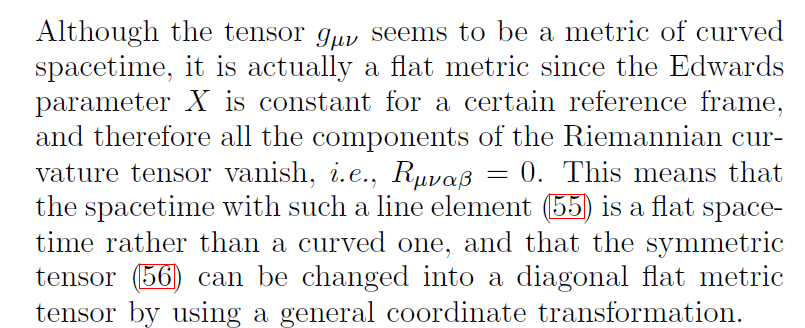
But in Lisle's convention, X would depend on (1-cos(ÃÂø)) which in turn depends on coordinates {x,y,z} of the photon and of the observer. Thus metric tensor g depends on coordinates via X, and the Riemannian curvature tensor does not vanish, so space-time is curved, therefore Lisle's convention makes a gravity field, but this is not observed.
Compare this to what Lisle wrote:
The anisotropic synchrony convention is just that: a convention. It is not a scientific model; it does not make testable predictions. It is a convention of measurement and cannot be falsified any more than the metric system can be falsified. [Jason Lisle, 2010]It makes testable predictions, it can be falsified, it was falsified.
Problems with Permittivity and Permeability of Free Space
Lisle has more problems with two physical constants that are important in electromagnetic theory, the permeability of free space ÃÂü0 and the permittivity of free space, ÃÂõ0. These two constants are involved in electronics, setting the strength of electrostatic attraction and the relationship between current and and magnetic field. They are together intimately connected to the speed of light c, so Lisle mucking with the speed of light will mess with them too. In ordinary units c is determined by the identity
c^2 = 1/ ÃÂü0 * ÃÂõ0.
Since Lisle makes c depend on ÃÂø which varies with the position of the photon, ÃÂü0 and ÃÂõ0 must depend on position as well. For this point I am indebted to a comment by Gabriel Hanna, who writes:
Nowhere does Lisle address this point, and I can't believe he is ignorant of it. When you do experiments with magnets and capacitors, you always get the same value for the speed of light even though you have no idea what direction that light might be moving in... If you forget that light is an electromagnetic wave, then you can accept Lisle's analysis.Hanna emailed Jason Lisle and like so many, got no substantive response:
âÃÂæEinstein assumed the Maxwell equations were true. Lisle just abolishes them without mentioning that he did so. Every engineer and scientist has seen the derivation of the invariant speed of light from the Maxwell equations. [Gabriel Hanna comment]
He [Lisle] says that e0 and m0 are tensors, different in every direction, and doesn't say anything about how many experiments must now come out totally wrong. He also says that ASC is a convention and can't be experimentally distinguished from Einstein's. He also repeats that the speed of light can only be measured by a round trip, and that Einstein said that he was merely assuming light to be anisotropic, when Einstein explicitly said in 1916 that no experiment has demonstrated anisotropy of light. [Gabriel Hanna comment]
A Final Comment on the Deceiver-God and His Creation With "Appearance of Maturity"
Because Lisle is today's most aggressive pusher of "Appearance of Age" argument, I'm going to discuss its paradoxes in more detail. The term "Omphalos" means "belly button" and is used to describe generic creationist arguments in which God deceptively makes the universe look different then it actually is, typically by creating the appearance of an ancient history that never really happened. The term was coined by Phillip Henry Gosse in his 1857 creationist book. Much like creationists after him, he argued by analogy: God had to create Adam with a belly button "omphalos" even though Adam had never been connected to an umbilical cord, because the function of the human body requires a belly button; and likewise, the function of the planet Earth requires fake fossils in the ground that look just like dead animals even though they never really lived.
Gosse's "fake fossils" idea was received very negatively by all sides, and today all big-money creationists would deny that they employ it; but in fact, all YECs, especially Jason Lisle, still invoke Omphalos for countless things-- for certain fossils, for starlight, or radiometric dating, or tree rings in ancient trees-- they just grew sneakier about it, choosing their Omphalos targets by carefully assessing what their target audience would consider absurd and what they could get away with.
All big-money creationists today would deny that they believe dinosaur fossils are fake-- but in fact, they only really assert the reality of fossils of complex animals and plants from the post-Cambrian era (e.g. dinosaurs). Many older or non-dinosaur fossils can still be tricks, for example, fossil stromatolites (multi-layered bacterial mats) and Grypania (multicellular algae) if they are pre-Cambrian are dismissed as not organic but made in some vague way, while post-Cambrian stromatolites that look just the same are indisputably organic. YECs treat dinosaurs and pre-Cambrian fossils differently because 1. Kids love dinosaurs but don't know about stromatolites or Grypania, and YECs know what their audience knows, and 2. YECs say that Noah's Flood started in the geological column at about the time of the Cambrian explosion, that is, with the first trilobite fossils. (By contrast the Ultra-Orthodox rabbi Menachem Schneerson did in fact teach his fanatical followers that dinosaur fossils are fakes planted by the devil; and some Jews in Israel demanded that dinosaur cartoons be taken off of kid's milk cartons because dinosaurs never existed.) Furthermore, there are huge numbers of pre-Cambrian marks from long, long before the dinosaur era like sedimentary strata, raindrop impressions, water ripples, dessication cracks, granite intrusions, etc. that look like records of past events, but which YECs like Robert Gentry say were created directly by God during Creation Week to look just like events that never happened.

Tree rings in very ancient trees, like the bristlecone pines are up to 4,900 years old which makes the oldest 600 years older than Noah's Flood. Tree rings don't just look old, they record history, for example forest fires, droughts, climatic cycles, etc. and they agree with each other and with known cyclic variations in solar output. Observe how Frank Lorey, writing for Jason Lisle's current employer, the ICR, bats away tree rings with a bit of Deceiver-God.
[Frank Lorey of ICR]: Also, creation had to involve some superficial appearance of earth history. Trees were likely created with tree-rings already in place. Rocks would likely have yielded old dates by the faulty radio-isotope methods in use today. Even man and animals did not appear as infants. This is known as the "Appearance of Age Theory." [Frank Lorey, M.A. 1994. Tree Rings and Biblical Chronology. Acts & Facts (ICR). 23: (6)]
Note that Morris and his ICR colleagues all used to call it "Appearance of Age theory", but later YECs later decided we must never call it that, we must only call it "Appearance of Maturity" since changing the name of a problem solves the problem. You see, the term "Appearance of Age" that they made up was a dirty trick played on them by evil evolutionists! And evolutionists even brainwashed Henry Morris, I guess, since he called it "Appaerance of Age" in The Genesis Flood.
Now they tell us, see, everything in the Garden of Eden was perfect, so any "Appearance of Age" can't be real but is just a trick played on them by evolutionist brainwashing; and they've been tricked because Adam ate an apple in the Garden and "Fell" and that makes our reason and our senses unreliable, as creationism itself amply proves. Now YECs insist that appearance of Age cannot ever be objectively real, but Appearance of Youth is objectively real. Here's Ken Ham of Answers in Genesis on fake tree rings.
[Ken Ham]: [on Creation Week] The various original plants, including trees, would have mature fruit... Perhaps trees even had tree rings, as a regular part of the tree's structure. Adam and Eve and the animals were created mature and fully functional so they could reproduce. But none of these things were 'old' or 'looked old.' [Ken Ham. Mature for Her 'Age'. AIG. August 25, 2008.]Never looked old? His wife must love him. Again, everyone has to call it "Appearance of Maturity" now, with maturity defined in terms of "function"... but "function" undefined. This vagueness can be exploited to falsely claim observations as "predictions" of the creationist model, a business that Jason Lisle, Ph.D. has built his career on.
Lisle never claimed that dinosaur fossils are fake, and rejected Morris' hypothesis that God created phony photons, neutrinos etc. en route from distant stars, so you might think Lisle rejects Omphalos. But you'd be wrong-- he's a presuppositionalist who defends "Appearance of Age" (don't call it "Appearance of Age!") more aggressively than any other YEC today. He just applies it to a huge number of other things besides Henry Morris' fake supernovae, or Gosse's fake dino fossils. Lisle's "ASC" solution to the Starlight Problem requires a different kind of fake photons created directly by God, on a far larger scale than Morris ever imagined, but Lisle's fake photons have to be way out in space and not necessarily the ones we see.
Here's an example of how devoted to Omphalos Lisle is: at a creationist meeting, Chris Sharp asked Lisle to explain Kirkwood Gaps. What are those? Well, if you plot the time periods that it takes all asteroids to make one revolution around the sun, you get a big scatter plot of diverse time periods, but certain periods are conspicuously absent-- those which are related to the period of Jupiter by a ratio of small integers. This can be easily explained by simple physics: over millions of years, Jupiter would approach those asteroids over and over, until its giant gravity field knocked them out of that orbit, clearing out the Kirkwood Gap. Simple-- if the solar system is more than a few millions of years old. But Lisle, put on the spot, yanks Deceiver-God out of his ass:
[Christopher Sharp writes]: ...I asked [Lisle] about... the Kirkwood gaps in the asteroid belt, showing irrefutably that the Solar System is much more than 6000 years old... I pointed out to him that after a few hundred thousand or million years of simulated time on a computer, asteroids in certain orbits are ejected, which confirms the Kirkwood gaps, to which he replied that God created the Solar System to appear that way. [Christopher Sharp on Lisle's visit to Tucson]Lisle especially demands that we must always call it "appearance of maturity" because if you call it a different name, that makes it plausible. He insists that "Appearance of Age" can't be objectively real but claims "Apperance of Youth" all through the universe is objectively real, because the absence of age is real, but its presence cannot be.
They define "maturity", if at all, in terms of "function"... but "function" is undefined. This becomes a big problem later when you ask what's the "function" of colliding galaxies, or a supernova, or its expanding nebula; and if you can't define "function", how can you define "mature"?
Creationists of course invoke an infinite number of teleological arguments: if the moon reflects light, its purpose is to reflect light; if glaciers melt in the spring, their purpose is to melt in the spring-- these are real creationist arguments, not parodies. So how do you define "maturity" or "function" of a supernova? Is its function to blow up?
Well, what Lisle does is, first he asks what real scientists have observed, and then he computes what scientific facts he can lie to his church audience about (some of Lisle's favorite "ha ha sucker" lies: scientists never observed stars or solar systems forming! Spiral galaxies can't last more than a few million years, because they'll unwind!), and he takes the sum of those two sets and tells his church audience that those are the "predictions" of the creationist model. Fraudictions, more like it.
All YECs including Lisle also deny that their god is a deceiver, feigning to be angry about it, on the grounds that God said one thing in the Bible and contradicted himself in the rocks and bones and stars, but he told the truth in the Bible, and contradiction is not deception. Of course, in the Bible God makes no mention of minutely arranging the ratios of daughter and parent isotopes in rocks, so that the more deeply buried rocks look much older than the surface rocks, or making fake stromatolites, or arranging asteroids into the Kirkwood Gaps. So he never really told us what he did or how he did it, or when or how we will some more Appearance of A-- excuse me, Maturity.
Conclusion: Lisle's Magical Cosmogony Fails
I raise all these issues of how you define "maturity" and "function" because Lisle's cosmogony, in which God slooowly creates the universe in concentric shells, contradicts all their jive about how God is required to create a "mature" universe, how their all-powerful God is unable to create a non-mature universe, like "mature" relativistic jets that are a hundred thousand light years long and would take at least a hundred thousand years to form, or the "mature" after-effects of galaxies colliding, or star clusters that penetrate our galaxy and in their "mature" form are torn up to shreds like shredded cotton run over sand paper.
In Lisle's cosmogony, God creates quarter-stars, then half-start, then three quarter stars, etc. and he does so slowly. The intermediate stages are not mature and not functional. Some stars are 100 times bigger than our sun, and at speed c/2 it would take God a long time to finish one. A star is a complicated machine, and it depends on balance. In Lisle's cosmology, when God has a star one-third finished, either the thing is not stable, not mature and not functional, and it will collapse or explode; or else God is supernaturally creating vast numbers of fake photons, fake phonons, fake convection currents etc. that appear to come from events that never happened: more Omphalos. The photons normally start from nuclear fusion in the core and take a very long time to work their way to the surface. The photon pressure pushing "up" is required to balance the gravitational weight pulling down, or else the whole shebang is unstable, and will either collapse or explode. But when God has a star is one-quarter finished, he would need to create fake photons that appear to come from the core of the star (which doesn't exist yet) produced by nuclear reactions (that never happened) in order to balance the whole thing.
Stars have complex internal structures, including convection currents far larger than many Earths that swirl around the interior, spherical harmonic vibrations jiggling the surface like a snare drum, solar flares and vast magnetically-guided storms that burst from the surface. All of these are part of their function and thus, "maturity." When God has a star one-quarter finished, they either collapse, or else God supernaturally creates huge numbers of fake phonons, magnetic fields etc. from events that never happened.
Similar arguments apply for even bigger structures: colliding galaxies, relativistic jets a hundred thousand light years long, vast nebulae, star birthing regions, elephant trunks, the Great Cosmic Bubble in the Magellanic Cloud, and on and on. All these structures would take Lisle's God a long time to slowly build, slice by slice, and the intermediate stages would not be mature and not functional, thus contradicting creationist blather about "Appearance of Maturity".
Reading Jason Lisle's blog, it's clear he wants his acolytes to know as little as possible about large-scale cosmic structure: he wants church audiences to think there basically is no large-scale structure in space-- like stars are just, you know randomly distributed or something! He knows the structure of the universe plus YEC requires an Omphalos Deceiver-God creating phony photons and phony particles in relativistic jets like records of make-believe histories that never happened.
180 Comments
TomS · 12 September 2014
I wonder about any argument which seems to save the Bible from saying something false (for example, that the Earth is fixed and not moving) by pointing out that there is a relativity to the statement (that there is no way to tell the difference between the motion of the Earth and the motion of everything else). This seems to "save" the Bible from saying something false by have it saying something meaningless.
That is to say, saying something meaningless about the natural world. Rather than expressing a poetic (or spiritual) truth in terms which have a poetic meaning. ("Tells us how to go Heaven, rather than how the heavens go.")
At the very best, it is saying something which could not be understood by its audience, not only beyond comprehension in the Ancient Near East, but also for some 3000 years (from its composition by Moses about 1500 BC or so, up to the beginnings of modern science in AD 1500 - or the General Theory of Relativity in AD 1900 or so). And about something which, as so many tell us, is important to the Christian faith.
Mike Elzinga · 12 September 2014
Nick's post illustrates one of the objectives of ID/creationists - especially YECs like Lisle - try to achieve; namely to up the ante by forcing "technical" discussions onto higher and higher levels of science and mathematics and onto their own territory of misconceptions and misrepresentations
To the rubes of the ID/creationist community this makes their "PhD" heroes appear to be taking down simultaneously all the best and brightest of science community (e.g., superhero Lisle defeating multiple demons all at once).
We had some discussion of this subject on the "Ohio: Here we go again" thread.
Everything Matt has mentioned about relativity can be found in undergraduate physics textbooks; the concepts, the history, and the mathematics. It is not hard to find where Lisle screws up; and as all ID/creationists do, they bollix up at the most basic levels. It is not really necessary to follow them into their labyrinths of misconceptions and misrepresentations about "advanced" physics, chemistry, geology, or biology.
As I mentioned on that previous thread, there are immediate consequences to messing around with the kinematics of relativity; and these show up in the dynamics of relativity. Broken symmetries produce observable effects in the universe. This is a pretty deep and fundamental idea in physics.
Lisle's attempt to make light travel at infinite speed toward everything and everyone and at c/2 away from everything and everyone is bizarre in the extreme. Even more bizarre is his ad hoc injection of the speed of light being c/(1 - cos(theta)), where theta is the angle relative to the radial line extending out from the receiving point in space.
Think about that for a moment; every receiving point in space?
Just what the hell does that mean for any extended object? What does it mean for a plate of glass for which one wants to know the index of refraction? What does it mean for a prism? What does it mean inside a transparent material? What does it mean for a cloud of, say, hydrogen absorbing and emitting photons? What does it mean for the Rydberg constant or the fine structure constant?
What does c even mean in mc2? How does Lisle explain the Ultimate Speed experiment shown to all undergraduates in physics? What does it mean for the Doppler Effect, the Lorentz transformations, or any other effect involving v/c?
You don't have to jump into General Relativity or any graduate level physics to begin seeing all sorts of problems with Lisle's scheme; you can see the problems already with high school level physics.
And that, I would claim, is an important lesson to take away from Lisle's sleight-of-hand attempts to appear to be a genius. Look first at the high school level and undergraduate levels of science that ID/creationists are mucking around with.
You can almost always make them look silly just by demonstrating that they don't even get the basics right. You don't need to follow their siren calls to drag you into debates about "advanced" science. You can make them look stupid right where high school and undergraduate students can see the problems.
It also helps to remember that these ID/creationists know they are directing their arguments at children and trying to screw up their attitudes toward learning. Just look at Ken Ham's AiG website.
tedhohio · 12 September 2014
So on the Creationist Calendar we have a Jason Lisle Day and a Paul Nelson Day. Do we also have a William Dembski day for releasing the explanation of his Design Inference Filter?
TomS · 12 September 2014
Doc Bill · 12 September 2014
SLC · 12 September 2014
It seems to me that the most preposterous thing about Lisle's conjecture is the following. Consider a photon approaching you. According to him, it has infinite speed. However, as soon as it passes you, it suddenly has a speed of c/2, an instantaneous infinite transition. Among other things, this would appear to provide a preferred direction in space which violates rotation invariance and hence conservation of angular momentum.
diogeneslamp0 · 12 September 2014
diogeneslamp0 · 12 September 2014
Mike Elzinga · 12 September 2014
diogeneslamp0 · 12 September 2014
ksplawn · 12 September 2014
How does the gravity well thing work without turning us into a fine atomic paste?
diogeneslamp0 · 12 September 2014
Mike Elzinga · 12 September 2014
Joe Felsenstein · 12 September 2014
Reynold Hall · 12 September 2014
Oh man, I remember him. I and some other people got into a long series of arguments with Lisle over on his blog.
We argued about everything from physics/astronomy, logic, and morality. That last was the most horrifying:
http://www.jasonlisle.com/2012/11/09/deep-time-the-god-of-our-age/comment-page-2/#comment-7376
Lisle says, quoting me at first:
"Remember Joseph saying that it would be immoral to NOT kill a baby if god commanded it?"
[Dr. Lisle: Joseph is right. What God commands is necessarily right. Any other definition of morality is ultimately arbitrary and therefore logically unjustified.]
Details and a bunch of screenshots here, if anyone is interested, though it's about 37 pages long:
http://www.wearesmrt.com/bb/viewtopic.php?p=114746#p114746
Reynold Hall · 12 September 2014
I could have really used this page back during those arguments, I believe.
Mike Clinch · 12 September 2014
I've always had a sneaking admiration for the original "Omphalos Creationism" proponents. After all, at the time it was proposed, Darwin had not yet published, and the idea of an old Earth was fairly new.
The Omphalos Creationism adherents wanted to believe that a benevolent God placed Adam and Eve in a mature forest, with fruit trees old enough to produce fruit (and presumably with annual growth rings in the branches, in case Adam wanted to roast that apple, and with a geomorphically mature landscape with eroded mountains, hills, integrated river systems and sand on the beaches of the ocean. Even the bellybuttons that gave rise to the name "Omphalos" seemed reasonable, so that Adam and Eve didn't appear too different to their kids, or in Medieval paintings.
It was a logical response to the scientific needs of the modern (i. e. scientific, historical) world view to the problems of how a newly-created couple of perfect humans could live in a world just created. Reasonable, given the time that it was proposed, and absolutely wrong, as we know that the world WASN'T created 6,000 years ago, and that the theory led itself to be caricatured by "last Thursdayism". It was a reasonable solution to the creationism of over 150 years ago, but it doesn't work today, since we know better - the world is actually 4.5 billio years old, life has evolved by Darwinian processes working on our DNA, the evidence of an ancient Earth is true, and there's no need to believe the Earth was created last Thursday.
Lisle and his cohorts are just barking up the wrong tree to still keep arguing this unnecessary, illogical world view. At least the modern YECers are rejecting Omphalos Creation, and claiming that Adam and Eve DIDN't have bellybuttons. They are consistent, even though they are still dead wrong.
TomS · 12 September 2014
IMHO the Achilles Heel of Creationism is the Omphalos Hypothesis. Well, I don't want to get into a Monty Python skit, but there are also Age of Starlight, There is No Alternative, and a couple of others.
But my favorite is the Omphalos Hypothesis because it was long ago recognized as a necessity for a sudden appearance of a world basically like today's world. Because it has its simple slogan, "Which Comes First, the Chicken or the Egg?" Because it doesn't require any deep science to understand. And, let it be admitted, because it really rankles. (I have a certain amount of respect for creationists who bite the bullet on this one. And geocentrists. I understand that the Rabbi Schneerson accepted both.)
Seriously, I see no way to avoid it, if one does not accept gradual change, or eternity or cyclical time.
There are some ways to mitigate its intimations of divine deception - that it was logically necessary for the world to appear with the appearance of age ("logic" being the only acceptable limit on omnipotence), and that God, realizing that the world would have the appearance of age, wrote the Bible to set the record straight.
But, for some reason, that excuse has not acquired much traction among the creationists. (A rare instance of lack of nerve to accept whatever it takes.)
Mike Elzinga · 12 September 2014
harold · 12 September 2014
harold · 12 September 2014
Mike Elzinga · 12 September 2014
Doc Bill · 12 September 2014
Lisle had the opportunity, training and education to be a normal person, but he chose to be a dick. I don't think he should be given any slack for that decision that was his own to make. As Dawkins observed of creationists he's "a disgrace to the human species."
No, I have no respect for any creationist.
Joe Felsenstein · 12 September 2014
TomS · 12 September 2014
Reynold Hall · 12 September 2014
stevaroni · 12 September 2014
Robert Byers · 13 September 2014
God can do anything. it would be that way. I have no interest in cosmology but there is no evidence that the light has been traveling this long but only a result that is now observed by the present "primate" ideas of how starlight moves.
whose says and who knows if there isn't more to be learned about such things?
Must the lesson of einstein correcting Newton always be invoked to prove things ain't settled.
Zetopan · 13 September 2014
Harold said: "[some] are starting to cry foul when they are called âcreationistsâ."
And as bizarre as it sounds, some of them actually "believe" that they are not creationists. I recently saw where a woman became incensed when she was called a creationist and she blurted out "I am NOT a creationist, I AM a Jehovah's Witness". Critical reasoning is apparently an exceptionally alien concept to such people.
Zetopan · 13 September 2014
Byers bleats: "God can do anything."
"Supernatural explanation (i.e. "magical explanation") is an oxymoron. Rational people can recognize that "to explain" means to render unknowns in terms of knowns. "Magical explanations" get this totally backwards by trying the explain knowns in terms of unknowns.
By happenstance, a very recent scientific paper has been published showing that universal constants like the strength of electromagnetism (and hence the speed of light in a vacuum) have not changed in at least the last 10 billion years. So much for Lisle and his ultra-credulous acolytes.
http://phys.org/news/2014-09-eyes-sky-track-laws-nature.html
TomS · 13 September 2014
Sylvilagus · 13 September 2014
harold · 13 September 2014
ksplawn · 13 September 2014
Frank J · 13 September 2014
Doc Bill · 13 September 2014
https://me.yahoo.com/a/JxVN0eQFqtmgoY7wC1cZM44ET_iAanxHQmLgYgX_Zhn8#57cad · 13 September 2014
Casey's so cute on his little wheel, too.
Glen Davidson
Henry J · 13 September 2014
Mike Elzinga · 13 September 2014
Scott F · 13 September 2014
Mike Elzinga · 13 September 2014
Matt Young · 13 September 2014
Joe Felsenstein · 13 September 2014
Scott F · 13 September 2014
Scott F · 13 September 2014
Mike Elzinga · 13 September 2014
Mike Elzinga · 13 September 2014
Kevin B · 13 September 2014
diogeneslamp0 · 13 September 2014
If you mean Waterloo, it was June 18.
diogeneslamp0 · 13 September 2014
All this talk about gravity raises the point in Lisle's model, for most of the universe, we don't exist yet. Because of relativity of simultaneity as explained in the article. So for most galaxies at this moment, when they look Earthward they see a black sphere of nothingness in that direction and we don't exist for them. They see themselves within a hollow sphere of mass with an outer edge and an inner edge, so they will feel a gravity force pulling them in. How big?
The Universe was created 6,000 years ago and God creates inward at half the speed of light in Lisle's model. We on Earth see all points in the universe as they are right now, so all galaxies are 6,000 years old. Therefore for all points in the universe right "now" with "now" defined by Earth frame, when they look Earthward they see 3,000 light years of mass and then the edge of the black sphere of nothingness. Since galaxies are ~100,000 light years across, an observer in the center would see 53,000 ly of stars and then a black wall. Virtually all points in the universe now see their galaxies as incomplete. Is that "mature creation", Jason?
They will not feel a gravity field from the shells "above" them, that is toward the edge of the universe. But they will "now" feel gravity from the 3,000 light years of created stars in the Earthward direction, before you hit the black sphere of nothing.
Mike, care to calculate the strength of that force?
Kevin B · 13 September 2014
Frank J · 13 September 2014
Henry J · 13 September 2014
Scott F · 13 September 2014
Okay. I'm confused. This subject came up on another thread here, and I didn't follow it completely. I can follow the coordinate transformation stuff from diogenes (thank you!), and recognize the lack of same in Lisleâs model. The problem I have is with the photon going toward all points at an infinite speed, and away from all points at c/2. Actually, several problems.
First (and I think someone touched on this) is the actual speed of the light coming toward you. If the speed is "infinite", then practically speaking the light takes zero time to get from point A to B. Effectively, the light simply arrives at your eyeball the instant it leaves the "source". There is no "time" in which the light can actually traverse the intervening space. It cannot "approach" you in any meaningful sense of the word, because "approach" implies a velocity, which implies a distance divided by time. But in this case, the "time" is (effectively, or approaches) zero.
This seems to lead to some serious problems. First is the observed Doppler shift. There shouldn't be any, if the light has infinite speed. Or rather, the Doppler shift certainly wouldn't be the one that we actually see, would it? Second would be the problem with the absorption lines in stellar spectra. If the light arrived at your eyeball instantaneously, it could not possibly have passed through the intervening interstellar dust. With an infinite speed, and hence a traversal time of zero, there would simply be no time in which the light could have interacted with the intervening medium. It doesn't even have to be stellar light. Any absorption spectroscopy would fail for the same reason. Wouldn't it? Otherwise, the implication would be that the light arriving at you eyeball in fact interacted with all of the intermediate media at the same instant. That is, it must have arrived at your eyeball simultaneously with arriving at the intervening galaxy millions of light years away. With an infinite speed, the photon has to have been at every point between the source and your eyeball at the same instant, making the photon infinitely long.
The second problem I have is watching the light (in principle) approach and leave my friend. I'm at point "A", my friend is a short distance away at point "B". If I could (in principle) "see" light "approaching him perpendicular to my line of sight from "A" to "B", wouldn't I "see" the light "approach" him (say from my right) at "infinite" velocity and the "leave" him (to my left) at c/2? Would I in fact "see" a change in the velocity of the light? If not, lets start shortening the distance between "A" and "B". At what distance "AB" does the "perpendicular" light start changing velocity? Is it an asymptotic or instantaneous transition as Length(AB) approaches zero?
The third problem is, with light "approaching" every point in space at an infinite speed, and leaving every point in space at c/2, how the heck does the light "know" whether it is coming or going? Isn't any photon simultaneously leaving one point and approaching another? And we're not talking here about "simultaneous" meaning "at the same time". It's a physical quality, or (perhaps in quantum terms) a superposition??? The light must be traveling both infinitely fast and at c/2, depending on who is looking at the photon, and probably traveling at all possible speeds in-between at the same time.
I realize that trying to understand quantum phenomena in typical physical terms is always problematic. But even Schrodinger's Cat makes some kind of sense. I mean, I get the notion that a Q-Bit contains all possible states until you "look" at it, at which time the wave function collapses to a single "real" value. But to have a photon that can have all possible velocities at the same time, and (essentially) be in all possible points of space along a line until you know whether you sent the light or received it? This doesn't seem to reach even that level of comprehension.
Of course, this would most likely make the Improbability Drive a "real" thing. You can be at your destination simultaneously with leaving your starting point, with no intervening time or space.
prongs · 13 September 2014
Mike Elzinga · 13 September 2014
Doc Bill · 13 September 2014
Mike Elzinga · 13 September 2014
tedhohio · 13 September 2014
TomS · 13 September 2014
There has been announced the plotting of the Laniakea Supercluster of galaxies which contains our Local Cluster of galaxies as a small part. You can read about it Wikipedia, and Wikipedia has links to a couple of videos. Take a look. It also includes a plot over time. Now imagine, if you can, the same thing as imagined as happening over a time scale of YECs. Yes, I know that this not a proof of anything. But it sure gives graphic illustration of the immensity of space and time that the YECs are trying to fit into a six-day creation. All of that was created in what - the lights in the firmament on day four? Yes, I know that it is a computer-generated video on the "assumption" of "naturalistic/evolutionist" science. But let's see what a YEC can do with the same data.
And remember that our galaxy is one dot. And that the Laniakea Supercluster is a fraction of the universe.
Rolf · 14 September 2014
TomS · 14 September 2014
Would your (legitimate) problems with the infinite speed of light (in one direction) be addressed by making it a very large speed? I assume that the factor of 1/(1-cos(theta)} was an arbitrary choice, and could be replaced by 1/(a+1-cos(theta)), witha small positive number, with as much theoretical justification, and still being compatible with less than 10,000 years.
harold · 14 September 2014
Frank J · 14 September 2014
harold · 14 September 2014
Frank J · 14 September 2014
Frank J · 14 September 2014
stevaroni · 14 September 2014
stevaroni · 14 September 2014
Frank J · 14 September 2014
More on irony and the left-right issue:
Judge Jones was not at all fooled by DI's games, and even saw fit to address the "replacement scam" (the one that never mentions ID or creationism) that the DI preferred. The DI wasn't happy about defending clowns that were not only promoting ID directly, but had previously advocated Biblical creationism (and tried to lie about that to boot). But since they were on the same radical anti-science side they had to grin and bear it (or weasel out as some of them did). Meanwhile, the conservative-but-not-authoritarian, and Christian-but-not-fundamentalist judge ruled solidly and forcefully against them. But he had the luxury of hearing their entire spiel (and the rebuttals of course), not just the sound bites that trickle down to the point that almost every American past 8th grade has heard at least one.
But compare a nonscientist-on-the-street, one that is even less conservative and/or religious than Judge Jones. They're likely to hear only the catchy but misleading sound bites that the DI wants them to hear. If they hear any rebuttals, chances are it will be unnecessary whining about "lying for Jesus" and nothing like the 50+ volumes of technical literature that Behe pretended didn't exist. Net effect is that most of them would side with the DI, and by extension, the Biblicals, if only for misguided "fairness" reasons. And many of them might also come away with: "Gee, evolution is not as slam dunk as I thought it was."
Mike Elzinga · 14 September 2014
Scott F · 14 September 2014
prongs · 14 September 2014
Scott F · 14 September 2014
Mike Elzinga · 14 September 2014
Scott F · 14 September 2014
A question just occurred to me, related to all this, though probably OT. You describe the emission of a photon from an electron changing energy states in an LED (or vice versa in a detector).
Does the transfer of energy from the electron to the photon, the "creation" of the photon, take any measurable time? Perhaps in a quantized reality, this might not be a meaningful question, or might not have a meaningful answer.
Put another way, does the transition of the electron from one energy state to another take any measurable time, and is there any measurable time between that change of state and the appearance of the photon?
The opposite direction might be easier. Is there any measurable time between the arrival (and apparent distraction) of a photon of the correct energy, and the change in energy state of the electron? I can imagine that in a quantized system, the transfer might be instantaneous (no measurable time), or the energy state of the electron might oscillate for a period of time as the probability wave of the photon arrives and is "absorbed" by the probability wave of the electron (that might depend on the "width" of an election and the "length" of a photon, or there might be some observable delay between the arrival of the photon and the change in state of the electron.
Conversely, the question might be meaningless, because the "measure" of the change in energy state of the electron might, in fact, the observation of the photon. The transition, and the means of "measuring" the transition are the same phenomenon.
This is sort of related, because if the speed of light is infinite in Lisle-World (at least in one direction), that might become a problem if the creation of the photon takes more than zero time.
Mike Elzinga · 14 September 2014
Doc Bill · 14 September 2014
I'm with Harold and, in fact, we co-founded the Darwinian Pressure Group, Delta Pi Gamma, back in the day when Ohio was in the news. They never got their Delta Pi Gamma Athletic Stadium, Nail Care and Tire Emporium after we cut off funding.
However, that said, the Tooters in particular and creationists in general are not accountable to anyone for what they do. In my career I had to be right very much most of the time. If I was wrong about a decision or project I got dinged for it. Delayed promotion or reduced merit pay. I had to perform to progress. Not so creationists. Luskin, Behe, Meyer, Wells and the entire circus can be proven wrong on every aspect of their career and they just move on. Sure, old Behe might have suffered some merit raises because he's a doofus, but he's cruising along to retirement. Same with the rest of them, Lisle included. As was pointed out earlier, he doesn't have to do squat for the rest of his life to keep drawing a salary.
The question I ask is who can live like that? Certainly not me! I can only imagine that in some Bizzarro world they are rewarded for their prevarication and somehow sleep well at night. Very strange.
harold · 15 September 2014
Frank J · 15 September 2014
Frank J · 15 September 2014
Dave Lovell · 15 September 2014
Frank J · 15 September 2014
@Harold & Scott:
I hope you both also agree that plenty of the rank-and-file on the far right also embrace pseudosciences other than creationism/ID. I personally know a few who never met a pseudoscience that they didn't like. And I think that trend is growing. For example, Steve Deace is a radio talk show host who is so radically "so con" that he makes Medved look downright libertarian. Many of the commercials on his show are for "all natural" "alternative" cures.
Once one denies the scientific method iteself, one is free to deny any substantiated claims, and/or believe any alternative that has been debunked. Once one subscribes, innocently (e.g. Morton's Demon) or deliberately, to the practice of cherry-picking "evidences," defining words to suit the argument, etc., a whole new seductive world awaits.
Dave Lovell · 15 September 2014
Dave Lovell · 15 September 2014
eric · 15 September 2014
harold · 15 September 2014
harold · 15 September 2014
TomS · 15 September 2014
Mike Elzinga · 15 September 2014
Mike Elzinga · 15 September 2014
Rolf · 15 September 2014
TomS · 15 September 2014
Mike Elzinga · 15 September 2014
callahanpb · 15 September 2014
TomS · 15 September 2014
Henry J · 15 September 2014
Mike Elzinga · 15 September 2014
Scott F · 15 September 2014
Scott F · 15 September 2014
Mike Elzinga · 16 September 2014
Rolf · 16 September 2014
Tom S, Indeed. The problems with YEC are so huge that it must take a tremenduous effort an a strong dedication to reject and deny all the evidence against it. And pecuniary interests should not be overlooked; they are among the strongest incentives facing the brittle human soul.
Not only is lots of the evidence by itself very clear and easily interpreted, but the correlation with entirely different kinds of evidence from all over and under the Earth as well as on the firmament makes a mountain of evidence dwarfing the Himalayas. But see, Robert Byers or Kurt Wise, still happily whistling the YEC anthem.
TomS · 16 September 2014
harold · 16 September 2014
Scott F · 16 September 2014
Rolf · 17 September 2014
TomS · 17 September 2014
Kevin B · 17 September 2014
Rolf · 18 September 2014
I wonder if not a different speed of light would have an impact on about everything else in the universe. AS for the YEC assumption, ice cores and too many other incontroversible facts makes it absolutely impossible to defend from a scientific point of view. The only 'viable' method is absolute denial in spite of the facts à la Kurt Wise.
harold · 18 September 2014
TomS · 18 September 2014
eric · 18 September 2014
gnome de net · 18 September 2014
TomS · 18 September 2014
diogeneslamp0 · 18 September 2014
TomS · 18 September 2014
Mike Elzinga · 18 September 2014
fnxtr · 18 September 2014
Funny how the discussion is way more interesting than the nonsense that inspired it.
Mike Elzinga · 18 September 2014
Scott F · 18 September 2014
Mike Elzinga · 18 September 2014
stevaroni · 18 September 2014
Mike Elzinga · 19 September 2014
stevaroni · 19 September 2014
Mike Elzinga · 19 September 2014
Dave Lovell · 19 September 2014
TomS · 19 September 2014
BTW, if the laws of physics are "intelligently designed", and if the speed of light behaves in such a complicated way that the universe gives the false impression of age, what does say about the "intelligent designer(s)".
This behavior of the speed of light is so complicated that requires familiarity with General Relativity to understand it. And even at that, it is so complicated that even people that understand GR can't quite get the hang of it, and that includes the discoverer of it, who is having difficulty in handling questions about it.
Does this mean that the Intelligent Designer(s) wanted all of us to learn General Relativity?
Or were the Intelligent Designer(s) were not intelligent enough to design light - or the human brain - so that we would have a chance to understand what is going on? (This includes not knowing about what humans could be capable of.) Not omniscient Or that the Intelligent Designer(s) were not up to the task of designing light without this complication? (Really, what demands were placed on the speed of light that it not be a lot simpler?) Not omnipotent Or that the Intelligent Designer(s) were not compassionate enough not to demand that we fallible humans believe something that is so beyond our capacity to understand? (And I'm not even going along with suggesting that they were deceptive.) Not omnibenevolent
KlausH · 19 September 2014
diogeneslamp0 · 19 September 2014
diogeneslamp0 · 19 September 2014
Henry J · 19 September 2014
Mike Elzinga · 19 September 2014
Lisle's "convention" is ambiguous with regard any experiment that clocks the one-way speed of light.
Consider an observer at O and a line, not passing through O, along which a beam of "Lisle photons" are moving. Extend a line from O perpendicular to that line of travel.
On the line of travel of the Lisle photons, place many, equally spaced mirrors such that the beam just clips the edges of the mirrors sending a few sample photons into identical photo detectors next to each mirror along the way.
Connect each photo detector by way of equal-length coaxial cables to a summing node connected to a detector with a fast oscilloscope trace.
In a normal experiment, one would see a series of equally-spaced blips on the oscilloscope trace as the beam shoots along the series of mirrors. Dividing the distance between each mirror by the time between each blip gives the speed of the photons.
But what do we expect to see in Lisle's scheme?
Is the velocity of the beam of Lisle photons the speed as seen by the observer at O (i.e., c/(1 - cos(theta) ), or is it the velocity as seen by each mirror along the path of the photons?
If it is the velocity as seen by each mirror, then what is the use of Lisle's formula for anything? It can't be observed in any experiment.
If the velocity is according to the observer at O, then we would expect to see a speed curve that is continuous and differentiable, i.e., decreasing smoothly from near infinity, passing through c, than on down to c/2. But then, what do the mirrors and detectors experience?
In either case, how are we to treat all the equal-length coax cables with regard to the speed that the signal is transmitted to the oscilloscope? Does Lisle's scheme apply only to photons, or does it apply to all electromagnetic phenomena regardless of whether it takes place in a vacuum or within a material medium?
In other words, do things like index of refraction and characteristic impedance depend on which direction the electromagnet field is traveling through the medium? Is it even possible to impedance-match a transmitter to a receiver through a coax cable? How do we measure the index of refraction of a transparent material?
What happens to the oscilloscope trace; does it depend on the orientation of the oscilloscope relative to the Lisle photon path?
Can one even do experiments in "Lisle World?" We know that ID/creationists never do experiments. Is this why?
TomS · 19 September 2014
Mike Elzinga · 19 September 2014
Henry J · 19 September 2014
Mike Elzinga · 20 September 2014
bplurt · 20 September 2014
Dave Lovell · 22 September 2014
TomS · 22 September 2014
Dave Lovell · 22 September 2014
harold · 22 September 2014
TomS · 22 September 2014
There is a fantasy on how small the Earth is, even in the (small, to us) universe of Aristotle and Ptolemy. Cicero's "Dream of Scipio" - in Wikipedia, "Somnium Scipionis".
Mike Elzinga · 22 September 2014
Just Bob · 22 September 2014
prongs · 22 September 2014
In the spirit of "teach the controversy" I offer the following question.
Since Lisle postulates the speed of light toward an observer as infinite, while the speed of light away from that same observer is half of the tradition value (call it c/2), and since mainstream Science considers the speed of light both toward and away from any observer to be c, what evidence has Lisle offered that the speed of light toward any observer isn't c/2 and the speed of light away from that observer isn't infinite?
I mean, come on, be fair. If it's not c toward and c away, then why should I believe it's infinite towards and c/2 away? Why shouldn't it be c/2 towards and infinite away?
What are the consequences, in Lisle's imaginary world, of the speed of light toward the observer being c/2, and infinite away from the observer?
Would that make the universe 2 x 13.75 billion years = 27.5 billion years old?
Inquiring minds want to know.
Mike Elzinga · 22 September 2014
harold · 23 September 2014
Mike Elzinga · 23 September 2014
TomS · 23 September 2014
Henry J · 23 September 2014
Say what? He's saying that in the "secular worldview" (whatever that is), gravity wouldn't cause stuff to aggregate, forming planets, stars, galaxies? EM force wouldn't cause atoms to form molecules? Quark color force wouldn't have formed nuclear particles?
Am I missing something here?
TomS · 23 September 2014
Mike Elzinga · 23 September 2014
Henry J · 23 September 2014
harold · 24 September 2014
TomS · 24 September 2014
Mike Elzinga · 24 September 2014
TomS · 24 September 2014
Just Bob · 24 September 2014
Mike Elzinga · 24 September 2014
TomS · 24 September 2014
TomS · 24 September 2014
https://www.google.com/accounts/o8/id?id=AItOawnKupVGX70N9ZsvLu8iScIzWpyVj8bds_Q · 24 September 2014
Mike, Amen to that. Every fundamentalist is convinced he or she is the center of the universe and the universe was designed specifically for him or her. Funny thing each is a completely separate universe and yet he or she will complain about the multiverse being a secular fantasy?
savoy rattler · 24 September 2014
For the GPS transmitters in orbit -- wouldn't their frequencies have to be lower than
those of the receivers on Earth, rather than higher?
Of course, this has no bearing on the points made in your discussion -- I thought it might be a typo equivalent
riandouglas · 24 September 2014
Mike Elzinga · 24 September 2014
Henry J · 24 September 2014
AltairIV · 27 September 2014
Mike Elzinga · 28 September 2014
Reynold Hall · 29 September 2014
I commented on Lisle's newest post here:
http://www.jasonlisle.com/2014/08/20/research-update/
I mentioned this article in particular and quoted a little bit of it. I'll see how he responds.
http://i32.photobucket.com/albums/d27/kvarku/LisleandASC01.jpg
http://i32.photobucket.com/albums/d27/kvarku/LisleandASC02.jpg
Rolf · 30 September 2014
Wow. If horror really was hair-raising, I should be looking like a piasava broom now.
I couldn't resist but had to make a comment there. Will go back later to see if it appears.
TomS · 30 September 2014
Just Bob · 30 September 2014
https://me.yahoo.com/a/JxVN0eQFqtmgoY7wC1cZM44ET_iAanxHQmLgYgX_Zhn8#57cad · 30 September 2014
Henry J · 30 September 2014
Yeah, never mind those annoying multiple convergent lines of evidence...
DS · 30 September 2014
TomS · 30 September 2014
Henry J · 30 September 2014
Earth in a privileged position? Just wait a few hundred million years and see how he likes living here then!
Henry J · 30 September 2014
Hey, just because ice cores show over a hundred thousand seasonal cycles is no reason to, uh, er, uh... Oh never mind.
TomS · 30 September 2014
TomS · 30 September 2014