The paperback edition of Stephen Meyer's book
Darwin's Doubt: The Explosive Origin of Animal Life and the Case for Intelligent Design has just been published. It has a new chapter responding to critics of the book -- Donald Prothero, Charles Marshall, and yours truly, the blogger the ID guys were dismissing for a year based on the fact that I wrote the review quickly. The largest section of the new chapter responds to me.
The response shows Meyer is finally improving on a few issues like crown/stem group thinking, but rather like a student who flunked the midterm of a phylogenetics course and decided to finally start paying attention, Meyer still makes huge, amateur mistakes. I'll highlight a few.
(Unfortunately, I have no time to do a detailed rebuttal, so this will just be quick notes. I am frantically trying to finish projects before meeting season starts in, hoo boy, two days. First I am going to
SMBE 2014 in Puerto Rico to present
this work, and then to
Evolution 2014 in Raleigh, NC to present
this work.
(By the way, see part of my presentation,
cool animations of stochastic mapping of possible biogeographic histories under different models, below...)
 Caption: Stochastic mapping of approximately equiprobable alternative histories under each model. Left: DEC model. Right: DEC+J, which includes founder-event speciation. Key: Blue, K=Kauai. Green: O=Oahu. Yellow: M=Maui-Nui. Red: H=Hawaii Big Island. Kauai is the oldest high island (~5.2 Ma), the Big Island is the youngest island (~0.5 Ma).
.
Background -- previous posts on the Cambrian/Meyer
Alan Gishlick, Nick Matzke, and Wesley R. Elsberry (2004). "Meyer's Hopeless Monster." Panda's Thumb post, August 24, 2004. http://pandasthumb.org/archives/2004/08/meyers-hopeless-1.html
The "Meyer 2004" Medley - The Panda's Thumb -- the complete history of the Meyer 2004 craziness.
Matzke, Nicholas (2005). Down with phyla! - The Panda's Thumb, which reviewed:
Matzke, Nicholas (2005). Down with phyla! (episode II) - The Panda's Thumb
Matzke, Nicholas (2007). Meet Orthrozanclus (down with phyla!) - The Panda's Thumb
Matzke, Nicholas (2013). "Meyer's Hopeless Monster, Part II." The Panda's Thumb.
Matzke, Nicholas (2013). "Luskin's Hopeless Monster." The Panda's Thumb.
Matzke, Nicholas (2013). "Meyer on Medved: the blind leading the blind." The Panda's Thumb.
.
Statistics and Phylogenetics: the Consistency Index (CI)
Meyer discusses -- for the first time ever -- the
Consistency Index (CI), which is a measure of the congruence of characters on a tree, and a standard statistic calculated in cladistic analysis to assess the treelike nature of the data. Meyer cites two CI values from cladistic analyses of Cambrian groups -- 0.565 (Legg et al. 2012) and 0.384 (Briggs and Fortey 1989) and declares them "low". In the case of Briggs and Fortey (1989), Meyer quotes the authors, who call 0.384 "rather low." Meyer doesn't mention that this was just about the very first preliminary attempt at cladistics of Cambrian arthropods, but that's not the most important problem.
The most important problem is that you can't just eyeball a CI value for a dataset and decide if it is "high" or "low". Intuitions based on letter grades (70% is a C, 80% is a B, or whatever) are a poor guide to using a technical statistic. Yes, sometimes scientists themselves eyeball a CI and declare it high or low based on intuition, but only when they have not been sufficiently trained on the topic.
Here's the reality. This is
Figure 1.2.1 of Doug Theobald's Macroevolution FAQ, derived originally from Figure 6 of Klassen et al. 1991:
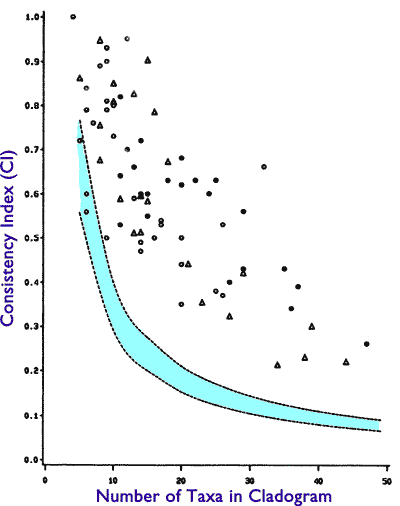 Figure 1.2.1. A plot of the CI values of cladograms versus the number of taxa in the cladograms. CI values are on the y-axis; taxa number are on the x-axis. The 95% confidence limits are shown in light turquoise. All points above and to the right of the turquoise region are statistically significant high CI values. Similarly, all points below and to the left of the turquoise region are statistically significant low values of CI. (reproduced from Klassen et al. 1991, Figure 6).
What is the expected CI value if there is no phylogenetic signal in the data? This is what creationists are claiming when they claim the data doesn't support a phylogenetic tree. This null expectation is easy to calculate (as I mentioned in my original review, but which Meyer, incredibly, missed) by reshuffling each character's data by randomly assigning the character states to species without regard to phylogeny. The resulting dataset will have the exact same percentages of each character state, the same number of states per character, etc., but will have no phylogenetic signal. Parsimony inference of cladograms can be performed, and CI statistics calculated, for these reshuffled datasets.
The result is a null distribution of CI values. The 95% confidence interval of this null distribution is displayed on the plot. As you can see, the null expectation changes somewhat depending on the number of species in the analysis. So, a CI of 0.5 is low if you have only 10 taxa, but it's high if you have 30. What is key is that if your dataset's CI is higher than the null, you can statistically reject the hypothesis of no tree structure in the data. With a little more work you could calculate how many standard deviations you are above the mean of the null distribution.
Briggs & Fortey (1989) had 28 taxa in their analysis. Legg et al. 2012 had 173. Now, consult the figure. I would want to do the randomization myself on the original datasets to be really sure, since conceivably the detailed results could depend e.g. on the number of characters with more than two states, but most morphology datasets are substantially binary characters anyway. As you can see, 28 taxa and a CI of 0.384 is a highly significant rejection of the hypothesis of no cladistic structure, and a CI 0.565 with 173 taxa is an incredibly, mind-bogglingly strong rejection of the null hypothesis. It's probably hundreds of standard deviations above the random expectation.
Even worse,
Meyer should have known about this. Not only has this finding about CI been in the literature since 1991, it's been prominently available in Theobald's common ancestry FAQ for 10 years! Meyer himself even cited the FAQ in
Darwin's Doubt, dismissing the entire thing in barely a sentence with "In reality, however, the technical literature tells a different story" (Meyer 2013, p. 122).
The only place where I've seen the argument "my gut says that's a low CI value, therefore cladistics doesn't support common ancestry" before is from Casey Luskin, Meyer's "research" assistant for
Darwin's Doubt. Meyer, get a new research assistant! Luskin, get educated before blabbing about technical topics you know nothing about!
Also, regarding Meyer's argument that a CI of 0.565 means that the 0.435 fraction of the data exhibits homoplasy -- the right answer here is "so what"? It is true that the "best characters" are ones that only change state a single time in all of evolutionary history. But character states that evolve twice on a tree still retain a huge amount of phylogenetic signal. Two changes is many fewer changes than you would get if you flipped a coin to place character states at the tips of a tree. Two changes still means that many taxa on the tree share the character state because of common ancestry. If you were going to attempt a classification based on that single character, of course, that wouldn't work well -- but only taxonomists from ancient times, and creationists, think that single-character classifications are how things should work. If you have 100 characters, each of which evolved twice on a tree, the tree would still be readily resolvable.
As usual, creationists make the perfect the enemy of the good. They completely fail understand the difference between "classic homologies" -- like the tetrapod limb -- and the typical characters used in modern "get as many characters as you can" analyses. In the latter, organisms are atomized as finely as possible while avoiding coding the same character twice under two descriptions. Yes, it would be highly problematic to suggest that the tetrapod limb evolved twice independently. But if you take that limb, and atomize into 100+ individual characters, including the bumps and twists of each bone -- is it possible that some of those bumps arose twice independently? Heck yes! If they arose once, they could arise several times, because these highly atomized characters are quite simple (unlike the whole tetrapod limb). Does this homoplasy invalidate the entire enterprise of cladistics and verifying common ancestry? Heck no! Some of those characters might have homoplasy, some might have such high homoplasy that they retain no phylogenetic signal at all (a different thing) -- but if you have lots of characters, it doesn't matter. All that is required is that, on average, most characters retain some phylogenetic signal. Like any measurement of anything in science, you add up many small independent pieces of evidence, some of them noisy or problematic, and yet the final result can be statistically very strong.
This is the typical result of a phylogenetic analysis, and the typical conclusion is that the statistical tree signal is real and quite strong. And this applies to studies of Cambrian taxa (particularly the more recent ones) as much as anywhere else.
Even David Berlinski admitted that the tree structure in cladistic data was real, back in the first round of responses to my review, so I'm not sure where Stephen Meyer thinks he got a leg to stand on on this one. Probably we can just chalk it up to poor research. As usual.
.
Ghost lineages and incongruence between cladograms and stratigraphy
Somehow, in his new chapter, Meyer manages to spend pages on ghost lineages and incongruence between cladograms and stratigraphy, without realizing there is a whole literature on statistically measuring this (despite Meyer's mentions of "statistical paleontology" in the main text, he has almost no familiarity with the field). The typical result of such tests is that there is overall congruence between the two, again a statistically strong pattern.
Again,
Theobald covered it thoroughly, and Meyer and Luskin just missed it. I think their brains must just short circuit when they see Theobald's FAQ:
The most scientifically rigorous method of confirming this prediction is to demonstrate a positive corellation between phylogeny and stratigraphy, i.e. a positive corellation between the order of taxa in a phylogenetic tree and the geological order in which those taxa first appear and last appear (whether for living or extinct intermediates). For instance, within the error inherent in the fossil record, prokaryotes should appear first, followed by simple multicellular animals like sponges and starfish, then lampreys, fish, amphibians, reptiles, mammals, etc., as shown in Figure 1. Contrary to the erroneous (and unreferenced) opinions of some anti-evolutionists (e.g. Wise 1994, p. 225-226), studies from the past ten years addressing this very issue have confirmed that there is indeed a positive corellation between phylogeny and stratigraphy, with statistical significance (Benton 1998; Benton and Hitchin 1996; Benton and Hitchin 1997; Benton et al. 1999; Benton et al. 2000; Benton and Storrs 1994; Clyde and Fisher 1997; Hitchin and Benton 1997; Huelsenbeck 1994; Norell and Novacek 1992a; Norell and Novacek 1992b; Wills 1999). Using three different measures of phylogeny-stratigraphy correlation [the RCI, GER, and SCI (Ghosts 2.4 software, Wills 1999)], a high positive correlation was found between the standard phylogenetic tree portrayed in Figure 1 and the stratigraphic range of the same taxa, with very high statistical significance (P [LESS THAN] 0.0001) (this work, Ghosts input file available upon request).
As another specific example, an early analysis published in Science by Mark Norell and Michael Novacek (Norell and Novacek 1992b) examined 24 different taxa of vertebrates (teleosts, amniotes, reptiles, synapsids, diapsids, lepidosaurs, squamates, two orders of dinosaurs, two orders of hadrosaurs, pachycephalosaurs, higher mammals, primates, rodents, ungulates, artiodactyls, ruminants, elephantiformes, brontotheres, tapiroids, chalicotheres, Chalicotheriinae, and equids). For each taxa, the phylogenetic position of known fossils was compared with the stratigraphic position of the same fossils. A positive correlation was found for all of the 24 taxa, 18 of which were statistically significant.
As a third example, Michael Benton and Rebecca Hitchin published a more recent, greatly expanded, and detailed stratigraphic analysis of 384 published cladograms of various multicellular organisms (Benton and Hitchin 1997). Using three measures of congruence between the fossil record and phylogeny (the RCI, SRC, and SCI), these researchers observed values "skewed so far from a normal distribution [i.e. randomness] that they provide evidence for strong congruence of the two datasets [fossils and cladograms]." Furthermore, Benton and Hitchin's analysis was extremely conservative, since they made no effort to exclude cladograms with poor resolution, to exclude cladograms with very small numbers of taxa, or to use only fossils with reliable dates. Including these types of data will add confounding random elements to the analysis and will decrease the apparent concordance between stratigraphy and cladograms. Even so, the results were overall extremely statistically significant (P [LESS THAN] 0.0005). As the authors comment in their discussion:
"... the RCI and SCI metrics showed impressive left-skewing; the majority of cladograms tested show good congruence between cladistic and stratigraphic information. Cladists and stratigraphers may breathe easy: the cladistic method appears, on the whole, to be finding phylogenies that may be close to the true phylogeny of life, and the sequence of fossils in the rocks is not misleading. ... it would be hard to explain why the independent evidence of the stratigraphic occurrence of fossils and the patterns of cladograms should show such striking levels of congruence if the fossil record and the cladistic method were hopelessly misleading." (Benton and Hitchin 1997, p. 889)
Additionally, if the correlation between phylogeny and stratigraphy is due to common descent, we would expect the correlation to improve over longer geological time frames (since the relative error associated with the fossil record decreases). This is in fact observed (Benton et al. 1999). We also would expect the correlation to improve, not to get worse, as more fossils are discovered, and this has also been observed (Benton and Storrs 1994).
As for Cambrian taxa, I don't believe this sort of analysis has been done yet (I could do it -- if you put me on your grant/paper!). But the available data already indicates the basic result will be the same as the above. The oft-mentioned pattern of "we see mostly stem groups in the early Cambrian" lines up extremely well with the stratigraphy-cladogram congruence pattern discovered elsewhere.
.
Other problems with Meyer's new chapter, briefly mentioned
- Meyer repeats the usual creationist silliness about transitional fossils, claiming that nothing except direct ancestors count, and cladistics can't provide these, so it's all meaningless. He even adds a quote from someone with old-school pattern cladist tendencies, in this case Henry Gee. Par for the course, and it completely ignores what the realistic expectations are when you take a phylogeny and sample it with just a few lagerstatten over 10s of millions of years, each of them sampling one narrow time period at one location. This isn't the late Cenozoic, where we can get pretty continuous and geographically representative samples of some lineages, enough to say that, say,
Homo erectus is very likely the species ancestral to
Homo sapiens. It's utterly ridiculous to expect that kind of precision in the Cambrian. Thus we look for familial relationships and collateral ancestry. The methods for determining these sister-group relationships are rigorous and well-tested, as discussed in my original review and in Theobald's FAQ, all of it completely ignored in Meyer's response.
- Meyer acts surprised about the term "collateral" ancestry, despite prominent discussions in, say, Prothero's
Evolution: What the Fossils Say and Why it Matters (p. 82),
Padian's testimony in Kitzmiller, or, say,
Darwin (1859).
- Meyer repeats his statements about how cladistics doesn't show how new information and developmental changes come about -- No, cladistics shows the major steps that occurred and their order, and that disproves the idea that it had to happen all at once in defiance of Darwinian gradualism, which is a key feature of Meyer's argument. Once you have the basic steps and their order, then evo-devo and other disciplines can work on each of the steps. Meyer's tactic of requiring field A to answer question Z' and field Z to answer question A', and never putting together the amazing idea that field A might answer A' and field Z might answer Z', is widespread with other creationists (e.g. Paul Nelson). It's a neat trick, but it will only work on people who are uninformed about these fields.
- Meyer again ignores the voluminous, detailed, published work on the evolution of new genes, with a vague hand wave about how all that biologists can show is merely "reshuffling information." I addressed the wild unreality of creationist failures to deal with the work and data in the "evolutionary origin of new genes" subfield in my original review. Meyer just ignores this. Again, even David Berlinski and Michael Behe have admitted that normal evolutionary processes can produce new genes. What's Meyer's problem? Where's the line, Stephen Meyer? And don't say "protein domains", because you still haven't shown that new protein domains had much of anything to do with the Cambrian Explosion. Most protein domains go way back to single-celled eukaryotes and to prokaryotes.
- Meyer mentions small shellies briefly -- mostly referencing his previous half-baked response online (summary paraphrase: "I briefly mentioned them in passing in a footnote, so I'm good, and Marshall's diagram draws their diversity separately from the Cambrian phyla, so they must not be connected, so I was right to decide to ignore them, even though it was probably a straight-up mistake rather than a decision."). In the new chapter, it is apparent that in Meyer's head, the small shellies are a totally separate event from the Cambrian explosion, as if the gradually increasing diversity and complexity in fossil shells in the 15 million years just before the classic "explosion" was just mere coincidence. It also ignores that some of the small shellies have been taxonomically connected to classic phyla, e.g. when a rare fossil is found showing how the small pieces of "chain mail" body armor assemble together to cover a larger animal. The apparently piecewise evolution of skeletons is, I suppose, also just another coincidence for Meyer.
.
Conclusion
A fair bit more could be said, but, as before, this is enough to show that Meyer is not a serious scholar on this issue. He's still making student-level mistakes.
I am interested in further discussion in the comments, as long as it doesn't get nasty.
188 Comments
ogremk5 · 5 June 2014
There's a new edition, with more crap? OK, then I'm done with my multi-chapter breakdown. There's no point anymore as I have no intention of buying the revised edition and I doubt my annoying benefactor will provide me one.
Still, I wrote 31 blog posts regarding Darwin's Doubt and probably as many words as Meyer himself. I've found dozens of quotemines, many statements that are just flat out wrong and statements that Meyer has used from previous books from a decade ago.
And my mysterious benefactor still absolutely refuses to answer the question, "Why do you take Meyer seriously with all these mistakes?" He also can't point to anywhere in the book that Meyer actually supports intelligent design. He kept asking me to do this chapter and that chapter and every one is more wrong than the last.
At least I can finally say, "BLEEP it. I'm done."
Nick Matzke · 5 June 2014
Thanks for the comment, but please no cussing, at least not on page 1, comment 1 when people are still reading. PT is in part an educational resource. I bleeped it.
DS · 5 June 2014
So if a CI of 0.384 means that there is significant phylogenetic signal. Then a Ci of 0.982 means the data is pretty good. So I guess Floyd was wrong again. The SINE insertion data for primate phylogeny is excellent.
Why is it that creationists are always wrong? Is it just chance? No, they would do better than that even if they guessed every time. So the null hypothesis is robustly rejected and there is no information in any creationist blubbering.
Nick Matzke · 5 June 2014
TomS · 5 June 2014
Is there any suggestion as to what happened, if it wasn't evolution?
Anything about why Intelligent Designers would resort to these contrivances, when they are presumably able to do lots of things? Why bother to design things like trilobites and dinosaurs, only to have them go away? Why make animals one way, and then resort to design to improve on the original idea? What would it look like if we were there when one of the designs were implemented?
ogremk5 · 5 June 2014
Sorry Nick. Won't happen again.
TomS, in the 1st edition, Meyer does make a comment (Chapter 11 I believe) that if evolution can't do it, then design could. There is an actual chapter (but only two! 17 and 18) on ID but they read like a pamphlet put out by ID. Nothing of substance (big shock).
Here's the links for my reviews (some partial) of them. http://www.skepticink.com/smilodonsretreat/2013/07/09/darwins-doubt-a-review/
DS · 5 June 2014
”… the RCI and SCI metrics showed impressive left-skewing; the majority of cladograms tested show good congruence between cladistic and stratigraphic information. Cladists and stratigraphers may breathe easy: the cladistic method appears, on the whole, to be finding phylogenies that may be close to the true phylogeny of life, and the sequence of fossils in the rocks is not misleading. … it would be hard to explain why the independent evidence of the stratigraphic occurrence of fossils and the patterns of cladograms should show such striking levels of congruence if the fossil record and the cladistic method were hopelessly misleading.” (Benton and Hitchin 1997, p. 889)
Yes, I would certainly like to hear an alternative explanation. How do creationists explain this pattern? Hydrologic sorting? Really? Coincidence? Really?
This is a robust and statistically highly significant confirmation of an important prediction of the theory of evolution. Is there any viable alternative? Anything? Anything at all? No. Well then consider the case for evolution closed. Creationism loses once and for all. Again.
ksplawn · 5 June 2014
spiritplumber · 5 June 2014
Stephen Meyer's Hopeless Monster?
Please tell me it's not another Twilight sequel.
Mickey Mortimer · 6 June 2014
"Theropod dinosaurs provide a classic example of this problem. They first appear in the fossil record millions of years after the birds that allegedly evolved from them."
Here Meyer is misquoting/misunderstanding an old an erroneous argument by the few paleornithologists (Alan Feduccia, Larry Martin, etc.) who thought birds didn't descend from dinosaurs. The argument was that the most bird-like theropods (e.g. Velociraptor, Deinonychus) lived later than the earliest known bird Archaeopteryx, thus birds couldn't have evolved from them. The "Birds Are Not Dinosaurs" group has about as much understanding of cladistics as creationists do though, in this case confusing ancestor-descendant relationships with common ancestry. No one ever claimed birds evolved from Velociraptor itself, only that Velociraptor and birds had a common ancestor that was itself a theropod dinosaur.
Of course, the 30 million year gap between Archaeopteryx and Deinonychus has closed completely since the 80s when that argument was first used, and now we have so many intermediates that it's hard to know if some complete skeletons are on the bird line or the Velociraptor/Deinonychus line. We even have species that lived before Archaeopteryx that seem pretty close to that common ancestor (e,g, Anchiornis, Aurornis, Eosinopteryx).
In 1999, we found out the Velociraptor/Deinonychus line had feathers, and when the Birds Are Not Dinosaurs group eventually accepted that, they accepted them as relatives of Archaeopteryx and modern birds, and suddenly the then 20 million year gap didn't matter anymore. So not only is Meyer using a terrible argument from a discredited group of scientists, he's using one even they don't believe anymore. It really is like a student scanning literature he doesn't understand.
While I'm here, one relevant thing that wasn't clear in your discussion of Consistency Indices is that when dealing with morphological studies such as the Cambrian 'explosion' examples, the CI is largely an artifact of which characters and taxa the authors chose to include. Sometimes authors will include mostly characters which support their own cladogram, and that results in a 'high' CI. Ideally, authors include characters that support rival hypotheses so that their analyses are actual tests of the strength of each competing cladogram. In these cases, the CI is 'low', but this is a good thing because more of the known data is being tested. In neither of these cases is the CI an actual value that exists in nature though, since we're always finding new species and new characters to add to studies. Now molecular studies on the other hand do have real CIs, since their characters are discrete nucleotide differences in a finite genome (though you'll still get a bit of variation depending on which taxa you use, and of course different parts of the genome have differing levels of noise).
Ron Okimoto · 6 June 2014
Rolf · 6 June 2014
Karen S. · 6 June 2014
eric · 6 June 2014
eric · 6 June 2014
reshen68 · 6 June 2014
david.starling.macmillan · 6 June 2014
The sort of obvious evidence that comes from phylogenetics has forced the more educated line of YECs into a hard-line "COMMON DESIGN COMMON DESIGN THAT'S THE ANSWER" approach, because they know nothing else will work for them. Conveniently, God common designed his way into creating what looks just like an evolutionary tree. No way to falsify that.
Nick Matzke · 6 June 2014
Nick Matzke · 6 June 2014
DS · 6 June 2014
TomS · 6 June 2014
Kevin B · 6 June 2014
david.starling.macmillan · 6 June 2014
Doc Bill · 6 June 2014
How can one discuss Meyer without cussing? That in itself would be a miracle!
I disagree with Nick's assessment that Meyer exhibits either a poor understanding of the material or mysterious research errors.
No, Meyer is like a skilled race car driver (making Luskin the crash test dummy. bah dum CHING!). Meyer sees the obstacles to his "thesis" as clearly as orange cones in the road and deftly steers around them.
My favorite assessment of Meyer was made by Marshall who observed that Meyer's work was a "systematic failure of scholarship."
All of those mined quotes in Doubt (and the rebuttal to critics), and all of the quotes with an ellipsis are mined, are skillfully cut and pasted together, sometimes from many pages apart. That's not accidental.
eric · 6 June 2014
DS · 6 June 2014
https://www.google.com/accounts/o8/id?id=AItOawnwsK3wlP8NWGKEz-zi8I95cJLbCdN-pWQ · 6 June 2014
OK wait- where is the evidence that natural selection and drift can account for the diversity of Cambrian organisms or any organisms? It isn't in peer-review and it isn't in biology textbooks, so where is it?
The point being is how can Meyer be wrong when there isn't any evidence that demonstrates that he is wrong?
Heck natural selection and drift can't get beyond populations of prokaryotes given populations of prokaryotes. And don't fool yourselves- endosymbiosis = nothing more than "it looks like it coulda been bacteria", and it doesn't explain the nucleus.
BTW Nick, how did you determine that the evolution of new genes was a happenstance event/ via natural selection and/ or drift? You do understand what is being debated, don't you?
So Nick ignores everything ID says and decides to prattle on regardless.
https://www.google.com/accounts/o8/id?id=AItOawnwsK3wlP8NWGKEz-zi8I95cJLbCdN-pWQ · 6 June 2014
As for common design, we see that every day with building codes and engineering standards. No need to re-invent the wheel every time you want/ need a different organism.
That means the only people who argue against the concept are the same people who are the most ignorant of design venues.
ogremk5 · 6 June 2014
Hi Joe.
I'll remind you that it's not ONE think in ONE paper that shows the evidence for evolution... it's thousands of things in millions of papers.
It's an inference, just like what ID claims to use. However, unlike ID, there is actual evidence that evolution occurs and that earlier populations changed into later populations.
Oh and I'll just add that "If the ID position is true, why does Meyer have to lie so much to support it?" The answer, of course, is that Meyer doesn't actually support the ID position. He attacks a strawman of evolution of his own creation and defends it with misrepresentations of actual science and taking quotes out of context from actual scientists.
Your last statement is the point. ID doesn't SAY anything. It's meaningless. And even if there was a designer... so what? What does that mean to the search for cures for cancer, or pest elimination, or better crops, or anything else that evolution is currently being used to work on and study.
I would really love to hear the ID processes for dealing with cancers.
DS · 6 June 2014
https://me.yahoo.com/a/JxVN0eQFqtmgoY7wC1cZM44ET_iAanxHQmLgYgX_Zhn8#57cad · 6 June 2014
https://me.yahoo.com/a/JxVN0eQFqtmgoY7wC1cZM44ET_iAanxHQmLgYgX_Zhn8#57cad · 6 June 2014
John Harshman · 6 June 2014
Nick,
Has anything changed in the paperback other than adding the new chapter? If so, that would be like adding another deck chair to the Titanic after it had sunk.
And is that chapter available anywhere separate from the book? I would like to see it.
Hey, I've reviewed the original too, and my comments could be found here if anyone is interested. Other reviews, including yours, are reproduced at the same site.
david.starling.macmillan · 6 June 2014
Doc Bill · 6 June 2014
Frank J · 6 June 2014
harold · 6 June 2014
harold · 6 June 2014
“Theropod dinosaurs provide a classic example of this problem. They first appear in the fossil record millions of years after the birds that allegedly evolved from them.”
AKA "If we came from monkeys why are there still monkeys?"
Mickey Mortimer · 6 June 2014
John Harshman · 6 June 2014
One simple example: Right after the discovery of Caudipteryx, oviraptorosaurs suddenly became flightless birds, and also were found to possess a host of avian synapomorphies. In the preceding decades, had one single BANDit ever remarked that Oviraptor might be a flightless bird itself? To my knowledge, no, even though all along it had possessed all those avian synapomorphies except one, the feathers (which we now presume to have been present but which were not preserved).
Mickey Mortimer · 6 June 2014
Jeffrey Shallit · 8 June 2014
Nick Matzke · 8 June 2014
TomS · 8 June 2014
Frank J · 8 June 2014
harold · 8 June 2014
Henry J · 8 June 2014
But the "disguise" is already in tatters anyway...
Frank J · 9 June 2014
John Harshman · 9 June 2014
Henry J · 9 June 2014
Jon Fleming · 10 June 2014
ksplawn · 10 June 2014
harold · 10 June 2014
John Harshman · 10 June 2014
harold · 11 June 2014
John Harshman · 11 June 2014
So Meyer is clearly saying that YEC is wrong; it's just that he doesn't care that it's wrong.
https://me.yahoo.com/a/hHXYfJpysYHQ3610gllC7ldTYTqv#37db0 · 12 June 2014
https://me.yahoo.com/a/hHXYfJpysYHQ3610gllC7ldTYTqv#37db0 · 12 June 2014
By the way, another great rebuttal from Nick. Well done!
TomS · 12 June 2014
eric · 12 June 2014
harold · 12 June 2014
harold · 12 June 2014
John Harshman · 12 June 2014
TomS · 12 June 2014
John Harshman · 12 June 2014
That seems rather advanced reasoning for a YEC. At least I've never seen one try it.
david.starling.macmillan · 12 June 2014
The "Cambrian explosion" talking point from YEC circles is more along these lines:
"There's a sudden appearance of life in the evolutionarily-constructed geologic timescale that the theory of evolution cannot explain. Therefore, either the construction is wrong or the theory is wrong. We say that both are wrong, and we can explain the data by saying 'Global Flood! Global Flood!', so clearly our solution is a better one."
John Harshman · 12 June 2014
And the reply to that would be to ask just how a global flood would explain this "sudden appearance of life". How would a creationist handle that?
DS · 12 June 2014
I think Tom is right. Claiming that a Cambrian explosion" ever happened is hugely problematic for a YEC. First they have to admit that real scientists discovered something real. Next they have to admit that it happened a really long time ago, which is not consistent with YEC. If not, then the scientists were completely wrong, so why are you listening to them in the first place? Third, they have to admit that the time scale over which it happened is also inconsistent with YEC. Fourth, they have to admit that no vertebrates of any kind were produced, so once again, the timing is completely incompatible with any YEC scenario. It is only a problem for evolution if it is completely misrepresented and it is never consistent with YEC. So, one way or the other, they are screed if they ever admit to any kind of a "Cambrian explosion".
david.starling.macmillan · 12 June 2014
david.starling.macmillan · 12 June 2014
TomS · 12 June 2014
eric · 12 June 2014
david.starling.macmillan · 12 June 2014
John Harshman · 12 June 2014
John Harshman · 12 June 2014
david.starling.macmillan · 12 June 2014
John Harshman · 12 June 2014
Scott F · 13 June 2014
TomS · 13 June 2014
DS · 13 June 2014
harold · 15 June 2014
https://me.yahoo.com/a/hHXYfJpysYHQ3610gllC7ldTYTqv#37db0 · 16 June 2014
https://me.yahoo.com/a/hHXYfJpysYHQ3610gllC7ldTYTqv#37db0 · 16 June 2014
Henry J · 16 June 2014
They claim to detect design without knowledge of the methods or limits of the designer? Not to mention the engineer(s) that implemented it?
Funny, I don't know of any way of detecting design without that as background.
Maybe I'm missing something?
TomS · 16 June 2014
Nick Matzke · 18 June 2014
Response to the response:
http://www.evolutionnews.org/2014/06/exactly_a_year_086901.html
Nick Matzke · 18 June 2014
PS: LOL...
DS · 18 June 2014
From the response to the response:
"It's like the note from the doctor or your mom that gets you out of school on the day of the big test. You may be home watching reruns on TV, but meanwhile in the classroom the test goes on. The questions it asks still matter, and eventually you'll be called on to answer them."
I could not have said it better myself. The creationists skipped class, (all classes apparently), and yet they still blubber on about things you know nothing about. They have already been called to answer for their lies and they have already been found wanting.
david.starling.macmillan · 18 June 2014
Robert Byers · 23 June 2014
For serious scholarly scientific work WHAT is there here for a YEC to get grips on?
Its all about comparing critters on details of the body.
From a common design model it would be expected /predicted that everything be in a continuum of the use of basic plans in biology.!
Its a error, however sincere, to INSTEAD say these likeness of parts ONLY could be because of common descent.
Its just a line of reasoning and thats all it is. Even if it was true.
phhht · 23 June 2014
Dave Luckett · 23 June 2014
DS · 24 June 2014
Well all Booby has to do is provide an explanation that explains the observed pattern better than the theory of common descent. Until then he can be ignored. Absolutely no one is ever going to be fooled by his mindless blubbering. And if they are, they deserve to be.
TomS · 24 June 2014
DS · 24 June 2014
I was referring specifically to the congruence between stratigraphy and phylogeny. but sure, you actually need to explain nested genetic hierarchies and all of the other evidence better than the theory of evolution as well. Bobby boy has never even attempted this, let alone succeeded. That is why he should be ignored. He doesn't even know the name of the game. never mind the rules. He couldn't play even if he wanted to. You would have thought that he would have at least read the post in order to know what he was disagreeing with, but to him I guess that disagreement is really all that matters. After all, he didn't watch the Cosmos series either.
Robert Byers · 24 June 2014
phhht · 24 June 2014
DS · 24 June 2014
TomS · 25 June 2014
DS · 25 June 2014
Henry J · 25 June 2014
Robert Byers · 25 June 2014
DS · 25 June 2014
So that would be a no. You still have no idea how to explain the observed pattern. Got it. Piss off.
phhht · 25 June 2014
TomS · 25 June 2014
Robert Byers · 26 June 2014
Dave Luckett · 27 June 2014
Byers is always very delicately balanced. Reading him is to walk a fine line between outrage, hilarity and pity. One is almost persuaded, in places, that that is the effect he actually intends; and if it is, I can only congratulate a writer of genius, engaged in the production of high art.
Keelyn · 27 June 2014
TomS · 27 June 2014
DS · 27 June 2014
Your incessant whining and idiotic mumbling is making creationism the target. Thats the big error that is coming to a end in our time. other mechanisms and biological boundaries will in the future define the issues. biological change is real and evolution is real. it was welcomed centuries ago and it didn't have anything to do with Genesis. It is founded on biological scientific investigation and on valid lines of reasoning from basic biological data points and also a series of other biological subjects like fossils, biogeography, genetics, etc etc. All pure investigation of biological processes. Therefore evolution is a scientific theory and a well supported hypothesis. Creationism, on the other hand, is nothing but an ancient myth with no evidence to support it. It is completely non-biological. It is subatomic and unproven. If it didn't have the theory of evolution to complain about, it would have nothing to do.
booby,
every time you post without addressing the main issue of this thread you expose the fact that you are wrong and you know you are wrong. keep it up booby keep exposing yourself its hilarious
DS · 27 June 2014
oh and booby, we know that you don't think that fossils are "biological" (even though it has been pointed out to you that they still have DNA) And we know that you think that genetics is "atomic and unproven" (that one is still good for a laugh) but how in the name of all that is unholy so you figure that "BIOgeography" is "non-biological"??? maybe you are the one who is "non-biological" are you a prototype robot?
Henry J · 27 June 2014
Prototype robot? What are the specifications for this, uh, robot?
DS · 27 June 2014
apokryltaros · 27 June 2014
apokryltaros · 27 June 2014
Robert Byers · 28 June 2014
Dave Luckett · 28 June 2014
It is, of course, no use asking Byers questions, because he doesn't think about things he doesn't think about. But "biology (having) mechanisms to change itself" and evolution are different, how?
(I can think of one way - evolution has natural selection to explain why "biology" changes itself, and divine creation doesn't have an explanation for it. But that's about it.)
So with one part of his mind Byers knows that living things evolve, and with another, he knows they don't, and he can't see a problem with this.
This is your mind on fundamentalist religion.
prongs · 28 June 2014
But to be fair, his present mental state may have been a pre-existing condition. He was then easy prey for those who promulgate fundamentalist religion. In this sense he might be like one of those zombie caterpillars whose bodies and minds are taken over by a virus such that they are no longer responsible for their own actions. Fairness requires we consider this possibility.
Perhaps he simply can't help himself in his present state.
TomS · 28 June 2014
https://me.yahoo.com/a/JxVN0eQFqtmgoY7wC1cZM44ET_iAanxHQmLgYgX_Zhn8#57cad · 28 June 2014
Scott F · 28 June 2014
I have a question for Robert.
Let's pretend that I walk into a forest that I've never been in before. I have a chain saw. I find a tree that I don't like the looks of, and I cut it down.
Robert: How old was that tree when I cut it down? How could I estimate the age of the tree?
Scott F · 28 June 2014
Another simple question for Robert:
The Pythagorean Theorem is just a line of reasoning. Every mathematical proof is just a line of reasoning.
Should we stop teaching mathematics, because it is "just a line of reasoning"? If not, why not?
Scott F · 28 June 2014
Scott F · 28 June 2014
Robert Byers · 30 June 2014
Robert Byers · 30 June 2014
DS · 30 June 2014
thats right booby biology isnt really science it doesnt start with hypothesis and then apply a methodology to establish confidence its only lines of reasoning from raw data, no experiments, no tests of any hypothesis, nothing like that. because of course no biologist is a real scientist. they all just become stupid when trying to do biology because they all want it to be true.
so booby, i guessing you have never read an article in a scientific journal or ever read any biology of an kind. so how would you know? all you have is a line of reasoning not based on raw data. what you have described is exactly what you have done, not biology. but then you already admitted that when you refused to answer the question about the observed pattern now didnt you? not my fault, urines.
TomS · 30 June 2014
DS · 30 June 2014
Does anyone else find it amusing that booby chooses a thread about a rigorous statistical test of a hypothesis to claim that biology contains no hypothesis testing? Does anyone else find it amusing that he choose the thread where the predictions of the theory were dramatically confirmed, using multiple independent lines of evidence, to claim that there is no methodology to confirm conclusions? Does anyone think that this guy can even read, let alone develop a "line of reasoning"? The evidence would seem to confirm that he is incapable of anything but rote parroting.
https://me.yahoo.com/a/JxVN0eQFqtmgoY7wC1cZM44ET_iAanxHQmLgYgX_Zhn8#57cad · 30 June 2014
I find it amusing that booby thinks that his mindless strings of words are anything but simple-minded gibberish.
I mean, he's too stupid even for almost any creationists to back up or encourage, like third-graders wondering at the incompetence of a first-grader.
Glen Davidson
TomS · 30 June 2014
Scott F · 30 June 2014
Scott F · 30 June 2014
Scott F · 30 June 2014
Robert Byers · 1 July 2014
Robert Byers · 1 July 2014
Scott F
I saw the iNNER fish show and no science was demonstrated in the connecting of these fossils.
A modern envirorment allows tree rings to tell the tale. However a different environment, pre flood or post flood for a while, could have massive greater growth that would not be recorded accurately by yearly rings. JUst as people lived hundreds of years but thier bodies didn't decay like ours quickly and so no accurate age count could come by looking at bones for them if they were found.
science is a methodology to raise the standard of investigation and so confidence in its conclusions.
Its not like math at all. its not mere lines of reasoning from raw data.
All investigation of everybody everyday is just raw data and reasoning. Yet it is not scientific investigation. A cut above.
Science is about a high and direct attention to the subject.
So in evolution it must be about biology processes and results and this from careful observation or careful analysis of data collected.
its not mere data gathering and reasoning and poof a hypothesis becomes a theory.
its a more intelligent and exhaustive investigation or don't call the conclusion a theory.
Evolution never had applied to it scientific biological standards.
it was just a hunch and raw data and lines of reasoning from and too the raw data.
thats why it must lean on geology, biogeography, genetics, morphology, etc etc to make its case.
there is no BIOLOGICAL scientific evidence for processes and results as evolutionary biology says and calls itself a theory.
PA Poland · 1 July 2014
TomS · 1 July 2014
TomS · 1 July 2014
Oh, by the way, here are some theories, and I ask about why they are called theories:
*the theory of flight
*the theory of antennas
*the theory of the Earth
*the theory of sound
*the theory of AC circuits
*the atomic theory of matter
*the germ theory of disease
*the theory of the novel
Dave Lovell · 1 July 2014
DS · 1 July 2014
Never underestimate the power of the human mind to deny reality. Evidence? You can always explain that away, just use silly word games. Arguments that shred your position, just parrot them back and accuse others of the same poor logic that you are using. Experts, they are all just deluded fools out to get you, so they can all be ignored. You were caught in a lie or proven to be completely wrong? Just repeat your assertions until people get fed up and go away.
See, booby has yet to actually address the topic of this thread. He has no explanation whatsoever for the correlation between phylogeny and stratigraphy. But what does he do? Does he admit he was wrong? Does he admit that there is biological evidence" Does he concede that this is a rigorous statistical test of a scientific hypothesis? No, he just ignores all of that and blubbers on and on about imaginary crap like the magic flood or the magic fall. And in so doing, he demonstrates exactly the same thing he accuses other of.
Somewhere, some time, someone pointed out that booby has no biological evidence for any of his crazy ideas. Ever since then, all he can do is parrot the same line back at anyone he disagrees with. Never mind that it is complete and total idiocy to try to claim that fossils and genetics are not biological, that doesn't matter. All that matters is that he can close his eyes and scream it as loud as he can. To him that probably makes it real. Pity the fool.
Robert Byers · 2 July 2014
Robert Byers · 2 July 2014
Dave Lovell · 2 July 2014
TomS · 2 July 2014
DS · 2 July 2014
Still no explanation booby? Just keep spouting lines of reasoning about trees then.
eric · 2 July 2014
Robert Byers · 2 July 2014
phhht · 2 July 2014
DS · 2 July 2014
So when creationists try to use any of this evidence, you are going to tell them that it is "non-biological" and that they can't prove anything that way, aren't you booby? You are going to tell creationists who make nonsensical arguments about tree rings that it's all just a line of reasoning aren't you booby? You aren't going to be complete hypocrite and apply some kind of idiotic double standard now are you booby? That's what I thought. Piss off.
Robert Byers · 3 July 2014
phhht · 3 July 2014
phhht · 3 July 2014
Mike Elzinga · 3 July 2014
Robert Byers · 5 July 2014
Robert Byers · 5 July 2014
DS · 5 July 2014
Keep it up booby. This is hilarious. A perfect glimpse into the deluded creationist mind.
phhht · 5 July 2014
PA Poland · 5 July 2014
Scott F · 5 July 2014
Scott F · 5 July 2014
Scott F · 5 July 2014
Scott F · 5 July 2014
Malcolm · 5 July 2014
I love it when creobots predict the immanent demise of the TOE. They never seem to get that it is probably the most well supported theory in modern science.
I would bet that the theory of gravity will be overturned before evolution is.
DS · 6 July 2014
booby wrote:
"A modern envirorment [sic] allows tree rings to tell the tale. However a different environment, pre flood or post flood for a while, could have massive greater growth that would not be recorded accurately by yearly rings."
What's the matter booby, no midnight dump last night? Are you constipated? Well, while your stool softener works, how about answering a few questions? I know you are allergic to them, but just give it a try anyway.
What is a tree ring? How does it form? In what type of environment would the number of tree rings per year vary? How are the rings from different trees correlated? How are they put together to create a continuous record of history? How is this record tested using independent data sets?
You do know that the formation of tree rings is a biological process don't you? you do know that we can observe their formation, right now, in real time, right before your very eyes don't you? You do know that your make believe scenario is nothing but a faulty line of reasoning with no biological evidence don't you? So, is you is or is you ain't just a lying hypocrite? I will take your non response as an affirmative answer.
Scott F · 6 July 2014
To my knowledge, Robert has never explained what he considers to be "biological evidence". All he's ever done is to say that Science never uses "biological evidence". Genetics, bio-geographical diversity or distribution, metabolism, reproduction, development, none of these things meet Robert's definition of "biological evidence". It seems to simply be a mystery, especially to him.
DS · 6 July 2014
Robert Byers · 7 July 2014
prongs · 7 July 2014
If the fossil record showed every parent giving birth to every child, and that child giving birth to its children - all the way from Homo Sapiens back to our ancestral fish, unbroken - would you accept that as 'proof' of evolution?
Would that convince you? (This is a hypothetical question. I'm not saying such a complete fossil record exists. I'm just asking the question, would that be enough evidence for you to say, yes evolution is true?)
DS · 7 July 2014
Tell us oh wise one of the late night dumps, exactly what does creationism predict that has been confirmed? Exactly how many fossils has it predicted or discovered? Exactly how is confirming a prediction not testing a hypothesis? Exactly how do you explain the existence of this intermediate form? Exactly why do you think that you can just claim that it isn't a test of a hypothesis when every real scientist, including the ones who discovered the fossil, know that it is? Here is a hint for you booby, if the predictions were not true they would not have found the fossil! That is what we call predictive power. You got none. You lose. A creationist did not "hypothesis" the existence of the fish, a creationist did not find it. and no creationist can explain it. Common design doesn't explain it. Hydrologic sorting doesn't explain it. Creationism is nothing but lies and ignorance.
Exactly why can't you explain the correlation between stratigraphy and phylogeny? This is dramatic confirmation of the "geologic deposition" that you have no explanation for. This is a rigorous statistical test of a hypothesis, you can't claim it isn't. Exactly what would it take for you to accept the obvious fact that evolution is real and realize that all you have is ignorance and stubborn denial? Evolution explains this, creationism does not. You lose again.
How about those tree rings booby? FIgured out what they are yet? Have you figured out that the only way to get more rings per year is to have more SEASONS per year? Have you got any evidence that there were more seasons per year before the magic flood, or after? Even anything from the bible? If this were somehow miraculously true, what predictions would you make about other things you would expect to find? Has anyone found any of them? Do you have any predictive power at all? No you don't, never did, never will. Just keep spouting ignorant nonsense booby. This is your brain on creationism.
All you have is a faulty line of reasoning. You have no biological evidence. You lose.
https://me.yahoo.com/a/JxVN0eQFqtmgoY7wC1cZM44ET_iAanxHQmLgYgX_Zhn8#57cad · 7 July 2014
Robert Byers · 7 July 2014
phhht · 7 July 2014
Gods you're dumb, Byers.
That paper of yours was pitiful.
Robert Byers · 7 July 2014
phhht · 7 July 2014
https://me.yahoo.com/a/JxVN0eQFqtmgoY7wC1cZM44ET_iAanxHQmLgYgX_Zhn8#57cad · 7 July 2014
https://me.yahoo.com/a/JxVN0eQFqtmgoY7wC1cZM44ET_iAanxHQmLgYgX_Zhn8#57cad · 7 July 2014
prongs · 8 July 2014
TomS · 8 July 2014
Robert Byers · 8 July 2014
phhht · 8 July 2014
Henry J · 9 July 2014
Geology is study of things in the ground.
Fossils are in the ground.
Duh.
Robert Byers · 9 July 2014
This comment has been moved to The Bathroom Wall.
Henry J · 9 July 2014
Geology and biology are both about things on the same planet, made of the same types of atoms and molecules, interacting with each other, and both producing evidence that is relevant to both subjects.
phhht · 9 July 2014
Gods you're dumb, Byers.
Robert Byers · 10 July 2014
Why was my last comment moved to the hither regions? It was just a plain answer!
Is that a hint or something.
phhht · 10 July 2014
I have replied to Robert's post at the Bathroom Wall.
https://me.yahoo.com/a/JxVN0eQFqtmgoY7wC1cZM44ET_iAanxHQmLgYgX_Zhn8#57cad · 10 July 2014