Daniel Wegmann: Every non-lethal genome position is variable in the human population #bc2Really?
-- Tuuli Lappalainen (@tuuliel) July 4, 2013
There are 23 pairs of chromosomes in the human genome. If you counted the number of positions - A's, T's, G's, and C's - you would have approximately three billion positions across those 23 chromosomes. And because each chromosome is part of a pair, you can multiply that number by two, for a total of six billion places where a mutation can happen. Assuming there are not very many lethal positions, is it really possible to have a mutation at every site in at least one living human?

In fact, we expect that across all humans, there are over 100 mutations at every single position in the human genome. And, here is the math to prove it:
The average mutation rate in the human genome is 1.2 x10^-8 mutations per site per generation. This is pretty small, so in each person, we only expect to observe a handful of new mutations relative to their parents. But, that handful of mutations adds up when you think of how many people are on the earth.
There are now 7.16 billion people on earth (at the time of this post the estimate was 7,165,212,612 ish).
If we let the birth of every person alive represent a single generation event, then we can estimate the average number of new mutations at each site across all 7.16 billion people by multiplying the mutation rate per generation, by the number of generations:
(1.2 x 10^-8) mutations/site/generation * 7,165,212,612 generations = 86 mutations/site
This says that if we could look at the genome of all 7 billion people, on average, we expect to observe 86 new mutations at each of the six billion individual positions across the genome. But we usually don't talk about each copy of a chromosome individually (the one you got from your mother and the one you got from your father), we just talk about a single chromosome, like chromosome 1. That is, we think about the genome as folded in half (that three billion number I first mentioned).
So, the folded number (thinking about the number of differences across the three billion sites), suggests that there are about 172 mutations at each site of every chromosome across the whole human population.

That sounds like a lot of mutations, and it really is, but think about all of the people on the earth!
 |
| A beach in Sri Lanka, by Denish C |
 |
| Taipei Rapid Transit on New Year's Eve, by Changlc |
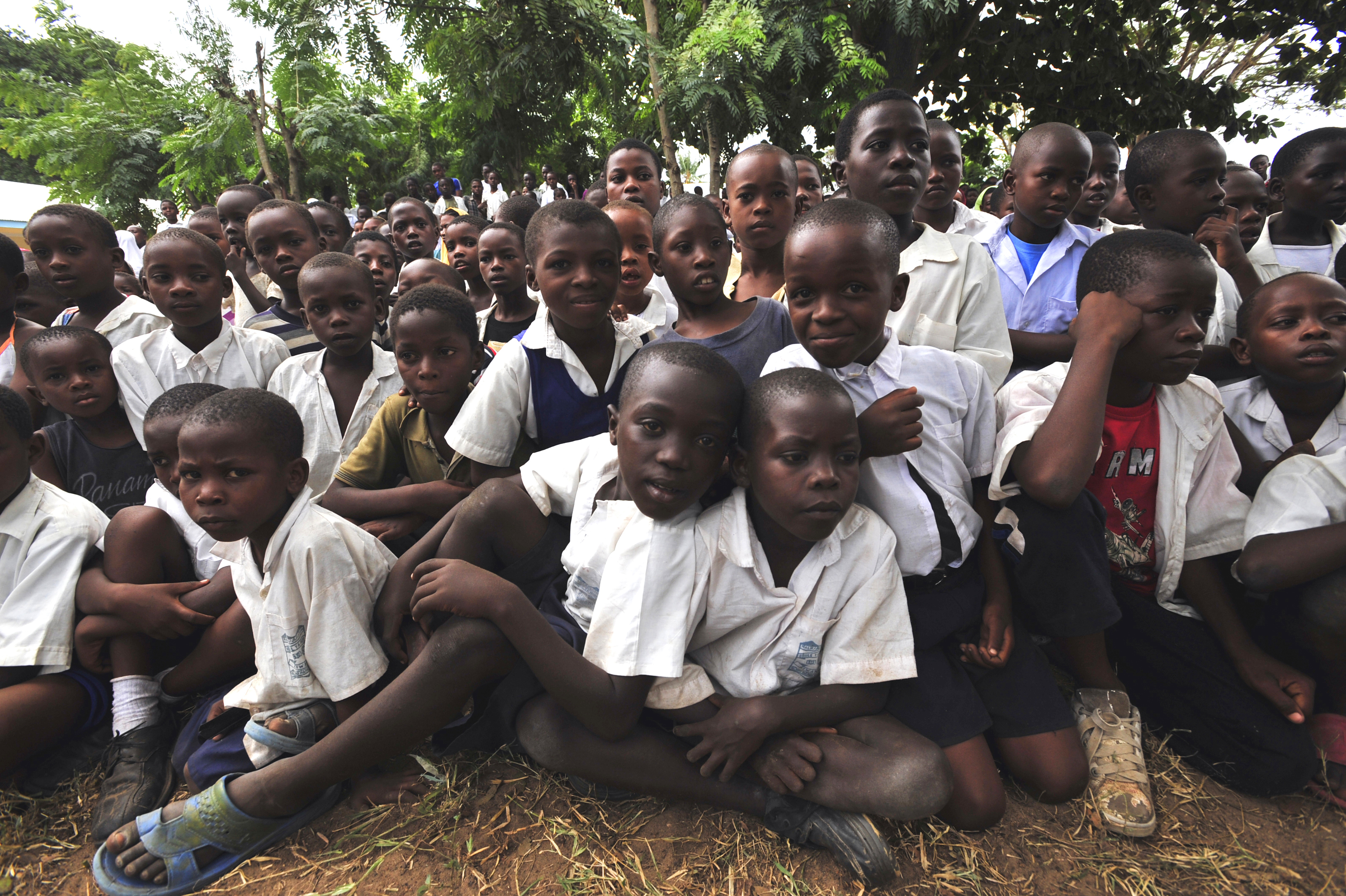 |
| School dedication ceremony, Pongwe, Tanzania, by Jesse Awalt |
 |
| Urawa Reds vs Gamba Osaka in Tokyo, Japan, by Pocopen |
When we consider all 7 billion of us together, a little math shows that, even though there are only a small number of new mutations in each individual, there really can be mutations at every single position in the genome. In fact, we expect hundreds of mutations at every single (non-lethal*) site!
Wow!!
*A mutation that results in death would not be tolerated, so we would not expect to observe mutations at a select set of very important sites. BUT, a mutation that is harmful in one tissue (like the brain) may not have any effect in a different tissue (say, the skin). That is a story for another day.
40 Comments
Dave Lovell · 16 July 2013
Interesting, but is the real variability not this simple. Is it not that there is potentially a one-bit to n-bit insertion at each site?
DS · 16 July 2013
And that's why it's possible to detect the hallmarks of selection at different position in the human genome. When we do this we find that some regions are under strong selective constraint but most are not. Indeed most evolve as if the variation were neutral, thus providing evidence for the "junk DNA" hypothesis. But that's the story of another thread.
glipsnort · 16 July 2013
Joe Felsenstein · 18 July 2013
This calculation is of the number of mutations that will have occurred in the current generation. It does not take into account mutant alleles that occurred in an earlier generation and were then inherited in the present generation.
To know of that you need to take into account the total branch length of the coalescent tree connecting all present individuals. This is a little bit different than when the coalescent shows the ancestry of just a modest-sized sample of gene copies from a population.
Anyway, the probability of seeing almost all possible single-base mutations, each at least once, is fairly high.
Chris Lawson · 19 July 2013
And don't forget that you *can* carry a non-functional mutation in a gene that is essential for life if (i) the gene is recessive, or (ii) the gene has multiple copies in the genome. I remember reading that every human carries around 6 lethal mutations (too long ago for me to recall the reference now).
Ron Okimoto · 20 July 2013
Cl · 20 July 2013
Please excuse a dumb question: How can you get 86 mutations per site, when there are only 4 possible values at each site, and one should be the expected one? I'd say you can only have 3 possible mutations at each site if A, T, G, and C are the only possible values, and one of them is the "non-mutated" value.
Henry J · 20 July 2013
I think the 86 was across the population, not within one individual organism.
Henry
Chris Lawson · 21 July 2013
Cl, As Henry J says, this was a back-of-the-envelope calculation of the number of people with a mutation at any given base pair. Not the number of possible variations at each base pair (which as you say maxes out at 4). Sayres is calculating the expected number of humans alive today with a single-point mutation at any given point.
This is obviously a rough calculation only -- it does't account for the fact that some parts of the genome have higher mutation rates, it doesn't account for evolutionary pressure, and it doesn't count frame-shift mutations, gene duplications, or other mutations...but it still makes the point that, contra the usual creationist rhetoric, even extremely rare events in an individual become common to the point of virtual certainty when applied to populations.
And if one applies the same logic to bacterial populations...well, the entire population of humans today (~7 billion) can be matched by an E. coli population in less than 100 ml of culture broth and E. coli can reproduce about every 20 minutes in good conditions...
Frank J · 21 July 2013
Frank J · 21 July 2013
Scott F · 21 July 2013
harold · 21 July 2013
harold · 21 July 2013
Cl · 21 July 2013
Thanks to all for the clarification. Seems obvious I guess, but for some reason I was not reading it as 86 individuals having a mutation at the given site.
M. Wilson Sayres · 21 July 2013
https://me.yahoo.com/a/RdfV1YQJ1oSFPntEbv7Ug6z0.CM6DYqt6t6ZE0XxwYlRtQ--#ad533 · 22 July 2013
But what's the deal with this finding? The vast majority of mutations degrade reproductive fitness and so natural selection will weed them out. There are only 3 million base pair differences between any two humans, and most of these are found in non-essential regions of the genome (formerly called "junk DNA" by the Darwinists).
diogeneslamp0 · 22 July 2013
https://me.yahoo.com/a/UIFqpY46nexUlCvhZ8zfKDh3zX4VO81SHItDeWm6L4agSA6W#dd2ba · 22 July 2013
https://me.yahoo.com/a/iS9p19oQ3c6VPNVNqDISaICkxmZpzT01EUrz#3f071 · 22 July 2013
diogeneslamp0 · 22 July 2013
https://me.yahoo.com/a/iS9p19oQ3c6VPNVNqDISaICkxmZpzT01EUrz#3f071 · 22 July 2013
diogeneslamp0 · 23 July 2013
https://me.yahoo.com/a/iS9p19oQ3c6VPNVNqDISaICkxmZpzT01EUrz#3f071 · 23 July 2013
Dave Lovell · 23 July 2013
https://me.yahoo.com/a/UIFqpY46nexUlCvhZ8zfKDh3zX4VO81SHItDeWm6L4agSA6W#dd2ba · 23 July 2013
harold · 23 July 2013
diogeneslamp0 · 23 July 2013
diogeneslamp0 · 23 July 2013
diogeneslamp0 · 23 July 2013
https://me.yahoo.com/a/iS9p19oQ3c6VPNVNqDISaICkxmZpzT01EUrz#3f071 · 23 July 2013
diogeneslamp0 · 23 July 2013
diogeneslamp0 · 23 July 2013
https://me.yahoo.com/a/iS9p19oQ3c6VPNVNqDISaICkxmZpzT01EUrz#3f071 · 23 July 2013
diogeneslamp0 · 23 July 2013
John Harshman · 24 July 2013
diogeneslamp0 · 24 July 2013
diwakark86 · 29 July 2013
Henry J · 29 July 2013
One type of mutation is duplication of existing sequences. Point mutations (changing of individual locations) are more common, but duplications happen sometimes, and can cause repeats of stuff.
(Somebody who knows more than me can elaborate on that.)
Scott F · 29 July 2013