Meyer's Hopeless Monster, Part II

Posted 19 June 2013 by

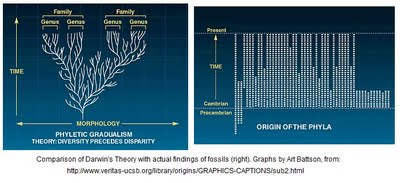
Note: I am extremely busy this summer, finishing grad school and moving to a postdoc. But when I got this book, I realized I wouldn't be able to focus on my real work without having gotten my 2 cents in. This is a rough-and-ready piece, so typos and missing references, and missing explanations of technical terms are to be expected, although I'm sure they can all be figured out with a wee bit of googling. I am off to Evolution 2013 tomorrow and will be incognito, writing, after that. So I may not comment much. However I expect commenters to be reasonable discussants and polite and will ban people who break the spirit of this expectation. Cheers, Nick Review of Stephen C. Meyer's Darwin's Doubt: The Explosive Origin of Animal Life and the Case for Intelligent Design This week, a new book came out by Stephen Meyer, Darwin's Doubt: The Explosive Origin of Animal Life and the Case for Intelligent Design. Having followed the ID movement and specifically its arguments on the Cambrian 'Explosion' for a long time, as well being somewhat up on the recent literature, and especially on phylogenetics, I feel that I have a pretty good sense of what to look for in any work purporting to be a capable commentary on the topic. As I read through Meyer's book, though, in case after case I see misunderstandings, superficial treatment of key issues which are devastating to his thesis once understood, and complete or near-complete omission of information that any non-expert reader would need to have to make an accurate assessment of Meyer's arguments. After months of exuberant propaganda about the book from the Discovery Institute, I was half-expecting some kind of definitive, detailed, "serious" treatment of the issue from Meyer, who has had 4 years since his last book to work on this one, and has had 9 years since we raked over the coals his 2004 incompetent and self-plagiarized offering in the blogpost "Meyer's Hopeless Monster". I was sorely disappointed. I'll hit a few of the main points. It would be nice if I had the time to write a comprehensive review, explain the issues from scratch in a Phylogenetics 101 sort of way, and provide detailed references, but given what my summer looks like, this is not likely. So, I'll just outline what occurs to me as the most significant points-- and what would occur to anyone else actually trained in phylogenetic methods, who also knows something about the Cambrian Explosion. If technical terms and the like don't make sense, I encourage readers to google them. In the cases I have checked, Wikipedia does better at explaining the actual issues and methods than Meyer does. . A. THE "EXPLOSION" TOOK AT LEAST 30 MILLION YEARS, AND WAS NOT REALLY "INSTANTANEOUS" NOR PARTICULARLY "SUDDEN" Darwin's Doubt is festooned with illustrations, mostly redrawn from other sources in a rather strange cartoon-like format also found in other recent ID books. However, there is never an illustration like these: (Marshall 2006) (Peterson et al. 2004) (Note: Erwin & Valentine 2013 of course contains similar illustrations) Instead, we are treated to ultrasimple figures of the times of origin of "phyla", which date back at least to the 1970s, although they've been endlessly copied by creationists/ID proponents and remain current in those circles because they convey the impression of "sudden" origin. Figures resembling this: (source: originally from UCSB ID guy Art Battson, but he got it from earlier sources, and it has been copied in random places on the ID websites) The reality is that, even on the most conservative interpretation of the fossil record which relegates all of the classic Ediacaran fossils to the stem below the bilaterian common ancestor, or to cnidarians, or to even more remote positions, we still have this sequence observed in the fossil record: All of this is pretty good evidence for the basic idea that the Cambrian "Explosion" is really the radiation of simple bilaterian worms into more complex worms, and that this took something like 30 million years just to get to the most primitive forms that are clearly related to one or another living crown "phyla", and occurred in many stages, instead of all at once. But, the reader gets very little of the actual big picture from Meyer. . . B. MEYER DOESN'T UNDERSTAND PHYLOGENETICS, NOR MODERN PHYLOGENETIC TAXONOMY, NOR THEIR RELATIONSHIP TO OLDER TAXONOMY OF THE CAMBRIAN "PHYLA" Much of Meyer's discussion is framed by the Burgess Shale, the famous Middle Cambrian locality in Canada which yielded many well-preserved fossils. The interpretation and classification of the fossils found therein was a major topic throughout the 20th century. The history can (very!) roughly be summarized with the following: All of the modern work on "transitional fossils" and the evolutionary origin of major groups (tetrapods, mammals, birds, whales, hominins, angiosperms, etc., etc.) is based on cladistic methodology and its successors (probability model-based phylogenetic methods). The study of the origin of the Cambrian "phyla" is no different. The major results of these studies, in taxon after taxon, with birds, mammals, tetrapods, hominins, etc. -- as well as in well-preserved Cambrian groups -- are that: Creationist "thinking" about the Cambrian, and "ID" thinking which derives directly and lineally from the 1980s creationist thinking on the topic, got all of its talking points (and figures!) from Stage #2 in the 1980s, and has continued basically unchanged since. No creationist/IDist has ever advanced to even understanding stage #3, let alone actually grappling with the implications, let alone even attempting to do the necessary work that would constitute a serious attempt at a rebuttal. Part of the problem is the residual influence of the confusing nature of stage 2 -- many of the most prominent popularizers of evolution in the last generation, e.g. Dawkins and Gould, were educated in pre-phylogenetic times and do not always thoroughly grasp the implications. The other part of the problem is that, if creationists ever really did "get" stage 3, they'd have to give up the vast majority of the talking points and quote-mines they've been relying on for decades in their discussions of the fossil record, in the Cambrian and elsewhere. A failure to grasp stage 3 is why Kevin Padian's testimony at the Kitzmiller v. Dover case was so devastating on the topic of fossils, and why creationists/IDists will always fail, and fail miserably, when actually confronted with informed opposition in a format that allows detailed, extended discussion of the science. Unfortunately, a corollary of going to graduate school and gaining expertise in technical topics is that one becomes (a) busier and busier and (b) more and more cognizant that time spent rebutting creationists, who usually won't put in the work required to understand you anyway, is time that should probably be better spent doing actual science. Now, Meyer couldn't stumble around in the Cambrian and phylogenetic literature without encountering a few of these issues. He does briefly discuss "lumpers versus splitters" and even Linnaean taxonomy versus rank-free taxonomy. But Meyer never presents for his readers the point that cladistic analyses reveal the order in which the characters found in living groups were acquired, nor the fact that stem taxa are the transitional fossils the creationists are allegedly looking for. And he especially avoids giving his readers any real sense of the number of transitional forms we know about for some groups, and the detail known about their relationships and about the order in which the characters of modern groups originated. The most egregious example is with the Cambrian arthropods and arthropod relatives. Why does Meyer never show his readers anything like this? Briggs_Fortey_1989_arthropod_evolution_cladogram.png (source: Brysse 2008, originally Briggs & Fortey 1989) Or this? F3.medium.gif (source: Legg et al. 2012) . C. NOT GETTING PHYLOGENETIC THINKING LEADS TO ALL KINDS OF OTHER PROBLEMS Once you understand (B) and know something about the application of phylogenetic methods and thinking to the Cambrian animals, you will start to identify all kinds of other problems in Meyer's book which stem from these fundamental misunderstandings. Again, the arthropods are instructive. Meyer continually and blithely refers to organisms such as Anomalocaris as "arthropods", as if this were an obvious and uncontroversial thing to say. But in fact, anyone actually mildly familiar with modern cladistic work on arthropods and their relatives would realize that Anomalocaris falls many branches and many character steps below the arthropod crown group (see the figure above). Anomalocaris lacks many of the features found in arthropods living today. It is one of many fossils with transitional morphology between the crown-group arthropod phylum, and the next closest living crown group, Onychophora (velvet worms). A related problem is Meyer's treatment (mostly non-treatment) of "Lobopodia", which he treats as a distinct phylum and includes in his phylum count. Meyer never spends a word on an actual critical discussion of what "Lobopodia" is supposed to mean -- the term appears in a few picture captions, in the titles of some of his references, and in a quote of Simon Conway Morris. Whatever the method of naming the various scientists who use the term "Lobopodia" -- Linnaean ranks, rank-free, etc. -- as far as I know every authority would agree that lobopods are a paraphyletic grab-bag on the stems of the crown-group phyla Arthropoda and Onychophora (and perhaps also on the stem below their common ancestor). In other words, the arthropod and velvet-worm phyla evolved from lobopods, and lobopods contain a whole series of transitional forms showing the basics of how this happened! How anyone could write a book on the origin of Cambrian animals, without mentioning Cambrian Explosion 101 findings like this, is mystifying. (Amongst other interesting implications of the above is the fact that the paraphyly of lobopods means that some of Stephen Meyer's "phyla", listed in endnote #5 of chapter 2, are actually subgroups of other "phyla" in the list! That, or Meyer accepts that one phylum evolved into two or more other phyla (Tardigrades may also be derived from lobopods; they are close to Arthrpoda and Onychophora on everyone's analyses), which seems like an unlikely representation of his point of view.) The above sorts of huge mistakes would not have happened if Meyer had taken care to get clear on the key concepts of "crown group" and "stem group", which are absolutely necessary in any modern discussion of the Cambrian. Meyer does discuss briefly the crown-group versus stem-group issue, buried in endnote 5 of chapter 3, which discusses Budd and Jensen (2000). But Meyer's discussion gets the definition of crown-group wrong, saying "crown groups arise whenever new characters are added to simpler, more ancestral stem groups." No, crown groups are retrospectively defined by humans living in the present. We take two living taxa -- say, humans and the platypus, and then whatever falls within the clade defined by these taxa and their common ancestor constitutes the crown group. The living "phyla" are just large crown groups -- whether we call e.g. chordates a phylum or a superphylum or a subphylum, or dispense with ranks entirely, is basically a matter of taste. What matters is that this is a monophyletic group about which we can devise rigorous, testable hypotheses, such as the time of origin of this group, which fossils fall inside the crown or down on the stem, etc. We can also ask what fossils (and relationships with other living crown groups) tell us about the steps by which the character suite reconstructed for the last common ancestor arose, and how it later changed within the lineages within the crown. Yet another confusion that Meyer exhibits relates to the idea of "ancestor". As with all creationists, Meyer exhibits no understanding of the fact that phylogenetic methods as they exist now can only rigorously detect sister-group relationships, not direct ancestry, and, crucially, that this is neither a significant flaw, nor any sort of challenge to common ancestry, nor any sort of evidence against evolution. Distinguishing between a close sister-group relationship and an exact ancestor is just a level of precision that we cannot expect in most cases. It's just a by-product of the method and the data available. (This is not quite the end of the discussion on this topic -- eventually, we will have Bayesian methods that will assign probabilities to hypotheses of direct ancestry, although this will require formal definition and then data-informed estimation of what "ancestral lineage" means in terms of morphological variability within a lineage, the biogeographic and stratigraphic range of "morphospecies" through times, etc. End nerdy sidetrack.) But phylogenetic methods can and do regularly and rigorously identify collateral ancestry -- sister group relationships, and ancestral grades and clades. We can say that birds descend from dinosaurs with essentially 100% statistical confidence, without knowing which if any currently-described fossils are exact direct ancestors rather than closely-related sister groups. For all of the above reasons, almost every page of Meyer's discussion of Cambrian organisms contains howlers of the first order. For example, in chapter 2:
First, the great profusion of completely novel forms of life in the Burgess assemblage (feature 3) demanded that even more transitional forms than had previously been thought missing. Each new and exotic Cambrian creature -- the anomalocarids (see Fig. 2.10), Marrella, Opabinia, and the bizarre and appropriately named Hallucigenia -- for which there were again no obvious ancestral forms in the lower strata, required its own series of transitional ancestors. But where were they?
Figure 2.10 is a picture of Anomalocaris. Again, it is only by refusing to depict and specifically discuss of the inter-relationships of these sorts of taxa, and the data that supports them, and to mention the statistical support for the resulting relationships, that Meyer manages to pretend to his readers that these questions are not even partially answered, are unanswerable, and that "poof, God did it" is a better explanation. Here's the cladogram from Legg et al. (2012) again: F3.medium.gif What goes into diagrams like this? They represent summaries of the morphological character data, which in this case you can see right here. Many readers, and virtually all creationists/IDists, will have little idea of the scale of effort that goes into constructing a dataset like this. These researchers, and the previous researchers that they are building upon, identified 580 individual, variable characters, each of which has to be identified, defined, divided up into discrete character states, and encoded. This laborious process had to be repeated for (in this case) 173 fossil taxa (correction -- some are living, e.g. Drosophila). A lot of fossils are missing a lot of characters -- typical and expected in paleontological analyses -- but it is still a lot of work. After this, one runs a cladistic or other phylogenetic analysis (whole textbooks and courses are devoted just to this step of the process, and articles devoted to testing the reliability of phylogenetic methods, and improving the methods, are continually being published) and calculates support statistics. The support statistics are important since they tell you whether or not your data have any phylogenetic tree structure. Usually this doesn't get major emphasis in scientific publications, because almost any biological dataset typically has extremely statistically significant tree signal, and this is true whether or not it agrees precisely with other analyses, and whether or not all relationships of interest to the researcher are precisely resolved with high support. To anyone familiar with this work, it is simply laughable and pretty much insulting to see Stephen Meyer proclaim throughout his book that fossils with transitional morphology don't exist, that the Cambrian body plans look like they originated all-at-once in one big sudden step. These statements don't respect scientific process, they don't respect the peer reviewed literature, they don't respect the intelligence and knowledge of people who actually do know what they are talking about, they don't respect the hard work of all the scientists that went out in the field and found these fossils, and then spent countless hours preparing them, describing them, inspecting them in microscopic detail, coding them in a morphology database, and analyzing them, all with care and effort and detail never taken by any creationist/IDist writer in any effort of comparative biology. And most importantly, Meyer's statements don't respect the data. They don't follow the evidence wherever it leads, mostly because Meyer is ignoring most of the evidence. . D. IT GETS EVEN WORSE WHEN MEYER STARTS DISCUSSING PHYLOGENETIC CONFLICT Despite the above omissions, Meyer is aware on some level that phylogenetic results, both on the molecular data from living organisms, and the morphological data from living and fossil organisms, represent some kind of challenge to his thesis. He thus devotes Chapter 7 and several other sections to dismissing the validity of phylogenetic methods and results in toto. His main argument is basically that phylogenetic results sometimes conflict, therefore the whole thing is meaningless. This exhibits a jaw-dropping level of incompetence. It's amateurish in the worst possible way, the opening-your-yapper-without-knowing-the-first-thing-about-what-you-are-discussing sort of amateurism. There is no point in wading through Meyer's mass of incomprehending quote-mining and cherry picking in detail, but in no particular order, here are some of the things that any attempt at an argument against phylogenetics and the phylogenetic evidence for the common ancestry of animals would have to address to merit any kind of serious attention from professionals: 1. Phylogenetic methods -- the inference of phylogenetic trees from character data, whether molecular or morphological -- are rigorous and well-tested. The easiest sort of test is computational. We can construct a phylogenetic tree in the computer, simulate the process of substitution (character change or mutational change) under one of hundreds of models (or a weighted combination of models, or some new model we just thought of), read off the simulated data at the tips, and then hand off this data to a phylogenetic inference program. We can then run the inference program, giving it no knowledge of the true tree, and see how well the inference program does at estimating the tree (and the evolutionary substitution model parameters as well, if desired). We can vary the models and model parameters and see when the methods break and when they work. The general conclusion from this research, over decades, is that the methods work quite well under a variety of conditions, and the areas where they don't work as well are also reasonably well-known, as are the causes of weaknesses in inference, and these can be identified in many situations when they occur in real-world datasets. 2. If that weren't enough, phylogenetic methods have also been applied to biological situations where the phylogeny is known -- e.g., to viruses grown in lab cultures, when the cultures are manually divided and divided again. The methods also work well in reconstructing the actual history when the actual history is known for sure by direct observation. 3. "Tree structure" is not something wantonly imposed upon character data -- it is something that is there or not, in quantifiable amounts according to standard statistics. The allegation that phylogenetics amounts to no more than "tree-drawing programs", an allegation made in various places by the Discovery Institute's Anne Gauger (without any rebuttal from Meyer or other DI colleagues) is an outrageous, incompetent statement that could only be made by someone with no familiarity, let alone coursework, in phylogenetics. It is easy to calculate statistics such as CI and RI, and compare them to CI and RI statistics calculated based on data reshuffled under a null hypothesis where any possible phylogenetic signal has been obliterated. (Well, it's easy if you're a phylogeneticist.) In virtually any real case, one will see substantial phylogenetic signal, even if there is uncertainty in certain portions of the tree. Any claim that the biological data shows no reliable tree signal about the base of the animal tree -- a claim which Meyer makes repeatedly -- would have to be a statistical, quantifiable statement. But Meyer shows no evidence of even being aware of statistical treatment of these issues. 4. "Conflict between trees" is also not an all-or-nothing thing, unlike what Meyer ignorantly suggests. The difference between two phylogenetic trees (or between 100 trees, or whatever) can be measured by statistics such as Robinson-Foulds distances. And, again, we can take the observed distance between two trees and compare it to a distribution of distances based on a null hypothesis of only random similarity between the trees. If the null hypothesis is falsified, then you've got strong statistical evidence for quantifiable agreement between trees, whatever the disagreements might be. 4a. Similarly, there are small disagreements and there are big disagreements. In cases where branches are short, there are few mutations or character changes grouping two lineages. Another dataset could easily support slightly different relationships, precisely because the branches were short and thus there was little time over which to average out the stochasticity of mutation and other evolutionary events. This is a minor disagreement. Whichever topology is the true one, the branching points of those lineages were close together in time, and it makes little statistical difference in an objective measurement of tree differences. If one dataset grouped arthropods with nematodes, and another dataset grouped them with plants, then we'd have a phylogenetic conflict worth making hay out of. But to creationists/IDists, all phylogenetic conflicts of any sort are considered equally, crashingly devastating. It's rather a lot like when the young-earth creationists argued if estimates of the age of the Earth varied between 4.5 and 4.6 billion years ago, this 100-my disagreement was huge, and therefore we should instead think the Earth is 6,000 years old. 5. Also, as mentioned in #1, phylogeneticists are well-aware of situations that are likely to produce uncertainty and disagreement between phylogenetic trees. These include: Meyer just cites cases of phylogenetic conflict with reckless abandon, especially cases of 5a-5c, without any evidence of having any idea that causes of conflict are often well-known and can be predicted ahead of time. It is true that some of the problem is that many biologists who are not phylogenetic specialists are also sometimes naive about problems 5a-5c, and make overly dramatic statements when they get a slightly different topology than previous studies. Biology is a huge area, it's impossible to be an expert on everything, and phylogenetic programs are easy to run but it takes a lot more detailed study to understand the details of what is going on. But surely, if someone is claiming, like Meyer, that the whole enterprise of phylogenetics, the common ancestry of Animalia, and the common ancestry of bilaterians are all bogus and based on nothing rigorous, then the onus on him is to know and review the ins and outs of phylogenetics with substantial expertise. Instead we get the typical beginner-level mistakes. The reality of the phylogenetic situation with the Cambrian bilaterians is that a great many issues in animal phylogeny are much clearer than they used to be just a decade or two ago. Several long-suspected relationships based on morphology or development have been confirmed -- e.g. echinoderms & chordates, or arthropods, tardigrades, and velvet worms. Major "superphylum" groups like lophotrochozoa and ecdysozoa are robust and here to stay. The monophyly of many of the classic "phyla" was also confirmed. Many of the other cases of "conflict" deal with groups that are basically worms which never had a huge amount of morphological support for any particular placements, or groups that may be reduced from a more complex ancestor because of small size, parasitism, or both (e.g. nematodes and relatives). This latter case of conflict also includes many cases where it turned out that one "phylum" nested within another, which should be impossible if, as creationists/IDists think, "phyla" are supposed to be highly distinct body plans that never grade into each other or evolve into each other. 6. Phylogenetics is a statistical science of estimation and approximation, like any statistical science. Like any measurement of almost anything interesting in science, data and inferences will have some degree of uncertainty and error. This is not some problem with phylogenetics, this is a common feature of all science, known to anyone who does science. Creationists/IDists, though, are almost unique in their penchant for categorical, binary, and inflexible thinking. They seem unable to think statistically, to realize that agreement and disagreement between hypotheses and data come in degrees, rather than all-or-nothing, and that it is quite possible for a general pattern of phylogenetic agreement to be extremely strongly statistically supported, while at the same time it being true that uncertainty remains about any number of detailed issues. 7. All of the major statistical phylogenetic issues I've raised above were put forward with much more patience and detail by Doug Theobald in his "29+ Evidences for Macroevolution" FAQ at talk.origins. Meyer cites this once, near the beginning of his quote-mining tour about conflict between phylogenies, but then asserts that "In reality, however, the technical literature tells a different story." This just ain't so. Meyer doesn't really understand the technical phylogenetic literature, he doesn't understand the difference between large and small phylogenetic disagreements, he doesn't know that the similarity between phylogenetic trees can be measured and that different datasets usually produce trees with a high degree of overall similarity, and he doesn't understand the statistical methods that tell us that the raw data, whether molecular or morphological, typically have a high degree of tree structure. He doesn't even get to addressing the basic material covered in Theobald's FAQ, let alone the technical literature cited therein, which is specifically devoted to testing common ancestry and phylogenetic consistency, tests which are passed with flying colors in a statistically rigorous way in case after case. Meyer's contribution to the phylogenetic portion of this discussion is therefore without merit and worthless, at least to anyone who knows something about phylogenetics. E. OTHER ISSUES Ironically, despite making such a hash of the key issues for dealing specially with the Cambrian fossil record and the phylogeny of animals, most of Meyer's book is about other topics entirely. My guess is that Meyer sensed on some level that he actually was on weak ground basing his argument on the fossil record and phylogenetics, which in reality are the home turf of evolutionary biologists and both of which actually tell strongly against his argument to anyone who is actually familiar with the issues I have reviewed. Instead, Meyer's main argument is really about "information". Back in his Signature in the Cell book, Meyer asserted that the only known source of information was intelligence, and that therefore we could safely infer that intelligent design was behind the origin of life. This is problematic for all sorts of reasons, but one of the biggest was that intelligence is not the only known source of information -- in particular, evolutionary processes of mutation+selection can produce it, thus intelligence is not the only cause of information, thus "information" isn't some magical signal uniquely evidencing intelligence in the complete absence of any other evidence. This objection was particularly devastating to Meyer's argument in Signature because of the way Meyer based his argument on mere "information", rather than primarily on the difficulty of explaining the origin of life or some such. Meyer's response to the but-evolution-produces-information counterargument was to argue that this didn't answer how information came about during the origin of life, which happened before there was evolution. This actually isn't necessarily strictly true -- look up "prevolution" and Addy Pross -- and, anyway, the vast majority of Meyer's presentation of the information ==> intelligent design argument explicitly relies on the premise that information is uniquely and exclusively produced by intelligence. Furthermore, it was clear enough in Signature, and in the rest of Meyer's writing, that he thinks, in a quite simple-minded way, that all genetic information everywhere in biology is produced by intelligence, and that evolutionary processes cannot do it at all. For Meyer, the origin of life, the origin of Cambrian groups, and the origin of each and every gene are all the product of one thing -- divine intervention, barely disguised with the weasel words "intelligent design". Thus, for several reasons, any and all evidence for the evolutionary origin of new information really was quite relevant to the assessment of Meyer's argument in Signature. But, whatever one thinks about Meyer's argument in Signature about information and the origin of life, and his avoid-the-topic-of-evolution defensive strategy there, there was no way for Meyer to get around the but-evolution-naturally-produces-new-genetic-information argument in Darwin's Doubt. Meyer is now in the realm of animal evolution, where there is absolutely no debate about whether or not evolutionary processes are a potential answer to the "where did new genetic information come from" question. Here, finally, Meyer has to confront the critics who have been pounding him on this issue ever since the 2004 PT post "Meyer's Hopeless Monster". Longtime PT readers may remember that the "Meyer's Hopeless Monster" post was a critical review of Meyer's article on the Cambrian Explosion (well, sort of on the Cambrian Explosion) in The Proceedings of the Biological Society of Washington (D.C.). PBSW was a rather obscure journal devoted mostly to alpha taxonomy, but it was edited by Richard von Sternberg, who I believe is now on the Discovery Institute payroll. The year 2004 was just about the peak of the ID movement, and after we put up our critical review, stating that Meyer's article was substantially self-plagiarized from his previous works, was wrong on a large number of specific issues, and thus could not be considered a competent work of biology, and the peer-review couldn't be considered competent either, a rather impressive fracas started. The whole story can be reviewed in endless detail in the PT archives. We never got a detailed response from Meyer, and a promised Discovery Institute detailed rebuttal flamed out after one or two posts. But now, at long last, Meyer devotes a big chunk of chapter 11 to rebutting one of the key arguments we made, namely that the origin of new genetic information by evolutionary processes is well-documented and well-understood, and this is demonstrated in part by a nice detailed review article by Long et al., (2003), Nature Reviews Genetics, entitled "The origin of new genes: glimpses from the young and old." The paper has two nice big tables, one giving a review of the many mutational mechanisms (all of them mutational processes known to occur naturally and in the lab) involved in the production of new genes, and another giving examples reviewing papers that had reconstructed the origin of new genes, typically recent genes where the evidence was very good and very clear, although this wasn't the case for every single example. The paper was so handy that it was used again as an evidential exhibit in the Kitzmiller v. Dover case, and it even got cited by the Judge in the final decision as shooting down the ID argument that genetic information requires intelligence. All of this apparently stung Meyer and the Discovery Institute folks, although it took them a long time to muster any sort of response to this fatal counterargument. Five years later, in 2010, we finally got a response from Casey Luskin, which basically amounted to the juvenile assertion that invoking mutations (which are known, regularly observed natural processes, which leave easily detectable and obvious evidence in the genome) and natural selection (which is also a known, observed natural process, and which also often leaves detectable statistical evidence in the genome, although it is not always quite as easy to detect as mutations) amount to "waving a magic wand" and telling a vague "just-so story." Please turn off your irony meters before you remember that this is coming from an ID advocate, who literally thinks that "poof, God did it through divine intervention!" should be an acceptable scientific explanation. Luskin's other argument seemed to be that if we don't know everything about the new gene in question -- its exact function and the exact reasons that selection occurred -- then we know nothing at all, and can safely sweep under the rug all of the evidence that we do have for the mutation and selection explanation (for example, in the case of Sdic, which I reviewed here with pictures). Why he expects this argument to be convincing to any serious scientist who works in genomics, genetics, or similar fields mystifies me. We know a lot about a lot of things in biology, but there is basically nothing about which we know everything we would like to know. Science progresses nonetheless, and we can say many things with confidence nonetheless, in part because we have rigorous statistical methods to detect past selection, to reconstruct the relationships of genes, and to reconstruct the approximate sequence of mutational events to some recently-originating new gene. (Also note that Richard Hoppe pithily pointed out the scientific implications of Luskin's "invoking well-known, well-understood natural processes is equivalent to just waving a magic wand and telling a just-so story" argument, in this PT post) Given Luskin's embarrassing attempt, does Meyer do any better in 2013 at rebutting Long et al. and similar copious evidence that new genes can and have been regularly produced by natural evolutionary mechanisms? Sad to say, nope, he doesn't. Meyer first reviews his 2004 paper and the "Meyer's Hopeless Monster" episode. (Inaccurately, as it turns out -- Meyer seems to say that "Meyer's Hopeless Monster" was first published on the "atheist" (?) talkreason.org website, and that it was published late in the controversy over Meyer's PBSW article; in fact, if memory serves, the article was published here on PT first, and furthermore it was the very first public notice that anyone made of the Meyer article.) Meyer then just half-heartedly lists a couple of random complaints and a couple of vague and question-begging alternative explanations of the data. Namely: Perhaps dissatisfied with his phoning-it-in response to the work of hundreds of scientists documenting the origin of new genes (work which has, by the way, greatly expanded since 2003...even writing a review article now would be a much bigger task), Meyer then switches topics to ORFans. Here he repeats the usual IDist problems with complete ignorance of the relevant statistical issues involving ORFans and homology searches between genomes -- as, unfortunately, can be found in some of the scientific literature on this topic. Meyer's last argument basically reverts to the improbability argument -- sequence space is large, functional space is small. This trumps all of the above evidence, according to Meyer. It never occurs to Meyer that his assessment of the probability of functional sequences might just be wrong, and that the deluge of evidence that new genetic information is easy to evolve is pretty direct evidence that his probability assessment is wrong. Elsewhere in the book Meyer invokes some other arguments to justify the "improbability of functional sequence" argument. These are Behe & Snoke's 2004 argument about multiple simultaneous mutations, Behe's Edge of Evolution argument about "chloroquine complexity clusters" and protein-protein binding sites, and work by Douglas Axe and Anne Gauger, run out of the Discovery Institute's approximately 2 person research institute, the Biologic Institute, which typically involves making evolutionarily absurd modifications to proteins and then showing that they don't work. This latter stuff is actually about as conceptually bad as the old YEC idea that evolution meant there should be such a thing as a "crocoduck". Anyway, most of this has been rebutted elsewhere on PT, and there is little point in doing it again. It is pretty strange, though, that most of these talking points were invoked in a very similar way in last year's DI book on human origins -- it looks like they will throw in some Behe and Axe just about anywhere. So really, when you buy a book from the Discovery Institute, you only get a portion of material devoted to the topic, and the rest is just a rehash of the same unconvincing material about what-if-multiple-mutations-were-required and poorly-informed intuitions about the improbability of evolutionary processes. The multiple-required-mutations stuff, by the way, is basically just Behe's refuted "irreducible complexity" argument disguised as an argument about sequence evolution, and is only relevant if it can be shown that 2 or more neutral mutations ever were required for anything relevant to the Cambrian Explosion, but, as is typical in DI literature, this is just blithely assumed rather than argued for. Showing it for any case would be nontrivial, and every detailed study I have read about multiple-mutation adaptations indicates that it doesn't usually apply -- instead, what typically occurs to produce an alleged "multiple mutations required" adaptation is that a variety of single-step mutations are selected as partial, imperfect adaptations to some chemical or environmental stressor. One or more of these enables the viability of some mutation of high adaptive value, which is then followed by selection of further mutations ameliorating whatever negative impacts the "major" adaptive mutation might have incurred. At the end of this process, you have something that would look as if several mutations would have had to happen at once, but only if you are ignorant of the somewhat circuitous-but-adaptive path (sometimes with selection for functions other than the final one) that was actually taken. Meyer's other go-to argument on information is basically, "even if evolution can produce new genes, it can't produce new protein domains". This is (A) basically a tacit admission of defeat on the information question, and (B) there's no evidence that new protein domains were required in the Cambrian -- I'd be surprised if any protein domains are known that are both unique to and required for the existence of Animalia. Animal genomes mostly just elaborate on and expand (through duplication) the already-complex pre-existing eukaryote genome. (For a tiny contribution to the where-eukaryotes-came-from question, you might check out my new coauthored PNAS paper, out this week.) The basic protein domains mostly originated very far back in evolutionary history, where things like ultrahigh population sizes help out, as well as the fact that there are probably a fairly limited number of protein domains, and the fact that point mutations and rearrangements can, on occasion, produce new or modified protein folds, in some cases without having much effect on enzymatic activity. . CONCLUSION Meyer discusses a number of other issues, e.g. development, that would be better treated by others. And he spends a lot of time on the usual quote mines, the misrepresentation of evo-devo, self-organization, Punk Eek, the Altenberg 16, etc., all as "alternatives" to "Neo-Darwinism", all of which is mistaken and misshapen but which would take longer to untangle than I have time for in the near future. He also repeats the usual ID talking points about junk DNA and the ENCODE project, apparently completely ignorant of the devastating responses based on the huge variability in animal genome sizes, amongst other issues. Even without addressing all of these other issues in depth, I think the above shows that Meyer's book is already holed beneath the waterline on the key issues of Cambrian paleontology, phylogenetics, and the information argument. I'm not sure it deserves much more of anyone's time. Sadly, some vaguely respectable people seem to have ignored the crashingly obvious flaws and endorsed the book, although in at least some cases they are already known for promoting bizarre opinions in other contexts. Enthusiastic reviewers in the blogosphere, like Tom Gilson at Thinking Christian, seem to lack even Wikipedia-level research abilities in critically assessing Meyer's claims. The one refreshing bit of the book is at the end, where Meyer basically admits that, yes, this really is all about bringing an interventionist God back into science, and thereby reconciling and harmonizing science and religion, and solving the problems of meaning in the culture and belonging in the Universe, or something. How exactly this could ever work, even if Meyer's argument's succeeded, is not explained. Meyer completely and explicitly punts on the question of providing any sorts of answers on what exactly is supposed to have happened at the Cambrian or anywhere else in geological history, on the ID view. All we get is ID did something, somewhere, somehow, for some reason, never mind extinction, the millions of years of twiddling around with arthropods, the billions of years of twiddling around with bacteria, the endless examples of apparent evidence for evolution, etc. If Meyer takes his own arguments at all seriously, he is invoking divine intervention not just for the origin of life and the Cambrian, for basically every new gene, ORFan, any adaptation of any significance, and some ill-specified level of morphological difference. This is, probably, billions of separate divine interventions. It essentially amounts to invoking divine intervention at every instance where Meyer personally doesn't understand something, even in cases where scientists understand something quite well, and Meyer simply can't be bothered to do the work necessary to understand what they are talking about. As I've said before, the real problem with creationists/IDists isn't when they stick God into the gaps in current scientific knowledge. Such a thing is unwise, given history, but at least questions that all of humanity still wonders about are vaguely worthy of divine intervention. The real problem is when creationists/IDists insert God into the gaps in their own personal knowledge, gaps which have already been filled by scientists. Here it is completely clear that the creationists/IDists are arrogant enough to call God down from Heaven to cover for their ignorance, basically because they are unwilling to do the basic "due diligence" and hard work required to get a basic understanding of the topic they commenting on. I'm not sure that most long-lived religious traditions actually support that kind of behavior. A final thought: I'd like to see Meyer, or his defenders, explain which of the lobopods and stem arthropods and arthropods in the figures above are in different "genera", "families", etc., up to "phyla", and why. I think that if you plunked those fossils down in front of an ID advocate without any prior knowledge except the general notion of taxonomic ranks, the ID advocate would place most of them in a single family of invertebrates, despite the fact that phylogenetic classification puts some of them inside the arthropod phylum and some of them outside of it. . . References (originally provided here) Briggs, D.E.G.; Fortey, R.A. (1989). "The early radiation and relationships of the major arthropod groups." Science, 246(4927), 241-243. http://www.sciencemag.org/content/246/4927/241 Brysse, Keynyn (2008). "From weird wonders to stem lineages: the second reclassification of the Burgess Shale fauna." Studies in History and Philosophy of Science Part C: Studies in History and Philosophy of Biological and Biomedical Sciences. 39(3), 298-313. http://dx.doi.org/10.1016/j.shpsc.2008.06.004 , http://www.sciencedirect.com/science/article/pii/S1369848608000393 Budd, G. E., and S. Jensen. 2000. "A critical reappraisal of the fossil record of the bilaterian phyla." Biological Reviews 75:253-295. Erwin D and Valentine J (2013). The Cambrian explosion : the construction of animal biodiversity. Greenwood Village, CO, Roberts and Company Publishers. Link: http://www.amazon.com/The-Cambrian-Explosion-Construction-Biodiversity/dp/1936221039 Legg, David A.; Sutton, Mark D.; Edgecombe, Gregory D.; Caron, Jean-Bernard (2012). "Cambrian bivalved arthropod reveals origin of arthrodization." Proceedings of the Royal Society, Series B: Biological Sciences. 279(1748), 4699-4704. http://dx.doi.org/10.1098/rspb.2012.1958 http://rspb.royalsocietypublishing.org/content/279/1748/4699/F3.expansion.html Marshall, Charles R. (2006). "Explaining the Cambrian 'explosion' of animals." Annual Review of Earth and Planetary Sciences. 34: 355-384. http://dx.doi.org/10.1146/annurev.earth.33.031504.103001 Meyer SC (2013). Darwin's doubt : the explosive origin of animal life and the case for intelligent design, HarperOne. Link: http://www.amazon.com/Darwins-Doubt-Explosive-Origin-Intelligent/dp/0062071475 Peterson, Kevin J.; McPeek, Mark A.; and Evans, David A. D. (2005). "Tempo and mode of early animal evolution: inferences from rocks, Hox, and molecular clocks." Paleobiology 31(2_Suppl), 36-55. http://dx.doi.org/10.1666/0094-8373(2005)031[0036:TAMOEA]2.0.CO;2 E.g. as cited by Kevin Padian in the Kitzmiller case: http://www.sciohost.org/ncse/kvd/Padian/Padian_transcript.html#s031 . . Strongly recommended reading (and the references therein) Alan Gishlick, Nick Matzke, and Wesley R. Elsberry (2004). "Meyer's Hopeless Monster." Panda's Thumb post, August 24, 2004. http://pandasthumb.org/archives/2004/08/meyers-hopeless-1.html The "Meyer 2004" Medley - The Panda's Thumb -- the complete history of the Meyer 2004 craziness. Matzke, Nicholas (2005). Down with phyla! - The Panda's Thumb, which reviewed: Matzke, Nicholas (2005). Down with phyla! (episode II) - The Panda's Thumb Matzke, Nicholas (2007). Meet Orthrozanclus (down with phyla!) - The Panda's Thumb (A late edit: I made a local copy of the Briggs & Fortey 1989 / Brysse 2008 figure, as it was hosted on a journal website and might not load for everyone depending on proxy settings etc.)

250 Comments

stevaroni · 20 June 2013

How does Meyers know about the Cambrian? Was he there?

Jeffrey Shallit · 20 June 2013

There seems to be at least one actual paleontologist, Mark McMenamin, who wrote a flattering blurb for the book. Any insight as to why? Political naif, closet creationist, or something else?

https://me.yahoo.com/a/JxVN0eQFqtmgoY7wC1cZM44ET_iAanxHQmLgYgX_Zhn8#57cad · 20 June 2013

Below is one of my comments on Amazon reviews, which I include here to emphasize the fact that, whatever questions there are about patterns that are clearly overall what is expected of evolutionary processes, Meyer simply has no explanation at all for any of the patterns of life:
Evolutionary processes in organisms lacking substantial horizontal gene transfers--such as in the eukaryotes of the Cambrian--enforce an extremely derivative inheritance, resulting in the nested hierarchies dominant in eukaryotic taxonomy. What do we see in Cambrian life? The extremely derivative inheritance reflected in nested hierarchies, just as we see in most eukaryotes before and after the Cambrian. Meyer has no explanation for that--certainly not design, which is never constrained by inheritance as life is--thus he fails completely to solve any sort of problem, or even to put a dent into evolution. Creationists don't care, of course, hence they ignore such a blatant lacuna. Nevertheless, anyone who cares about science cares about causes and effects, and notes that genealogical trees extend throughout the metazoan world.
Source at Amazon It's the usual, fault evolution, provide no legitimate evidence for design, and fail to provide any real, if tentative, explanation for what evolution does explain. Glen Davidson

Nick Matzke · 20 June 2013

Author Profile Page Jeffrey Shallit | June 20, 2013 12:39 AM | Reply There seems to be at least one actual paleontologist, Mark McMenamin, who wrote a flattering blurb for the book. Any insight as to why? Political naif, closet creationist, or something else?
Something else. Remember the alleged Triassic fossilized aquatic nest of a giant kraken? That was McMenamin. http://freethoughtblogs.com/pharyngula/2011/10/10/traces-of-a-triassic-kraken/ http://dinogoss.blogspot.com/2011/10/release-nah-forget-it.html

Dave Wisker · 20 June 2013

Very nice, Nick. Well done.

https://me.yahoo.com/a/JxVN0eQFqtmgoY7wC1cZM44ET_iAanxHQmLgYgX_Zhn8#57cad · 20 June 2013

Amazon deleted a bunch of my posts, leaving the dishonesty that I responded to. Sure, I called these dishonest people on their lies, something Amazon can't seem to bring itself to care about. Well, they're out to sell books to the mindless, dull, and gullible. Why should they let anyone call out gross dishonesty? Since they'll likely protect their stupid market by my calling out their censorship, here's how I responded:
Well it looks like Amazon is out to just delete for no good cause--or probably due to lies that it cares not to investigate. Way to go Amazon, side with dishonesty. I can't say I'm surprised at your inability to be just. You have to sell this garbage to the gullible, can't have people being called out for the rank dishonesty of their creationism. Bring the banhammer down upon truth. Oh sure, delete this too, you wouldn't want an honest record here. Might hurt sales.
Glen Davidson

https://me.yahoo.com/a/JxVN0eQFqtmgoY7wC1cZM44ET_iAanxHQmLgYgX_Zhn8#57cad · 20 June 2013

Should have been something like: "Since they’ll likely protect their market to the stupid by my also deleting my post calling out their censorship, here’s how I responded:"

Glen Davidson

https://me.yahoo.com/a/JxVN0eQFqtmgoY7wC1cZM44ET_iAanxHQmLgYgX_Zhn8#57cad · 20 June 2013

Hm, well, "Since they’ll likely protect their market to the stupid by also deleting my post calling out their censorship, here’s how I responded:"

Way too late, but I haven't been able to sleep.

Glen Davidson

SensuousCurmudgeon · 20 June 2013

This is an outrage! Nick's article is so good that now there's nothing left for me to do at my humble blog except post daily links sending people over here.

Tenncrain · 20 June 2013

Thanks, Nick. Your article is fine reading.

A decade ago, geologist Keith Miller of Kansas State University published Perspectives on an Evolving Creation, an anthology of mainstream scientists and theists. In particular, Chapter 9 beats down the anti-evolutionist notion that the Cambrian Explosion is an obstacle for evolutionary theory.

Unfortunately, looks like pseudoscience books from the likes of the Disco Tute still get much of the attention.

BTW, Keith Miller is an officer member of the Affiliation of Christian Geologists. He is also heavily involved with the pro-science organization Kansas Citizens For Science.

Tenncrain · 20 June 2013

This all is "just a line of reasoning" in ..............3.........2.........1.........

pete moulton · 20 June 2013

Well done, Nick! Unfortunately, Meyer and the rest of the Disco Tuters are so ignorant of the science they're attacking that there's literally no hope that they'll understand your critique.

DS · 20 June 2013

So the creationists got the science wrong again. What a surprise. They just can't deal with the evidence. But apparently they do realize how damaging the fossil record is to their pet ideas. They feel compelled to attack the science without ever understanding it. Unfortunately for them, even the most cursory examination of the evidence is sufficient to falsify all of their ideas. Calling attention to the evidence, no matter how you try to twist or distort it, can only backfire. If they were smart they would leave the science alone and crawl back under their pews and hide their faces. But then again, if they were smart they wouldn't try to denigrate modern evolutionary theory.

Rolf · 20 June 2013

But what else can they do? they have their faith and a crowd to cater for. Fight evilutionism with what tools (hardly any weapons) they have, or leave innocent people to the vultures?

An ingrown faith is among the sturdiest mental obstacles to accepting contrary 'winds'.

BTW, Nick's done a great job!

https://me.yahoo.com/a/JxVN0eQFqtmgoY7wC1cZM44ET_iAanxHQmLgYgX_Zhn8#57cad · 20 June 2013

Well look at this headline at UD, evilutionists:
Historian who follows ID: Significance of Meyer’s Darwin’s Doubt exceeds that of Behe’s Darwin’s Black Box
I'm inclined to believe it. More significant than Darwin's Black Box. Keep going like that for a few decades and it might be as important as Chariots of the Gods by von Daniken! Glen Davidson

Gary_Hurd · 20 June 2013

Excellent dissection, Nick.

@Glen Davidson, Amazon.com had deleted anti-creationist reviews, and comments for years. I simply stopped buying from them when it was obvious that this was actually their unwritten policy.

https://me.yahoo.com/a/JxVN0eQFqtmgoY7wC1cZM44ET_iAanxHQmLgYgX_Zhn8#57cad · 20 June 2013

Gary_Hurd said: Excellent dissection, Nick. @Glen Davidson, Amazon.com had deleted anti-creationist reviews, and comments for years. I simply stopped buying from them when it was obvious that this was actually their unwritten policy.
Thanks for pointing that out. I believe that I'm headed that way, too. Glen Davidson

apokryltaros · 20 June 2013

In other words, Meyer's latest magnum opus discusses how the Cambrian Explosion is a fatal problem for Evolution(ary Biology) by ignoring almost all of the current information and breakthroughs, and deliberately distorting and quotemining paper mountains out of what little, and apparently blatantly out of date intel he does bother to mention.

I take it he also fails to explain why saying GODDESIGNERDIDIT is supposed to be a superior scientific explanation, too?

apokryltaros · 20 June 2013

Gary_Hurd said: Excellent dissection, Nick. @Glen Davidson, Amazon.com had deleted anti-creationist reviews, and comments for years. I simply stopped buying from them when it was obvious that this was actually their unwritten policy.
I think it's actually because it is written Amazon.com policy for merchants to be able to delete reviews perceived as being abusive or defamatory as they please.

apokryltaros · 20 June 2013

pete moulton said: Well done, Nick! Unfortunately, Meyer and the rest of the Disco Tuters are so ignorant of the science they're attacking that there's literally no hope that they'll understand your critique.
If any science-denier understood science in the first place, why would they bother to attack it in the first place?

ogremk5 · 20 June 2013

Last night I published a list of predictions for DD. (http://www.skepticink.com/smilodonsretreat/2013/06/19/darwins-doubt-a-prediction/)

I wasn't aware that the book was already available. For some reason I though it wasn't coming out until next week.

Anyway, it appears that almost all of my predictions are confirmed. Yay me... although it wasn't hard.

TomS · 20 June 2013

apokryltaros said: I take it he also fails to explain why saying GODDESIGNERDIDIT is supposed to be a superior scientific explanation, too?
I'd like to know whether he even bothers to describe "Intelligent Design", or how it explains anything, scientific or not. Let's assume, for the sake of discussion, that there is some major flaw in evolutionary biology. What did happen, when and where, that living things ended up this way, rather than something else? Does nihilism provide a better outlook on life?

https://me.yahoo.com/a/JxVN0eQFqtmgoY7wC1cZM44ET_iAanxHQmLgYgX_Zhn8#57cad · 20 June 2013

TomS said:
apokryltaros said: I take it he also fails to explain why saying GODDESIGNERDIDIT is supposed to be a superior scientific explanation, too?
I'd like to know whether he even bothers to describe "Intelligent Design", or how it explains anything, scientific or not.
I'm sure that he doesn't really do so, but he plays at it. Chapter 8 is "The Cambrian Information Explosion," ch.17 is "The Possibility of Intelligent Design," and ch.18 is "Signs of Design in the Cambrian." So he's apparently prating around it, pretending that ID explains something. I have ordered the book, but I'm going hardcover and it'll take a while, so I can only go by the table of contents, and a little at the begininng, which is on the web. No, he's not going to write a book without making a pretense that'll fool the most gullible--and there are quite enough of those for some good sales (isn't that right Amazon?). Glen Davidson

apokryltaros · 20 June 2013

Nick Matzke said:
Author Profile Page Jeffrey Shallit | June 20, 2013 12:39 AM | Reply There seems to be at least one actual paleontologist, Mark McMenamin, who wrote a flattering blurb for the book. Any insight as to why? Political naif, closet creationist, or something else?
Something else. Remember the alleged Triassic fossilized aquatic nest of a giant kraken? That was McMenamin. http://freethoughtblogs.com/pharyngula/2011/10/10/traces-of-a-triassic-kraken/ http://dinogoss.blogspot.com/2011/10/release-nah-forget-it.html
I once loaned my copy of McMenamin's The Garden of Ediacara to one of my Biology professors, and he found it to be so unreadable that he (sort of and sort of not) jokingly regretting my offer to loan it to him. He said it was because he got bogged down in McMenamin's nattering of irrelevant details of his own personal life. I liked the book (or at least, found it readable) mostly because I focused almost entirely on the illustrations, crude as they were (and now woefully out of date).

John · 20 June 2013

Well done, Nick. I should note that both Paul Burnett and I have posted appropriate reviews over at Amazon. Meyer's "scholarship" extends to his ignorance of the Great Ordovician Biodiversification Event which resulted in substantially higher rates of diversification than in the "Cambrian Explosion".

John · 20 June 2013

Jeffrey Shallit said: There seems to be at least one actual paleontologist, Mark McMenamin, who wrote a flattering blurb for the book. Any insight as to why? Political naif, closet creationist, or something else?
Mark McMenamin is a renegade. His position is not one endorsed by other, more credible, paleobiologists.

harold · 20 June 2013

apokryltaros said:
Gary_Hurd said: Excellent dissection, Nick. @Glen Davidson, Amazon.com had deleted anti-creationist reviews, and comments for years. I simply stopped buying from them when it was obvious that this was actually their unwritten policy.
I think it's actually because it is written Amazon.com policy for merchants to be able to delete reviews perceived as being abusive or defamatory as they please.
So Amazon reviews are to some degree worthless. They're advertizing. If fairness, it's asking a lot to expect any merchant to post negative reviews of a product in the actual place of sale. It's also an issue that unmoderated anonymous internet reviews could quickly degenerate, with someone with a grudge against an author publishing thousands of negative reviews under different sockpuppet accounts and so on. I don't mean to give Amazon a pure pass here. It's mildly sleazy to deceptively appear to have an open policy for reviews, but actually allow merchants to remove negative reviews. There should be a huge disclaimer for at the top of the review section, if that's the policy. But still, yes, Amazon does sell books for a profit, and there's nothing terribly shocking about that. They are a for profit company, not an academic library, and their behavior naturally reflects that. Only very few people will read this entire book with understanding, and all of those people will be scientists reading it to critique it. Most sales of the book will probably be to people who do not read it. Many will probably be bulk sales to right wing think tanks. I have heard credible rumors of boxes of copies of books going unpacked in such places. Others will be to loyalists who won't be able to get through it. A handful of UD dullwit types will uncomprehendingly force their way through it via the sheer willpower it must take to read uncomprehended words. I would be willing to bet that well under a thousand people worldwide will actually READ the thing - not buy, read - and of those, the vast majority will be critics.

Elizabeth Liddle · 20 June 2013

Bravo, Nick!

ogremk5 · 20 June 2013

harold said:
apokryltaros said:
Gary_Hurd said: Excellent dissection, Nick. @Glen Davidson, Amazon.com had deleted anti-creationist reviews, and comments for years. I simply stopped buying from them when it was obvious that this was actually their unwritten policy.
I think it's actually because it is written Amazon.com policy for merchants to be able to delete reviews perceived as being abusive or defamatory as they please.
So Amazon reviews are to some degree worthless. They're advertizing. If fairness, it's asking a lot to expect any merchant to post negative reviews of a product in the actual place of sale. It's also an issue that unmoderated anonymous internet reviews could quickly degenerate, with someone with a grudge against an author publishing thousands of negative reviews under different sockpuppet accounts and so on. I don't mean to give Amazon a pure pass here. It's mildly sleazy to deceptively appear to have an open policy for reviews, but actually allow merchants to remove negative reviews. There should be a huge disclaimer for at the top of the review section, if that's the policy. But still, yes, Amazon does sell books for a profit, and there's nothing terribly shocking about that. They are a for profit company, not an academic library, and their behavior naturally reflects that. Only very few people will read this entire book with understanding, and all of those people will be scientists reading it to critique it. Most sales of the book will probably be to people who do not read it. Many will probably be bulk sales to right wing think tanks. I have heard credible rumors of boxes of copies of books going unpacked in such places. Others will be to loyalists who won't be able to get through it. A handful of UD dullwit types will uncomprehendingly force their way through it via the sheer willpower it must take to read uncomprehended words. I would be willing to bet that well under a thousand people worldwide will actually READ the thing - not buy, read - and of those, the vast majority will be critics.
Aside, I've just about stopped reading Amazon reviews since they have become an art form and are easily manipulated by even small groups.

Nick Matzke · 20 June 2013

I think I've got most of the typos now, lemme know if you see others.

gerdien.dejongx · 20 June 2013

What is the source of the figures? (I might like them for a lecture).

John Harshman · 20 June 2013

You definitely need to cite your references. I see you mention Budd and Jensen 2000, still one of my favorite paleo papers. Here's a full citation: Budd, G. E., and S. Jensen. 2000. A critical reappraisal of the fossil record of the bilaterian phyla. Biological Reviews 75:253-295.

The main message is that many Cambrian supposed members of modern phyla are either stem-members or are even basal to two or more phyla. And the same goes for arthropod classes. As you say. Does Meyers cite Budd and Jensen? I'm thinking not.

Nick Matzke · 20 June 2013

gerdien.dejongx said: What is the source of the figures? (I might like them for a lecture).
In order, Charles Marshall 2006 Peterson et al 2005, e.g. http://www.sciohost.org/ncse/kvd/Padian/Padian_transcript.html#s031 Brysse 2008: http://www.sciencedirect.com/science/article/pii/S1369848608000393 ...although it originally comes from Briggs & Fortey 1989. Legg et al. 2012 The Brysse article is good intro to several of the main points I zipped over: ============== From weird wonders to stem lineages: the second reclassification of the Burgess Shale fauna Keynyn Brysse Institute for the History and Philosophy of Science and Technology, University of Toronto, Room 316, Victoria College, 91 Charles Street West, Toronto, Ontario M5S 1K7, Canada http://dx.doi.org/10.1016/j.shpsc.2008.06.004 Abstract The Burgess Shale, a set of fossil beds containing the exquisitely preserved remains of marine invertebrate organisms from shortly after the Cambrian explosion, was discovered in 1909, and first brought to widespread popular attention by Stephen Jay Gould in his 1989 bestseller Wonderful life: The Burgess Shale and the nature of history. Gould contrasted the initial interpretation of these fossils, in which they were ‘shoehorned’ into modern groups, with the first major reexamination begun in the 1960s, when the creatures were perceived as ‘weird wonders’, possessing unique body plans and unrelated to modern organisms. More recently, a third phase of Burgess Shale studies has arisen, which has not yet been historically examined. This third phase represents a revolutionary new understanding, brought about, I believe, by a change in taxonomic methodology that led to a new perception of the Burgess creatures, and a new way to comprehend their relationships with modern organisms. The adoption of cladistics, and its corollary, the stem group concept, has forged a new understanding of the Burgess Shale … but has it also changed the questions we are allowed to ask about evolution? ============== Cheers! Nick

Nick Matzke · 20 June 2013

John Harshman said: You definitely need to cite your references. I see you mention Budd and Jensen 2000, still one of my favorite paleo papers. Here's a full citation: Budd, G. E., and S. Jensen. 2000. A critical reappraisal of the fossil record of the bilaterian phyla. Biological Reviews 75:253-295. The main message is that many Cambrian supposed members of modern phyla are either stem-members or are even basal to two or more phyla. And the same goes for arthropod classes. As you say. Does Meyers cite Budd and Jensen? I'm thinking not.
He does, but just in that endnote discussion of crown/stem groups which I mentioned.

hrich · 20 June 2013

Under E. you write
'Back in his Signature in the Cell book, Meyer asserted that the only known source of information was intelligence, and that therefore we could safely infer that intelligent design was behind the origin of life.'
Back when I waded through Signature in the Cell, understanding part of it I hope, it appeared to me that with all the numerous examples of intelligent design Meyer cited, all but two involved the intellegence of human brains. The two exceptions were 1) the intelligence he was trying to establish as being behind the origin of life, and 2) a hypothetical intelligence which he offered as a fictional, and he specified that it was fictional, story, which could have, at a time in the geological record before the possible existence of humans.
Can I not conclude from this that the only known source of intelligence is living brains? And where does that lead as to the origin of life? Does my simple mind detect a circle here?

hrich · 20 June 2013

I seem to have left out what it was that the fictional intelligence was supposed to have done - left some evidence of intelligent design - but no matter, it was all a fiction in any case. I think Meyer called it a parable, or an allegory, or some such.

https://www.google.com/accounts/o8/id?id=AItOawlNAx_hMLpNhL4ENvJ7PRK27pKE0eyNG7Y · 20 June 2013

Jeffrey Shallit said: There seems to be at least one actual paleontologist, Mark McMenamin, who wrote a flattering blurb for the book. Any insight as to why? Political naif, closet creationist, or something else?
McMenamin can only be described as a renegade eccentric. Many of us in the paleo community go to his GSA talks in anticipation of outrageous and ludicrous statements. A few years ago he seemed to imply that he had found evidence of telepathy in the fossil record. Some colleagues just dismiss him as "crazy" but it is true that McMenamin has had some good ideas over the years. I am not part of the Ediacaran/Cambrian paleo crowd and don't know him personally. What I can say is that many of us are simply baffled by his talks and his wacky claims. I don't know whether he does this to get attention or because he really believes them. What can be said for sure is that his supportive review of Meyer's book can hardly be viewed as an endorsement by the paleontological community. Indeed, since Meyer craves to be taken seriously (which he has utterly failed at) he should probably put some distance between himself and McMenamin's views.

harold · 20 June 2013

https://www.google.com/accounts/o8/id?id=AItOawlNAx_hMLpNhL4ENvJ7PRK27pKE0eyNG7Y said:
Jeffrey Shallit said: There seems to be at least one actual paleontologist, Mark McMenamin, who wrote a flattering blurb for the book. Any insight as to why? Political naif, closet creationist, or something else?
McMenamin can only be described as a renegade eccentric. Many of us in the paleo community go to his GSA talks in anticipation of outrageous and ludicrous statements. A few years ago he seemed to imply that he had found evidence of telepathy in the fossil record. Some colleagues just dismiss him as "crazy" but it is true that McMenamin has had some good ideas over the years. I am not part of the Ediacaran/Cambrian paleo crowd and don't know him personally. What I can say is that many of us are simply baffled by his talks and his wacky claims. I don't know whether he does this to get attention or because he really believes them. What can be said for sure is that his supportive review of Meyer's book can hardly be viewed as an endorsement by the paleontological community. Indeed, since Meyer craves to be taken seriously (which he has utterly failed at) he should probably put some distance between himself and McMenamin's views.
In every field of science, but especially in biomedical sciences, there exists a certain type of person who is sometimes a nut but sometimes so brilliant that they generate incredibly some of the most important new idea. Sometimes the nuttiness comes late in their career, sometimes it comes on early and stays, and sometimes they fluctuate. Right off the top of my head - Kerry Mullis (most extreme example), Lynn Margulis, whichever of Watson and Crick has been raving on about "consciousness" for years. A lot of people would add Linus Pauling. I wouldn't, because high doses of vitamin C are relatively safe and have several medical uses (it's a good treatment for mild gout, for example). His hypothesis was respectable. In addition to the well known association of bipolar disorder with creative breakthroughs in art and science, it does seem that there is some association between eccentric thinking and brilliant thinking. However - Meyer is just a cookie cutter right wing science denier. (I'm not saying his own views are right wing, although I'd be astounded if they aren't, but that he advances the stereotyped science denial propaganda which is embraced by the mainstream American right wing.) He isn't interesting, he isn't original, and as far as I know, none of the people I mentioned, not even Mullis, are authoritarian follower religious right propaganda parrots. (I may have to stop calling people "propaganda parrots"; it's a bit insulting to parrots. Broken records, maybe...too retro.) On rare occasions, naive creative eccentric types transiently mistake drumbeat science denial propaganda for a sincere attempt at something original. That's probably what happened here.

Just Bob · 20 June 2013

harold said: Right off the top of my head - Kerry Mullis (most extreme example), Lynn Margulis, whichever of Watson and Crick has been raving on about "consciousness" for years.
Maybe Fred Hoyle?

StevenS · 20 June 2013

I wrote this about Mark McMenamin in an Amazon comment:

I can only conclude that the scientists whom Thomas Gilson lists as endorsers of the new book share Meyer's ignorance of the subject or are biased because they themselves are ID Creationists like Meyer. This would not explain Mark McMenamin's endorsement, however, since he is certainly knowledgeable about the topic (the Ediacara biota is his research topic) and I don't think he is a Creationist. His situation, however, presents another problem. McMenamin is a neovitalist and therefore does not accept modern evolutionary biology. But why he would endorse a book positing Intelligent Design Creationism, with all its expected sophistry and misuse of evidence? Maybe he was just feeling especially beneficent the morning he wrote it. Maybe, since McMenamin is not a Creationist, he has not studied the IDC literature and just thinks that since Meyer is criticizing mainstream scientific interpretations of the Cambrian diversification (you know, the ones involving mundane things such as genes, natural selection, fossilization, chronology, common descent, etc.), he is therefore a kindred spirit.

Vitalism is the abandoned hypothesis that living organisms are fundamentally different from non-living entities because they contain some non-physical element or are governed by different principles than are inanimate things. Vitalism was rejected by mainstream science early in the twentieth century and is now considered to be fringe science. It would be in the same category as a form of intelligent design that rejected a supernatural designer but posited a natural one (that is, a form of ID different than Stephen Meyer's IDC), a hypothesis for which there is no natural evidence but one that could be tested scientifically if there was some.

Mark McMenamin's Wikipedia entry was written by a sycophant and reads like a hagiography. I found it to be hilarious ("international reputation for being able to articulate solutions to challenging problems," such as a giant Triassic Kraken that intentionally arranged the bodies of multiple icthyosaurs in an unusual pattern; McMenamin optimistically states that his hypothesis "is currently the leading hypothesis, and none of the critics so far has proposed a fatal or even relatively significant objection."). The References appear to include everything in McMenamin's CV, but the WP hagiography understandably omits his neovitalism. The reviewers of his book, the Garden of Ediacara, do not fail to mention it, however. Also noted is that McMenamin believes that the Ediacara organism were all plants, not animals, despite having central nervous systems and brains that he believes developed independently from animal evolution. McMenamin's Hypersea hypothesis, which has its own book, is a speculative extension of the Gaia hypothesis that involves the commingling of body fluids of terrestrial organisms (I am not kidding). An appreciative reviewer of the Hypersea book says, "The Hypersea and Gaia hypotheses are the only two clearly defined scientific theories that have been put forth to give us some answers to questions not asked by most of biology." I can only agree wholeheartedly with this assessment. In short, Mark McMenamin's endorsement may not be the most desirable one for Steve Meyer or his publisher.

Jack Krebs · 20 June 2013

To hrich above: yes, exactly.

Beau Stoddard · 20 June 2013

You are a long winded son of a gun. Where can i read some of your books or peer reviewed articles? Where did you receive your doctorate? Sometimes these bloggers just have to chime in, I like my info from a credible source.

Jack Krebs · 20 June 2013

Who, me? :-)

https://me.yahoo.com/a/hHXYfJpysYHQ3610gllC7ldTYTqv#37db0 · 20 June 2013

Excellent review Nick! I'm glad that experts like you are exposing and destroying the IDiots' fallacious arguments.
But the IDiots won't understand your in-depth analyses. Already, Casey Luskin is out showing how some recent journal articles acknowledge the key issue Meyer's book is addressing:

http://www.evolutionnews.org/2013/06/as_darwins_doub073571.html

rob · 20 June 2013

Nick,

Very nice!

fnxtr · 20 June 2013

Nick Matzke said: I think I've got most of the typos now, lemme know if you see others.
(safire)You probably meant incommunicado, not incognito.(/safire)

fnxtr · 20 June 2013

... and nice work. ;-)

dphorning · 20 June 2013

It’s funny how similar Meyer’s issues with phylogenetics in Darwin’s Doubt are to his treatment of origin of life research in Signature in the Cell. There, too, Meyer seems to have gotten all his arguments from an earlier period (I’d guess late 80s to 90s), and although he cites more recent papers he doesn’t really seem to understand them and how they undermine his claims. Thus he explains that the RNA world theory is only supported by evidence that RNA performs “only a few minor functional roles”; and although the RNA in ribosomes “promotes” peptide bond formation, we can be reassured that the peptidyl transferase is a protein, that the ribosome is protein-dominated, etc. He cites the ribosome crystal structure papers that came out post 2000 as evidence of its complexity, but seems completely unaware that they show how the ribosome is fundamentally an RNA machine, falsifying these other statements. Thus we get a chapter on the RNA world that avoids seriously discussing what scientists consider the strongest evidence for it. And that’s just one example, there are similar problems with his treatment of the tRNA synthetases, Hadean oxygen levels etc. etc.

He also had the habit of burying contrary evidence in the end-notes, arguing that these were technical details that the non-specialist should skip over. Invariably he would mis-cite, mis-explain, or dismiss this evidence with shoddy science. So again, seems like he’s just continuing the same habits in Darwin’s Doubt.

Nick Matzke · 20 June 2013

More discussion of these same phylogenetic issues, although originally on the topic of ants, although Casey Luskin lets it drop that he was a research assistant on Meyer's book. This explains a few things about the book!

http://www.evolutionnews.org/2013/06/dna_study_turns072951.html

http://www.evolutionnews.org/2013/06/what_darwinist_073541.html

http://myrmecos.net/2013/05/15/pachycondyla-a-genus-that-wasnt/

Nick Matzke · 20 June 2013

dphorning said: It’s funny how similar Meyer’s issues with phylogenetics in Darwin’s Doubt are to his treatment of origin of life research in Signature in the Cell. There, too, Meyer seems to have gotten all his arguments from an earlier period (I’d guess late 80s to 90s), and although he cites more recent papers he doesn’t really seem to understand them and how they undermine his claims. Thus he explains that the RNA world theory is only supported by evidence that RNA performs “only a few minor functional roles”; and although the RNA in ribosomes “promotes” peptide bond formation, we can be reassured that the peptidyl transferase is a protein, that the ribosome is protein-dominated, etc. He cites the ribosome crystal structure papers that came out post 2000 as evidence of its complexity, but seems completely unaware that they show how the ribosome is fundamentally an RNA machine, falsifying these other statements. Thus we get a chapter on the RNA world that avoids seriously discussing what scientists consider the strongest evidence for it. And that’s just one example, there are similar problems with his treatment of the tRNA synthetases, Hadean oxygen levels etc. etc. He also had the habit of burying contrary evidence in the end-notes, arguing that these were technical details that the non-specialist should skip over. Invariably he would mis-cite, mis-explain, or dismiss this evidence with shoddy science. So again, seems like he’s just continuing the same habits in Darwin’s Doubt.
Meyer got his start on all of this in the 1980s, basically adopting a number of the creationist arguments back then, and was part of the original re-casting of these as "ID" arguments. E.g., much of this stuff can be found in the 1989 Of Pandas and People -- right up to the "phylogenetic lawn" figures etc.!

Robert Byers · 21 June 2013

This review finds a need to be wordy.
I understand the book is doing very well with sales and so another important publication in our time about origin issues.
The first thing questioned by the reviewer here is the geology.
here we go again with geology leading by the nose biological conclusions!
Not biological evidence first off the bat.
AS a YEC I reject the geology stuff in the first place.
As a thinker I reject any claim of making hard and fast(or softly sluggish) conclusions about biological descent and processes where its only revealed IF one accepts the fossils are in sequence of time and this sequence is showing change in types of creatures.
if the biology ideas ONLY work because of the geology then its not scientific investigation of a unique subject like biology.

ID folks easily can make a good case about sudden complexity arriving without evidence of complexity descent because everyone is slave to the conclusions the life in the fossil slab indicates moments in time that are accepted to be in succession.
Evolutionists reap the reward of a old sin!
It wasn't a explosion but old time slow they cry!
Science on biology can't be done on rocks!!

harold · 21 June 2013

Nick Matzke said:
dphorning said: It’s funny how similar Meyer’s issues with phylogenetics in Darwin’s Doubt are to his treatment of origin of life research in Signature in the Cell. There, too, Meyer seems to have gotten all his arguments from an earlier period (I’d guess late 80s to 90s), and although he cites more recent papers he doesn’t really seem to understand them and how they undermine his claims. Thus he explains that the RNA world theory is only supported by evidence that RNA performs “only a few minor functional roles”; and although the RNA in ribosomes “promotes” peptide bond formation, we can be reassured that the peptidyl transferase is a protein, that the ribosome is protein-dominated, etc. He cites the ribosome crystal structure papers that came out post 2000 as evidence of its complexity, but seems completely unaware that they show how the ribosome is fundamentally an RNA machine, falsifying these other statements. Thus we get a chapter on the RNA world that avoids seriously discussing what scientists consider the strongest evidence for it. And that’s just one example, there are similar problems with his treatment of the tRNA synthetases, Hadean oxygen levels etc. etc. He also had the habit of burying contrary evidence in the end-notes, arguing that these were technical details that the non-specialist should skip over. Invariably he would mis-cite, mis-explain, or dismiss this evidence with shoddy science. So again, seems like he’s just continuing the same habits in Darwin’s Doubt.
Meyer got his start on all of this in the 1980s, basically adopting a number of the creationist arguments back then, and was part of the original re-casting of these as "ID" arguments. E.g., much of this stuff can be found in the 1989 Of Pandas and People -- right up to the "phylogenetic lawn" figures etc.!
I realize all regulars know this, but in case anyone doesn't... Original ID/creationist arguments are very rare, and usually invented to deal with a crisis. And the "original" arguments are usually just an attempted rebuttal of a scientific finding. Almost all ID/creationist works are full of repetition of previously refuted claims. There was a burst of mainly physical-sciences related creationist soundbits in the last 60's - the crisis probably being the high prestige of mainstream science during the Apollo program era combined with expanding rights for women and ethnic minorities. Not that all of those claims were necessarily all original, but they began to be heavily repeated. Then there was largely a steady state until the Edwards v. Aguillard decision. Then "ID arguments" - basically about half a dozen variations on false analogy to human design, false claims about probability, and false dichotomy - were quickly introduced, in innumerable verbose volumes, in order to obfuscate the religious nature of creationism for legal reasons. Since then, the only real change has been the Orwellian adoption of the term "academic freedom" for anti-science bills. There's a lot of repetition.

harold · 21 June 2013

StevenS said: I wrote this about Mark McMenamin in an Amazon comment: I can only conclude that the scientists whom Thomas Gilson lists as endorsers of the new book share Meyer's ignorance of the subject or are biased because they themselves are ID Creationists like Meyer. This would not explain Mark McMenamin's endorsement, however, since he is certainly knowledgeable about the topic (the Ediacara biota is his research topic) and I don't think he is a Creationist. His situation, however, presents another problem. McMenamin is a neovitalist and therefore does not accept modern evolutionary biology. But why he would endorse a book positing Intelligent Design Creationism, with all its expected sophistry and misuse of evidence? Maybe he was just feeling especially beneficent the morning he wrote it. Maybe, since McMenamin is not a Creationist, he has not studied the IDC literature and just thinks that since Meyer is criticizing mainstream scientific interpretations of the Cambrian diversification (you know, the ones involving mundane things such as genes, natural selection, fossilization, chronology, common descent, etc.), he is therefore a kindred spirit. Vitalism is the abandoned hypothesis that living organisms are fundamentally different from non-living entities because they contain some non-physical element or are governed by different principles than are inanimate things. Vitalism was rejected by mainstream science early in the twentieth century and is now considered to be fringe science. It would be in the same category as a form of intelligent design that rejected a supernatural designer but posited a natural one (that is, a form of ID different than Stephen Meyer's IDC), a hypothesis for which there is no natural evidence but one that could be tested scientifically if there was some. Mark McMenamin's Wikipedia entry was written by a sycophant and reads like a hagiography. I found it to be hilarious ("international reputation for being able to articulate solutions to challenging problems," such as a giant Triassic Kraken that intentionally arranged the bodies of multiple icthyosaurs in an unusual pattern; McMenamin optimistically states that his hypothesis "is currently the leading hypothesis, and none of the critics so far has proposed a fatal or even relatively significant objection."). The References appear to include everything in McMenamin's CV, but the WP hagiography understandably omits his neovitalism. The reviewers of his book, the Garden of Ediacara, do not fail to mention it, however. Also noted is that McMenamin believes that the Ediacara organism were all plants, not animals, despite having central nervous systems and brains that he believes developed independently from animal evolution. McMenamin's Hypersea hypothesis, which has its own book, is a speculative extension of the Gaia hypothesis that involves the commingling of body fluids of terrestrial organisms (I am not kidding). An appreciative reviewer of the Hypersea book says, "The Hypersea and Gaia hypotheses are the only two clearly defined scientific theories that have been put forth to give us some answers to questions not asked by most of biology." I can only agree wholeheartedly with this assessment. In short, Mark McMenamin's endorsement may not be the most desirable one for Steve Meyer or his publisher.
Do we know whether McMenamin spontaneously acted, or whether he was recruited as an endorser? Because the objective of ID/creationism, was, solely, to disguise the religiosity of creationism for courtroom purposes (that objective, has, technically, already failed), there is a half-hearted but constant search for "agnositics who endorse ID". It never works out very well, because first of all virtually no-one who isn't a member of the religious right and its associated ideology has any interest in ID/creationism. When they do find a rare "agnostic" crackpot who is un-insightful and antagonistic enough toward colleagues to endorse them, that person is never well accepted by the "base" - because the base knows it is supposed to be about authoritarian religion. Random "agnostic" crackpots will often prove to have progressive views on something ostensibly unrelated to ID, but actually totally unacceptable to ID/creationists, such as gay marriage. I dimly recall at least one "pro-ID agnostic" who turned out to be sort of a Hugh Hefner wannabe type character. And even when the "agnostic" does have otherwise impeccable Fox News ideology credentials, it still grates on them. As Lenny Flank used to mention, trying to get fundamentalists to hide their fundamentalism is a pretty much impossible task. They strain to do it (no-one can accuse them of excessive honesty) but it's never sustainable. But at the same time, they have the conflicted need to come up with token "agnostic ID proponents" to maintain the "not religious fiction". Although McMenamin might just be acting spontaneously out of nuttiness, it's also possible that they were crafty enough to recruit him as a potentially favorable reviewer.

harold · 21 June 2013

That should be ' "not religious" fiction ', rather than "not religious fiction", of course, but it works either way.

Jon Fleming · 21 June 2013

Beau Stoddard said: You are a long winded son of a gun. Where can i read some of your books or peer reviewed articles? Where did you receive your doctorate? Sometimes these bloggers just have to chime in, I like my info from a credible source.
Look here.

harold · 21 June 2013

Beau Stoddard said: You are a long winded son of a gun. Where can i read some of your books or peer reviewed articles? Where did you receive your doctorate? Sometimes these bloggers just have to chime in, I like my info from a credible source.
On the contrary, you probably want your information from the least credible sources. There is nothing long winded about the critique here - it's rather terse, considering how verbose and repetitive the book being reviewed actually is. It's easy to verify that Nick Matzke has qualifications, but it's more important to note that the points he makes are valid.
Where can i read some of your books or peer reviewed articles
Where can I read some peer-reviewed, well-accepted articles by Meyer? Anyone can write a creationist book. No-one can stop them. There is no peer review process for "spiritual" books.

Rich · 21 June 2013

DI is trying to use their busted definition of information to push their real agenda, stop regulation and taxation of their billionaire donors.
Not mentioned in the review is the quite conscious concordance of Gilder's use of information theory in economics with Stephen Meyer's use of information theory in his own new book (that Gilder read in manuscript), Darwin's Doubt. The latter will be published next week, on June 18. What is found in science -- namely biology -- is found in technology and in economics. Both Gilder and Meyer are meditating on the subject of creativity in various forms. That is a large element in the robust "fresh worldview" to which Benko alludes. "Once we, of DC, get done rethinking economic policy along Gilderian lines the world likely never will be the same," writes Benko. "It will be better. Information theory laps classical economics and, perhaps at last, drives the wooden stake into the heart of undead Keynians dogma haunting the capital. Gilderianism eats Keynesianism for breakfast."
Here's how Forbes' review describes Gilder.
George Gilder, whose new book publishes today, is one of the original pillars of Supply Side economics. As stated by Discovery Institute, which he co-founded, “Mr. Gilder pioneered the formulation of supply-side economics when he served as Chairman of the Lehrman Institute’s Economic Roundtable, as Program Director for the Manhattan Institute….”
How does Gilder use information theory?
“Could it be that the fundamental cause of the [2008 financial] crisis was that the monetary system, alone among the structures of capitalism, lacks a low-entropy physical layer? “Over the centuries of monetary history, the remedy for unstable money has always been gold. Critics who say the gold standard has been eclipsed by an information standard based on the Internet do not grasp the essence of information theory, which measures the information content by its ‘news’ (expressed in digital form as unexpected bits or entropy). It takes a low-entropy carrier to bear a high-entropy newsworthy message. “The 130,000 metric tons of gold that has been mined in all of human history constitutes the supreme low-entropy carrier for the upside surprises of capitalism. Without guidance from gold, currency markets are subject to political high entropy. They resemble a communications system without a predictable carrier that enables the information to be distinguished from the noise in the line. “…Without a baseline of gold, entrepreneurship in the world economy degenerates into the manipulation of currencies for the interests of profiteers and government insiders. This is a pathology of capitalism ….” (p. 122)
According to real information theory the more the entropy the greater the bandwidth of the channel needs to be. Given a fixed amount of bandwidth for a business manager to absorb you want to minimize surprises. This argues for more not less regulation which Gilder is allergic to. As for the information in the genome it is the difference from the genome of the parents given the prediction that the genome of the children is identical. ID argues that this information cannot be described by a probabilistic distribution but it can most definitely can since even genomes of related species differ by small enough percentages to be explained by random mutation. (This is obviously oversimplified but even such things as copy number variation are low information with the information solely being the number of copies.)

ogremk5 · 21 June 2013

To dogpile on Beau,

Meyer is creating one long Gish Gallop. This is a debate technique, where one's opponent throws out as much BS as possible without providing sources, documentation, or any form of support. Then dares the opponent to deal with all of it. If the opponent doesn't deal with every single bit of it, then the one performing the Gish Gallop wins by default.

It's a fine debate tactic, because, as you can see, it can take a lot of effort to debunk even one sentence. When you have to deal with fundamental mistakes of the type Meyer makes, then you have explain why he's wrong. When you're explaining why he's wrong to a lay-audience, then you have give a lot of background, a lot of detail, and a very easy path to follow.

I once undertook to debunk an 11 point "Weaknesses of evolution" website from a Texas creationist organization. A mere 11 sentences. It took me several weeks, some 13 blog posts of about 1000 words each and 30-40 references.

Anyone who engages in the Gish Gallop, probably knows that they are wrong (and maybe why), so they purposefully ignore the material that would show them to be wrong and sell it to the rubes as the greatest science research ever. It's not. But, it's very difficult for people to understand that... especially when it supports their already established beliefs.

Everyone else is right. This is a short rebuttal of a few points. A chapter-by-chapter take-down of all of Meyer's mistakes would be a book length tomb of information probably 5-7 times larger than Meyer's book itself.

And it would be nearly wasted effort. Scientists know that Meyer doesn't have a clue what's going on and the people who believe Meyer won't read it anyway. Oh there's one or two people who might see the light after such a treatment, but they can get that information from what's already been published on Meyer, the Cambrian explosion, evo devo, etc. Because, from all accounts, Meyer isn't saying anything new from what he's been saying for the last decade.

John · 21 June 2013

harold said: Do we know whether McMenamin spontaneously acted, or whether he was recruited as an endorser? Because the objective of ID/creationism, was, solely, to disguise the religiosity of creationism for courtroom purposes (that objective, has, technically, already failed), there is a half-hearted but constant search for "agnositics who endorse ID". It never works out very well, because first of all virtually no-one who isn't a member of the religious right and its associated ideology has any interest in ID/creationism. When they do find a rare "agnostic" crackpot who is un-insightful and antagonistic enough toward colleagues to endorse them, that person is never well accepted by the "base" - because the base knows it is supposed to be about authoritarian religion. Random "agnostic" crackpots will often prove to have progressive views on something ostensibly unrelated to ID, but actually totally unacceptable to ID/creationists, such as gay marriage. I dimly recall at least one "pro-ID agnostic" who turned out to be sort of a Hugh Hefner wannabe type character. And even when the "agnostic" does have otherwise impeccable Fox News ideology credentials, it still grates on them. As Lenny Flank used to mention, trying to get fundamentalists to hide their fundamentalism is a pretty much impossible task. They strain to do it (no-one can accuse them of excessive honesty) but it's never sustainable. But at the same time, they have the conflicted need to come up with token "agnostic ID proponents" to maintain the "not religious fiction". Although McMenamin might just be acting spontaneously out of nuttiness, it's also possible that they were crafty enough to recruit him as a potentially favorable reviewer.
He was recruited Harold. Another one they recruited was noted Harvard geneticist George Church whom I heard a few weeks ago at the World Science Festival discussing the science of studying consciousness in the brain. Here's David Klinghoffer crowing about Church's praise: http://www.evolutionnews.org/2013/05/george_church_p072741.html Church's blurb is: "Stephen Meyer's new book Darwin's Doubt represents an opportunity for bridge-building, rather than dismissive polarization -- bridges across cultural divides in great need of professional, respectful dialog -- and bridges to span evolutionary gaps." Meanwhile Meyer is claiming that more "reputable" biologists are endorsing his book and that recently published science is supporting it: http://www.darwinsdoubt.com/news-events/ Here's the relevant link where Luskin is quote-mining from recently published research supporting his - and Meyer's - claim that the "Cambrian Explosion" was indeed "mysterious" and a "problem" for "Neo-Darwinism": http://www.evolutionnews.org/2013/06/as_darwins_doub073571.html Finally, last, but not least, here's more mendacity from Klinghoffer regarding a "debate" between Meyer and a self-identified evolutionary biologist that occurred yesterday on the Michael Medved Show, (Radio talk show host and movie critic Medved is a Dishonesty Institute Senior Fellow BTW.): http://www.evolutionnews.org/2013/06/on_the_medved_s073531.html

Richiyaado · 21 June 2013

Gish Gallop is apt. I don't know how Nick Matzke keeps his patience while slogging through this stuff, but I'm glad he does.

Mike Elzinga · 21 June 2013

Richiyaado said: Gish Gallop is apt. I don't know how Nick Matzke keeps his patience while slogging through this stuff, but I'm glad he does.
It is not only apt; it is a habitual tactic coming directly from Duane Gish back in the 1970s. Take a look at the website of AiG and sample some of their videos. Every one of them does exactly the same thing by throwing out tons of garbage before anyone can even do a double-take on any one of their assertions. Duane Gish did this to high school biology teachers in Kalamazoo, Michigan back when he worked at what was then the Upjohn Company in the 1960s. He would show up unannounced in biology classes and harass the teachers in front of the students. Their grass-roots efforts to get ID/creationism into the public schools is precisely to confuse students with a flood of this kind of trash before students even have a chance to learn the real science. The only proper way to look at ID/creationism is as a sectarian political movement to inject their dogma into society. It is and always has been a political movement. Nick used to work at the National Center for Science Education. He knows the history of ID/creationism extremely well. Knowing that history allows one to predict what they will do; and they always do it.

eric · 21 June 2013

Rich said: How does Gilder use information theory?
“Could it be that the fundamental cause of the [2008 financial] crisis was that the monetary system, alone among the structures of capitalism, lacks a low-entropy physical layer? “Over the centuries of monetary history, the remedy for unstable money has always been gold....
Well, it really sounds to me like he's using the word 'entropy' in a very humpty dumpty fashion; there's no concept behind it at all. But let's pretend he's just very bad at communicating and there's actually a meaningful, self-consistent concept behind his use of the word 'entropy.' I bet that by whatever definition of 'low entropy' he gives,* I could find something else that is lower. I'd also bet that, given a definition, a moderately competent comp sci guy could probably come up with some software 'thing' that is lower, thus obvioating the need for any "physical layer" at all. But what is much more bothersome to me from a policy perspective is that nothing prevents them from using their own system. Fundies are more than welcome to conduct all their interfundie transactions using gold. Yet they don't. This is literally a case of a group of people wanting to force the entire US to use a system they won't voluntarily use themselves. *Excluding tautological definitions, like "low entropy = gold."

Richiyaado · 21 June 2013

Mike Elzinga said: The only proper way to look at ID/creationism is as a sectarian political movement to inject their dogma into society. It is and always has been a political movement.
Yes, ID is politics... and public relations. I only dip my toe into these waters intermittently, but see that nothing changed in the last ten years or so.

petrushka · 21 June 2013

The Amazon reviews are evenly split between one and five star reviews. I'm sure anyone can figure this out. I don't understand the Amazon bashing.

John · 21 June 2013

petrushka said: The Amazon reviews are evenly split between one and five star reviews. I'm sure anyone can figure this out. I don't understand the Amazon bashing.
The best reviews are the one star reviews IMHO. Nick Matzke, Paul Burnett and I have written them, with Nick noting that he has a much longer review here. But the best one may be from some fellow from Australia who made an Amazon verified purchase of Meyer's risible mendacious intellectual pornography.

DavidK · 21 June 2013

It would appear the use of the terms such as the "Cambrian explosion" and "In a geological blink of an eye,..." are at the heart of much of the creationist/ID argument. To their audiences that time span is measured in but a few of the 6000-10,000 years of their creation episode, and readily fits into their Go/intelligent designer/didit framework whereas the science community recognizes it involves a span of tens of millions of years. But clearly the terminology is ambiguous and without an understanding of the context, creationists are milking it for all it's worth. It's easy to see then how creationists/id'ers can readily set up their smoke screen and get away with their gibberish. But even in reputable science journals the terms are loosely used, and though the context is understood by scientists, it makes incredibly easy pickings for quote miners like Meyer and the IRC and the dishonesty institute.

DavidK · 21 June 2013

Amazon ranks "Darwin's Doubt" as #1 and 2, right along with Stephen Hawkings, Carl Sagan, Brian Greene, et. al, in the Cosmology category! Wow, Meyer's is really at the top of his game here. But really, his work is out of this world.

Though the book was highly hyped by the dishonesty institute I can't find it ranked anymore at Barnes & Noble.

ogremk5 · 21 June 2013

I wonder how many the DI has bought?

harold · 21 June 2013

ogremk5 said: I wonder how many the DI has bought?
Not to mention that other, "sympathetic" think tanks may have bulk ordered.

Matt Young · 21 June 2013

Not to mention that other, “sympathetic” think tanks may have bulk ordered.

Bad punctuation -- I think you mean

Not to mention that other, sympathetic "think tanks" may have bulk ordered.

ksplawn · 21 June 2013

Nick Matzke said: Instead, Meyer’s main argument is really about “information”. Back in his Signature in the Cell book, Meyer asserted that the only known source of information was intelligence, and that therefore we could safely infer that intelligent design was behind the origin of life.
Only intelligence can produce information? Let's say we have a random jumble of gravel, all broken up into different sizes and of course different shapes. The bucket of random gravel might not have a lot of discernible signal; you can't get much "information" out of it. Suppose we have a sloped trough lined on its bottom side with fine screens that gradually become less fine towards the far end, until the final screen has openings large enough to admit the biggest gravel chunk in the lot. The closest screens are only just large enough to admit the tiniest specks of rock. Between the two extremes is the gradient of progressively larger holes. If we dump our random gravel pile onto the sloped trough and shake, rake, wash, or otherwise set the gravel in motion so that it tends to move towards the bottom end with the largest openings, then what would happen? Along the way, the pieces of gravel would be sorted neatly by size! How could that happen if there was no "information" in the system of gravel, screens, and trough? If there wasn't any kind of underlying signal for each rock and screen, then the end result would be indistinguishable from the starting one; a random jumble of rocks without any organized pattern. Sorting them without this inherent quality of information about size (which itself requires no input from outside "intelligence") would be impossible. It's as if somehow, the rocks just "decided" to go through the screens that were the right size to let them pass. The final result is a neatly organized and specific categorization of gravel by size. IDists have argued that intelligence involves making decisions based on criteria. We could say that the decision to deposit gravel in appropriate places based on their size. It rejected those that were too large and accepted those that were sufficiently small. What's more, it had already weeded out those that were much smaller than the screen's openings by previous iterations of the process. Are we seriously going to propose that an inanimate trough is intelligent, since it can pick and choose which rocks go where? It certainly fulfills the basic definition often invoked by IDists. IDists would certainly point out neat piles of rocks sorted by sizes of a few millimeters' difference and say that it could only be the product of intelligence. It's just so very specified! Doesn't this require information, and hence intelligence as a source of that information? It seems that IDists want "intelligence" to be both the source and the process of things. They want it to be the input and the algorithm that forms the output. We can only conclude that they have not really defined the problem that "intelligence" is supposed to solve, let alone what the answer is supposed to mean. We could say that the information is the group of sorted rock piles, a result of intelligence, and without this filter of intelligence there is no information to be had. That seems to be what Meyers is getting at. Or we could say that the information is the size of the rocks, regardless of whether they're in neat piles or a random jumble. If the latter is the case, then why is intelligence necessary to make gravel different sizes and create such information? That happens all the time when rocks fall onto other rocks, or become weathered and erode away with the wind, or a volcano erupts and destroys a mountainside, or a hundred variations that produce rocks of different sizes without any apparent intelligence in the mix determining which rock becomes which size. The physics of gravity and other forces means that size is a kind of inherent information which helps determine how a rock interacts with the rest of the world. The "size" information of a rock didn't need intelligence to come about. The ambitious Intelligent Design advocate could try to argue that intelligence was required to devise the screened sorting trough in just the way that allowed for neatly sorting rocks, conveniently ignoring the inherent "information" that the rocks themselves possess about how big they are. But even that deflection doesn't hold water. To understand why, we can turn to... water! Streams, specifically. With a little gravitational gradient and a flow gradient (i.e. places where the water's speed is reduced), naturally-occurring "sorting troughs" exist all around us. You can see how they work in this visualization which shows the concept in action. Fast-flowing water currents, such as through a narrow channel, have enough concentrated energy to pick up and carry everything from minute clay particles up through sandy grit and out to large pebbles. When the water flows more slowly, such as in a wider opening into a lake, there isn't enough energy at any one point in the water to carry a pebble. Then further downstream in the flow there isn't enough to carry sand. Finally, there's not enough concentrated energy to move many of the microscopic clay particles any further. All along the way, the particles are being sorted roughly by size and weight in just the same fashion as our progressively larger-screened trough. It's a process that leaves you with specific outcomes: rocky streams, sandy beaches, and silty clay basins. Very much like our neatly sorted piles of gravel. And all you needed were a few simple rules of physics and a couple of conditions involving gradients to get things moving. Who is seriously going to argue that this implies a Designer behind every stream flowing into a lake? At what point to you say "okay, this is no longer a watch being made by a watchmaker but the result of natural processes?" ID's entire purpose (allegedly) is to distinguish between events that happen naturally and those that require intelligence to come about. According to ID, you can't get the same kind of results from a purely natural process as you can with an artificial one. We need a Cdesign proponentsist to tell us why a screened trough that sorts gravel is the product of intelligence, but a river flowing into a lake is instead a natural occurrence when the end result is pretty much the same, something that should not be true under IDist philosophy.

ogremk5 · 21 June 2013

ksplawn said: We need a Cdesign proponentsist to tell us why a screened trough that sorts gravel is the product of intelligence, but a river flowing into a lake is instead a natural occurrence when the end result is pretty much the same, something that should not be true under IDist philosophy.
I've been asking the same thing for years. The one thing that ID must be able to do is determine the difference between something designed and something not designed. They can't even tell the difference between designed and random.

eric · 21 June 2013

ksplawn said: We need a Cdesign proponentsist to tell us why a screened trough that sorts gravel is the product of intelligence, but a river flowing into a lake is instead a natural occurrence when the end result is pretty much the same, something that should not be true under IDist philosophy.
ID doesn't just have one answer to that, it has many! Rhetorical answer: Quiet, you. Dembski answer: We have no need of puny mechanistic explanations. Omphalos/Naive street answer: they both contain information because everything is designed! Cynical answer: my friends, here is our plan for bringing God back into schools. Now shhh, there's a secularist coming. Anthropic answer: The former is designed because we know someone wanted to sort the rocks, the latter is not because we know nobody wanted to sort those rocks. And its obvious that G...er, an intelligent designer wanted our planet, universe, selves etc to be the way they are. Courtier answer: you clearly don't understand information. Please read....

Richard B. Hoppe · 21 June 2013

ksplawn said:
Nick Matzke said: Instead, Meyer’s main argument is really about “information”. Back in his Signature in the Cell book, Meyer asserted that the only known source of information was intelligence, and that therefore we could safely infer that intelligent design was behind the origin of life.
Only intelligence can produce information? Let's say we have a random jumble of gravel, all broken up into different sizes and of course different shapes. The bucket of random gravel might not have a lot of discernible signal; you can't get much "information" out of it. Suppose we have a sloped trough lined on its bottom side with fine screens that gradually become less fine towards the far end, until the final screen has openings large enough to admit the biggest gravel chunk in the lot. The closest screens are only just large enough to admit the tiniest specks of rock. Between the two extremes is the gradient of progressively larger holes.
You don't even need that much intervention. Just measure the distribution of mean sediment size as a function of distance below a natural rapids to see "information" and "order" produced by purely natural processes from a random input at the top of the rapids. No screens required.

Richard B. Hoppe · 21 June 2013

Oops. I see ksplawn developed that very point later in his comment. Sorry.

fanthamjulie · 21 June 2013

Maybe Nick would like to reply here: http://www.uncommondescent.com/evolution/calling-nick-matzkes-bluff/

TomS · 22 June 2013

Do I understand correctly that this tremendous new breakthrough does not cast doubt on, and may actually support ideas like these:

Life has been changing on Earth for at least hundreds of millions of years. Many present-day forms, such as humans, were not around for most of that time. Other forms which once existed are now gone.

Humans are physically related to other forms of life on Earth, and in particular, most closely related to chimps and other apes, while the apes are somewhat more distantly related to other mammals, and the mammals are still more distantly related to other vertebrates. They don't just look the same, they are actually physically related.

So that:

Common descent with modification has been going on among the vertebrates (as well as other large groups of animals, such as insects) for some hundreds of millions of years and this natural process accounts for the pattern of similarities and differences in bodily forms among the vertebrates, both living and extinct.

Frank J · 22 June 2013

TomS said: Do I understand correctly that this tremendous new breakthrough does not cast doubt on, and may actually support ideas like these: Life has been changing on Earth for at least hundreds of millions of years. Many present-day forms, such as humans, were not around for most of that time. Other forms which once existed are now gone. Humans are physically related to other forms of life on Earth, and in particular, most closely related to chimps and other apes, while the apes are somewhat more distantly related to other mammals, and the mammals are still more distantly related to other vertebrates. They don't just look the same, they are actually physically related. So that: Common descent with modification has been going on among the vertebrates (as well as other large groups of animals, such as insects) for some hundreds of millions of years and this natural process accounts for the pattern of similarities and differences in bodily forms among the vertebrates, both living and extinct.
As you know it has been really bothering me lately that you and I are almost the only ones who consider that significant. Yes Meyer misrepresents evolution in countless ways, and uses every pseudoscience trick in the book. But even if he were right about "RM + NS" being unable to cause such a great burst of phyla (and/or ease of fossilization) in a mere 5 million years, he still plainly admits, explicitly or implicitly, that the "explosion" occurred in the oceans (so much for "dust"), ~3 billion years after the first life on earth, and that some of those aquatic critters, not to mention the much later "monkeys," are our ancestors. He was pretty clear on that during the recent radio interview by fellow DI activist Michael Medved. Also as you know, the only DI activist to take a clear position on "what happened when," Michael Behe, doesn't even discount the possibility that "RM + NS" - even the DI caricature - is responsible for the other-ape-to-human transition. Without looking at Meyer's book, I'll bet that he does not challenge Behe on that. Since the DI never misses a trick to promote doubt, the only reasonable conclusion is that they all privately believe we're right, at least on that. DI fellows are keenly aware that, despite the fact that ~45% of people choose the "man was created in his present form in the last 10,000 years" that most agree that earth and life are billions of years older. And that those who do give it more than 5 minutes' thought will admit that humans are related to other species, and that the 10K think is mainly about "souls, not cells." In following many polls for years I conclude that "hard YECs" are less than 20% of the population. And most of them would retreat to Omphalism if forces to give it more than 5 minutes' thought. But as much as 75% say things like "I hear that evolution has gaps." "Cdesign proponentsists" may be our "Cambrian explosion," but the "big tent" scam was evolving well before that, even if it left few "fossils" as dramatic as that one.

harold · 22 June 2013

fanthamjulie said: Maybe Nick would like to reply here: http://www.uncommondescent.com/evolution/calling-nick-matzkes-bluff/
I'll assume this comment is naive rather than disingenuous. 1) It's fairly useless to try to post anything at UD. The site is well-known to delete comments and ban accounts to prevent criticism. Nevertheless, comments 12 and 15, as of right now, basically refute everything else. 2) A second feature of UD is the bizarre "bornagain77" account. He/she/they spend(s) twenty-four hours per day obsessively posting incoherent verbiage on UD, that ostensibly rebuts the "opposition". That's absolutely the equivalent of yammering as fast as you can and refusing to let another person speak because you're afraid to hear what they might say. Any internet discussion of any topic can potentially attract someone like that, and it's an obvious anti-rational tactic, designed to shut down discourse. A feature of all such accounts is subject-changing (because they're desperately trying to drown out a logical discussion of a specific topic). You'll note that he?she?they? is raving about "materialism" and that bacteria must have been designed to lay down "favorable mineral deposits" for later humans in that thread, subjects that have nothing to do even with Meyer's claims. Any rational conversation on UD by necessity would - even if moderators permitted it - occupy about 5% of the comment thread space, with rants by "bornagain77" occupying the other 95%, and his?her?their? obsessive intensity would undoubtedly go up in proportion to the amount of attempted reasonable discussion. It really doesn't make a lot of sense to post anything on UD. It's a little-read orphan site, abandoned by its founder long ago, where critical discourse is banned. On the other hand, this kind of thing is encouraged. Emphasis mine...
Is Nick okay? Has anyone ever meet him? I feel kinda bad for him. It’s almost like he was abused as a child and is now responding in such a way that reflects an extremely damaged patient. We should help him or please Nick…help yourself. If you have the time to review a book that came out 24 hours before you wrote the review…there is something wrong there. Like really something wrong. It shows you haven’t really THOUGHT about Meyer’s worldview. You haven’t even considered it. It’s why he/you don’t understand the arguments. I really suggest some mental help, and I’m not just saying that to be mean. I’m really concerned.
To summarize more succinctly - "If you said something that I don't like, you must be crazy, crazy people deserve mockery, nah, nah, nah." Note the unconscious adoption of an authoritarian technique associated with the Soviet Union - label any critical discourse as mental illness, then denigrate all people labeled mentally ill. (An obvious corrolory of this is that people with real mental illness are stereotyped as transgressive, and mental health treatment takes on overtones of punishment - a potential problem even in free societies.) (Many books are reviewed before they are even released commercially at all, of course.) When that is the encouraged level of discourse, there is not much point in directly engaging.

Kevin B · 22 June 2013

petrushka said: The Amazon reviews are evenly split between one and five star reviews. I'm sure anyone can figure this out. I don't understand the Amazon bashing.
I rather like the review that purports to believe that Darwin's Doubt was written by Stephenie Meyer, the author of the Twilight Saga..... Does this "error" actually actually surpass every one of (Stephen) Meyer's failures of scholarship?

Les Lane · 22 June 2013

It's important to recognize that Meyer's audience is composed of ladder thinkers. They aren't motivated to understand phylogenetics. In fact they're motivated to ignore anything complex or potentially threatening to their long held, commonsensical "worldviews." They are impervious to phylogenetic perspectives.

TomS · 22 June 2013

Creationists present such a tempting target for scientists and other experts to share their hard-won information about the way things are. Scientists (etc.) are, of course, really interested in their subject, and are eager to talk about it, and the urge gets even stronger when someone is presenting a misrepresentation of it.

A number of us readers here are glad when get to hear about some of that. In a sense, the creationists are doing us a favor by presenting a situation where we can get informed. Creationists are wrong about so many things that they encourage a virtually unlimited stream of enlightenment. That's the selfish reason that I'm interested in creationism, more so than other - er -"unconventional concepts".

But I think that we should keep insisting that the anti-evolutionists give some sort of exposition as to their "alternative". I think that it is clear that the popular base of support for anti-evolutionism is simply that "it's yucky to think that I'm related to a monkey". I suspect that most of the sophisticated anti-evolutionists realize that, but also realize that it beyond any conceivable respectability to deny that close relationship. To a lesser degree, I would mention "deep time". And anti-evolutionism has a history of not having an alternative account (quite aside from the issue of evidence or reason backing it up) for the variety of life on Earth. "Omphalism" seems to be the only consistent alternative, while "Intelligent Design" has chosen the path of removing all traces of "what happened and when/where/why/how".

TomS · 22 June 2013

Les Lane said: It's important to recognize that Meyer's audience is composed of ladder thinkers. They aren't motivated to understand phylogenetics. In fact they're motivated to ignore anything complex or potentially threatening to their long held, commonsensical "worldviews." They are impervious to phylogenetic perspectives.
Indeed. I would like to see an Amazon review which pointed out that there is nothing in this book to relieve the anxiety of being physically related to monkeys or of accepting that the world of life has really been changing over many millions of years. The most powerful arguments that the best of the anti-evolutionists can come up with deal with obscure events about "worms" of hundreds of millions of years ago. That they are mistaken about even that pales in comparison to the important point that it grants that "evolutionists" are unchallengeable on those anxiety-producing issues.

Wesley R. Elsberry · 22 June 2013

"If you have the time to review a book that came out 24 hours before you wrote the review…there is something wrong there."

The person stating that is right, something is wrong. However, the wrongness is not on the part of the critics in this case. For example, I posted the following within a day or so of obtaining a copy of William Dembski's "No Free Lunch":

http://www.antievolution.org/people/dembski_wa/rev_nfl_wre_capsule.html

Looking back on it, I don't see anything that is wrong about my commentary.

How was I able to make informed, accurate commentary about a book that I had only gotten hours previously? Because almost all of it was comprised of arguments and essays that Bill Dembski had already made public elsewhere.

And the same very likely applies to Nick and Meyer's latest opus. Nick has been carefully following a number of IDC advocates' arguments, including Meyer. It's not likely this volume is anything dramatically different than what has come before.

diogeneslamp0 · 22 June 2013

Nick Matzke said: much of this stuff can be found in the 1989 Of Pandas and People -- right up to the "phylogenetic lawn" figures etc.!
Great! Does anybody have a JPG of the "phylogenetic lawn" from Of Pandas and People? We must post it and compare them! Here is Casey Luskin from 2006 hoaxing up his own fake chart about the Cambrian: [Design vs. Descent: A Contest of Predictions. Casey Luskin. IDEA Center. Undated (no refs later than 2003). ] Like Meyer's, Luskin's chart is based on the creationist imagination, passed off as data.
Casey Luskin wrote: Morphologically diverse organisms appear all at once along the Cambrian / Pre-Cambrian boundary, without any fossil ancestors.

air · 22 June 2013

Kevin B:
I rather like the review that purports to believe that Darwin’s Doubt was written by Stephenie Meyer, the author of the Twilight Saga.….
I think that review is on to something.... Have you actually ever seen Stephenie and Stephen together?? The nonstandard spelling of Stephenie is an obvious giveaway!

Richiyaado · 22 June 2013

The existence of twinkly vampires is more plausible than anything claimed by ID.
air said: Kevin B:
I rather like the review that purports to believe that Darwin’s Doubt was written by Stephenie Meyer, the author of the Twilight Saga.….
I think that review is on to something.... Have you actually ever seen Stephenie and Stephen together?? The nonstandard spelling of Stephenie is an obvious giveaway!
This is an insult to Stephenie Meyer. As others have pointed out, the existence of twinkly vampires is far more plausible than anything Stephen Meyer claims.

John · 22 June 2013

Kevin B said:
petrushka said: The Amazon reviews are evenly split between one and five star reviews. I'm sure anyone can figure this out. I don't understand the Amazon bashing.
I rather like the review that purports to believe that Darwin's Doubt was written by Stephenie Meyer, the author of the Twilight Saga..... Does this "error" actually actually surpass every one of (Stephen) Meyer's failures of scholarship?
That's my favorite one of the entire bunch. But let's be honest. Stephanie Meyer writes much better fiction than Stephen Meyer can ever hope to write.

Kevin B · 22 June 2013

Richiyaado said: The existence of twinkly vampires is more plausible than anything claimed by ID.
air said: Kevin B:
I rather like the review that purports to believe that Darwin’s Doubt was written by Stephenie Meyer, the author of the Twilight Saga.….
I think that review is on to something.... Have you actually ever seen Stephenie and Stephen together?? The nonstandard spelling of Stephenie is an obvious giveaway!
This is an insult to Stephenie Meyer. As others have pointed out, the existence of twinkly vampires is far more plausible than anything Stephen Meyer claims.
Since Intelligent Design is a revivification of Creation Science, perhaps it is sort of undead.

https://me.yahoo.com/a/JxVN0eQFqtmgoY7wC1cZM44ET_iAanxHQmLgYgX_Zhn8#57cad · 22 June 2013

John said:
Kevin B said:
petrushka said: The Amazon reviews are evenly split between one and five star reviews. I'm sure anyone can figure this out. I don't understand the Amazon bashing.
I rather like the review that purports to believe that Darwin's Doubt was written by Stephenie Meyer, the author of the Twilight Saga..... Does this "error" actually actually surpass every one of (Stephen) Meyer's failures of scholarship?
That's my favorite one of the entire bunch. But let's be honest. Stephanie Meyer writes much better fiction than Stephen Meyer can ever hope to write.
I can't see it there any more. Which suits me, since it did appear to be rather pro-ID, the usual BS about not being able to believe, well, whatever (dullness is effected in me by ID claims, hence I have trouble remembering specific ones), which apparently doesn't extend to totally made-up stories. Glen Davidson

Richiyaado · 22 June 2013

Seems I committed a "Cdesign proponentsists" error in my last post, and can't edit... whoops.

air · 22 June 2013

Richiyaado-
This is an insult to Stephenie Meyer. As others have pointed out, the existence of twinkly vampires is far more plausible than anything Stephen Meyer claims.
Total goalpost shifting - I'm not arguing the reputational effect of the Stephenie/Stephen Hypothesis. Non sequitur- the relative plausibility of Meyer's claims is not in dispute. Please address the issue directly: If you weren't there, how do you know they are not the same person? Eh? /tongue in cheek

John · 22 June 2013

https://me.yahoo.com/a/JxVN0eQFqtmgoY7wC1cZM44ET_iAanxHQmLgYgX_Zhn8#57cad said:
John said:
Kevin B said:
petrushka said: The Amazon reviews are evenly split between one and five star reviews. I'm sure anyone can figure this out. I don't understand the Amazon bashing.
I rather like the review that purports to believe that Darwin's Doubt was written by Stephenie Meyer, the author of the Twilight Saga..... Does this "error" actually actually surpass every one of (Stephen) Meyer's failures of scholarship?
That's my favorite one of the entire bunch. But let's be honest. Stephanie Meyer writes much better fiction than Stephen Meyer can ever hope to write.
I can't see it there any more. Which suits me, since it did appear to be rather pro-ID, the usual BS about not being able to believe, well, whatever (dullness is effected in me by ID claims, hence I have trouble remembering specific ones), which apparently doesn't extend to totally made-up stories. Glen Davidson
I think the writer was attempting sarcasm. That's why I appreciated it.

Somon Gunkel · 22 June 2013

There´s a bit of history gone wrong in there in my opinion, mainly on what Wonderful life actually tries to say - there´s a bit of context that Gould doesn´t provide, which leads to misunderstandings.

As a bit of a pretext, Mayr had done some work to update the Linnean system in the light of evolution. In the 50-60s various people thought that this wasn´t quite adequate - one of them of course was Hennig, first publishing on phylogenetic systematics in 1950 (though nobody gave a damn until it got translated in 66). Another influential approach was phenetics (and some of its methods have crept back into systematics).

Now, some statistics-affine paleontologists went that route and Gould was one of them, rather than looking for apomorphies the approach tries to find clusters in a morphospace. As it happens this became a big topic in paleontology just when Hennig got popular - there were two methods offering improvements over traditional taxonomy. Now, phylogenetic systematics won this (the pheneticists mainly had one thing going for them: they could handle continuous traits better, discretizing them always ends up arbitrary).

In the late 70s a couple of studies were published running simulations of clades and then running the type of clustering methods en vogue - the MBL papers (all witten by Gould, Raup and various co-authors including Schopf, Simberloff and Sepkosky).

Flash forwards a bit - phenetics has been abandoned, but people have these models, data and statistical methods. So if they are useless for systematics, could they be used for something else? The concept of disparity is introduced, which you could define as a mean distance between pairs of species in a morphospace. There aren´t theoretical morphospaces for everything, but sure enough there are some and the concept gets used (first by Runnegar, 1987). Shortly afterwards Erwin, Valentine and Sepkosky (1987) introduce the idea of taxonomic disparity:
"The underlying assumption was that taxonomic rank was a relatively reliable index of disparity, and that genera and families were a reliable proxy for species diversity." (from Erwins review in 2007).

It´s worth noting that the first figure in the article I´m commenting on uses precisely this method to map disparity and diversity (Classes are used as a proxy for disparity, genera for diversity).

When Gould uses Phylum in Wonderful life, he is not using it as "a monophyletic clade", but as "a useful proxy for disparity". Because their systematic affiliations nonwithstanding quite a few of the burgess fossils plot quite far apart from other "phyla" in that sense in morphospace.

The big issue with Gould is that he doesn´t go into this point really - if you read the book after you´ve read Erwin et al. you see what he´s doing there, but it´s not like his audience generally has (heck, even most of his technical audience hadn´t read that particular paper - which at the time of publication really way the one paper that explains the idea behind that method).

That being said, studies using phenetic methods to look at disparity mostly confirm Goulds result - early on disparity goes up, then diversity increases but disparity doesn´t increase or only increases slowly. This isn´t particular to the Cambrian explosion though, but is a pattern we find for a lot of clades. That it happened to the eumetazoa in the Cambrian, oh well. But the pattern is there and needs an explanation - there are some proposed options in the literature and I´ve got my favorite (basically the same reason there´s a universal genetic code - frozen accidents are the key features of the history of life).

John Harshman · 22 June 2013

That being said, studies using phenetic methods to look at disparity mostly confirm Goulds result - early on disparity goes up, then diversity increases but disparity doesn´t increase or only increases slowly.
But wait, that isn't Gould's result, or at least not his message. He doesn't talk about initial high disparity followed by little increase. He talks about early disparity followed by *reduction* ("the inverted cone"), and subsequent studies largely falsify just that claim, largely in reaction to Gould. Though they also appear to falsify Gould's non-preferred model, the "cone of increasing disparity".

Frank J · 23 June 2013

To a lesser degree, I would mention “deep time”.

— TomS
I mention "deep time" above everything, Using as many numbers as possible, e.g. 530 mY, as Meyer himself did on Medved's show. Over the years only a tiny % of the suspected evolution-deniers I talked to challenged me, and when they did is was usually a "maybe God's time is different than ours" cop-out. The ones on these boards are more in-on-the-scam, so they just usually remain silent, even if they peddle young-earth or young-life arguments elsewhere. The "kinds" think is another issue that catches most deniers-on-the-street off guard (and similarly causes online ones to run away). When people give it some thought as to which "kinds" share ancestors and which don't (implying independent origin) most concede that we are "probably" related to broccoli. And this is what drives me nuts. ~75% would agree with us if they gave it some thought, yet only ~25% has not fallen for some misleading anti-evolution sound bite (and as I mention often, I once was one who did). To use a common Medved phrase, the DI "focuses like a laser beam" on the other ~50%, not the beyond-hope deniers who prefer Ken Ham, Jack Chick, etc. anyway. As you know, very few people have heard of the DI, yet most know some of their catchy but misleading sound bites. Medved's new regular DI segment will change that. But will that help the DI, or have unintended consequences? For every listener who's scammed by that radio spot it's possible that at least one other will "smell a rat." It all depends how well-trained Medved's guests are at knowing what not to say, and how good the station is at screening callers, to allow only pro-ID cheerleaders or science-challenged atheists.

John Harshman · 23 June 2013

Nick,

I'm just wondering: does Meyer ever give any indication that he has any knowledge beyond Wonderful Life, in particular that Gould's "weird wonder" reconstruction of Hallucigenia was upside down and back to front, and that it's really just another armored lobopod?

Nullifidian · 23 June 2013

David Klinghoffer has managed to burble out something negative about your review. He's taken his cue from Polonius and asserted "This is too long" — and just look at the scientists who are saying nice things to us!
I hope Mr. Matzke, now completing his graduate studies, will have the opportunity at some point soon to explain his view -- a bit more succinctly please, since people are busy! -- to the scientists who have praised Stephen Meyer's book. See here, here, here, here, in addition to Dr. Lönnig, and more to come.
More to come? I think there needs to be a special term for that kind of heedless idealism. "Irreducible Optimism", perhaps? Of course, despite the title, Lönnig cannot be described as "More Biologists Endors[ing] Darwin's Doubt" because there's only one of him and because he already gave them an endorsement to put on the back cover of the book. "Creationist Who Blurbed Our Book Continues to Say Nice Things about Darwin's Doubt" would have been a more honest headline. Presumably the length of your review is why they haven't gotten around to a fuller refutation. Don't you know that it's unfair to make them read over 9,000 words of scientific content all at once? They're still reading your review, moving their lips as they go and running their fingers under each word, so they won't be able to respond with anything more in-depth for weeks, perhaps months.

ogremk5 · 23 June 2013

I had a guy tell me that Lonnig was a Darwinist (whatever that is) who liked Meyer's book. Of course, Lonnig is on the editorial board for BIO-Complexity along with Sternberg, Dembski, Marks, Wells, and Behe.

Somehow, I just don't think that means that Lonnig has an unbiased view of the book.

SWT · 23 June 2013

Nullifidian said: David Klinghoffer has managed to burble out something negative about your review. He's taken his cue from Polonius and asserted "This is too long" — and just look at the scientists who are saying nice things to us!
I hope Mr. Matzke, now completing his graduate studies, will have the opportunity at some point soon to explain his view -- a bit more succinctly please, since people are busy! -- to the scientists who have praised Stephen Meyer's book. See here, here, here, here, in addition to Dr. Lönnig, and more to come.
More to come? I think there needs to be a special term for that kind of heedless idealism. "Irreducible Optimism", perhaps? Of course, despite the title, Lönnig cannot be described as "More Biologists Endors[ing] Darwin's Doubt" because there's only one of him and because he already gave them an endorsement to put on the back cover of the book. "Creationist Who Blurbed Our Book Continues to Say Nice Things about Darwin's Doubt" would have been a more honest headline. Presumably the length of your review is why they haven't gotten around to a fuller refutation. Don't you know that it's unfair to make them read over 9,000 words of scientific content all at once? They're still reading your review, moving their lips as they go and running their fingers under each word, so they won't be able to respond with anything more in-depth for weeks, perhaps months.
Perfect strategy: A short response to Meyer is inappropriate because it don't address the details and indicates that the reviewer hasn't read or understood the book. A long, detailed response is, well, too long and detailed -- and is consequently ignored.

https://me.yahoo.com/a/JxVN0eQFqtmgoY7wC1cZM44ET_iAanxHQmLgYgX_Zhn8#57cad · 23 June 2013

I hope Mr. Matzke, now completing his graduate studies, will have the opportunity at some point soon to explain his view – a bit more succinctly please, since people are busy! – to the scientists who have praised Stephen Meyer’s book. See here, here, here, here, in addition to Dr. Lönnig, and more to come.
Why yes, follow the evidence. Which comes solely from authorities (especially One), of course. Glen Davidson

Frank J · 23 June 2013

ogremk5 said: I had a guy tell me that Lonnig was a Darwinist (whatever that is) who liked Meyer's book. Of course, Lonnig is on the editorial board for BIO-Complexity along with Sternberg, Dembski, Marks, Wells, and Behe. Somehow, I just don't think that means that Lonnig has an unbiased view of the book.
I would have asked that guy exactly what he meant by "Darwinist." And if his answer was vague I would give him specific examples from which to choose. E.g. did he mean that he accepted ~4 billion years of common descent with modification, like Behe? Or that he was an agnostic, like Berlinski, whose objection to evolution is not religious (but nevertheless ideological), etc.?

Somon Gunkel · 23 June 2013

ogremk5 said: I had a guy tell me that Lonnig was a Darwinist (whatever that is) who liked Meyer's book. Of course, Lonnig is on the editorial board for BIO-Complexity along with Sternberg, Dembski, Marks, Wells, and Behe. Somehow, I just don't think that means that Lonnig has an unbiased view of the book.
Lönnig has been publically denying being a creationist and is an interesting case study, because in 89 he published an article claiming to show a "Beweis der Schöpfungslehre" (proof of creationism", then went to "Intelligente Schöpfung" (intelligent creation) in 1993 and then moved to a consistent use of intelligent design. So he´s a bit of a living typo there... He´s a member of JWs and seems to have made that move just when JWs in general did. @John Harshman: I think I phrased that wrong. Briggs et al. inrespose to Gould shoed that modern arthropods occupied a similarly sized region in the morphospace they constructed. Which, using the mean distance definition would imply a dramaticall lower disparity. So I should have written that early on there´s an expansion in morphospace occupancy, which slows down, although species richness increases.

Richiyaado · 23 June 2013

To be fair, not being a scientist, I'm still reading the review and moving my lips as I go (not so much finger running, though). I'm glad of it, though, as I always find these posts educating and enjoyable, and I have no trouble at all understanding the many ways cdesign proponentsists distort and dissemble to spin their yarns.

fanthamjulie · 23 June 2013

"I'll assume this comment is naive rather than disingenuous.

1) It's fairly useless to try to post anything at UD. The site is well-known to delete comments and ban accounts to prevent criticism"

Nick has not been banned and has responded many times through the years at UD with critical comments. If Nick's comments have been censored, let's have the evidence

fanthamjulie · 23 June 2013

harold said:
fanthamjulie said: Maybe Nick would like to reply here: http://www.uncommondescent.com/evolution/calling-nick-matzkes-bluff/
“I’ll assume this comment is naive rather than disingenuous. 1) It’s fairly useless to try to post anything at UD. The site is well-known to delete comments and ban accounts to prevent criticism” Nick has not been banned and has responded many times through the years at UD with critical comments. If Nick’s comments have been censored, let’s have the evidence I'll assume this comment is naive rather than disingenuous. 1) It's fairly useless to try to post anything at UD. The site is well-known to delete comments and ban accounts to prevent criticism. Nevertheless, comments 12 and 15, as of right now, basically refute everything else. 2) A second feature of UD is the bizarre "bornagain77" account. He/she/they spend(s) twenty-four hours per day obsessively posting incoherent verbiage on UD, that ostensibly rebuts the "opposition". That's absolutely the equivalent of yammering as fast as you can and refusing to let another person speak because you're afraid to hear what they might say. Any internet discussion of any topic can potentially attract someone like that, and it's an obvious anti-rational tactic, designed to shut down discourse. A feature of all such accounts is subject-changing (because they're desperately trying to drown out a logical discussion of a specific topic). You'll note that he?she?they? is raving about "materialism" and that bacteria must have been designed to lay down "favorable mineral deposits" for later humans in that thread, subjects that have nothing to do even with Meyer's claims. Any rational conversation on UD by necessity would - even if moderators permitted it - occupy about 5% of the comment thread space, with rants by "bornagain77" occupying the other 95%, and his?her?their? obsessive intensity would undoubtedly go up in proportion to the amount of attempted reasonable discussion. It really doesn't make a lot of sense to post anything on UD. It's a little-read orphan site, abandoned by its founder long ago, where critical discourse is banned. On the other hand, this kind of thing is encouraged. Emphasis mine...
Is Nick okay? Has anyone ever meet him? I feel kinda bad for him. It’s almost like he was abused as a child and is now responding in such a way that reflects an extremely damaged patient. We should help him or please Nick…help yourself. If you have the time to review a book that came out 24 hours before you wrote the review…there is something wrong there. Like really something wrong. It shows you haven’t really THOUGHT about Meyer’s worldview. You haven’t even considered it. It’s why he/you don’t understand the arguments. I really suggest some mental help, and I’m not just saying that to be mean. I’m really concerned.
To summarize more succinctly - "If you said something that I don't like, you must be crazy, crazy people deserve mockery, nah, nah, nah." Note the unconscious adoption of an authoritarian technique associated with the Soviet Union - label any critical discourse as mental illness, then denigrate all people labeled mentally ill. (An obvious corrolory of this is that people with real mental illness are stereotyped as transgressive, and mental health treatment takes on overtones of punishment - a potential problem even in free societies.) (Many books are reviewed before they are even released commercially at all, of course.) When that is the encouraged level of discourse, there is not much point in directly engaging.

Steve P. · 23 June 2013

Nullifidian, Thats the kind of puffery and arrogance from your side that plays right into ID hands. Go ahead and keep thinking Meyer's doesn't understand the argument. This Matzke Marathon is indeed comparable to the Gish Gallop. At the end of the day, it will be taken apart and shown that the vast majority of his arguments mask the key issues. But then that's what evolutionary theory is all about, masking the intractable issues to give the appearance that evolution is up to the explanatory task. Game on.
Nullifidian said: David Klinghoffer has managed to burble out something negative about your review. He's taken his cue from Polonius and asserted "This is too long" — and just look at the scientists who are saying nice things to us!
I hope Mr. Matzke, now completing his graduate studies, will have the opportunity at some point soon to explain his view -- a bit more succinctly please, since people are busy! -- to the scientists who have praised Stephen Meyer's book. See here, here, here, here, in addition to Dr. Lönnig, and more to come.
More to come? I think there needs to be a special term for that kind of heedless idealism. "Irreducible Optimism", perhaps? Of course, despite the title, Lönnig cannot be described as "More Biologists Endors[ing] Darwin's Doubt" because there's only one of him and because he already gave them an endorsement to put on the back cover of the book. "Creationist Who Blurbed Our Book Continues to Say Nice Things about Darwin's Doubt" would have been a more honest headline. Presumably the length of your review is why they haven't gotten around to a fuller refutation. Don't you know that it's unfair to make them read over 9,000 words of scientific content all at once? They're still reading your review, moving their lips as they go and running their fingers under each word, so they won't be able to respond with anything more in-depth for weeks, perhaps months.

Just Bob · 23 June 2013

Stevie,

The short and long of it is that evolution WORKS. You can do stuff with it. Knowledge of it helps you discover things that allow you to do even more useful--even lifesaving--stuff. And it locks in with many other related fields of science and technology that all work together to make YOUR modern world work.

ID just doesn't do any of that. It doesn't answer any questions that help us actually DO anything better than we do it now. It's 'scientists' haven't produced a single--not one--useful discovery or technology using the principles of ID alone. ID hasn't opened up any new and productive scientific paths.

The real job of of IDists apparently isn't to actually DO anything with it, or USE it for anything, but to SELL it. And guess who bought the snake oil guaranteed to cure rheumatism, gout, baldness, female complaints, homosexuality, materialism, and the decline of the Western World.

phhht · 23 June 2013

Steve P. said: Nullifidian, Thats the kind of puffery and arrogance from your side that plays right into ID hands. Go ahead and keep thinking Meyer's doesn't understand the argument. This Matzke Marathon is indeed comparable to the Gish Gallop. At the end of the day, it will be taken apart and shown that the vast majority of his arguments mask the key issues. But then that's what evolutionary theory is all about, masking the intractable issues to give the appearance that evolution is up to the explanatory task. Game on.
Nullifidian said: David Klinghoffer has managed to burble out something negative about your review. He's taken his cue from Polonius and asserted "This is too long" — and just look at the scientists who are saying nice things to us!
I hope Mr. Matzke, now completing his graduate studies, will have the opportunity at some point soon to explain his view -- a bit more succinctly please, since people are busy! -- to the scientists who have praised Stephen Meyer's book. See here, here, here, here, in addition to Dr. Lönnig, and more to come.
More to come? I think there needs to be a special term for that kind of heedless idealism. "Irreducible Optimism", perhaps? Of course, despite the title, Lönnig cannot be described as "More Biologists Endors[ing] Darwin's Doubt" because there's only one of him and because he already gave them an endorsement to put on the back cover of the book. "Creationist Who Blurbed Our Book Continues to Say Nice Things about Darwin's Doubt" would have been a more honest headline. Presumably the length of your review is why they haven't gotten around to a fuller refutation. Don't you know that it's unfair to make them read over 9,000 words of scientific content all at once? They're still reading your review, moving their lips as they go and running their fingers under each word, so they won't be able to respond with anything more in-depth for weeks, perhaps months.
Aw, SkevieP, it's just so long, isn't it? It's just so hard. I feel sure Nick Matzke would have written a shorter review, if there weren't so much wrong with the book. Now why don't you run along, and don't come back until you have an objective method I can use to distinguish design from non-design.

Henry J · 23 June 2013

Perfect strategy: A short response to Meyer is inappropriate because it don’t address the details and indicates that the reviewer hasn’t read or understood the book. A long, detailed response is, well, too long and detailed – and is consequently ignored.

Heads I win, tails you lose?

SWT · 23 June 2013

Steve P. said: Nullifidian, Thats the kind of puffery and arrogance from your side that plays right into ID hands. Go ahead and keep thinking Meyer's doesn't understand the argument. This Matzke Marathon is indeed comparable to the Gish Gallop. At the end of the day, it will be taken apart and shown that the vast majority of his arguments mask the key issues. But then that's what evolutionary theory is all about, masking the intractable issues to give the appearance that evolution is up to the explanatory task. Game on.
Nullifidian said: David Klinghoffer has managed to burble out something negative about your review. He's taken his cue from Polonius and asserted "This is too long" — and just look at the scientists who are saying nice things to us!
I hope Mr. Matzke, now completing his graduate studies, will have the opportunity at some point soon to explain his view -- a bit more succinctly please, since people are busy! -- to the scientists who have praised Stephen Meyer's book. See here, here, here, here, in addition to Dr. Lönnig, and more to come.
More to come? I think there needs to be a special term for that kind of heedless idealism. "Irreducible Optimism", perhaps? Of course, despite the title, Lönnig cannot be described as "More Biologists Endors[ing] Darwin's Doubt" because there's only one of him and because he already gave them an endorsement to put on the back cover of the book. "Creationist Who Blurbed Our Book Continues to Say Nice Things about Darwin's Doubt" would have been a more honest headline. Presumably the length of your review is why they haven't gotten around to a fuller refutation. Don't you know that it's unfair to make them read over 9,000 words of scientific content all at once? They're still reading your review, moving their lips as they go and running their fingers under each word, so they won't be able to respond with anything more in-depth for weeks, perhaps months.
Exactly wrong. Nick took the book seriously enough to prepare a detailed review rather than dismissing it out of hand ... that's not arrogance, that's professionalism. As far as I know, Meyer is welcome to stop by and respond in as much detail as he wishes without fear of being banned for expressing his opinion (as happens so often to non-ID people at UD).

DS · 23 June 2013

Steve P. said: Nullifidian, Thats the kind of puffery and arrogance from your side that plays right into ID hands. Go ahead and keep thinking Meyer's doesn't understand the argument. This Matzke Marathon is indeed comparable to the Gish Gallop. At the end of the day, it will be taken apart and shown that the vast majority of his arguments mask the key issues. But then that's what evolutionary theory is all about, masking the intractable issues to give the appearance that evolution is up to the explanatory task. Game on.
Nullifidian said: David Klinghoffer has managed to burble out something negative about your review. He's taken his cue from Polonius and asserted "This is too long" — and just look at the scientists who are saying nice things to us!
I hope Mr. Matzke, now completing his graduate studies, will have the opportunity at some point soon to explain his view -- a bit more succinctly please, since people are busy! -- to the scientists who have praised Stephen Meyer's book. See here, here, here, here, in addition to Dr. Lönnig, and more to come.
More to come? I think there needs to be a special term for that kind of heedless idealism. "Irreducible Optimism", perhaps? Of course, despite the title, Lönnig cannot be described as "More Biologists Endors[ing] Darwin's Doubt" because there's only one of him and because he already gave them an endorsement to put on the back cover of the book. "Creationist Who Blurbed Our Book Continues to Say Nice Things about Darwin's Doubt" would have been a more honest headline. Presumably the length of your review is why they haven't gotten around to a fuller refutation. Don't you know that it's unfair to make them read over 9,000 words of scientific content all at once? They're still reading your review, moving their lips as they go and running their fingers under each word, so they won't be able to respond with anything more in-depth for weeks, perhaps months.
And yet you utterly failed to address even one single scientific issue. Exactly why is that Stevie boy? Here is a hint for you Stevie, you can't Gish gallop when writing. It only works when you keep running your mouth off and don't give the other guy a chance to respond. That isn't going to work here. That's why Meyer is getting skewered once again, he wrote stuff down and now he can't take it back or hide it. His ignorance and dishonesty will be dissected for all to see. And until you are willing and able to discuss the science, there isn't a thing you can do about it.

https://www.google.com/accounts/o8/id?id=AItOawlFudmiD44Ve463zhqgNyeQrn3FIh5I_nk · 23 June 2013

Steve P. said: Nullifidian, Thats the kind of puffery and arrogance from your side that plays right into ID hands. Go ahead and keep thinking Meyer's doesn't understand the argument.
Just curious Steve. What is ID's explanation for the Ediacaran biota, and the Archean, and indeed the whole two and a half billion year fossil record of life on the planet before the Cambrian diversification?

https://www.google.com/accounts/o8/id?id=AItOawm-WhebH0itIDDTj06EQo2vtiF0BBqF10Q · 23 June 2013

Looking forward to the series of reviews on the content of Biological Information: New Perspectives Tom English announced on his DiEBlog.

diogeneslamp0 · 23 June 2013

I was reading the UD thread attacking Matzke. What comedy!
Barb at UD wrote: A magical designer can do whatever he wants given the fact that he is all powerful and all knowing. Unlike you.
That's not satire. That's the actual hypothesis of ID, stated honestly by an ID proponent..

stevaroni · 23 June 2013

Barb at UD wrote: A magical designer can do whatever he wants given the fact that he is all powerful and all knowing. Unlike you.
Oddly, I'm totally OK with this as a "hypothesis for ID". After all, that's what we're really talking about when we talk about what God did and when, right? As long as the ID proponents are willing to admit that they, A) mean God and not some spaceman, and, B) God used magic, I think that's an absolutely fine position for them to take, and I wholeheartedly support their right to take it. In my humble opinion it's self-delusional and laughable, but hey - at least they're being honest. The thing that really bothers me is when they try to weave science into the mix because, not only is their concept of science patently wrong and downright offensive, but it's obvious that they don't really mean it anyway. Hell, creationists, just come out and say it was God-magic. It was "Poof!". You'll still be totally, delusionally, wrong, but at least you'll be honest (a concept your Bible is big on, by the way).

fanthamjulie · 24 June 2013

diogeneslamp0 said: I was reading the UD thread attacking Matzke. What comedy!
Barb at UD wrote: A magical designer can do whatever he wants given the fact that he is all powerful and all knowing. Unlike you.
That's not satire. That's the actual hypothesis of ID, stated honestly by an ID proponent..
Yeah it's pretty comical you quote mine a comment but not address the so called 'attack'. What's even more comical is your response I noticed here starting @496: http://www.uncommondescent.com/intelligent-design/ub-sets-it-out-step-by-step/ It appears you can comment at UD, why don't you go set the record straight regarding the 'attack' instead of hiding out here?

diogeneslamp0 · 24 June 2013

fanthamjulie said:
diogeneslamp0 said: I was reading the UD thread attacking Matzke. What comedy!
Barb at UD wrote: A magical designer can do whatever he wants given the fact that he is all powerful and all knowing. Unlike you.
That's not satire. That's the actual hypothesis of ID, stated honestly by an ID proponent..
Yeah it's pretty comical you quote mine a comment but not address the so called 'attack'. What's even more comical is your response I noticed here starting @496: http://www.uncommondescent.com/intelligent-design/ub-sets-it-out-step-by-step/ It appears you can comment at UD, why don't you go set the record straight regarding the 'attack' instead of hiding out here?
I don't comment at UD because they banned me. No reason given, of course. Almost all posters who can expose the hoax of ID have been banned by UD-- Nick being a rare exception. Accusing me of quote mining, are you? You could've proven it by copying n pasting the context of the quote. You didn't, and you won't, because you're full of it. If you REALLY want me to show up at UD and give them another hiding, you can go ask Arrington to unpurge me. Or-- this is easier-- if you REALLY want me to give them another hiding, I'll write comments here and you copy n paste them there. According to you I make a fool of myself there (strangely, you do not copy my actual comments), so why not help me out? Since you acted like it was so darned important! Still important, or will you change the subject now?

fanthamjulie · 24 June 2013

diogeneslamp0 said:
fanthamjulie said:
diogeneslamp0 said: I was reading the UD thread attacking Matzke. What comedy!
Barb at UD wrote: A magical designer can do whatever he wants given the fact that he is all powerful and all knowing. Unlike you.
That's not satire. That's the actual hypothesis of ID, stated honestly by an ID proponent..
Yeah it's pretty comical you quote mine a comment but not address the so called 'attack'. What's even more comical is your response I noticed here starting @496: http://www.uncommondescent.com/intelligent-design/ub-sets-it-out-step-by-step/ It appears you can comment at UD, why don't you go set the record straight regarding the 'attack' instead of hiding out here?
I don't comment at UD because they banned me. No reason given, of course. Almost all posters who can expose the hoax of ID have been banned by UD-- Nick being a rare exception. Accusing me of quote mining, are you? You could've proven it by copying n pasting the context of the quote. You didn't, and you won't, because you're full of it. If you REALLY want me to show up at UD and give them another hiding, you can go ask Arrington to unpurge me. Or-- this is easier-- if you REALLY want me to give them another hiding, I'll write comments here and you copy n paste them there. According to you I make a fool of myself there (strangely, you do not copy my actual comments), so why not help me out? Since you acted like it was so darned important! Still important, or will you change the subject now?
You have been banned, really!!? I will ask Barry about that. And where did I say you made a fool of yourself? Project much..

fanthamjulie · 24 June 2013

diogeneslamp0 said:
fanthamjulie said:
diogeneslamp0 said: I was reading the UD thread attacking Matzke. What comedy!
Barb at UD wrote: A magical designer can do whatever he wants given the fact that he is all powerful and all knowing. Unlike you.
That's not satire. That's the actual hypothesis of ID, stated honestly by an ID proponent..
Yeah it's pretty comical you quote mine a comment but not address the so called 'attack'. What's even more comical is your response I noticed here starting @496: http://www.uncommondescent.com/intelligent-design/ub-sets-it-out-step-by-step/ It appears you can comment at UD, why don't you go set the record straight regarding the 'attack' instead of hiding out here?
I don't comment at UD because they banned me. No reason given, of course. Almost all posters who can expose the hoax of ID have been banned by UD-- Nick being a rare exception. Accusing me of quote mining, are you? You could've proven it by copying n pasting the context of the quote. You didn't, and you won't, because you're full of it. If you REALLY want me to show up at UD and give them another hiding, you can go ask Arrington to unpurge me. Or-- this is easier-- if you REALLY want me to give them another hiding, I'll write comments here and you copy n paste them there. According to you I make a fool of myself there (strangely, you do not copy my actual comments), so why not help me out? Since you acted like it was so darned important! Still important, or will you change the subject now?
The quote mine is right in front of your face by Barb with your assertion this is ID

fanthamjulie · 24 June 2013

diogeneslamp0 said:
fanthamjulie said:
diogeneslamp0 said: I was reading the UD thread attacking Matzke. What comedy!
Barb at UD wrote: A magical designer can do whatever he wants given the fact that he is all powerful and all knowing. Unlike you.
That's not satire. That's the actual hypothesis of ID, stated honestly by an ID proponent..
Yeah it's pretty comical you quote mine a comment but not address the so called 'attack'. What's even more comical is your response I noticed here starting @496: http://www.uncommondescent.com/intelligent-design/ub-sets-it-out-step-by-step/ It appears you can comment at UD, why don't you go set the record straight regarding the 'attack' instead of hiding out here?
I don't comment at UD because they banned me. No reason given, of course. Almost all posters who can expose the hoax of ID have been banned by UD-- Nick being a rare exception. Accusing me of quote mining, are you? You could've proven it by copying n pasting the context of the quote. You didn't, and you won't, because you're full of it. If you REALLY want me to show up at UD and give them another hiding, you can go ask Arrington to unpurge me. Or-- this is easier-- if you REALLY want me to give them another hiding, I'll write comments here and you copy n paste them there. According to you I make a fool of myself there (strangely, you do not copy my actual comments), so why not help me out? Since you acted like it was so darned important! Still important, or will you change the subject now?
You were not banned, the last comment you made was apologizing and wishing UB luck on his hypothesis.

fanthamjulie · 24 June 2013

fanthamjulie said:
diogeneslamp0 said:
fanthamjulie said:
diogeneslamp0 said: I was reading the UD thread attacking Matzke. What comedy!
Barb at UD wrote: A magical designer can do whatever he wants given the fact that he is all powerful and all knowing. Unlike you.
That's not satire. That's the actual hypothesis of ID, stated honestly by an ID proponent..
Yeah it's pretty comical you quote mine a comment but not address the so called 'attack'. What's even more comical is your response I noticed here starting @496: http://www.uncommondescent.com/intelligent-design/ub-sets-it-out-step-by-step/ It appears you can comment at UD, why don't you go set the record straight regarding the 'attack' instead of hiding out here?
I don't comment at UD because they banned me. No reason given, of course. Almost all posters who can expose the hoax of ID have been banned by UD-- Nick being a rare exception. Accusing me of quote mining, are you? You could've proven it by copying n pasting the context of the quote. You didn't, and you won't, because you're full of it. If you REALLY want me to show up at UD and give them another hiding, you can go ask Arrington to unpurge me. Or-- this is easier-- if you REALLY want me to give them another hiding, I'll write comments here and you copy n paste them there. According to you I make a fool of myself there (strangely, you do not copy my actual comments), so why not help me out? Since you acted like it was so darned important! Still important, or will you change the subject now?
You were not banned, the last comment you made was apologizing and wishing UB luck on his hypothesis.
Correction: Which username were you supposedly banned at UD under, you appear to have more than one...

harold · 24 June 2013

stevaroni said:
Barb at UD wrote: A magical designer can do whatever he wants given the fact that he is all powerful and all knowing. Unlike you.
Oddly, I'm totally OK with this as a "hypothesis for ID". After all, that's what we're really talking about when we talk about what God did and when, right? As long as the ID proponents are willing to admit that they, A) mean God and not some spaceman, and, B) God used magic, I think that's an absolutely fine position for them to take, and I wholeheartedly support their right to take it. In my humble opinion it's self-delusional and laughable, but hey - at least they're being honest. The thing that really bothers me is when they try to weave science into the mix because, not only is their concept of science patently wrong and downright offensive, but it's obvious that they don't really mean it anyway. Hell, creationists, just come out and say it was God-magic. It was "Poof!". You'll still be totally, delusionally, wrong, but at least you'll be honest (a concept your Bible is big on, by the way).
The paradox of ID/creationism is that it exists precisely to stop "Barb" or anyone else from openly stating this. ID is a 100% legal/political product. The Supreme Court ruled in Edwards v. Aguillard that openly sectarian creationism can't be taught as science in public schools. The immediate response of creationists was to attempt to disguise and code the sectarian nature of ID http://en.wikipedia.org/wiki/Of_pandas_and_people#Origins_and_publication.

harold · 24 June 2013

fanthamjulie -

1) Could any evidence convince you of the theory of evolution, and if so, what type of evidence is now lacking, that would convince you, if present?

2) The Supreme Court ruled against the direct teaching of Biblical Young Earth Creationism as science in public schools; however, if that ruling were overturned, which would you support more, teaching of ID, or direct teaching of Bible-based YEC?

3) Do you think it is important for opponents of the theory of evolution to fully understand the theory of evolution? If so, can you explain it, and if not, can you explain why not?

4) Who is the designer? How can we test your answer?

5) What did that designer do? How can we test your answer?

6) How did the designer do it? How can we test your answer?

7) When did the designer do it? How can we test your answer?

8) What is an example of something that was not designed by the designer?

Keelyn · 24 June 2013

fanthamjulie said:
diogeneslamp0 said: I was reading the UD thread attacking Matzke. What comedy!
Barb at UD wrote: A magical designer can do whatever he wants given the fact that he is all powerful and all knowing. Unlike you.
That's not satire. That's the actual hypothesis of ID, stated honestly by an ID proponent..
Yeah it's pretty comical you quote mine a comment but not address the so called 'attack'. What's even more comical is your response I noticed here starting @496: http://www.uncommondescent.com/intelligent-design/ub-sets-it-out-step-by-step/ It appears you can comment at UD, why don't you go set the record straight regarding the 'attack' instead of hiding out here?
Where is quote-mine?? Here is everything that was said - in context:
Barb June 22, 2013 at 9:10 am Evolve @ 12:

If a designer had randomly created organisms as per his will, we wouldn’t expect to see phylogenetic trees with nested hierarchies.

But he didn’t randomly create organisms; each organism reproduces according to its kind, as Genesis clearly states. This is why we have multiple species of dogs, cats, bears, etc.
Barb’s last statement [highlighter] is ignorant of itself. It simply demonstrates that she has no understanding of evolutionary theory. I mean, why wouldn’t we expect to see multiple species of dogs, cats, bears, etc. due to evolution? It then continued:
Barb June 22, 2013 at 9:16 am Evolve again writes:

Evolve: I’m not saying God should act as per my whims; fancies. But one automatically expects a magical designer to do magic everywhere.

Yet that is exactly what you are doing. Because you cannot imagine why God allowed such a long span of time (4 billion years, give or take) before organisms appeared, then God obviously doesn’t exist. Your entire argument boils down to “I can’t imagine why he’d do it this way, so he obviously didn’t do it!” How utterly ignorant. A magical designer can do whatever he wants given the fact that he is all powerful and all knowing. Unlike you.

Evolve: You’re saying that the designer is supernatural; capable of incredible feats, but still he created life in a way that’s indistinguishable from natural processes, taking billions of years!

It’s really not indistinguishable from natural processes, as per the evidence shown to you above. Natural processes do not begin to explain the huge gulfs between reptiles, amphibians, mammals, and humans, nor do they explain why humans have cultivated appreciation for abstract concepts such as music and art.

Evolve: If that’s the case, then why even invoke a designer? The designer is a redundant and unnecessary explanation until; unless you can show that he exists and that he has had a hand in earth’s history.

We just did show that a designer exists. You are the one refusing to examine the evidence for yourself.
That is the exchange. Now again, where is the quote-mine?? And please, where does Barb remotely demonstrate a designer exists?

Keelyn · 24 June 2013

And this statement from Barb:

Natural processes do not begin to explain the huge gulfs between reptiles, amphibians, mammals, and humans, nor do they explain why humans have cultivated appreciation for abstract concepts such as music and art.

only helps reinforce that fact that she does not have any understanding of evolutionary theory. Apparently, neither does fanthamjulie.

Frank J · 24 June 2013

2) The Supreme Court ruled against the direct teaching of Biblical Young Earth Creationism as science in public schools; however, if that ruling were overturned, which would you support more, teaching of ID, or direct teaching of Bible-based YEC?

— harold
IIRC the 87 decision applied to the various Biblical OECs (day-age, gap, progressive, etc.) as well as YEC (heliocentric, geocentric, flat-earth, etc.). Heliocentric YEC promoters brought on the case, but adherents of the other varieties were not about to go away. Which is why the "don't ask, don't tell what happened when, just keep the focus on 'weaknesses' of 'Darwinism'" strategy was growing, at least in some circles of the movement, even before "cdesign proponentsists." ID peddlers are always welcome to back up their "ID is not creationism" claim by devoting "equal time" to criticizing what they call "creationism." Admitting billions of years of life, saying "maybe" about common descent is a start, but the double standard of obsessing over faults of "Darwinism" and "Darwinists" while merely distancing themselves from AiG, ICR, etc. doesn't cut it. That will only encourage the "See. ID is too creationism!" response. Then again, that's exactly what they want.

fanthamjulie · 24 June 2013

Keelyn said: And this statement from Barb:

Natural processes do not begin to explain the huge gulfs between reptiles, amphibians, mammals, and humans, nor do they explain why humans have cultivated appreciation for abstract concepts such as music and art.

only helps reinforce that fact that she does not have any understanding of evolutionary theory. Apparently, neither does fanthamjulie.
And you miss the point, neither you nor your friend Diogenes actually addressed the content of the supposed 'attack' (Diogenes words) You choose to mine a comment by Barb for your own agenda and use this as a blanket statement. Are you really that clueless or could it possibly be intentional cluelessness to avoid the actual content of Donald's assertions. What a joke..

harold · 24 June 2013

fanthamjulie said:
Keelyn said: And this statement from Barb:

Natural processes do not begin to explain the huge gulfs between reptiles, amphibians, mammals, and humans, nor do they explain why humans have cultivated appreciation for abstract concepts such as music and art.

only helps reinforce that fact that she does not have any understanding of evolutionary theory. Apparently, neither does fanthamjulie.
And you miss the point, neither you nor your friend Diogenes actually addressed the content of the supposed 'attack' (Diogenes words) You choose to mine a comment by Barb for your own agenda and use this as a blanket statement. Are you really that clueless or could it possibly be intentional cluelessness to avoid the actual content of Donald's assertions. What a joke..
I don't understand your comments, but I'm willing to try. First of all, I hope you will answer my eight questions above. Second of all, Barb was not "quote mined"; quote mining means taking quotes out of context to distort their meaning. Barb clearly meant this sincerely -
A magical designer can do whatever he wants given the fact that he is all powerful and all knowing. Unlike you.
Do you disagree with Barb's characterization of the designer? If you do, will you state specifically which part of it you disagree with?

https://www.google.com/accounts/o8/id?id=AItOawlFudmiD44Ve463zhqgNyeQrn3FIh5I_nk · 24 June 2013

fanthamjulie, since Steve P can't answer maybe you or Barb can post the official ID position:

What is ID’s explanation for the Ediacaran biota, and the Archean, and indeed the whole two and a half billion year fossil record of life on the planet before the Cambrian diversification?

TomS · 24 June 2013

Frank J said: IIRC the 87 decision applied to the various Biblical OECs (day-age, gap, progressive, etc.) as well as YEC (heliocentric, geocentric, flat-earth, etc.). Heliocentric YEC promoters brought on the case, but adherents of the other varieties were not about to go away. Which is why the "don't ask, don't tell what happened when, just keep the focus on 'weaknesses' of 'Darwinism'" strategy was growing, at least in some circles of the movement, even before "cdesign proponentsists." ID peddlers are always welcome to back up their "ID is not creationism" claim by devoting "equal time" to criticizing what they call "creationism." Admitting billions of years of life, saying "maybe" about common descent is a start, but the double standard of obsessing over faults of "Darwinism" and "Darwinists" while merely distancing themselves from AiG, ICR, etc. doesn't cut it. That will only encourage the "See. ID is too creationism!" response. Then again, that's exactly what they want.
I also think that it was becoming quite obvious that any substantive statements about "what happened and when" were becoming obviously untenable. Creationism always was short on the details (what would it be like for a "Biblical kind" to be created?), and "Intelligent design" just extends on this. While their political base of support still insists on a "young Earth" and even details of the Deluge, the professionals in evolution denial do generally have some grasp of reality.

Dave Luckett · 24 June 2013

"Quote mine" is another expression that the creationist noise machine has latched on to. It means "words taken out of context, or omitting other words, selected for the purpose of giving a misleading impression of the meaning of the utterer".

For example, the famous quote mine of Charles Darwin stating that the evolution of the eye would seem in the highest degree improbable, which reverses his meaning by omitting the following words where he demonstrates that its evolution is not at all improbable.

There is no quote mine in this:

"Barb at UD wrote:

A magical designer can do whatever he wants given the fact that he is all powerful and all knowing. Unlike you."

That's not only what the poster wrote, it's what s/he meant. It was an attempted denial of the inconsistency of inferring supernatural means in a given situation when they are not inferred in others. It simply asserts the sovereignity of God - and that necessarily means that this "intelligent designer" is... God. Which means that ID is religion, which was Ogre's perfectly legitimate point.

TomS · 24 June 2013

https://www.google.com/accounts/o8/id?id=AItOawlFudmiD44Ve463zhqgNyeQrn3FIh5I_nk said: fanthamjulie, since Steve P can't answer maybe you or Barb can post the official ID position: What is ID’s explanation for the Ediacaran biota, and the Archean, and indeed the whole two and a half billion year fossil record of life on the planet before the Cambrian diversification?
I think that it would be even more fascinating to hear an account of what happened in the half billion years after the Cambrian, and particularly dicy as we get to the diversification of mammals ... and hominids. But, come to think of it, what is the ID account for during the Cambrian diversification? Other than "whatever happened, please don't let evolution be involved."

fanthamjulie · 24 June 2013

Keelyn said:
fanthamjulie said:
diogeneslamp0 said: I was reading the UD thread attacking Matzke. What comedy!
Barb at UD wrote: A magical designer can do whatever he wants given the fact that he is all powerful and all knowing. Unlike you.
That's not satire. That's the actual hypothesis of ID, stated honestly by an ID proponent..
Yeah it's pretty comical you quote mine a comment but not address the so called 'attack'. What's even more comical is your response I noticed here starting @496: http://www.uncommondescent.com/intelligent-design/ub-sets-it-out-step-by-step/ It appears you can comment at UD, why don't you go set the record straight regarding the 'attack' instead of hiding out here?
Where is quote-mine?? Here is everything that was said - in context:
Barb June 22, 2013 at 9:10 am Evolve @ 12:

If a designer had randomly created organisms as per his will, we wouldn’t expect to see phylogenetic trees with nested hierarchies.

But he didn’t randomly create organisms; each organism reproduces according to its kind, as Genesis clearly states. This is why we have multiple species of dogs, cats, bears, etc.
Barb’s last statement [highlighter] is ignorant of itself. It simply demonstrates that she has no understanding of evolutionary theory. I mean, why wouldn’t we expect to see multiple species of dogs, cats, bears, etc. due to evolution? It then continued:
Barb June 22, 2013 at 9:16 am Evolve again writes:

Evolve: I’m not saying God should act as per my whims; fancies. But one automatically expects a magical designer to do magic everywhere.

Yet that is exactly what you are doing. Because you cannot imagine why God allowed such a long span of time (4 billion years, give or take) before organisms appeared, then God obviously doesn’t exist. Your entire argument boils down to “I can’t imagine why he’d do it this way, so he obviously didn’t do it!” How utterly ignorant. A magical designer can do whatever he wants given the fact that he is all powerful and all knowing. Unlike you.

Evolve: You’re saying that the designer is supernatural; capable of incredible feats, but still he created life in a way that’s indistinguishable from natural processes, taking billions of years!

It’s really not indistinguishable from natural processes, as per the evidence shown to you above. Natural processes do not begin to explain the huge gulfs between reptiles, amphibians, mammals, and humans, nor do they explain why humans have cultivated appreciation for abstract concepts such as music and art.

Evolve: If that’s the case, then why even invoke a designer? The designer is a redundant and unnecessary explanation until; unless you can show that he exists and that he has had a hand in earth’s history.

We just did show that a designer exists. You are the one refusing to examine the evidence for yourself.
That is the exchange. Now again, where is the quote-mine?? And please, where does Barb remotely demonstrate a designer exists?
You miss the point, neither you nor your friend diogeneslamp0 actually address the content, instead you mine a comment and use it as a blanket for your own agenda. Are you really that clueless or perhaps you're purposely clueless to avoid addressing the OP. Let me guess, you will say you were banned also, seems to be the norm here by crying the big bad ban wolf. Nick was not banned nor censored, so where is he, hiding out?

Keelyn · 24 June 2013

fanthamjulie said:
Keelyn said: And this statement from Barb:

Natural processes do not begin to explain the huge gulfs between reptiles, amphibians, mammals, and humans, nor do they explain why humans have cultivated appreciation for abstract concepts such as music and art.

only helps reinforce that fact that she does not have any understanding of evolutionary theory. Apparently, neither does fanthamjulie.
And you miss the point, neither you nor your friend Diogenes actually addressed the content of the supposed 'attack' (Diogenes words) You choose to mine a comment by Barb for your own agenda and use this as a blanket statement. Are you really that clueless or could it possibly be intentional cluelessness to avoid the actual content of Donald's assertions. What a joke..
Well, you were the one who used the term "quote-mine." Now, you don't want to address it. Surprise? And I have no agenda. As for the "attack," well what do you want to call it? If you plow your way through BA77's rampant blatherings (virtually all copy/paste of things he has absolutely no understanding of, let alone their proper application), that rarely have anything to do with the topic being discussed, it looks very much like an attack on Nick Matzke’s long, detailed, well written critique of Meyer’s new book. I suppose you could call Matzke’s critique an attack on Meyer's book, too – a very eloquent one. I would say it depends on your perspective of how the work “attack” (and actually, he said attacking) is being applied. Anyway, where is the quote-mine you spoke of?

Keelyn · 24 June 2013

And I have not been banned at UD because I would not bother posting there. I an not interested in pseudoscience - I prefer and am engaged in the real stuff.

Keelyn · 24 June 2013

By the way, the OP IS the sort of pseudoscience I am not interested in addressing. It is not worth the effort. And do not ask me where Nick is hiding. He doesn't tell me everything. Sorry!

ogremk5 · 24 June 2013

Althought, that would be an interesting experiment. fanthamjulie, would you be willing to risk banning by posting someone from PT's comments at UD?

Would you be willing to see the experiment through to its inevitable end (banning)?

SWT · 24 June 2013

Hey, fanthamjulie --

I seem to have missed the posts here where you address the scientific content of Nick Matzke's original post -- can you point me to that?

TIA,

SWT

Tenncrain · 24 June 2013

Steve P. said: But then that's what evolutionary theory is all about, masking the intractable issues to give the appearance that evolution is up to the explanatory task.
This coming from the side (ID) in which one of its "stars" while under oath did not dispute this remark at the Kitzmiller trial:
“there are no peer reviewed articles by anyone advocating for intelligent design supported by pertinent experiments or calculations which provide detailed rigorous accounts of how intelligent design of any biological system occurred” (Dr Michael "ID = Astrology" Behe agreed with this statement)
Even since Kitzmiller, where is the rapid growth of ID “research” considering the huge sums of money being pumped into the ID movement by the likes of billionaire Howard Ahmanson Jr? Perhaps a few more clams from Ahmanson could get the ID movement a first rate lab like this one.

DS · 24 June 2013

Keelyn said: And this statement from Barb:

Natural processes do not begin to explain the huge gulfs between reptiles, amphibians, mammals, and humans, nor do they explain why humans have cultivated appreciation for abstract concepts such as music and art.

only helps reinforce that fact that she does not have any understanding of evolutionary theory. Apparently, neither does fanthamjulie.
Really. Well, if differences are somehow magically evidence against evolution, then similarities are evidence for evolution. I can name thousands of similarities, many obviously due to common descent, that unite the vertebrates. In reality, there is no "huge gulf" between them. So either Barb is ignorant or lying or both. As for "natural processes", if she doesn't know anything about biology, which seems more than likely since she didn't name even one of the processes, how would she know what hey can accomplish? And of course she hasn't explained any of the evidence that these groups actually did evolve by natural processes, regardless of her ignorant opinion, nor has she proposed any alternative, presumably unnatural, processes. How typical.

Karen S. · 24 June 2013

Even since Kitzmiller, where is the rapid growth of ID “research” considering the huge sums of money being pumped into the ID movement by the likes of billionaire Howard Ahmanson Jr?
Are we forgetting the vast network of underground ID research labs?

ogremk5 · 24 June 2013

Karen S. said:
Even since Kitzmiller, where is the rapid growth of ID “research” considering the huge sums of money being pumped into the ID movement by the likes of billionaire Howard Ahmanson Jr?
Are we forgetting the vast network of underground ID research labs?
Whose results are routinely suppressed by the darwinist conspiracy.

Just Bob · 24 June 2013

Karen S. said:
Even since Kitzmiller, where is the rapid growth of ID “research” considering the huge sums of money being pumped into the ID movement by the likes of billionaire Howard Ahmanson Jr?
Are we forgetting the vast network of underground ID research labs?
There was one in my neighborhood, but I turned it in to the Darwinist Black Helicopter Police, and now there's just a smoking hole in the ground.

https://www.google.com/accounts/o8/id?id=AItOawlFudmiD44Ve463zhqgNyeQrn3FIh5I_nk · 24 June 2013

Any of the ID proponents backing Meyer's book want to take a shot at explaining the fossil record of life for the two and a half billion years before the Cambrian, and the half billion years after the Cambrian explosion?

Anyone?

Why is it so darn hard to get an IDer to answer the simplest questions?

TomS · 24 June 2013

Keelyn said: And this statement from Barb:

Natural processes do not begin to explain the huge gulfs between reptiles, amphibians, mammals, and humans, nor do they explain why humans have cultivated appreciation for abstract concepts such as music and art.

only helps reinforce that fact that she does not have any understanding of evolutionary theory. Apparently, neither does fanthamjulie.
Let's leave aside for the moment the vast amount of research on the transitions involved, and point out this, once again: "Intelligent Design" or other varieties of evolution-denial does not even make an attempt at explaining anything. In particular, evolution-denial does not tell us anything about the similarities and differences, the gulfs or continuities in the world of life, nor "why humans have cultivated appreciation for abstract concepts such as music and art." (BTW, does that mean that infants and others who don't have a "cultivated appreciation" are sub-human? There are some scary consequences that you haven't thought through.) Why is the human body most similar to the bodies of chimps and other apes? Did our "intelligent designer(s)" have similar purposes in mind when "designing" all of us? Should we be telling our kids that, to follow the intentions of our designer(s), they should act like monkeys? Everybody admits that there are things that evolutionary biology is not in the business of explaining: Evolutionary biology does not explain the Pythagorean theorem, the periodic table of elements, or the tides. But evolution-denial offers nothing about such topics, either, nor about topics which evolutionary biology does explain quite well. Consider the nested hierarchy of biological taxonomy: nobody has ever offered an account for this which does not involve common descent with modification.

Tenncrain · 24 June 2013

Just Bob said:
Karen S. said:
Even since Kitzmiller, where is the rapid growth of ID “research” considering the huge sums of money being pumped into the ID movement by the likes of billionaire Howard Ahmanson Jr?
Are we forgetting the vast network of underground ID research labs?
There was one in my neighborhood, but I turned it in to the Darwinist Black Helicopter Police, and now there's just a smoking hole in the ground.
You sure it wasn't one of them underground green screen labs? These are part of ID's brilliant decoy strategy to divert away from their "real" underground labs.

Karen S. · 24 June 2013

There was one in my neighborhood, but I turned it in to the Darwinist Black Helicopter Police, and now there’s just a smoking hole in the ground.
That's what happens when the ID researchers forget to wear their tin foil hats.

Karen S. · 24 June 2013

harold,

To your excellent list of questions, I would add:

What sort of being is the Intelligent Designer? Man? God? Alien? Other?

Is the Intelligent Designer mortal? If so, how old is she? Is she still living?

How many Intelligent Designers are there?

Kevin B · 24 June 2013

Just Bob said:
Karen S. said:
Even since Kitzmiller, where is the rapid growth of ID “research” considering the huge sums of money being pumped into the ID movement by the likes of billionaire Howard Ahmanson Jr?
Are we forgetting the vast network of underground ID research labs?
There was one in my neighborhood, but I turned it in to the Darwinist Black Helicopter Police, and now there's just a smoking hole in the ground.
If the hole is smoking, the Tobacco Lobby must be in on the Conspiracy. :)

TomS · 24 June 2013

Karen S. said: How many Intelligent Designers are there?
Ramanuja (?1017-?1137) brought up arguments in favor of multiple designers:
The conclusion that there is just one supreme causal agent surpassing all ordinary souls cannot be justified on the grounds that the latter lack the capacity for constructing this wonderful world, which is produced by some agent. For we can see the surprising powers of those exceptional souls abounding in accumulated merit who, by their capacity arising from their superior karma, are able to produce extraordinary effects — thus the idea that there is just one supreme person of infinite superior karma is faulty (Çr␣ Bhå‚ya 1.1.3).
C. Mackenzie Brown, "The Design Argument in Classical Hindu Thought", International Journal of Hindu Studies, vol. 12 no. 2 (2008), pages 103-151, doi: 10.1007/s11407-008-9058-8, quotation from page 132.

Frank J · 24 June 2013

While their political base of support still insists on a “young Earth” and even details of the Deluge, the professionals in evolution denial do generally have some grasp of reality.

— TomS
What group do you mean by "their political base of support"? The only ones I know of who insist on a young earth are the activists in AiG, ICR, and some odd extremist Biblical groups. Like WorldNetDaily, which even the DI's Michael Medved has repeatedly ridiculed on the radio. If you mean politicians, even Don McLeroy, whom everyone but me calls a YEC, has, a la Phillip Johnson, repeatedly advised against discussing the "when" questions. All of them, plus all the comical local politicians who "didn't read the memo," add up to less than 1% of the population. If you mean the the rank-and-file deniers, even committed ones, are OK with an old earth, often even old life. And even the ones who start out insisting on a young earth usually backpedal to either some kind of Omphalism or "don't ask, don't tell" when forced to give it 5 minutes' thought.

Frank J · 24 June 2013

Ramanuja (?1017-?1137) brought up arguments in favor of multiple designers:

— TomS
How could you forget the 21st century "creationist" who still advocates it? ;-)

Richiyaado · 24 June 2013

Kevin B said:
Just Bob said:
Karen S. said:
Even since Kitzmiller, where is the rapid growth of ID “research” considering the huge sums of money being pumped into the ID movement by the likes of billionaire Howard Ahmanson Jr?
Are we forgetting the vast network of underground ID research labs?
There was one in my neighborhood, but I turned it in to the Darwinist Black Helicopter Police, and now there's just a smoking hole in the ground.
If the hole is smoking, the Tobacco Lobby must be in on the Conspiracy. :)
We had one in NOLA, too, where it was pointed out that we're below sea level, so it would be impossible. They replied, "All the better!"

apokryltaros · 24 June 2013

https://www.google.com/accounts/o8/id?id=AItOawlFudmiD44Ve463zhqgNyeQrn3FIh5I_nk said: Any of the ID proponents backing Meyer's book want to take a shot at explaining the fossil record of life for the two and a half billion years before the Cambrian, and the half billion years after the Cambrian explosion? Anyone? Why is it so darn hard to get an IDer to answer the simplest questions?
Because Intelligent Design Theory was never intended to or designed to answer anything beyond ejaculating "Evolution is wrong/bad/evil/stupid/icky because GODDIDIT" That none of the Intelligent Design proponents do anything beyond this proves my point, too, unfortunately.

apokryltaros · 24 June 2013

ogremk5 said: I had a guy tell me that Lonnig was a Darwinist (whatever that is) who liked Meyer's book. Of course, Lonnig is on the editorial board for BIO-Complexity along with Sternberg, Dembski, Marks, Wells, and Behe. Somehow, I just don't think that means that Lonnig has an unbiased view of the book.
Of course Lonnig has an unbiased view of Meyer's silly book. His view would only be biased if he didn't like the book. (Then again, he'd probably be removed, with extreme haste and prejudice, from his position in BIO-Complexity if he ever dared express a biased view.)

John · 24 June 2013

fanthamjulie said:
Keelyn said:
fanthamjulie said:
diogeneslamp0 said: I was reading the UD thread attacking Matzke. What comedy!
Barb at UD wrote: A magical designer can do whatever he wants given the fact that he is all powerful and all knowing. Unlike you.
That's not satire. That's the actual hypothesis of ID, stated honestly by an ID proponent..
Yeah it's pretty comical you quote mine a comment but not address the so called 'attack'. What's even more comical is your response I noticed here starting @496: http://www.uncommondescent.com/intelligent-design/ub-sets-it-out-step-by-step/ It appears you can comment at UD, why don't you go set the record straight regarding the 'attack' instead of hiding out here?
Where is quote-mine?? Here is everything that was said - in context:
Barb June 22, 2013 at 9:10 am Evolve @ 12:

If a designer had randomly created organisms as per his will, we wouldn’t expect to see phylogenetic trees with nested hierarchies.

But he didn’t randomly create organisms; each organism reproduces according to its kind, as Genesis clearly states. This is why we have multiple species of dogs, cats, bears, etc.
Barb’s last statement [highlighter] is ignorant of itself. It simply demonstrates that she has no understanding of evolutionary theory. I mean, why wouldn’t we expect to see multiple species of dogs, cats, bears, etc. due to evolution? It then continued:
Barb June 22, 2013 at 9:16 am Evolve again writes:

Evolve: I’m not saying God should act as per my whims; fancies. But one automatically expects a magical designer to do magic everywhere.

Yet that is exactly what you are doing. Because you cannot imagine why God allowed such a long span of time (4 billion years, give or take) before organisms appeared, then God obviously doesn’t exist. Your entire argument boils down to “I can’t imagine why he’d do it this way, so he obviously didn’t do it!” How utterly ignorant. A magical designer can do whatever he wants given the fact that he is all powerful and all knowing. Unlike you.

Evolve: You’re saying that the designer is supernatural; capable of incredible feats, but still he created life in a way that’s indistinguishable from natural processes, taking billions of years!

It’s really not indistinguishable from natural processes, as per the evidence shown to you above. Natural processes do not begin to explain the huge gulfs between reptiles, amphibians, mammals, and humans, nor do they explain why humans have cultivated appreciation for abstract concepts such as music and art.

Evolve: If that’s the case, then why even invoke a designer? The designer is a redundant and unnecessary explanation until; unless you can show that he exists and that he has had a hand in earth’s history.

We just did show that a designer exists. You are the one refusing to examine the evidence for yourself.
That is the exchange. Now again, where is the quote-mine?? And please, where does Barb remotely demonstrate a designer exists?
You miss the point, neither you nor your friend diogeneslamp0 actually address the content, instead you mine a comment and use it as a blanket for your own agenda. Are you really that clueless or perhaps you're purposely clueless to avoid addressing the OP. Let me guess, you will say you were banned also, seems to be the norm here by crying the big bad ban wolf. Nick was not banned nor censored, so where is he, hiding out?
I've been banned from posting at Uncommonly Dense, which is fine with me since most of those posting tend to be as intellectually-challenged as you. As for Nick, he's been busy attending the annual meeting of the Society for the Study of Evolution, which he noted at the onset of his blog posting here. Given the low threshold of "proof" that Meyer has claimed for the existence of Intelligent Design, I believe that there would be a much stronger case made for the existence of Klingons or Fillory, the magical realm conjured by Time magazine literary critic and fantasy suthor Lev Grossman in his "Magicians" novels. Meyer thinks he is reinventing the wheel with regards to our understanding of the Cambrian Explosion, but instead he trots out the time-worn arguments stated repeated by himself and his fellow creationists. Moreover, he seems to have ignored the existence of the Great Ordovician Biodiversification Event which resulted in far more rapid taxonomic diversification than what occurred during the "Cambrian Explosion".

Karen S. · 24 June 2013

How could you forget the 21st century “creationist” who still advocates it? ;-)
The multiple designer hypothesis would make sense, given what we see going on in nature. A "game of thrones" for designers. One designer for humans, another for Plasmodium malariae. Since ID is not religious at all, why do ID advocates not embrace the multiple designer hypothesis? The more designers, the merrier!

diogeneslamp0 · 24 June 2013

fanthamjulie said: You were not banned, the last comment you made was apologizing and wishing UB luck on his hypothesis.
That was not my last comment. I presume I was banned sometime later because, while I can login at UD, if I post a comment, it simply disappears. There is no message of the form "your comment is awaiting moderation"; it just vanishes. You will note that on that thread I returned many times and refuted UB's argument (that the genetic code is a semiotic code, therefore it must be intelligently designed), in particular at Comment #749. I tried to formulate UB's "proof" in terms of linear algebra. I asked POLITELY if UB or anybody there understood linear algebra. No one answered. I repeatedly asked them to define their argument mathematically; this is the ONLY equation they were capable of, in response:
Mung wrote: b.s. + bluster = diogenes [Comment #757 by Mung]
Wateron1 wrote: So guys, do you think Diogenes has refuted UB’s argument? He has been taunting on the blogosphere he has crushed the UDites beyond recovery. [Chuckle] Mungs analogy of bs + bolster = Diogenes seems to sum it up quite well [Comment #797 by Wateron1]
Again, this is the only math those intellectuals were capable of. The above comments are actually some of the MOST polite, civil comments directed at me at UD.
Mung wrote: So guys, do you think Diogenes has refuted UB’s argument? I don’t. :) [Comment #811 by Mung]
Wow. What a devastating refutation.

diogeneslamp0 · 24 June 2013

And over at the anti-Matzke thread at UD we have more geniuses with their irrefutable arguments. We have BA77 again saying we'll go to hell if we don't agree with his unprovable, vaguely defined hypothesis.
Bornagain77 wrote: ...everything that is said to support Darwinism, when scrutinized, falls completely apart for Darwinism. I simply can’t find anything within Darwinism to rigidly hold up and that does not fall completely apart upon scrutiny. That is of course save for the unflinching resolve (faith) of neo-Darwinists themselves that all life was created by unguided processes. That never, ever, ever, falls apart…. Seeing as the eternal consequences for ‘getting God wrong’ in this all of this debate between Theists and Atheists are pretty severe, at least in a Christian view of reality where separation from God at death results in hell, I would think that would temper such dogmatic people (neo-Darwinists) to look at the evidence a bit more open minded, but such is not the case. Truly sad!: [Bornagain77 comment 41]
We have Joe "security clearance" Gallien with his usual chestnuts:
Joe "security clearance" Gallien wrote: ID is NOT anti-evolution.
And then in his very next comment:
Joe "security clearance" Gallien wrote:
What evidence can you present to show that a mysterious designer designed the cambrian fauna?
For one the total lack of evidence that natural selection could do it. ...ID says NS isn’t up to that task.

apokryltaros · 24 June 2013

To be fair, diogenes, asking an Intelligent Design proponent if they understand anything is considered a heinous insult in science-denying circles, on par with asking a French chef "How much MSG did you put in this stirfried dog?"

That, and the moderators were also probably dreadfully concerned you may become a bad influence on the commentors by provoking them into doing critical thinking on their own behalf.

apokryltaros · 24 June 2013

diogeneslamp0 said: And over at the anti-Matzke thread at UD we have more geniuses with their irrefutable arguments. We have BA77 again saying we'll go to hell if we don't agree with his unprovable, vaguely defined hypothesis.
Bornagain77 wrote: ...everything that is said to support Darwinism, when scrutinized, falls completely apart for Darwinism. I simply can’t find anything within Darwinism to rigidly hold up and that does not fall completely apart upon scrutiny. That is of course save for the unflinching resolve (faith) of neo-Darwinists themselves that all life was created by unguided processes. That never, ever, ever, falls apart…. Seeing as the eternal consequences for ‘getting God wrong’ in this all of this debate between Theists and Atheists are pretty severe, at least in a Christian view of reality where separation from God at death results in hell, I would think that would temper such dogmatic people (neo-Darwinists) to look at the evidence a bit more open minded, but such is not the case. Truly sad!: [Bornagain77 comment 41]
We have Joe "security clearance" Gallien with his usual chestnuts:
Joe "security clearance" Gallien wrote: ID is NOT anti-evolution.
And then in his very next comment:
Joe "security clearance" Gallien wrote:
What evidence can you present to show that a mysterious designer designed the cambrian fauna?
For one the total lack of evidence that natural selection could do it. ...ID says NS isn’t up to that task.
In other words, "Evolution is wrong/stupid/evil/dumb because GODDIDIT"

DavidK · 24 June 2013

Here's a little bit of real research:

"Two Mutations Triggered an Evolutionary Leap 500 Million Years Ago"

http://www.sciencedaily.com/releases/2013/06/130624152617.htm

https://me.yahoo.com/a/JxVN0eQFqtmgoY7wC1cZM44ET_iAanxHQmLgYgX_Zhn8#57cad · 24 June 2013

Reviews seem to wink in an out randomly at Amazon, and the "Stephenie" review is back for now. Just to document why I found the "Stephenie Meyer" to be less than a shining example of either decency or honesty, there's this:
Stephanie claims that all the highly complicated intricacies of nature are due to God's design, yet that makes less sense than the hardcore atheist belief that everything just came into being in the whole universe from a total fluke!
Right, that's the scientific argument, uh huh. It goes along with the title: I Also Believe in the Tooth Fairy, Santa Claus and, of course, the Easter Bunny. Well indeed he should believe in those, if he's going to believe in the Designer. He wrote that because he doesn't actually have any excuse for his invisible, imperceptible Designer who make life appear evolved. Glen Davidson

Keelyn · 24 June 2013

TomS said:
Keelyn said: And this statement from Barb:

Natural processes do not begin to explain the huge gulfs between reptiles, amphibians, mammals, and humans, nor do they explain why humans have cultivated appreciation for abstract concepts such as music and art.

only helps reinforce that fact that she does not have any understanding of evolutionary theory. Apparently, neither does fanthamjulie.
Let's leave aside for the moment the vast amount of research on the transitions involved, and point out this, once again: "Intelligent Design" or other varieties of evolution-denial does not even make an attempt at explaining anything. In particular, evolution-denial does not tell us anything about the similarities and differences, the gulfs or continuities in the world of life, nor "why humans have cultivated appreciation for abstract concepts such as music and art." (BTW, does that mean that infants and others who don't have a "cultivated appreciation" are sub-human? There are some scary consequences that you haven't thought through.) Why is the human body most similar to the bodies of chimps and other apes? Did our "intelligent designer(s)" have similar purposes in mind when "designing" all of us? Should we be telling our kids that, to follow the intentions of our designer(s), they should act like monkeys? Everybody admits that there are things that evolutionary biology is not in the business of explaining: Evolutionary biology does not explain the Pythagorean theorem, the periodic table of elements, or the tides. But evolution-denial offers nothing about such topics, either, nor about topics which evolutionary biology does explain quite well. Consider the nested hierarchy of biological taxonomy: nobody has ever offered an account for this which does not involve common descent with modification.
According to Bill O'Reilly, no one knows why the "tide comes in, tide goes out, never a missed communication. You can't explain that." Likewise, "Sun comes up, Sun goes down, never a missed communication. Happens every time." Scientists are pretty dumb, huh?

Karen S. · 24 June 2013

According to Bill O’Reilly, no one knows why the “tide comes in, tide goes out, never a missed communication. You can’t explain that.” Likewise, “Sun comes up, Sun goes down, never a missed communication. Happens every time.” Scientists are pretty dumb, huh?
Well somebody doesn't know! Doesn't that count?

Just Bob · 24 June 2013

Karen S. said:
According to Bill O’Reilly, no one knows why the “tide comes in, tide goes out, never a missed communication. You can’t explain that.” Likewise, “Sun comes up, Sun goes down, never a missed communication. Happens every time.” Scientists are pretty dumb, huh?
Well somebody doesn't know! Doesn't that count?
You know, I always wonder why Jesus doesn't tell people like that (his devoted followers) not to say such stupid things.

harold · 24 June 2013

https://me.yahoo.com/a/JxVN0eQFqtmgoY7wC1cZM44ET_iAanxHQmLgYgX_Zhn8#57cad said: Reviews seem to wink in an out randomly at Amazon, and the "Stephenie" review is back for now. Just to document why I found the "Stephenie Meyer" to be less than a shining example of either decency or honesty, there's this:
Stephanie claims that all the highly complicated intricacies of nature are due to God's design, yet that makes less sense than the hardcore atheist belief that everything just came into being in the whole universe from a total fluke!
Right, that's the scientific argument, uh huh. It goes along with the title: I Also Believe in the Tooth Fairy, Santa Claus and, of course, the Easter Bunny. Well indeed he should believe in those, if he's going to believe in the Designer. He wrote that because he doesn't actually have any excuse for his invisible, imperceptible Designer who make life appear evolved. Glen Davidson
"My mythology sounds pretty stupid, but a straw man version of 'atheism' that I just made up sounds even stupider, therefore I'm right".

Sylvilagus · 24 June 2013

DavidK said: Here's a little bit of real research: "Two Mutations Triggered an Evolutionary Leap 500 Million Years Ago" http://www.sciencedaily.com/releases/2013/06/130624152617.htm
Amazing work. As a non-scientist I am constantly amazed at the sophistication of contemporary evolutionary research methods. The level of detail and precision is mind blowing. One project like this one reveals more thought, understanding, creativity, and intellectual power than the whole "corpus" of ID "work". How are people like Meyers not embarrassed to even open their mouths in the face of such talent and professionalism. They claim to have plumbed the depths but haven't even put their little toe in the water yet.

Frank J · 25 June 2013

How are people like Meyers not embarrassed to even open their mouths in the face of such talent and professionalism. They claim to have plumbed the depths but haven’t even put their little toe in the water yet.

— Sylvilagus
I may be slightly overestimating their shrewdness, but the rest of you are grossly underestimating it. They are playing a game and they know it. They - and I mean the DI gang, not Biblical-literalism peddlers line Ken Ham – knew 30 years ago that “creation science” could never be supported even if the courts let them teach it in public schools. They knew that, sooner or later creation “science” would have to concede so many details to evolution, that it would be virtually indistinguishable from it. They had no choice but to play “don’t ask, don’t tell” on the “what happened when” and testable proximate causes of species change. Their game is to cherry pick evidence, define terms to suit the argument, bait-and-switch definitions concepts (e.g. evolution with abiogenesis), and of course quote mine. This is standard practice in any pseudoscience, and was a cornerstone of the creation “science” that preceded ID (& still exists among other groups). But the ID scam was to make the arguments strictly negative against evolution, and let the audience fill in the blanks with whatever altrenative they’re comfortable. That most critics, who know better, allow them to keep the focus on “weaknesses” of evolution, or "who's the designer," instead of forcing them to provide, and support, testable details of their own theory, is probably beyond their wildest dreams. The excuse I invariably get is “why bother, they’ll just evade the questions.” But that’s the whole point. The audience they are targeting – the ~half of the public that has various problems with evolution but is not in hopeless denial – needs to see who’s evading the questions, censoring their opponents, and even censoring themselves when necessary. It does not take much to make this audience suspicious of science and scientists. So it should not take much to make them suspicious of a radical paranoid authoritarian outfit like the DI. And yet, most non-Biblical literalists I know can recite several common anti-evolution sound bites, yet never heard of Kitzmiller v. Dover. What does that tell you?

Frank J · 25 June 2013

Speaking of embarrassment and Dover, what about Behe’s “wanna get away?” moment on the stand? Someone who had to go to work every day knowing that he’s the laughingstock of his own department had surely prepared himself for a few uncomfortable moments at a trial that most people would never hear about.

joaozinho666 · 25 June 2013

Frank J said: That most critics, who know better, allow them to keep the focus on “weaknesses” of evolution, or "who's the designer," instead of forcing them to provide, and support, testable details of their own theory, is probably beyond their wildest dreams.
This. A thousand times over. Why don't scientists get this? Moreover, these liars easily stumble into making testable predictions in the form of false assumptions. For example, Behe claims that evolution is hopelessly constrained by an inability to create new "protein-protein" binding sites. While he's wrong, because your immune system can evolve them in a couple of weeks, that's not the place to attack. The place to attack is to ask Behe or his acolyte, "If that's a huge problem, how many such sites differ between you and a chimp?" Of course they don't know, but the followup should be, "Why isn't Behe looking? Why aren't you or any of his other fans applying to grad school at Lehigh to do this important work with him?" IDCreationists are motivated by a lack of faith. ID hypotheses make empirical predictions. Look for them. It's fun.

TomS · 25 June 2013

http://biologos.org/news/apr-2013/clergy-and-their-views-on-human-origins-a-survey
BioLogos, "Clergy and Their Views on Origins: A Survey"
19% are "core" YEC, and 35% are "leaning" YEC.

Wesley R. Elsberry · 25 June 2013

joaozinho666 said:
Frank J said: That most critics, who know better, allow them to keep the focus on “weaknesses” of evolution, or "who's the designer," instead of forcing them to provide, and support, testable details of their own theory, is probably beyond their wildest dreams.
This. A thousand times over. Why don't scientists get this? Moreover, these liars easily stumble into making testable predictions in the form of false assumptions. For example, Behe claims that evolution is hopelessly constrained by an inability to create new "protein-protein" binding sites. While he's wrong, because your immune system can evolve them in a couple of weeks, that's not the place to attack. The place to attack is to ask Behe or his acolyte, "If that's a huge problem, how many such sites differ between you and a chimp?" Of course they don't know, but the followup should be, "Why isn't Behe looking? Why aren't you or any of his other fans applying to grad school at Lehigh to do this important work with him?" IDCreationists are motivated by a lack of faith. ID hypotheses make empirical predictions. Look for them. It's fun.
How broad a brush are you two using? You might try out the videos linked here that show me asking Dembski to provide a workbook of examples of his "design inference" being applied to a spectrum of biological phenomena. We never got it, and I at least have been pretty vocal about the lack of substantiation Dembski has for his claims.

fnxtr · 25 June 2013

John said: I've been banned from posting at Uncommonly Dense, which is fine with me since most of those posting tend to be as intellectually-challenged as you. (snip)
I still think being banned from UD is like being kicked out of the high-school dungeons-and-dragons club.

harold · 25 June 2013

joaozinho666 said:
Frank J said: That most critics, who know better, allow them to keep the focus on “weaknesses” of evolution, or "who's the designer," instead of forcing them to provide, and support, testable details of their own theory, is probably beyond their wildest dreams.
This. A thousand times over. Why don't scientists get this? Moreover, these liars easily stumble into making testable predictions in the form of false assumptions. For example, Behe claims that evolution is hopelessly constrained by an inability to create new "protein-protein" binding sites. While he's wrong, because your immune system can evolve them in a couple of weeks, that's not the place to attack. The place to attack is to ask Behe or his acolyte, "If that's a huge problem, how many such sites differ between you and a chimp?" Of course they don't know, but the followup should be, "Why isn't Behe looking? Why aren't you or any of his other fans applying to grad school at Lehigh to do this important work with him?" IDCreationists are motivated by a lack of faith. ID hypotheses make empirical predictions. Look for them. It's fun.
I agree that we should ask ID/creationists to clarify their own positive claims. I disagree that this is not being done. We do it all the time. No answer is ever received. There is a very simple reason why. Prior to ID there was "Creation Science". It did make some positive claims. It was taught in schools as "science". It got to the Supreme Court. It was found to be sectarian dogma, not legal to teach in public, taxpayer-funded schools. So ID was created, in an effort to sneak sectarian evolution denial into science classrooms. ID is in essence, Creation Science stripped of all positive claims, in a crude effort at coded language with "plausible deniability". All ID consists of is either endless verbose false analogy to human design, or endless verbose but empty statements that "there is something evolution can't explain" (so far, always false), followed by the false dichotomy conclusion that "design" is the default if evolution can't explain something right now.

John · 25 June 2013

Frank J said:

How are people like Meyers not embarrassed to even open their mouths in the face of such talent and professionalism. They claim to have plumbed the depths but haven’t even put their little toe in the water yet.

— Sylvilagus
I may be slightly overestimating their shrewdness, but the rest of you are grossly underestimating it. They are playing a game and they know it. They - and I mean the DI gang, not Biblical-literalism peddlers line Ken Ham – knew 30 years ago that “creation science” could never be supported even if the courts let them teach it in public schools. They knew that, sooner or later creation “science” would have to concede so many details to evolution, that it would be virtually indistinguishable from it. They had no choice but to play “don’t ask, don’t tell” on the “what happened when” and testable proximate causes of species change. Their game is to cherry pick evidence, define terms to suit the argument, bait-and-switch definitions concepts (e.g. evolution with abiogenesis), and of course quote mine. This is standard practice in any pseudoscience, and was a cornerstone of the creation “science” that preceded ID (still exists among other groups). But the ID scam was to make the arguments strictly negative against evolution, and let the audience fill in the blanks with whatever altrenative they’re comfortable. That most critics, who know better, allow them to keep the focus on “weaknesses” of evolution, or "who's the designer," instead of forcing them to provide, and support, testable details of their own theory, is probably beyond their wildest dreams. The excuse I invariably get is “why bother, they’ll just evade the questions.” But that’s the whole point. The audience they are targeting – the ~half of the public that has various problems with evolution but is not in hopeless denial – needs to see who’s evading the questions, censoring their opponents, and even censoring themselves when necessary. It does not take much to make this audience suspicious of science and scientists. So it should not take much to make them suspicious of a radical paranoid authoritarian outfit like the DI. And yet, most non-Biblical literalists I know can recite several common anti-evolution sound bites, yet never heard of Kitzmiller v. Dover. What does that tell you?
You've hit the nail on the head Frank J. They ought to know that they are playing a game and at least Philip Johnson was honest enough back in 2006 to admit that there is not yet a scientific theory of Intelligent Design. I see our lurker from UD hasn't opted to "drive by" again. Too bad! I was hoping to explain to her how much Casey Luskin reminds me of a Dark Side-seduced Quentin Coldwater from Lev Grossman's "Magician" novels.

Nullifidian · 25 June 2013

Steve P. said: Nullifidian, Thats the kind of puffery and arrogance from your side that plays right into ID hands.
Awww! A IDist wants to warn me off against playing into the ID's hands. Why do I hear the words, "Don't throw me in that awful briar patch, Br'er Fox!"?
Go ahead and keep thinking Meyer's doesn't understand the argument.
On the contrary, I'm confident that Meyer does understand Matzke's critique. In fact, I bet he didn't even need to be told, because he was already aware as he was writing the book that he was burying relevant evidence in his footnotes, if he addressed it at all. But I won't take the Vegas odds on PoloniusKlinghoffer understanding Matzke's critique... or much of anything else about biology.
This Matzke Marathon is indeed comparable to the Gish Gallop.
No it isn't. A Gish Gallop only works where limitations of time and/or space prevent the respondent from fully addressing the claims made. This is a blog. The comment section is wide open for anyone who wishes to dispute Matzke's claims. You have all the time and space you require to construct a point-by-point rebuttal if you're capable of it.
At the end of the day, it will be taken apart and shown that the vast majority of his arguments mask the key issues.
What a strange way of phrasing the matter. If you actually knew that Matzke's critique was off-base, you'd say something like "I will take this review apart". Instead you hide behind the passive voice, as if you don't know who will refute Matzke, but you take it as an article of faith that some champion will come along so that you don't have to bother thinking too hard about his critique. And that's probably what you do think. Well, I hope your knight on a white steed comes up with something better than that damp squib at UD that we've already demolished.
But then that's what evolutionary theory is all about, masking the intractable issues to give the appearance that evolution is up to the explanatory task.
That's funny. I've always understood the task of evolutionary theory to be that of explaining and predicting facts related to species diversity, adaptation, variation, and the history of life on Earth.

DS · 25 June 2013

harold said:
joaozinho666 said:
Frank J said: That most critics, who know better, allow them to keep the focus on “weaknesses” of evolution, or "who's the designer," instead of forcing them to provide, and support, testable details of their own theory, is probably beyond their wildest dreams.
This. A thousand times over. Why don't scientists get this? Moreover, these liars easily stumble into making testable predictions in the form of false assumptions. For example, Behe claims that evolution is hopelessly constrained by an inability to create new "protein-protein" binding sites. While he's wrong, because your immune system can evolve them in a couple of weeks, that's not the place to attack. The place to attack is to ask Behe or his acolyte, "If that's a huge problem, how many such sites differ between you and a chimp?" Of course they don't know, but the followup should be, "Why isn't Behe looking? Why aren't you or any of his other fans applying to grad school at Lehigh to do this important work with him?" IDCreationists are motivated by a lack of faith. ID hypotheses make empirical predictions. Look for them. It's fun.
I agree that we should ask ID/creationists to clarify their own positive claims. I disagree that this is not being done. We do it all the time. No answer is ever received. There is a very simple reason why. Prior to ID there was "Creation Science". It did make some positive claims. It was taught in schools as "science". It got to the Supreme Court. It was found to be sectarian dogma, not legal to teach in public, taxpayer-funded schools. So ID was created, in an effort to sneak sectarian evolution denial into science classrooms. ID is in essence, Creation Science stripped of all positive claims, in a crude effort at coded language with "plausible deniability". All ID consists of is either endless verbose false analogy to human design, or endless verbose but empty statements that "there is something evolution can't explain" (so far, always false), followed by the false dichotomy conclusion that "design" is the default if evolution can't explain something right now.
Indeed, I did just that over on the shake and twist thread. I asked if any creationist could explain the observed pattern. None of the trolls answered and no other creationist answered either. But then again, I've been asking Floyd to explain the SINE data for over two years now, along with five other data sets. He just hems and haws and tries to pick fights. He must realize that everyone can hear the sound of crickets chirping loud and clear.

TomS · 25 June 2013

harold said: I agree that we should ask ID/creationists to clarify their own positive claims. I disagree that this is not being done. We do it all the time. No answer is ever received. There is a very simple reason why. Prior to ID there was "Creation Science". It did make some positive claims. It was taught in schools as "science". It got to the Supreme Court. It was found to be sectarian dogma, not legal to teach in public, taxpayer-funded schools. So ID was created, in an effort to sneak sectarian evolution denial into science classrooms. ID is in essence, Creation Science stripped of all positive claims, in a crude effort at coded language with "plausible deniability". All ID consists of is either endless verbose false analogy to human design, or endless verbose but empty statements that "there is something evolution can't explain" (so far, always false), followed by the false dichotomy conclusion that "design" is the default if evolution can't explain something right now.
I agree also that there has been not enough emphasis on exposing ID for being an advertising slogan devoid of substantive content. While, of course, it is obvious that there are legal advantages to not making any overtly religious claims, I contend that the policy of avoiding substantive content is also an expansion on a long-standing policy of evolution denial. As early as 1852, Herbert Spencer wrote an essay pointing that out, The Development Hypothesis. As science has developed, anti-science has been forced into ever more absurd positions - the "Vapor Canopy" hypothesis is a good example. Something like the "Big Tent" policy almost had to result, even apart from the legal problems. Elsberry pointed out his and Shallit's essay in the issue of Synthese, and I would also mention the essay of Sarkar in that same issue. But generally speaking, the advocates of ID have managed to avoid addressing their lack of substance. It isn't the scandal that it should be.

John · 25 June 2013

TomS said:
harold said: I agree that we should ask ID/creationists to clarify their own positive claims. I disagree that this is not being done. We do it all the time. No answer is ever received. There is a very simple reason why. Prior to ID there was "Creation Science". It did make some positive claims. It was taught in schools as "science". It got to the Supreme Court. It was found to be sectarian dogma, not legal to teach in public, taxpayer-funded schools. So ID was created, in an effort to sneak sectarian evolution denial into science classrooms. ID is in essence, Creation Science stripped of all positive claims, in a crude effort at coded language with "plausible deniability". All ID consists of is either endless verbose false analogy to human design, or endless verbose but empty statements that "there is something evolution can't explain" (so far, always false), followed by the false dichotomy conclusion that "design" is the default if evolution can't explain something right now.
I agree also that there has been not enough emphasis on exposing ID for being an advertising slogan devoid of substantive content. While, of course, it is obvious that there are legal advantages to not making any overtly religious claims, I contend that the policy of avoiding substantive content is also an expansion on a long-standing policy of evolution denial. As early as 1852, Herbert Spencer wrote an essay pointing that out, The Development Hypothesis. As science has developed, anti-science has been forced into ever more absurd positions - the "Vapor Canopy" hypothesis is a good example. Something like the "Big Tent" policy almost had to result, even apart from the legal problems. Elsberry pointed out his and Shallit's essay in the issue of Synthese, and I would also mention the essay of Sarkar in that same issue. But generally speaking, the advocates of ID have managed to avoid addressing their lack of substance. It isn't the scandal that it should be.
I'm going to disagree respectfully with your point TomS about not exposing ID as an "advertising slogan". I think it's been done ever since Nick Matzke and Barbara Forrest spotted the term "cdesign proponentsis" during the research done prior to the 2005 Kitzmiller vs. Dover Area School District trial. What we need to do is to demand from Meyer et al. how a theory of ID could do a better job in explaining the history and current composition of Earth's biodiversity; a demand I have made of Behe and Dembski in the past that they have ignored. Now that Meyer claims that ID is "scientific" - which he laid out explicitly in "Signature" - we should make a similar demand of him.

TomS · 25 June 2013

John said: I'm going to disagree respectfully with your point TomS about not exposing ID as an "advertising slogan". I think it's been done ever since Nick Matzke and Barbara Forrest spotted the term "cdesign proponentsis" during the research done prior to the 2005 Kitzmiller vs. Dover Area School District trial. What we need to do is to demand from Meyer et al. how a theory of ID could do a better job in explaining the history and current composition of Earth's biodiversity; a demand I have made of Behe and Dembski in the past that they have ignored. Now that Meyer claims that ID is "scientific" - which he laid out explicitly in "Signature" - we should make a similar demand of him.
First of all, I recognize that this is dispute between friends over details. You ask "how a theory of ID could do a better job ...", and point out that "Meyer claims that ID is 'scientific'." I ask, rather how a theory of ID does any kind of job of explaining - better or worse, scientific or otherwise. Sahotra Sarkar wrote in the essay that I mentioned above:
...the most credible philosophical argument against ID being treated as science is to point out the absence of any positive specification of its fundamental concepts, intelligence and design ... . The basic claim is that, in the absence of such a specification, ID cannot be a substantive theory, scientific or not. In the case of intelligence, there is no positive specification at all. In the case of design, there is no coherent specification
page 302 in Sahotra Sarkar, "The science question in intelligent design" ''Synthese'', volume 178 number 2 (2011), pages 291-305, doi 10.1007/s11229-009-9540-x I am afraid that if we mention that ID is not scientific, its advocates are given an opportunity to bring up the red herring of the philosophically controversial issue of the "demarcation problem". I'm saying that ID is not scientific for the same reason that "Chocolate Frosted Sugar Bombs are Great" is not scientific. (Without getting distracted about the "greatness" of high amounts of sugar and caffeine in Calvin's favorite cereal.)

https://me.yahoo.com/a/JxVN0eQFqtmgoY7wC1cZM44ET_iAanxHQmLgYgX_Zhn8#57cad · 25 June 2013

I wrote a review that hit pretty hard at the lack of any explanation from ID. This is what I received in reply, starting with a quote from my review:
"At the same time, it should be noted that "design" had failed as a biologic explanation even before Darwin, since many facts are simply contrary to what any known designer would do." this is fraught with perils of lack of logic (ignoring a very desperate attempt to rewrite history by implying "Design" had failed even before Darwinism - news to host of scientist before that were very much theists and therefore would have subscribed to design) . What "known designers" are there? Humans? OR was the reader to think there was some vast other reservoir of designers the reviewer was pulling from? Does ID propose that humans were the universe designers? So in essence the reviewer is claiming that the constraints of what designer would do are determine by what they THINK as humans a non human designer would never do. In the case of a materialist human mind the logic is eminently circular.
Right, because I won't consider what sort of design an unknown designer might create, my reasoning is "circular." The whole thing, including my response, here. But yes, I generally agree with Frank J., far too much response to the IDiots is directed precisely at what they say, rather than pointing out the complete lack of explanation by them. No, their lack of any competent explanation is not wholly neglected, but it is far too much, and the average reader bogs down in the minutiae, getting the notion that the IDiots might have something after all. Glen Davidson

Frank J · 25 June 2013

TomS said: http://biologos.org/news/apr-2013/clergy-and-their-views-on-human-origins-a-survey BioLogos, "Clergy and Their Views on Origins: A Survey" 19% are "core" YEC, and 35% are "leaning" YEC.
Thanks, but that proves my point even more. Note that the "leaning YEC" 35% is mainly about young life not earth. More suprising is that the 19% for Protestant Clergy is actually lower than the 22% I recall from a poll of the general public! While the difference may be statistically insignificant, it shows that Protestant Clergy are no more literalist than the

Kevin B · 25 June 2013

fnxtr said:
John said: I've been banned from posting at Uncommonly Dense, which is fine with me since most of those posting tend to be as intellectually-challenged as you. (snip)
I still think being banned from UD is like being kicked out of the high-school dungeons-and-dragons club.
Are you sure that you aren't thinking of Calvin & Hobbes' "Get Rid Of Slimy girlS" club. Certainly, the UD commenting policy makes the rules of Calvinball appear to be a model of consistency.

ksplawn · 25 June 2013

It might help when asking for explanations to distinguish between what ID typically does, i.e. assign credit for things to some party, and an actual explanation. I tend to use an analogy that involves coming home to find a car on the rooftop. Here's a highly modified form:
Janet arrives at her house from a long day of work at the telephone sanitation depot. The first thing she notices is that her husband's car is sitting precariously on the roof of their two-story suburban bungalow. Janet enters the home carefully, intent on finding a good explanation. "Children," she calls upon walking through the door. "Can one of you dears tell me how daddy's car got onto the roof?" Enter two healthy young 'uns, bubbling over with joy that their mom is home. In response to her question, the tykes reply in unison. "Mr. Crabtree did it!" they declare. Mr. Crabtree happens to be their crotchety, elderly neighbor. Try as she might, Janet could not picture Mr. Crabtree bodily heaving the late-model sedan up and onto the roof of their house. "Supposing that's the case," Janet said, "can you explain how Mr. Crabtree put the car onto the roof, little ones?" "Yeah," offers Trisha, elder of the two, "Mr. Crabtree did it." "He sure did, alright!" chimes in her younger brother Nathan. "Well I'm ready to accept that Mr. Crabtree might be responsible," Janet replies, "but I'd like an explanation. How did Mr. Crabtree do it?" "Look, mom," mouthed Trisha, annoyance scrunched into her round young face, "if you're not going to entertain that there's an agency at work in this, you can keep your silly Carwinist just-so stories." She then storms off to blog about how unreasonable her mother is being by not accepting her perfectly good explanation. Janet sighed. Her daughter was apparently getting to the 'moody' phase of development. Patiently, she turned back to Nathan. "Well, your sister was not very helpful," said Janet. "What I'd like to know is how rickety old Mr. Crabtree was able to place a big whole car on top of our roof. Can you shed some light on this, dearheart?" "Gosh, mommy!" Nathan exclaimed while throwing up his tiny hands in a show of consternation. "We already told you who did it! You expect us to say HOW he did it too? We don't have to match your pathetic level of detail!" Then Nathan retired himself to his room where, in crayon, he scrawled out a tract on the impossibility of tornadoes blowing through a junkyard and randomly assembling entire sedans on rooftops. Poor Janet never managed to get an actual explanation from her children regarding how the sedan got up onto the roof, despite twenty further years of effort and generous allowances that, Janet could tell from asking around the neighborhood, were more than enough for other children to produce explanations as to how their pants became torn or how the dog managed to get into the leftovers.
Simply saying that "Design" is how some feature came about is no different from telling Janet WHO put a car on the rooftop. It does not say HOW the thing got that way. Using a quick and easy story like this that differentiates between attribution and explanation might help IDists realize the precariousness of their situation. Without a working explanation, what do they even have to test? How does a Designer actually implement designs? Does she guide individual cosmic ray particles to strike at just the right place in the chromosome to produce the desired mutation? If so, what does she use to guide it? Magnetic fields? How are they so arranged as to produce the right outcome? What force changes the field to make it into the right kind of guide for the selected cosmic ray particle? What is interacting with what to make the "design" turn into a finished product?

fnxtr · 25 June 2013

Maybe because "Mr. Crabtree is a wizard and used his magical powers!" wouldn't gain much traction with Janet.

diogeneslamp0 · 25 June 2013

Look, as for how to debate ID, we have to choose between refuting ID, YEC, or generic anti-evolution. Generic anti-evolution is more popular than either YEC or ID. Most average Americans can tell that IDers are deceptive and using weasel-talk to disguise religious ideas as science. They're not that dumb. However, YECs and IDiots have done a fairly good job at popularizing bullshit anti-evolution arguments, such as 1. "No natural process can increase information" or 2. "There are no transitional fossils." A lot of non-creationist believe that shit. YECs and IDs have popularized those claims for the simple reason that when someone makes a bold fact-claim, and uses scientific jargon in the process (even if they don't know what the jargon means), most people think, "Hmm, a normal sane adult wouldn't lie outright!" It seems to me that the only way we can refute anti-evolution is to show, with facts, citations and references, that Indeed, a normal sane adult WOULD lie outright. We have to show a preponderance of outright factual falsehoods from their side, enough so that the average listener will NOT trust them by default where fact-claims are concerned; and it would help to educate average people about how to detect the figures of speech (like authority quotes out of context, passive tense voice, and un-quantified nouns without definite articles, etc.) that dishonest people use to lie. Take the topic of this thread: Stephen Meyer's fraudulent plot in "Darwin's Doubt." Meyer publishes a graphic in his book that's basically a fake-- it's not based on real data, it's a description of the ID creationist hypothesis, passed off as evidence fitting that hypothesis. Fraud, basically. But most people would look at that and say: 'Oh, it's a plot! A science-y graph! It's based on data! A normal sane adult wouldn't use graphs to lie!' Well, they would. You have to prove that. The creationists have done well endlessly reiterating the fake drawings of Haeckel (and often exaggerating them beyond belief). Why shouldn't we make the many fake plots and graphs and drawings of of creationists equally popular and well-known? Here, for comparison, is Casey Luskin's equally fake plot showing Luskin's creationist hypothesis that all phyla appeared abruptly in the Cambrian, passed off as observed data. And of course on the topic of the Cambrian, we have Carl Wieland's fake drawing of species that appear in the Cambrian explosion: octopuses, starfish, crabs, and jawed, finned, bony vertebrate fish! (Compare that to Duane Gish's Have You Been Brainwashed? with its drawings of shrimps and ammonites in the Cambrian explosion, and his statements like
Duane Gish wrote (1974): Not a single, indisputable multicellular fossil has been found anywhere in the world in a rock supposedly older than Cambrian rocks. Billions of highly complex animals… trilobites, brachiopods, corals, worms, jellyfish, etc,… just suddenly appear, with no signs of gradual development from lower forms.
It took decades for us to get them to take that back, and only when Ian Plimer humiliated Gish in debate in Australia. We must publish all their fake drawings and charts and diagrams and humiliate them until they learn never to utter such falsehoods again. Then, after that, we must constantly re-iterate and recycle their fake drawings and charts and plots and keep them forever fresh in the public's mind. That's what we need to do with Stephen Meyer's fake plot in Darwin's Doubt: make it slide #1 if you ever debate a creationist. Luskin's fake plot is #2.

Doc Bill · 25 June 2013

Luskin the DI attack gerbil has a squeaky response to Matzke! Gee, why didn't Stevie Meyer his own self write the rebuttal? I wonder why? Anyway here's what Luskin has to say about phylogenetic analysis:
One could say more in response to Matzke's substantive claims about phylogenetic analysis. For now, I recommend Meyer's book itself.
That's it. Luskin punts. Luskin punts on the main topic of Matzke's critique. Nothing. A big Zippo. "One could say more" Luskin writes in his 10 billion word review, but Ah'm feeling a case of the vapours, rhally I am! He's an insult to gerbils, he is.

Frank J · 25 June 2013

Frank J said:
TomS said: http://biologos.org/news/apr-2013/clergy-and-their-views-on-human-origins-a-survey BioLogos, "Clergy and Their Views on Origins: A Survey" 19% are "core" YEC, and 35% are "leaning" YEC.
Thanks, but that proves my point even more. Note that the "leaning YEC" 35% is mainly about young life not earth. More suprising is that the 19% for Protestant Clergy is actually lower than the 22% I recall from a poll of the general public! While the difference may be statistically insignificant, it shows that Protestant Clergy are no more literalist than the
I accidentally hit "submit" and was unable to re-log on. What I had prepared to finish it with is "...general public, including all atheists. And that the %s are probably lower still for Catholic clergy." In retrospect, one should expect Clergy to be less literalist, than the general public, because their job forces them to think maybe a few hours about the evidence, and how it conflicts with the various literal interpretations of Genesis, which are themselves hopelessly mutually contradictory. Whereas the average person on the street rarely gives it 5 minutes, and can be easily misled by common sound bites. My 2c on the "debate" whether critics ask ID peddlers "what happened when" questions about their "theory": You're both right: Plenty questions are asked, and not all by TomS, Harold and me (though sometimes it seems like 90%). But the questions, and the responses that are either obnoxious evasion, or the occasional concession to evolution, rarely "trickle down" to the general public. And even where the public is unlikely to encounter them, they're usually drowned out by answers to IDers questions. Those are necessary of course, but always come with the risk of providing ID peddlers more data and quotes to mine, to further fool those with little time to sort through it all. DI folks know better to try and do science that they know will only undermine their claims. So they have a lot more free time than we do to mine data and quotes, and spin more incredulity to unsuspecting audiences.

Just Bob · 25 June 2013

Frank J said: DI folks know better [than] to try and do science that they know will only undermine their claims. So they have a lot more free time than we do to mine data and quotes, and spin more incredulity to unsuspecting audiences.
Their real job isn't science, and never has been. It's SELLING. Advertising. And in the advertising business almost anything goes. Since IDists are not selling a commercial product, or drug, or medical device, there are essentially no legal restraints on what they can claim. Madison Avenue ad agencies can stretch the truth and exaggerate, but they can't outright knowingly lie about the performance of their product or a competitor's without potential legal repercussions. Such restrictions do not apply to ID advertisers. They can and do knowingly lie with legal impunity. They only balk at a lie that would be so patently absurd that even Joe Sixpack would recognize it as false, and thereby ID would lose credibility with their target audience.

Beau Stoddard · 25 June 2013

Regardless of his science Casey did expose your dishonesty today Nick. It's unfortunate you were in such a hurry to trash the book you made embarrassing errors in your review. You should indeed correct these errors. Many of them aren't scientific, simply misrepresentations or lack of presenting full content. I think you knew a lot of this would slide because you read and wrote a small library of a review within 24 hours of the books release. Perhaps another review is coming?

Keelyn · 25 June 2013

Beau Stoddard said: Regardless of his science Casey did expose your dishonesty today Nick. It's unfortunate you were in such a hurry to trash the book you made embarrassing errors in your review. You should indeed correct these errors. Many of them aren't scientific, simply misrepresentations or lack of presenting full content. I think you knew a lot of this would slide because you read and wrote a small library of a review within 24 hours of the books release. Perhaps another review is coming?
What would those errors and misrepresentations be, Beau? You could at least present some examples.

joaozinho666 · 25 June 2013

Wesley R. Elsberry said: ...I at least have been pretty vocal about the lack of substantiation Dembski has for his claims.
Wesley, that's sad. You're playing entirely on their turf. No layperson will ever give a damn. Do you not grasp the difference between testing empirical predictions of a hypothesis and the claims of a particular person? You're just talking. To a layperson, how are you different from them? It just looks like a debate to them, which is the goal of the IDC movement. You're helping them and hurting science by playing on their turf. Do you not grasp the difference in political potency between your dry academic approach versus mockingly asking ANYONE who buys into ID, "So why haven't you or anyone else been inspired to DO anything? Here's an empirical prediction. Why aren't you testing it? Why isn't Behe testing it?"

joaozinho666 · 25 June 2013

Just Bob said: Their real job isn't science, and never has been. It's SELLING.
I agree. So why don't we try a better approach? Relentlessly mock them for their sales pitch failing to inspire anyone, including themselves, to do anything in the lab or in the field? Pretending that peer review was important has been a political failure.

joaozinho666 · 26 June 2013

TomS said: But generally speaking, the advocates of ID have managed to avoid addressing their lack of substance. It isn't the scandal that it should be.
But WE have to address their lack of substance in a politically effective way. Mocking them for not DOING anything echoes the right-wing bromide, "Those who can, do; those who can't, teach." If you're going to go after their claims, it has to be relentless and simple, like Abbie Smith's mockery of Behe over HIV. Almost anyone can understand the difference between 0 and 1 new genes. Behe was compelled to respond. The only thing that's in the same league for effectiveness was Dover, which is unlikely to recur. We simply don't leverage their absence of faith in their hypothesis enough. Their target audience gets faith.

joaozinho666 · 26 June 2013

John said: I'm going to disagree respectfully with your point TomS about not exposing ID as an "advertising slogan". I think it's been done ever since Nick Matzke and Barbara Forrest spotted the term "cdesign proponentsis" ...
That was outstanding, but we're not doing that any more.
What we need to do is to demand from Meyer et al. how a theory of ID could do a better job in explaining the history and current composition of Earth's biodiversity;
No. We need to demand that they DO something in the lab or in the field to test THEIR OWN hypothesis, so that the flailing of Axe and Gauger can't be offered as evidence. Science has more to do with empirical prediction than explanation. They lack sufficient faith to test any empirical prediction of their own hypothesis.
...a demand I have made of Behe and Dembski in the past that they have ignored.
So that worked really well, huh? Did Behe successfully ignore Abbie Smith?
Now that Meyer claims that ID is "scientific" - which he laid out explicitly in "Signature" - we should make a similar demand of him.
Only if we are demanding empirical effort that should come from their enthusiastic faith in their hypothesis. Explanation is too easy to fake.

Rolf · 26 June 2013

joaozinho666 said:
Wesley R. Elsberry said: ...I at least have been pretty vocal about the lack of substantiation Dembski has for his claims.
Wesley, that's sad. You're playing entirely on their turf. No layperson will ever give a damn. Do you not grasp the difference between testing empirical predictions of a hypothesis and the claims of a particular person? You're just talking. To a layperson, how are you different from them? It just looks like a debate to them, which is the goal of the IDC movement. You're helping them and hurting science by playing on their turf. Do you not grasp the difference in political potency between your dry academic approach versus mockingly asking ANYONE who buys into ID, "So why haven't you or anyone else been inspired to DO anything? Here's an empirical prediction. Why aren't you testing it? Why isn't Behe testing it?"
From my non-scientist's POW, I share your opinion.

joaozinho666 · 26 June 2013

TomS said: I ask, rather how a theory of ID does any kind of job of explaining - better or worse, scientific or otherwise.
Not explaining, Tom--predicting and then testing. Honest work, not blathering. Even engineers can get that. For example, when IDCers quote mine a new paper, our challenge should be, "If this is such strong evidence favoring an ID hypothesis, why wasn't the work done by an ID advocate? Why can we predict with absolute certainty that this paper will never inspire any ID advocate to perform (or even propose) a followup experiment with clear predictions?"

joaozinho666 · 26 June 2013

harold said: I agree that we should ask ID/creationists to clarify their own positive claims. I disagree that this is not being done. We do it all the time.
Harold, it wasn't "positive claims," it was empirical predictions. That's not being done. It should be, as it leads to interesting questions about physical laziness and lack of faith that laypeople can more easily grasp.

TomS · 26 June 2013

Wesley R. Elsberry said: the lack of substantiation Dembski has for his claims.
Yes, but what about the lack of substance in his claims? What happened, when and where? Does Meyer's book, for example, tell us anything about what the ID advocates think was going on during the Cambrian explosion - quite aside from the issues about how natural evolutionary events aren't all of it. How about a description of the intelligent designer(s) which tells us how and why they decided to transform the world of life into phyla - rather than all of the other possibilities open to agents with powers which go beyond the natural? I think that your and Shallitt's essay does point out that Dembski does not have a consistent, coherent and uniform description of his well-publicized terminology.

Frank J · 26 June 2013

Their real job isn’t science, and never has been. It’s SELLING. Advertising. And in the advertising business almost anything goes.

— Just Bob
You hit the nail on the head. Advertising is the ultimate temptation to lie. And half-truths that deliberately withhold important information are among the most evil lies. Before it was even known as ID, peddlers of that scam realized that old-style "scientific" creationism was making too many claims that even the average person on the street would find unconvincing, and often contradictory with other claims. And I mean simple stuff like "how many years ago life first appeared on earth" or which of these fossils is fully (other) ape and which is fully human." ID peddlers have long known that dwelling on these issues would cause millions of "fence-sitters" (as much as half the adult population) to gradually defect to evolution. Whereas "don't mask, don't tell what happened when" maintains this 30+ year long (per that obnoxious Gallup poll) mass confusion among the general public. Before some ID spin artist whines that "Darwinists" "sell too" (one had the chutzpah to call NCSE "National Center for Selling Evolution"), that too exploits the common misconception between informing, and deliberately deceiving. "Darwinists" at least attempt to inform, though not always in terms understandable to the general public. Meanwhile, ID peddlers have mastered the art of spreading catchy but misleading sound bites. It's as fascinating as it is troubling that people who never heard of the DI, or Dover, nevertheless uncritically repeat sound bites like "I hear the jury's still out over evolution."

TomS · 26 June 2013

I want to call attention to a recent essay: http://philsci-archive.pitt.edu/9036/1/Intelligent_design_and_the_nature_of_science.pdf Ingo Brigandt, "Intelligent Design and the Nature of Science", in: Kostas Kampourakis, ed. Philosophical Issues in Biology Education (Berlin:Springer, forthcoming) see particularly pages 3, 15, 22 and this from page 25:
there is no ID theory apart from alleged arguments against evolution

harold · 26 June 2013

joaozinho666 said:
harold said: I agree that we should ask ID/creationists to clarify their own positive claims. I disagree that this is not being done. We do it all the time.
Harold, it wasn't "positive claims," it was empirical predictions. That's not being done. It should be, as it leads to interesting questions about physical laziness and lack of faith that laypeople can more easily grasp.
Why don't you lead by example and demonstrate what it is you want others to do? I'm mildly confused, but an empirical demonstration of how you, personally, respond effectively to ID/creationism, might help. The other advantage of this would be that, if you do what you want done, at least one person will be doing it. That way, even if you can't quite get the rest of us to do it perfectly, at least it will be done. Everyone Else - There is absolutely no conflict between showing how creationist statements are false, while also pressing ID/creationists to be specific. Historically, prior to Edwards, creationists were moderately specific. Species "appeared abruptly", this was due to a miracle of creation by the Christian God, Noah's Ark is a literal story, and so on. Therefore, it is true that there was, historically, a tendency to focus on rebutting creationist claims. What happened is that science won. Creation Science lost. Therefore creationists largely switched to weasel worded "plausible deniability" coded attacks on science. Now they still make many false claims about science and math, but also contort themselves to avoid providing an alternate explanation.

eric · 26 June 2013

joaozinho666 said:
Wesley R. Elsberry said: ...I at least have been pretty vocal about the lack of substantiation Dembski has for his claims.
Wesley, that's sad. You're playing entirely on their turf.
Actually I think you two are basically saying the same thing. Elseberry: Dembski et al., you've never gotten beyond the 'form hypothesis' stage. Joaozinho: Dembski et al., you should go do work beyond the 'form hypothesis' stage.

TomS · 26 June 2013

harold said: Everyone Else - There is absolutely no conflict between showing how creationist statements are false, while also pressing ID/creationists to be specific. Historically, prior to Edwards, creationists were moderately specific. Species "appeared abruptly", this was due to a miracle of creation by the Christian God, Noah's Ark is a literal story, and so on. Therefore, it is true that there was, historically, a tendency to focus on rebutting creationist claims. What happened is that science won. Creation Science lost. Therefore creationists largely switched to weasel worded "plausible deniability" coded attacks on science. Now they still make many false claims about science and math, but also contort themselves to avoid providing an alternate explanation.
The personal opinions from me, a non-scientist who has a long interest in evolution denial: First of all, I want to make it clear that I strongly agree with harold. And I appreciate the scientists who take the time to clarify points about evolutionary biology and such. Evolution deniers make mistakes about so many different subjects that it amounts to something like a universal education to be informed about the things that they get wrong. And, of course, the "real facts" are important. But I always have the fear that evolution deniers are seeking some kind of recognition from real scientists, and that they can get some of that recognition from a technical response. How many lay people have a reaction like: "I don't understand what they are talking about, but it sounds like there is a scientific dispute"? Therefore, I think that it is important that it be made clear that on the spectrum of evolution-and-other-science-denial, from YECs to ID-advocates, there is no controversy to oppose to the scientific findings. And I think that one way that that can be made clear to lay people is to point out that evolution-deniers have not managed to take even the first step of producing an alternative scenario - what happened and when. The YECs do have a few things to say, and the ID-advocates make a point of having nothing at all to say.

John · 26 June 2013

Beau Stoddard said: Regardless of his science Casey did expose your dishonesty today Nick. It's unfortunate you were in such a hurry to trash the book you made embarrassing errors in your review. You should indeed correct these errors. Many of them aren't scientific, simply misrepresentations or lack of presenting full content. I think you knew a lot of this would slide because you read and wrote a small library of a review within 24 hours of the books release. Perhaps another review is coming?
What errors, Beau? I posted a negative review over at Amazon but opted to pull it temporarily simply for all the ridiculous comments I was getting from your fellow delusional IDiots. If there is anyone more qualified to comment on Meyer's latest pathetic example of mendacious intellectual pornography, then it is Nick, not merely because he was a NCSE employee at the time of the 2005 Kitzmiller vs. Dover Area School District trial. As for Meyer he doesn't understand paleobiology, evolutionary developmental biology, ecology and genetics. Why? To call the "Cambrian Explosion" an "unexplained mystery" explainable only by Intelligent Design cretinism flies in the face of ample research by paleobiologists, evolutionary developmental biologists and geneticists as Nick has noted here in his review.

John · 26 June 2013

joaozinho666 said:
John said: I'm going to disagree respectfully with your point TomS about not exposing ID as an "advertising slogan". I think it's been done ever since Nick Matzke and Barbara Forrest spotted the term "cdesign proponentsis" ...
That was outstanding, but we're not doing that any more.
What we need to do is to demand from Meyer et al. how a theory of ID could do a better job in explaining the history and current composition of Earth's biodiversity;
No. We need to demand that they DO something in the lab or in the field to test THEIR OWN hypothesis, so that the flailing of Axe and Gauger can't be offered as evidence. Science has more to do with empirical prediction than explanation. They lack sufficient faith to test any empirical prediction of their own hypothesis.
...a demand I have made of Behe and Dembski in the past that they have ignored.
So that worked really well, huh? Did Behe successfully ignore Abbie Smith?
Now that Meyer claims that ID is "scientific" - which he laid out explicitly in "Signature" - we should make a similar demand of him.
Only if we are demanding empirical effort that should come from their enthusiastic faith in their hypothesis. Explanation is too easy to fake.
You may have forgotten that DI IDiots have had nearly twenty years to produce the "empirical evidence", ever since the DI Center (for the Renewal) of Science was established. Instead, what we see are not only lies and gross distortions with regards to well established science but such patent nonsense as Meyer's "test" for "deviations from Design" in the fossil record as outlined in his "Signature in the Cell". They - meaning Meyer, Luskin et al. - have such a "robust" means of detecting Design that by their own logic, one could claim that there is substantially more proof for the existence of Klingons, Harry Potter and Fillory (Lev Grossman's fantasy realm in his "Magicians" novels.) than there is for Intelligent Design. As for Behe's "debate" with Abbie Smith, it should be noted that she did receive ample assistance from Ian Musgrave. IMHO Zack Kopplin has been far more effective in dealing with Luskin and his ilk, as, for example, his "debate" between himself and Luskin and Michael Medved several weeks ago on the nationally-syndicated Michael Medved Show. (For those who don't know already, Medved is a DI Senior Fellow.)

apokryltaros · 26 June 2013

Beau Stoddard lied: Regardless of his science Casey did expose your dishonesty today Nick. It's unfortunate you were in such a hurry to trash the book you made embarrassing errors in your review. You should indeed correct these errors. Many of them aren't scientific, simply misrepresentations or lack of presenting full content. I think you knew a lot of this would slide because you read and wrote a small library of a review within 24 hours of the books release. Perhaps another review is coming?
Please point out these errors in Nick Matze's review, or we will be forced to assume that you are lying in order to defend Meyers' anti-science dreck.

John · 26 June 2013

eric said:
joaozinho666 said:
Wesley R. Elsberry said: ...I at least have been pretty vocal about the lack of substantiation Dembski has for his claims.
Wesley, that's sad. You're playing entirely on their turf.
Actually I think you two are basically saying the same thing. Elseberry: Dembski et al., you've never gotten beyond the 'form hypothesis' stage. Joaozinho: Dembski et al., you should go do work beyond the 'form hypothesis' stage.
Agreed and Wesley, along with Jeffrey Shallit, have been rather effective in demonstrate how much nonsense like Dembski's "Explanatory Filter" represents mediocre probability theory, not a new " conceptual breakthrough" for IDiots like Dembski and Meyers.

John · 26 June 2013

Beau Stoddard lied: Regardless of his science Casey did expose your dishonesty today Nick. It's unfortunate you were in such a hurry to trash the book you made embarrassing errors in your review. You should indeed correct these errors. Many of them aren't scientific, simply misrepresentations or lack of presenting full content. I think you knew a lot of this would slide because you read and wrote a small library of a review within 24 hours of the books release. Perhaps another review is coming?
Inquiring minds like those of us here at PT who are credible really want to know which lies Stoddard. If you can't give us examples, then you are as contemptible as Meyer and his fellow DI mendacious intellectual pornographers.

apokryltaros · 26 June 2013

John said:
eric said:
joaozinho666 said:
Wesley R. Elsberry said: ...I at least have been pretty vocal about the lack of substantiation Dembski has for his claims.
Wesley, that's sad. You're playing entirely on their turf.
Actually I think you two are basically saying the same thing. Elseberry: Dembski et al., you've never gotten beyond the 'form hypothesis' stage. Joaozinho: Dembski et al., you should go do work beyond the 'form hypothesis' stage.
Agreed and Wesley, along with Jeffrey Shallit, have been rather effective in demonstrate how much nonsense like Dembski's "Explanatory Filter" represents mediocre probability theory, not a new "conceptual breakthrough" for IDiots like Dembski and Meyers.
Dembski's "Explanatory Filter" would only represent mediocre probability theory only if he could demonstrate how to use it or even how it functions. But since Dembski repeatedly refuses to demonstrate either with his 'Filter, the Explanatory Filter fails even as an example of mediocre probability theory because it is nothing more than mathematical-flavored "Flimflam For Jesus."

John · 26 June 2013

apokryltaros said:
John said:
eric said:
joaozinho666 said:
Wesley R. Elsberry said: ...I at least have been pretty vocal about the lack of substantiation Dembski has for his claims.
Wesley, that's sad. You're playing entirely on their turf.
Actually I think you two are basically saying the same thing. Elseberry: Dembski et al., you've never gotten beyond the 'form hypothesis' stage. Joaozinho: Dembski et al., you should go do work beyond the 'form hypothesis' stage.
Agreed and Wesley, along with Jeffrey Shallit, have been rather effective in demonstrate how much nonsense like Dembski's "Explanatory Filter" represents mediocre probability theory, not a new "conceptual breakthrough" for IDiots like Dembski and Meyers.
Dembski's "Explanatory Filter" would only represent mediocre probability theory only if he could demonstrate how to use it or even how it functions. But since Dembski repeatedly refuses to demonstrate either with his 'Filter, the Explanatory Filter fails even as an example of mediocre probability theory because it is nothing more than mathematical-flavored "Flimflam For Jesus."
I tend to think of it as Panglossian mendacity. There are others, including Gary Hurd, who have taken Dembski to task on trying to explain how it is legitimate mathematics and probability theory. Surprisingly, Dembski, with a MA in Statistics and a Ph. D. in Mathematics seems incapable of doing anything more than attack his critics, including yours truly, Wesley Elsberry and Jeffrey Shallit.

JimNorth · 26 June 2013

John said: As for Behe's "debate" with Abbie Smith, it should be noted that she did receive ample assistance from Ian Musgrave. IMHO Zack Kopplin has been far more effective in dealing with Luskin and his ilk, as, for example, his "debate" between himself and Luskin and Michael Medved several weeks ago on the nationally-syndicated Michael Medved Show. (For those who don't know already, Medved is a DI Senior Fellow.)
So, one bright kid against two DI heavyweights...The DI was outnumbered...

KlausH · 26 June 2013

Would that be Pangloss from Candide?

John · 26 June 2013

KlausH said: Would that be Pangloss from Candide?
Yes. I asked Dembski in person and via e-mail how he could calculate the confidence limits for his "Explanatory Filter" using which probability function. He ignored me.

joaozinho666 · 26 June 2013

John said: Agreed and Wesley, along with Jeffrey Shallit, have been rather effective...
Effective by what criterion, John?

joaozinho666 · 26 June 2013

eric said: Actually I think you two are basically saying the same thing. Elseberry: Dembski et al., you've never gotten beyond the 'form hypothesis' stage. Joaozinho: Dembski et al., you should go do work beyond the 'form hypothesis' stage.
They're different. One's about rhetoric, the other is about action.

John · 26 June 2013

joaozinho666 said:
John said: Agreed and Wesley, along with Jeffrey Shallit, have been rather effective...
Effective by what criterion, John?
They've been effective by demonstrating mathematically that what Dembski has done is bad mathematics and bad probability theory. In plain English, by showing that Dembski's math makes no sense, period.

joaozinho666 · 26 June 2013

John said: You may have forgotten that DI IDiots have had nearly twenty years to produce the "empirical evidence", ever since the DI Center (for the Renewal) of Science was established.
Er, no, John. In fact, that's all we should be talking about, because laypeople don't know this. You don't seem to be getting my point.
Instead, what we see are not only lies and gross distortions with regards to well established science but such patent nonsense as Meyer's "test" for "deviations from Design" in the fossil record as outlined in his "Signature in the Cell". They - meaning Meyer, Luskin et al. - have such a "robust" means of detecting Design that by their own logic, one could claim that there is substantially more proof for the existence of Klingons, Harry Potter and Fillory (Lev Grossman's fantasy realm in his "Magicians" novels.) than there is for Intelligent Design.
But most laypeople don't know this.
As for Behe's "debate" with Abbie Smith, it should be noted that she did receive ample assistance from Ian Musgrave.
But Abbie came in bashing Behe's head with mockery. Ian was the good cop and enhanced her head bashing.
IMHO Zack Kopplin has been far more effective in dealing with Luskin and his ilk, as, for example, his "debate" between himself and Luskin and Michael Medved several weeks ago on the nationally-syndicated Michael Medved Show. (For those who don't know already, Medved is a DI Senior Fellow.)
You may have forgotten that Behe greatly outranks Luskin in the ID pantheon.

Elizabeth Liddle · 26 June 2013

Passing on questions from Eric Anderson:
Well, let’s just ask him: Nick, did you read Darwin’s Doubt before posting your essay? (a) The whole thing? (b) A chapter or two? (c) Just skimmed a couple of pages? (d) Not at all? Please answer and tell us which is it. Also, how much of your review did you write before you actually received the book?
And Sal Cordova:
The way to go about this is to ask Nick. Ask Nick: 1. When did he write the review 2. When did he read Meyer’s book, did he read 10%,20%, etc. 3. Did he start writing the review before he read Meyer’s book 4. How did Nick get a copy of the book and go from there.
Hoping Nick will rush to defend both his honour and mine :)

ksplawn · 26 June 2013

Ah yes, because questioning how much science went into a so-called critical examination of a scientific issue is a high offense!

But giving Nick the 3rd degree about how much reading went into his review of said book is a moral obligation.

John Harshman · 26 June 2013

Let's suppose that Nick wrote the whole review before ever seeing the book, based only on his knowledge of Meyer's prior publications. It seems to me that this would be wrong only if Nick had been wrong about his predictions of what the book would say. But as it happens, he wouldn't have been wrong. Nothing Meyer says in that book is new, even for him.

Mind you, there are enough references to specifics and direct quotes in the review that my scenario above isn't credible. But if it were, what would be the problem? An old shoe can fit as well as a new shoe; you just have to try it on to see.

Elizabeth Liddle · 26 June 2013

Well, I'd have to suspect divine intervention myself - I couldn't have read that book in 24 hours AND written that review!

I assumed he'd laid hands on a pirated galley.

cyberpunkpaleontologist · 26 June 2013

joaozinho666 said:
John said: You may have forgotten that DI IDiots have had nearly twenty years to produce the "empirical evidence", ever since the DI Center (for the Renewal) of Science was established.
Er, no, John. In fact, that's all we should be talking about, because laypeople don't know this. You don't seem to be getting my point.
Instead, what we see are not only lies and gross distortions with regards to well established science but such patent nonsense as Meyer's "test" for "deviations from Design" in the fossil record as outlined in his "Signature in the Cell". They - meaning Meyer, Luskin et al. - have such a "robust" means of detecting Design that by their own logic, one could claim that there is substantially more proof for the existence of Klingons, Harry Potter and Fillory (Lev Grossman's fantasy realm in his "Magicians" novels.) than there is for Intelligent Design.
But most laypeople don't know this.
As for Behe's "debate" with Abbie Smith, it should be noted that she did receive ample assistance from Ian Musgrave.
But Abbie came in bashing Behe's head with mockery. Ian was the good cop and enhanced her head bashing.
IMHO Zack Kopplin has been far more effective in dealing with Luskin and his ilk, as, for example, his "debate" between himself and Luskin and Michael Medved several weeks ago on the nationally-syndicated Michael Medved Show. (For those who don't know already, Medved is a DI Senior Fellow.)
You may have forgotten that Behe greatly outranks Luskin in the ID pantheon.
Wrong, most people critical of ID have noted that "Design research" has had at least twenty years to substantiate that it is indeed science. As for the general public, I find hopeful that there are some Evangelical Protestant Christian groups who support having children educated in well established science like evolutionary biology, not in ID or other flavors of creationism. No, Ian Musgrave wasn't playing "good cop" to Abbie Smith's "bad cop". Even Behe at one point, I believe, realized that Musgrave was leading her, not the other way around. I agree that Behe does outrank Luskin, but that's only slightly since Luskin is the Minister of Propaganda for the Dishonesty Institute. John Kwok (For some reason I can't access my FB account, so I am using my new GOOGLE account to sign in.)

Carl Drews · 26 June 2013

If Nick Matzke has super-powers such that he can write an accurate review without even seeing the book, so be it. The important thing is that his review should be accurate. Beau Stoddard needs to be specific about what he/she calls the "embarrassing errors in your [Nick's] review".

Chris · 26 June 2013

Book went on sale on June 18. 9400 word review posted on June 19. Book is 400 pages. Amazing!

SWT · 26 June 2013

Elizabeth Liddle said: Passing on questions from Eric Anderson:
Well, let’s just ask him: Nick, did you read Darwin’s Doubt before posting your essay? (a) The whole thing? (b) A chapter or two? (c) Just skimmed a couple of pages? (d) Not at all? Please answer and tell us which is it. Also, how much of your review did you write before you actually received the book?
And Sal Cordova:
The way to go about this is to ask Nick. Ask Nick: 1. When did he write the review 2. When did he read Meyer’s book, did he read 10%,20%, etc. 3. Did he start writing the review before he read Meyer’s book 4. How did Nick get a copy of the book and go from there.
Hoping Nick will rush to defend both his honour and mine :)
Of course, none of these questions matter a single bit. What matters is, (1) does Nick's review in fact address points made by Meyer and (2) are Nick's points in fact correct. The rest of the "who knew what when" is obvious diversion.

apokryltaros · 26 June 2013

Carl Drews said: If Nick Matzke has super-powers such that he can write an accurate review without even seeing the book, so be it. The important thing is that his review should be accurate. Beau Stoddard needs to be specific about what he/she calls the "embarrassing errors in your [Nick's] review".
The "embarrassing errors" that Beau is whining about is that Nick Matze failed to give Stephen Meyers' book gushing, nauseatingly saccharine, and suffocatingly cloying praise about how great the new magnum opus is, and how the book is yet another stake in the heart of the evil carcass of Darwinism.

SLC · 26 June 2013

I'm a little confused here. It is my information that Behe refused to debate Abbie Smith on the subject of evolution and HIV because she is only a graduate student. Actually, of course, as a researcher in HIV, she undoubtedly knows far more about the subject matter then he does and he is quite adverse to being shown up by a "mere" graduate student. Ole Behe has some chicken feathers where his internal fortitude should be.
John said:
joaozinho666 said:
John said: I'm going to disagree respectfully with your point TomS about not exposing ID as an "advertising slogan". I think it's been done ever since Nick Matzke and Barbara Forrest spotted the term "cdesign proponentsis" ...
That was outstanding, but we're not doing that any more.
What we need to do is to demand from Meyer et al. how a theory of ID could do a better job in explaining the history and current composition of Earth's biodiversity;
No. We need to demand that they DO something in the lab or in the field to test THEIR OWN hypothesis, so that the flailing of Axe and Gauger can't be offered as evidence. Science has more to do with empirical prediction than explanation. They lack sufficient faith to test any empirical prediction of their own hypothesis.
...a demand I have made of Behe and Dembski in the past that they have ignored.
So that worked really well, huh? Did Behe successfully ignore Abbie Smith?
Now that Meyer claims that ID is "scientific" - which he laid out explicitly in "Signature" - we should make a similar demand of him.
Only if we are demanding empirical effort that should come from their enthusiastic faith in their hypothesis. Explanation is too easy to fake.
You may have forgotten that DI IDiots have had nearly twenty years to produce the "empirical evidence", ever since the DI Center (for the Renewal) of Science was established. Instead, what we see are not only lies and gross distortions with regards to well established science but such patent nonsense as Meyer's "test" for "deviations from Design" in the fossil record as outlined in his "Signature in the Cell". They - meaning Meyer, Luskin et al. - have such a "robust" means of detecting Design that by their own logic, one could claim that there is substantially more proof for the existence of Klingons, Harry Potter and Fillory (Lev Grossman's fantasy realm in his "Magicians" novels.) than there is for Intelligent Design. As for Behe's "debate" with Abbie Smith, it should be noted that she did receive ample assistance from Ian Musgrave. IMHO Zack Kopplin has been far more effective in dealing with Luskin and his ilk, as, for example, his "debate" between himself and Luskin and Michael Medved several weeks ago on the nationally-syndicated Michael Medved Show. (For those who don't know already, Medved is a DI Senior Fellow.)

Tenncrain · 26 June 2013

Just Bob said: Their real job isn't science, and never has been. It's SELLING. Advertising. And in the advertising business almost anything goes.
Yes. Put another way, public relations. Even though they produce virtually no science (if you exclude pseudoscience), they often have brilliant PR. Their second job may be political lobbying. Afterall, in order to short-circuit the science peer review process, they need to sway legislatures, school boards, governors, etc.

Mike Elzinga · 26 June 2013

Nick has been looking at ID/creationist writings for quite a while; and he has had access to a lot of other information while he worked that The National Center for Science Education.

Those of us who have observed this political movement since the 1970s, and have read their stuff, quickly discover that they recycle everything. Meyer has written all this stuff before.

When something “new” comes out of wherever it comes from in ID/creationist land, all one has to do is check concepts. One can pick up many clues from the abstracts alone. Going through a book is not much more difficult. You first scan it and verify that the exact same concepts and arguments are there. You will usually find in this “new” work a word for word copy of the same stuff that they previously wrote.

There are only a few themes that run through all of ID/creationist literature; and these themes get key science concepts wrong in exactly the same way Henry Morris and Duane Gish got them wrong.

If there are any “changes,” most of those are attempts to gussy-up previous arguments with more bamboozlement in an attempt to “refine” their arguments in the light of comments by their critics.

Reviewing ID/creationist literature is not as hard as it may look to those who are not already familiar with the central themes of misconceptions and misrepresentations ID/creationists have been using for nearly fifty years now.

ID/creationism is a political movement; all they have to do is convince those school boards and state legislators who won’t know anything about ID/creationist history. They don’t give a damn about the science. Writing books continues to allow them to assert that there is a huge debate going on in the scientific community. Reviews of their books and “debates” on the internet are their “evidence.”

https://me.yahoo.com/a/JxVN0eQFqtmgoY7wC1cZM44ET_iAanxHQmLgYgX_Zhn8#57cad · 26 June 2013

Mike Elzinga said: Nick has been looking at ID/creationist writings for quite a while; and he has had access to a lot of other information while he worked that The National Center for Science Education. Those of us who have observed this political movement since the 1970s, and have read their stuff, quickly discover that they recycle everything. Meyer has written all this stuff before. When something “new” comes out of wherever it comes from in ID/creationist land, all one has to do is check concepts. One can pick up many clues from the abstracts alone. Going through a book is not much more difficult. You first scan it and verify that the exact same concepts and arguments are there. You will usually find in this “new” work a word for word copy of the same stuff that they previously wrote. There are only a few themes that run through all of ID/creationist literature; and these themes get key science concepts wrong in exactly the same way Henry Morris and Duane Gish got them wrong. If there are any “changes,” most of those are attempts to gussy-up previous arguments with more bamboozlement in an attempt to “refine” their arguments in the light of comments by their critics. Reviewing ID/creationist literature is not as hard as it may look to those who are not already familiar with the central themes of misconceptions and misrepresentations ID/creationists have been using for nearly fifty years now. ID/creationism is a political movement; all they have to do is convince those school boards and state legislators who won’t know anything about ID/creationist history. They don’t give a damn about the science. Writing books continues to allow them to assert that there is a huge debate going on in the scientific community. Reviews of their books and “debates” on the internet are their “evidence.”
Even easier to know is what they'll ignore--like how the specific entailments of evolutionary processes leave behind the specific effects that we find throughout life, and that these are as compelling for those reasons as "a designer could have done it that way" isn't the slightest bit compelling. And the most predictable of all is that the answer to any "problem" (real or not--& I do think the Cambrian Explosion is a real problem--& it requires a real solution) is that the Designer wanted it that way, that only an omnicompetent being (how could you suppose that they mean God?) could have done it. Since that is a non-answer to everything, we always know that they have no answer to anything. Really, do we have to read every book by von Daniken to know what's wrong with the each one? Or even any book by him (I haven't)? ID is a non-starter at any and all points. Glen Davidson

joaozinho666 · 26 June 2013

cyberpunkpaleontologist said: Wrong,
Pardon me? You're missing the point again. Let's review. You: You may have forgotten... Me: Er, no, John. In fact, that's all we should be talking about... [i.e., I haven't forgotten] You: Wrong... So let me get this straight: I say I haven't forgotten and you say I'm wrong? In what way have I forgotten?

joaozinho666 · 26 June 2013

SLC said: I'm a little confused here. It is my information that Behe refused to debate Abbie Smith on the subject of evolution and HIV because she is only a graduate student. Actually, of course, as a researcher in HIV, she undoubtedly knows far more about the subject matter then he does and he is quite adverse to being shown up by a "mere" graduate student. Ole Behe has some chicken feathers where his internal fortitude should be.
You are correct. The combination of Abbie's youth and aggressiveness with Ian's more formal approach allowed her to bait Behe in a way that neither could do alone. Ian nudged Behe quite politely when necessary and gave the kill to Abbie. Both did a masterful job and we need more of it. However, this was about an extremely simple point that could be followed by laypeople. In contrast, no laypeople are going to be interested in a dry manuscript about how Dembski's math is based on false assumptions. I understand your confusion, but I suspect you're less confused than John. I am arguing about tactics and advocating that we should ridicule their inaction instead of engaging them more rhetorically, because the latter only serves to make their rhetorical approach look like science to laypeople. John can't seem to grasp that.

Carl Drews · 26 June 2013

For Panda's Thumb readers who missed it the last time we talked about this: There are environmental factors involved in the Cambrian Radiation. The level of atmospheric oxygen increased to about 13% of the atmosphere's volume shortly (in geological time) before the Cambrian. Here are three graphs at Wikimedia Commons that show the increase: Oxygen was produced by photosynthesis long before the Cambrian, but it kept getting absorbed by natural sinks like iron, which likes to combine with free oxygen. Finally the sinks became saturated, and the levels of atmospheric oxygen rose. Stromatolites started to get worried. Since many life forms use oxygen, all this must have had something to do with the diversification of life during the Cambrian period. For real scientists, the rise in atmospheric oxygen is a Big Fat Clue about what happened roughly 540 million years ago. There are theories. For a real scientist, new (valid) data is always welcome, because it helps to figure out what's going on with the problem under study. For non-real scientists, new data is unwelcome because it represents something else to explain and possibly upset the carefully crafted party line. I have seen many creationists brush off the transitional hominid fossils that I have shown them. In the case of the Cambrian Explosion, the rise of atmospheric oxygen is an important clue that cannot and should not be ignored. Does Stephen Meyer mention atmospheric oxygen in his book Darwin's Doubt? I acknowledge that the 400 pages may be devoted to paleontology, and that environmental factors may be out of the primary scope. They still deserve a paragraph or two. What does Meyer say about oxygen? Do the three graphs I linked to bolster his case for Intelligent Design?

https://me.yahoo.com/a/JxVN0eQFqtmgoY7wC1cZM44ET_iAanxHQmLgYgX_Zhn8#57cad · 26 June 2013

Here seems a likely transitional form (not necessarily ancestral, I'd note) found from the Cambrian: Cambrian fossil with five-fold symmetry

As always, the research that the IDiots don't do, and, if they could, would at best impede, at worst, prevent.

Glen Davidson

Anguspure · 27 June 2013

Its much more simple than that Nick; the truth is that you do not tell the truth.

SWT · 27 June 2013

Anguspure said: Its much more simple than that Nick; the truth is that you do not tell the truth.
This is a significant allegation. Perhaps you'd be willing to provide specific examples in which you're alleging Nick has lied.

Keelyn · 27 June 2013

SWT said:
Anguspure said: Its much more simple than that Nick; the truth is that you do not tell the truth.
This is a significant allegation. Perhaps you'd be willing to provide specific examples in which you're alleging Nick has lied.
Well, I suppose everyone could wade over there and see for themselves. But then, you would have to slosh through all the pseudoscience bullshit to perhaps, just perhaps, get a glimpse of what Beau and Angus are referring to. I really don’t feel like doing a quick scroll through BA77’s blitzkrieg of posts of things he has absolutely no understanding of. Or Gillian’s foulness – the science illiterate buffoon who seems to think that mixing vinegar and baking soda in the kitchen sink and watching it fizz is cutting edge modern chemistry. And then there is Barb, who appears to have never set in science class in her entire life. And that’s just to name a few. I mean, they came running over here first; it would just be a lot more convenient if they brought their briefcases with them and dumped the papers out for everyone to see. I don’t think that is too much to ask. Beau? Angus?

SWT · 27 June 2013

Keelyn said:
SWT said:
Anguspure said: Its much more simple than that Nick; the truth is that you do not tell the truth.
This is a significant allegation. Perhaps you'd be willing to provide specific examples in which you're alleging Nick has lied.
Well, I suppose everyone could wade over there and see for themselves.
I suppose, but right now I've got limited time and extremely limited tolerance for stupid attempts at argument (peeking in on our own Bathroom Wall gets me way past my quota for that) so I'm not inclined to go looking for more at other sites.

apokryltaros · 27 June 2013

Anguspure said: Its much more simple than that Nick; the truth is that you do not tell the truth.
Please specify exactly what "lies" Nick Matze told about Stephen Meyers' book. Furthermore, please also realize that "not giving glowing praise" is not lying, either.

apokryltaros · 27 June 2013

SWT said:
Anguspure said: Its much more simple than that Nick; the truth is that you do not tell the truth.
This is a significant allegation. Perhaps you'd be willing to provide specific examples in which you're alleging Nick has lied.
If any of these accusing Discovery Institute sycophant-harpies had, between the lot of them, the integrity or rudimentary brainpower to actually specify what nasty alleged lies mean old Nick Matze has been spinning about poor Stephen Meyers' poor book, they would have said so. But, it's painfully transparent to everyone, save for the trolls, that these sycophant-harpies are here solely to try and shame Nick Matze into silence simply because he really hurt Stephen Meyers' feelings very much by meticulously dissecting the bullshit content of Meyers' lousy book.

John · 27 June 2013

joaozinho666 said:
cyberpunkpaleontologist said: Wrong,
Pardon me? You're missing the point again. Let's review. You: You may have forgotten... Me: Er, no, John. In fact, that's all we should be talking about... [i.e., I haven't forgotten] You: Wrong... So let me get this straight: I say I haven't forgotten and you say I'm wrong? In what way have I forgotten?
You're engaged in quote mining here, and not accurately. We need to point out to IDiots and their enablers that the "intellectual rigor" of their claims that ID is scientific is as rigorous as saying that there is indeed ample proof for the existence of Klingons, Harry Potter, etc. and that using their logic, that there is indeed more proof for them than there is for ID.

John · 27 June 2013

joaozinho666 said:
SLC said: I'm a little confused here. It is my information that Behe refused to debate Abbie Smith on the subject of evolution and HIV because she is only a graduate student. Actually, of course, as a researcher in HIV, she undoubtedly knows far more about the subject matter then he does and he is quite adverse to being shown up by a "mere" graduate student. Ole Behe has some chicken feathers where his internal fortitude should be.
You are correct. The combination of Abbie's youth and aggressiveness with Ian's more formal approach allowed her to bait Behe in a way that neither could do alone. Ian nudged Behe quite politely when necessary and gave the kill to Abbie. Both did a masterful job and we need more of it. However, this was about an extremely simple point that could be followed by laypeople. In contrast, no laypeople are going to be interested in a dry manuscript about how Dembski's math is based on false assumptions. I understand your confusion, but I suspect you're less confused than John. I am arguing about tactics and advocating that we should ridicule their inaction instead of engaging them more rhetorically, because the latter only serves to make their rhetorical approach look like science to laypeople. John can't seem to grasp that.
Based on your criteria then, Zack Kopplin has been far more effective than Abbie Smith. How? He's the one who has been promoting the importance of teaching evolution and other well established science (e. g. reality of anthropogenic global warming) on nationally syndicated radio and television shows such as the Michael Medved Show (radio) and Bill Maher Show (cable television). It's not the issue of "good cop" vs. "bad cop", but rather who has been more effective. IMHO Zack has been, even if he hasn't succeeded yet in getting the Louisiana Science Education Act repealed.

John · 27 June 2013

Anguspure lied: Its much more simple than that Nick; the truth is that you do not tell the truth.
As a former paleobiologist, your mendacious and rather inane observation doesn't compute. Not only is Nick telling the truth, but he's been a co-author of two important papers published in Nature in 2011 and 2012 in which an excellent effort was made in determining that current extinction rates approach those of mass extinctions recognized in the fossil record like the terminal Cretaceous extinction that wiped out nonavian dinosaurs, pterosaurs, ammonites, etc. (2011) and that Earth may be at a tipping point with regards to biodiversity losses (2012). In fact, Nick has published far more noteworthy research than Mever, Luskin and their fellow DI mendacious intellectual pornographers ever have... or will.

Nick Matzke · 27 June 2013

This thread has gotten long and run it's course. Let's move to the new one.

Izzy · 27 June 2013

Read "Rush to Judgment: Nick Matzke's Hasty Review of Darwin's Doubt Makes Bogus Charges of Errors and Ignorance - See more at: http://www.evolutionnews.org/2013/06/rush_to_judgmen073791.html#sthash.gM2l8ul0.dpuf" at http://www.evolutionnews.org/2013/06/rush_to_judgmen073791.html.

Nick Matzke · 27 June 2013

Heh - um see new thread: http://pandasthumb.org/archives/2013/06/luskins-hopeles.html