The Discovery Institute Fails at Exoplanets

Posted 14 September 2011 by

KOI-701.03, an as yet unconfirmed, Earth-like world probably in the habitable zone of its Sun. KOI-703.03 visualized in Celestia (click to embiggen).
On this Thursday at 18:00 UT NASA will hold a press conference on a recent discovery by the Kepler, the exoplanet discovery telescope. I don't know what to expect, on the basis of past performance they will probably announce a tidally locked super-Earth in the habitable zone of a Red Dwarf as if we have found a second Earth (or maybe they will confirm KOI-701.03 really is in the habitable zone of a reasonably sun like star). Still, despite coming hard on the heels of the 50 new exoplanets found by HARPS, the existing bonanza of Kepler worlds and discovering the atmospheric composition of some exoplanets, one can hardly suppress a thrill at the prospect of learning something new about the plethora of extrasolar worlds we have found. One wonders how William Dembski feels after proclaiming in 1992:
"Dawkins, to explain life apart from a designer, not only gives himself all the time Darwin ever wanted, but also helps himself to all the conceivable planets there might be in the observable universe (note that these are planets he must posit, since no planets outside our solar system have been observed, nor is there currently any compelling theory of planetary formation which guarantees that the observable universe is populated with planets)"
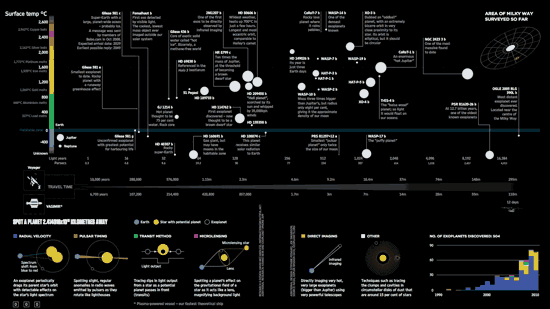
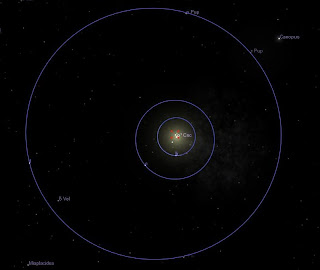
Three years later the first exoplanet was confirmed, and the current count stands at 677. Exoplanets visualized at "Data is Beautiful" for Wired. It's not the first time a pundit has been wrong, after all the philosopher Auguste Comte claimed that we would never know the composition of the stars, yet 25 years later the spectroscope revealed the elements they were made of (and in 1814 Frauenhoffer had seen the spectral lines that would reveal the stars secrets when chemistry improved). But it's not the fact the Dembski was wrong (or Paul Nelson, who quoted him approvingly in 1993), but the way that they were wrong. The claim is that "Darwinists" posited a plethora of worlds to fulfil the needs of evolutionary theory, without any strong evidence. Yet Dembski and company couldn't be more wrong. The 55 Cnc system (excluding the outermost planet), 55 Cnc e is marked by the red cross near the sun. Note that Dembski says "nor is there currently any compelling theory of planetary formation which guarantees that the observable universe is populated with planets". You might think this hedges his bets a bit, with the qualifications "compelling" and "guarantees", but it doesn't By the 60's the dominant theory of planetary formation was a variant of the nebular hypothesis, which with further modification became dominant in the 1970's. It was abundantly obvious even in the 60's that the implication of this hypothesis was that planet formation would not be a rare event (for example the RAND corporation study "Habitable Planets for Man" published in 1964 used this model as a basis for estimating the number of stars with planets). Then there was stellar rotation. In the solar system, most of the angular momentum is in the planets, and the sun has most of the mass but just a fraction of the angular moment momentum because during planet formation the momentum of the spinning protostellar disk is transferred to the planets. Most sun-like stars have angular momentum like the Sun's suggesting that the majority of these systems had planets. Dust disk and exoplanet around Beta Pictoris, image source, Wiki Commons.. Observations in the early 80's of dusty disks around young T-Tauri stars and then dust disks around stars like Beta Pictoris were in line with the nebula hypothesis and strengthened the case that planets were common. George Wetherill's classic paper "The Formation and Habitability of Extra-Solar Planets" did not come out until 1996, but his work in 1988, 19989 and 1991 on planet formation made scientists confident that solar system equivalents were not rare in the galaxy. Certainly, when Dawkins published "the Blind Watchmaker" in 1986, there was a compelling theory of planetary formation, along with astromomical observations which guaranteed that there would be planets around other suns. When Dembski wrote his words in 1992, astronomers were busy designing the very instruments that would reap a harvest of extrasolar planets just a few years later. Dembski was trying to claim that "Darwinists" make things up to bolster their arguments. Yet Dembski was doing what he criticised "Darwinists" for. If he had taken a few moments to read the astronomical literature, or even asked an astronomer, he could not have made his statement. Based on the Kepler data of 2010, we can say that around 50% of Sun-like stars have planets, and there may be at least one million Earth-like planets in habitable zones in the Milky-Way alone. And that is probably an underestimate. Some good resources are the Exoplanet encyclopaedia, Exoplanet.org (with the exoplanet data plotter) and the Habitable Zone as well as my posts on exoplanets. UPDATE: NASA's big announcement was a planet orbiting a binary star, a bit like Tatooine, if Tatooine was a frigid gas giant. It could have a habitable Moon though. Evolution News and Views posted a response to this article, my response is here.
70 Comments

jlesow · 14 September 2011

I would be more optimistic if we found lots of Jupiter like planets in Jupiter like orbits.

Ian Musgrave · 14 September 2011

Well, we'd have to wait around 33 years to confirm a Jupiter size object in a Jupiter like orbit (usually 3 orbits are needed for confirmation), still the new data have a lot more small objects in more solar-system like orbits, hot Jupiters no longer dominate (try playing with the plotter for an idea of the size distributions)

harold · 14 September 2011

The expected frequency of other planets in the universe with something we would recognize as life is given by -

A) (Number of planets in the universe we can observe sufficiently closely to see if what we can recognize as life is there)

Multiplied by

B) (Probability that life has ever existed on such a planet, up to time of human observation)

Multiplied by

c) (Probability that if life ever was present, life, or definitive remnants of life, are still present at time of human observation).

Currently, we have crude but improving estimates for "A)" but no estimates at all for "B)" or "C)".

If "A" is large, then the expected frequency is large, unless B*C is very small, but since we have no estimates for "B" or "C", that is not very meaningful.

The only way we can gain good estimates for "B" or "C" is by either finding life enough times to have a fair sample that we can generalize from, or by coming up with some kind of model of abiogenesis that is so good that it allows some kind of reasonable estimate of one or both of these parameters.

If we do find recognizable life and survive doing so, that will falsify many claims made by DI types, but they will simply deny having made those claims, and argue that the new life is "more evidence for design" (with the implied agenda - "and evidence for design is proof that the United States must be transformed into a brutal authoritarian theocracy with a harsh economic system that produces third world conditions").

harold · 14 September 2011

Correction.
A) (Number of planets in the universe we can observe sufficiently closely to see if what we can recognize as life is there) Multiplied by B) (Probability that life has ever existed on such a planet, up to time of human observation) Multiplied by c) (Probability that if life ever was present, life, or definitive remnants of life, are still present at time of human observation).
Actually, if we had good numbers for parameters "B" and "C", we wouldn't have to observe the planets to come up with an estimate of the frequency of observable life in the universe, just count them and multiply that number by B and C. However, the most obvious way to come up with numbers for "B" and "C" is by observing a sample of planets and seeing how many have life. If enough life is observed to form a sufficient sample, we could then conclude that B*C = (number of planets observed)/(number we saw evidence of life on). The indirect method of coming up with an estimate of B*C via a highly precise model of abiogenesis is also unlikely to occur any time soon.

harold · 14 September 2011

Aargh.
However, the most obvious way to come up with numbers for “B” and “C” is by observing a sample of planets and seeing how many have life. If enough life is observed to form a sufficient sample, we could then conclude that B*C = (number of planets observed)/(number we saw evidence of life on)
Of course that should be "(number of planets with life)/(total number observed for life)", not the other way around.

jlesow · 14 September 2011

The prevalence of big planets in close orbits seems, at face value, to rule out earth like planets in suitable orbits. I'm no astronomer, but current theories suggest that you need a Jupiter to sweep and stabilize a system for earth like planets.

It's not like we really know for sure.

But it's wonderful to be learning stuff like this. I've always been a science futurist, at least since the late 50s. Two really big things I never, never anticipated happening in my lifetime: Genetic engineering, and discovery of planets outside our solar system.

dalehusband · 14 September 2011

Ian Musgrave said: Well, we'd have to wait around 33 years to confirm a Jupiter size object in a Jupiter like orbit (usually 3 orbits are needed for confirmation), still the new data have a lot more small objects in more solar-system like orbits, hot Jupiters no longer dominate (try playing with the plotter for an idea of the size distributions)
You think maybe that's why we see so many giant worlds in tiny, fast orbits around stars? Because our methods of observation are biased in favor of such things? What about all the exoplanets as small as Earth, or as long orbiting as Jupiter, that we cannot confirm, or even detect yet?

https://www.google.com/accounts/o8/id?id=AItOawkDp_xo0moKWxtwldHdblYB7LXvm8qaRoo · 14 September 2011

Ah yes, the Habitable Zone. A concept introduced by astronomer Guillermo Gonzalez, Senior Fellow of the Discovery Institute's Center for (pseudo) Science and (faux) Culture.

Apparently still pursuing academic freedom at Grove City College, although not so much in the spotlight anymore.

https://me.yahoo.com/a/JxVN0eQFqtmgoY7wC1cZM44ET_iAanxHQmLgYgX_Zhn8#57cad · 14 September 2011

One wonders how William Dembski feels after proclaiming in 1992:
“Dawkins, to explain life apart from a designer, not only gives himself all the time Darwin ever wanted, but also helps himself to all the conceivable planets there might be in the observable universe (note that these are planets he must posit, since no planets outside our solar system have been observed, nor is there currently any compelling theory of planetary formation which guarantees that the observable universe is populated with planets)”
Probably he feels as angry as ever that he isn't acknowledged as the Isaac Newton of information theory by the infidels. I'm wondering if any of them ever feels anything but anger and disappointment that their genius isn't recognized by, well, the educated segment of the population that jeers at them. They are, after all, the ones that they care about, not the slackjawed dolts that really are impressed by their intellect. Glen Davidson

https://me.yahoo.com/a/JxVN0eQFqtmgoY7wC1cZM44ET_iAanxHQmLgYgX_Zhn8#57cad · 14 September 2011

I would note, too, that the press conference likely is being staged in part to keep Kepler funded. Star variability has been found to be greater than expected, which makes finding planets in longer orbits more difficult during the time period thus far allotted to Kepler's operation. Missions have often been able to expect to be extended so long as the instruments are working well and the work is deemed reasonably important, but in this time of tight budgets it's not so certain that Kepler will continue.

If they managed to get an especially tantalizing find, this will make the needed mission extension more probable.

Glen Davidson

rossum · 14 September 2011

George Wetherill’s classic paper “The Formation and Habitability of Extra-Solar Planets” did not come out until 1996, but his work in 1988, 19989 and 1991 on planet formation made scientists confident that solar system equivalents were not rare in the galaxy.
When is his paper on time machines coming out, or hasn't it been translated from the Sumerian yet?

Nick Matzke · 14 September 2011

https://www.google.com/accounts/o8/id?id=AItOawkDp_xo0moKWxtwldHdblYB7LXvm8qaRoo said: Ah yes, the Habitable Zone. A concept introduced by astronomer Guillermo Gonzalez, Senior Fellow of the Discovery Institute's Center for (pseudo) Science and (faux) Culture. Apparently still pursuing academic freedom at Grove City College, although not so much in the spotlight anymore.
I'm pretty sure that what ID types claim is that Gonzalez introduced the "Galactic Habitable Zone", not the solar system habitable zone, which has been around for decades. I don't know the current scientific status of the "Galactic Habitable Zone" -- it actually explicitly depends on naturalistic theories of planetary formation to make any sense at all. And if e.g. non-sun-like stars (like red dwarfs) produce habitable planets, then that may have changed the ballgame.

Karen S. · 14 September 2011

This is all so cool.

Mike Elzinga · 14 September 2011

Whenever Dembski and any other ID/creationists make comments like that one, it is blatantly obvious they are just blowing smoke and trying to sound like they are the “most interesting men in the world.”

But physics and chemistry are the simplest of the scientific disciplines; and math is the basic tool used by these disciplines. If ID/creationists constantly mangle these basics whenever they make their pompous proclamations about what can or cannot be in geology, astrophysics and biology, then there is no hope that they can understand anything that happens in these fields that deal with systems of greater complexity.

And then we have these pretentious pseudo-philosophers like Stephen Meyer inventing “philosophical” rationalizations for why ID/creationism should have equal or higher scientific status than science itself.

These people have constructed pseudo-history, pseudo-philosophy, and pseudo-science as a complete package that all locks together with their sectarian pseudo-religion; and they are now pushing it through pseudo-universities and attempting to enforce it all with the socio/political actions of extreme, well-funded Right Wing organizations.

It’s easy to laugh at this stuff when one understands just how ludicrous it all is. But the fact that so many people are still fooled by this crap makes in not so funny.

richardpenner · 14 September 2011

Is there a working definition of "pseudo-philosophy" ? Pseudo-mathematics is all bound up in "ain't it cool" and claims of numbers having extra-mathematical significance and disregard of even primitive concepts of proof. Pseudo-science is about aping the language and appearance of science without a fundamental intellectual honesty about bringing hypotheses into confrontation with experiment. Both pseudo-mathematics and pseudo-science attempt to usurp the authority of reliable mathematics and science for an individual's claims.

But, as I am acquainted only with David Berlinski's ridiculous attempt to be portrayed with steepled fingers and reclining in a couch while making pretentious claims about what I do and do not know, I don't understand the difference between pseudo-philosophy and the benefits of philosophy.

Aristotle's reputation as a philosopher and his rejection of empiricism cause me to wonder where the dividing line is, since I have a hard time dividing intellectual honesty from empiricism.

eric · 14 September 2011

Looks like its Baghdad Bob time for the discoveroids again. There are no exoplanets! I meant no rocky exoplanets! I meant no rocky exoplanets in the habitable zone! I meant no rocky exoplanets in the habitable zone with detectable atmospheres! I meant no rocky planets in the habitable zone with detectable atmospheres and detectable signs of life...
richardpenner said: But, as I am acquainted only with David Berlinski's ridiculous attempt to be portrayed with steepled fingers and reclining in a couch while making pretentious claims about what I do and do not know, I don't understand the difference between pseudo-philosophy and the benefits of philosophy.
I think creationists do the same thing with philosophy as they do the natural sciences. I.e., attempt to ape/fake/impersonate its structures and activities so as to lend false academic credibility to their theology. They don't do philosophy or science, so much as they do 'philosophy theater' and 'science theater.'

Paul Burnett · 14 September 2011

Mike Elzinga said: These people have constructed pseudo-history, pseudo-philosophy, and pseudo-science as a complete package that all locks together with their sectarian pseudo-religion; and they are now pushing it through pseudo-universities and attempting to enforce it all with the socio/political actions of extreme, well-funded Right Wing organizations.
Don't forget to mention pseudo-history. The Willie Dembski of pseudo-history is the pseudo-historian David Barton, the subject of Liars For Jesus, Chris Rodda's book about the religious right's alternate version of American history - see http://www.liarsforjesus.com/

DavidK · 14 September 2011

I think Gonzalez is not the originator of that term. It was a concept frequently used when discussing life on earth and its position between Venus and Mars, kinda like the three bears, we were in the just right zone. He doesn't deserve creadit for using this term, sorry.

Matt G · 14 September 2011

richardpenner said: Is there a working definition of "pseudo-philosophy" ?
Theology?

Ian Musgrave · 14 September 2011

dalehusband said:
Ian Musgrave said: Well, we'd have to wait around 33 years to confirm a Jupiter size object in a Jupiter like orbit (usually 3 orbits are needed for confirmation), still the new data have a lot more small objects in more solar-system like orbits, hot Jupiters no longer dominate (try playing with the plotter for an idea of the size distributions)
You think maybe that's why we see so many giant worlds in tiny, fast orbits around stars? Because our methods of observation are biased in favor of such things? What about all the exoplanets as small as Earth, or as long orbiting as Jupiter, that we cannot confirm, or even detect yet?
Yes, that is definitely why. We are biased towards finding hot Jupiters because they are very easy to find. The newer surverys (Kepler, HARP, MOST) with longer observing arcs are finding more and more low mass planets in more solar system like steups (again, see the plotter link for a better idea of the distribution of planet sizes now). We now have a huge harvest of Neptune-like worlds that we could never see before. Even so, finding earth-sized worlds at eath orbital distances reamins a challenge, and we really need newer scopes for this.

Ian Musgrave · 14 September 2011

https://www.google.com/accounts/o8/id?id=AItOawkDp_xo0moKWxtwldHdblYB7LXvm8qaRoo said: Ah yes, the Habitable Zone. A concept introduced by astronomer Guillermo Gonzalez, Senior Fellow of the Discovery Institute's Center for (pseudo) Science and (faux) Culture.
The Habitable Zone is a concept dating back to at least the 60's (again, see the RAND paper on this), and was more completely formulated by Kasting in the 80's. While Gonzalez did make the concept of "'Galactic Habitable Zone" more widely known, even this was foreshadowed by th book "Rare Earth", which suggested that life was common in the galaxy, but planets hosting complext metazoans were relatively rare.

jandmkidder · 14 September 2011

What I don't understand is why anyone would have thought that there WOULDN'T be planets around some of these stars. It stands to reason that if our star has orbiting planets, there would be other planets out there.

Ian Musgrave · 14 September 2011

jlesow said: The prevalence of big planets in close orbits seems, at face value, to rule out earth like planets in suitable orbits. I'm no astronomer, but current theories suggest that you need a Jupiter to sweep and stabilize a system for earth like planets.
No, not really. It's been hypothesized that we need jovians in a Jupiter-like orbit to stop frequent mass-extinction impacts, but terrestrail plantes in terrestrial orbits should form just fine. Super-Jupiters are no-longer the prevalent planet type, as we rack up more exoplanets (and exoplanetary solar systems), and it is possible for Earth-like worlds to form bejhind a hot Jupiter. As we get more data, and surveys with newer telescopes are completed, we will have a better idea.

Ian Musgrave · 14 September 2011

jandmkidder said: What I don't understand is why anyone would have thought that there WOULDN'T be planets around some of these stars. It stands to reason that if our star has orbiting planets, there would be other planets out there.
This depends on how planets form. If the "stellar close encounter" theory was right, and planets formed from material drawn out after near-collisions between stars, planets would be very rare. But in this case, when the dominant theory had been established (with modifications of increasing sophistication) for decades, Dembski and co would just have to be plain ignorant to not know of it.

fnxtr · 14 September 2011

Gotta say I agree with Karen S., this is like 27 kinds of awesome. :-)

386sx · 14 September 2011

jandmkidder said: What I don't understand is why anyone would have thought that there WOULDN'T be planets around some of these stars. It stands to reason that if our star has orbiting planets, there would be other planets out there.
He's probably being ornery. We don't need no stinkin planets. Get offa my lawn stinkin planets. *grumble* Planets didn't come from no damn monkeys. Lol. He's just being his professional denialist and science stopping self as usual.

fnxtr · 14 September 2011

It is now obvious that Earth is the only planet in the universe that is capable of accepting light and solar energy from the sun. The sun is aimed directly at us only. It bypasses Venus, Mercury, Uranus and all those other planets closer to the sun--they receive nothing. They deserve nothing. These planets are useless to us. They are only in the way. We must use our nuclear weaponry and laser beams to destroy them. I'm sick of the universe getting in my way all the time. --Zoogz Rift (The Liquid Moamo)

richardpenner · 14 September 2011

richardpenner said: But, as I am acquainted only with David Berlinski's ridiculous attempt to be portrayed with steepled fingers and reclining in a couch while making pretentious claims about what I do and do not know, I don't understand the difference between pseudo-philosophy and the benefits of philosophy.
eric said: I think creationists do the same thing with philosophy as they do the natural sciences. I.e., attempt to ape/fake/impersonate its structures and activities so as to lend false academic credibility to their theology. They don't do philosophy or science, so much as they do 'philosophy theater' and 'science theater.'
Ah! So the critical element is acting. Thank you.

Roger · 15 September 2011

fnxtr said:

It is now obvious that Earth is the only planet in the universe that is capable of accepting light and solar energy from the sun. The sun is aimed directly at us only. It bypasses Venus, Mercury, Uranus and all those other planets closer to the sun--they receive nothing. They deserve nothing. These planets are useless to us. They are only in the way. We must use our nuclear weaponry and laser beams to destroy them. I'm sick of the universe getting in my way all the time. --Zoogz Rift (The Liquid Moamo)

Is he a Discovery Institute fellow too?

stevaroni · 15 September 2011

Ian Musgrave said: Yes, that is definitely why. We are biased towards finding hot Jupiters because they are very easy to find. - snip - finding earth-sized worlds at earth orbital distances reamins a challenge, and we really need newer scopes for this.
The important point - at least for the proximate discussion - is that we find these planets at all. I've never quite understood why Christian theology insists that there are no worlds other than earth - after all, my copy of the Bible doesn't say "And the lord sayeth 'I have no interests other than this small planet'". Nonetheless, they do insist we are unique and alone. End of story. And yet, as soon as our ability to detect other worlds develops, we immediately find things. All the way back to Galileo spotting the moons of Jupiter with his first telescope. As soon as we could seek, yea did we findeth. They were there all the time. Once again fundamentalist cosmology is demonstrated to be wrong the moment it becomes possible to actually run the test.

Rolf · 15 September 2011

I’ve never quite understood why Christian theology insists that there are no worlds other than earth - after all, my copy of the Bible doesn’t say “And the lord sayeth ‘I have no interests other than this small planet’”.

If all he wanted was a planet to toy with, even to the absurdity of selecting just one tribe as his 'chosen people', why bother with creating this vast universe that needed 13 billion years before producing his tribe? Or was that just an afterthought?

Torbjörn Larsson, OM · 15 September 2011

Thanks for the tip on the interesting press conference! Finding terrestrials in the habitable zone and detecting atmospheric imbalances in those that shouldn't have any will help constrain anvironments conducive for abiogenesis.
harold said: B) (Probability that life has ever existed on such a planet, up to time of human observation) Multiplied by c) (Probability that if life ever was present, life, or definitive remnants of life, are still present at time of human observation). Currently, we have crude but improving estimates for "A)" but no estimates at all for "B)" or "C)".
harold said: The indirect method of coming up with an estimate of B*C via a highly precise model of abiogenesis is also unlikely to occur any time soon.
As a rather fresh student of astrobiology, I don't think that is the facts. There are estimates, if not generally accepted, and they don't rely on precise models of abiogenesis. These estimates rely on dropping the facile idea of Monod as describing the process in terms that I can only interpret as a phase space portrait of a dynamical process, a small phase space volume of "a freak accident" possibly revisited on many exoplanets. Instead it is treated as a bona fide stochastic process, which may be informative on its occurence and deterministic properties. And with modern data on early first observed occurence of life, this can be done. Not to review the literature thoroughly, but Carter proposed a step model for evolution of ETI already 1983 that allow for observing its properties. [Carter, B. (1983), "The anthropic principle and its implications for biological evolution." Philos. Trans. R. Soc. Lond., A 310, 347–363.] Considering abiogenesis more precisely, Lineweaver and Davis proposed a Las Vegas model. ["Does the Rapid Appearance of Life on Earth Suggest that Life Is Common in the Universe?", Astrobiology, 2002.] Possible recurrence of abiogenesis sets a lower bound of ~ 13 % @ 95 % confidence. Watson improved on Carter's model by equating steps with evolutionary transitions. ["Implications of an Anthropic Model of Evolution for Emergence of Complex Life and Intelligence", Astrobiology, 2008.] He concluded that Lineweaver et al result is an overestimate. And Spiegel and Turner [ST] published a bayesian model of abiogenesis this year. ["Life might be rare despite its early emergence on Earth: a Bayesian analysis of the probability of abiogenesis", PNAS.] They support Watson's analysis. Now I think ST have made some mistakes. They don't allow for competing processes, but assume unrealistically only one pathway allowed. The basic model they start from I had already used as a toy model earlier, and I think it is self-consistent as opposed to theirs: ------------- The conclusion is that the timeline of life may get us information. We observe that life on Earth didn't occur halfway in on the biosphere lifetime, which is estimated to be ~ 5 - 7 Gy. Let us try a stochastic model to see what we can get out of that. Abiogenesis, having probiotic chemistry evolve into protobiotic cellular life, could be a repeated process of attempts over time and locales. In the simplest stochastic model this belongs to the family of Poisson processes. Such processes stacks their probability mass early, due to their exponential distribution. A homogeneous Poisson process has P(T > t) = e- λt. This is a testable model. To simplify we use a normed distribution where observation time t = 1. Since this is a one-sided interval from t = 0, we want to have a set of distributions with at least 0.99 of the probability mass within the interval. The probability mass is expressed by the cdf (cumulative distribution function). Inserting into the Poisson cdf, we get F(t,λ) = 1 - exp(-t*λ) ≥ 0.99 → t*λ > 4.6. Now t = 1 corresponds to λ ~ 5. That means the normed waiting time T ~ 0.2. With actual time t* ~ 5 Gy we get actual waiting time T* ~ 1 Gy. With current understanding we have putative observations of life from ~ 3.8 - 3.5 Gy ago. Earth aggregated ~ 4.5 Gy ago, which means the interval gets close to the required ≤ 1 Gy. ------------------ Let us look at if such a model achieves what it set out to do. In principle a stationary process means a stationary mechanism in a stationary environment. This isn't what happened at the start, since volatiles were collected, temperatures and pressures going down and tectonics started. But since it *looks* stationary it means it was close to stationary in some stochastic sense, even if it was frustrated in actuality. In this sense the process was robust and the environment stable enough. Further smaller wait time, which could be even smaller if tectonics had allowed observation, means that there were many parallel attempts. Larger wait time considered above means deterministically either fewer attempts over long time for some reason or fewer successful for some other. Both is indicative of deterministic difficulty. Further as opposed to other situations in statistics there is no inherent problem with having just one data point, though it is lousy as an estimate. This is informative. [Leaving out a long discussion on caveats. =D] What could we learn? Let us assume that observations are good enough to push the model into testability, and a test is devised replacing the above rough estimate. - Abiogenesis looks simple and robust; it is modeled by a stationary Poisson process. - Abiogenesis looks easy and/or fast; a normed rate is high. - A habitable planet has a 36 % likelihood of being inhabited at 5 Gy age. After that the likelihood quickly raises to ~ 100 %; it is ~ 95 % at 7 Gy age. --------- In other words, the simplest possible statistical process models support Lineweaver et al claims (since it allows for repetition, competing but slower processes, et cetera). Life may be really easy to come by, at least if the current trend if early indicators of life stands up. And the model answers both your B) and C).

Karen S. · 15 September 2011

I’ve never quite understood why Christian theology insists that there are no worlds other than earth - after all, my copy of the Bible doesn’t say “And the lord sayeth ‘I have no interests other than this small planet’”.
Maybe fundie theology insists this but I'm fine with other worlds existing. In fact, I'm thrilled by these discoveries. And I don't see that it would a big deal for other mainstream Christians. Do you think only non-Christians panicked when War of the Worlds was broadcast?

harold · 15 September 2011

Tobjorn Larsson - To summarize, I said the expected number of planets with human-recognizable life (not "intelligent" life) would be A*B*C, where A is the number suitable of planets. B and C were...
B) (Probability that life has ever existed on such a planet, up to time of human observation) Multiplied by c) (Probability that if life ever was present, life, or definitive remnants of life, are still present at time of human observation). Currently, we have crude but improving estimates for “A)” but no estimates at all for “B)” or “C)
I mentioned that the most simplistic yet most empirically rigorous method of estimating B*C would be to look at a large sample of planets and see how often we observe life or remnants of life. If the sample were large enough, (number of planets with evidence life)/(number of planets observed) would be an estimate of B*C. Sadly, that method is not currently available. Just so everyone is clear, neither Tobjorn nor I is denying or asserting extra-terrestial life (although it's implicit in his argument that he favors that if would be relatively frequent); we're talking about estimating that probability that detectable evidence of life would be present on a planet at some given point in time, via models of abiogenesis. Tobjorn said -
Such processes stacks their probability mass early, due to their exponential distribution. A homogeneous Poisson process has P(T > t) = e- λt. This is a testable model. To simplify we use a normed distribution where observation time t = 1. Since this is a one-sided interval from t = 0, we want to have a set of distributions with at least 0.99 of the probability mass within the interval. The probability mass is expressed by the cdf (cumulative distribution function). Inserting into the Poisson cdf, we get F(t,λ) = 1 - exp(-t*λ) ≥ 0.99 → t*λ > 4.6. Now t = 1 corresponds to λ ~ 5. That means the normed waiting time T ~ 0.2. With actual time t* ~ 5 Gy we get actual waiting time T* ~ 1 Gy. With current understanding we have putative observations of life from ~ 3.8 - 3.5 Gy ago. Earth aggregated ~ 4.5 Gy ago, which means the interval gets close to the required ≤ 1 Gy
The statistical stuff here looks very straightforward and reasonable, but there is a key unstated assumption, and there are a couple of major simplifications (one of which you note), which may be acceptable, but which I will mention below. First I'll start by talking about the unstated assumption; perhaps that assumption will turn out to be correct, but perhaps not. The ONLY parameter in this model is time from planetary formation. The unstated assumption is we will be dealing with planets similar enough to earth that all the other variables can be considered approximately equivalent to whatever they are on earth. That is implicit in the use of time from formation as the only parameter needed to estimate the probability of current life. (For example, we wouldn't even apply this model to Saturn.) The simplifications are that 1) as Tobjorn mentioned, under this model, can occur more than once on the same planet - and is actually expected to, at a mean frequency of about once every billion years (however, this is not a huge deal, as our major question is "is there life at all") and 2) related, there is no life termination in this model - once life is there it is there.
- Abiogenesis looks simple and robust; it is modeled by a stationary Poisson process. - Abiogenesis looks easy and/or fast; a normed rate is high. - A habitable planet has a 36 % likelihood of being inhabited at 5 Gy age. After that the likelihood quickly raises to ~ 100 %; it is ~ 95 % at 7 Gy age. In other words, the simplest possible statistical process models support Lineweaver et al claims (since it allows for repetition, competing but slower processes, et cetera). Life may be really easy to come by, at least if the current trend if early indicators of life stands up. And the model answers both your B) and C)
Under the assumptions and simplifications inherent in this model.

eric · 15 September 2011

Karen S. said: Maybe fundie theology insists this but I'm fine with other worlds existing. In fact, I'm thrilled by these discoveries. And I don't see that it would a big deal for other mainstream Christians.
I think you are certainly right. I don't think there's much in the original theology about it one way or the other. The problem comes not with the theology but with people who claim to understand/speak for God. I.e. religious authority figures. Once you say the equivalent of "God's message is clear, I know what God is saying, and God says x," you pretty much have to defend x or your claim to know what God says is directly undermined. Whether you are the pope or Ken Ham or some other religious authority, if at some point in the past you claimed to know the earth is uniquely habitable based on scripture or revelation, you're pretty much stuck defending that belief. Because if you admit error, you are admitting there's no reason anyone should listen to you about God's message. I think that is the situation we are seeing here. Some religious authorities made early claims that the earth was uniuqely habitable, for instance as part of a fine tuning argument. And now they have to defend that claim or admit they don't understand God's message as well as they advertise.

harold · 15 September 2011

eric said:
Karen S. said: Maybe fundie theology insists this but I'm fine with other worlds existing. In fact, I'm thrilled by these discoveries. And I don't see that it would a big deal for other mainstream Christians.
I think you are certainly right. I don't think there's much in the original theology about it one way or the other. The problem comes not with the theology but with people who claim to understand/speak for God. I.e. religious authority figures. Once you say the equivalent of "God's message is clear, I know what God is saying, and God says x," you pretty much have to defend x or your claim to know what God says is directly undermined. Whether you are the pope or Ken Ham or some other religious authority, if at some point in the past you claimed to know the earth is uniquely habitable based on scripture or revelation, you're pretty much stuck defending that belief. Because if you admit error, you are admitting there's no reason anyone should listen to you about God's message. I think that is the situation we are seeing here. Some religious authorities made early claims that the earth was uniuqely habitable, for instance as part of a fine tuning argument. And now they have to defend that claim or admit they don't understand God's message as well as they advertise.
This is probably why creationist assertions are, in my experience, 100% associated with authoritarian tendencies. (Tiresomely, I'll need to bother to mention that I am not personally religious before I continue. Otherwise someone might think that, by criticizing creationists in a way that does not apply to all religious people, I am "saying something good about religion".) Implicitly, they claim to be the only true interpreters of what God says. But here's the key part - God doesn't get to change His or Her mind. They actually either see themselves as in command of God. God can't speak to a new prophet and say that gay marriage is fine going forward, for example. Literally, the official creationist theology stance is that "God got one chance to express himself, I get to interpret it in a self-serving way, and God now has to keep His mouth shut - no modifications, clarifications or mind-changing allowed". It's not even clear that God has any permission to act independently at all. Other than ill-aimed natural disasters, all his actions must be preceded by fundamentalist prayer - and they may well be constantly praying for him to smite the sinful with natural disasters, too, so even that may not be independent.

Karen S. · 15 September 2011

Harold,

You have described fundamentalism perfectly.

SLC · 15 September 2011

Actually, theories as to how planetary systems form have been around for some 400 years, starting with Swedenborg, Kant and Laplace in the 18th Century, which proposals were refined by von Weizsacker and Kuiper in the middle of the 20th century. As a matter of fact, if the theory they proposed is correct, then most stars, at least those that have only one component, should have planetary systems (planetary systems revolving around multiple star systems are generally unstable over long periods of time because of non-central forces). Dr. Dumbski merely demonstrated his ignorance of the history of astrophysics.

Torbjörn Larsson, OM · 15 September 2011

harold, tank you, I think that is a fair summary. I left out some caveats about the statistical nature of repeated successes (Lèvy processes, looks like Poisson close to such a generic situation), but post facto we see a universal tree that looks like 1 success. And as you note the process isn't stationary after success, but c'est la vie [sic!]. Life eats abiogenetic chemicals for breakfast, and today commandeer the CONSP circulation of CHONSP elements that mainly builds cells. I believe already Darwin realized that in some of his letters to friends, didn't he? Indeed the A) factor of number of habitable planets is the environment here or in the Drake equation. I should note here that under the model of testability that I use, at successful validation a testable model and its data is self-consistent, so what is commonly described as "assumptions" are tested with the theory. As you say, we couldn't then use this for non-habitable planets. These models usefulness (testability) revolves around the observation of early life. What is really interesting is the recent putative re-dating scenario of a late Earth-Moon system @ 4.36 Ga before present. Even if you use conservative observations of Strelley Pool Formation microfossils (Brasier et al) or stromatolites (Allwood et al) @ ~3.5 Ga bp you are currently closing the gap from both ends. ------------------------------- By the way, a late Earth-Moon really stresses the tentative timeline. Let me take the opportunity to recapitulate it in its most optimistic form to show why:

~ 4.55 Ga bp: Planet formation starts.

~ 4.04 Ga bp: Latest formation of 1st crust (Jack Hill zircons).

~ 4.36 Ga bp: Earth-Moon impactor.

~ 4.35 Ga bp: Latest presence of liquid water (Jack Hill zircons).

~ 4.31 Ga bp: Latest date for the first gene family (gene family clock).*

~ 4.28 - 4.25 Ga bp: Earliest putative trace fossils (potential earliest dating of the Nuvvuagittuq greenstone belt @ 4.28 Ga bp, unpublished data on a sulfur cycle; Jack Hill diamonds @ 4.25 Ga bp).

Since some researchers place Earth planet formation at ~ 30 Ma and Earth 1st crust formation at ~ 10 Ma, all these dates are possibly still consistent! Note that the Late Heavy Bombardment is survivable in recent models of the actual process, since cells proliferate and repopulate faster than all realistic impact rates can sterilize. Life is a plague on a planet. =D The current "best" estimate for abiogenesis time may be ~ 40 +30/-40 Ma. That is an order of magnitude less than needed to establish ease of abiogenesis without having to wait for astronomic observations of other biospheres.

-

* This is another toy model of mine. It derives from the (still early) work on fairly steady gene family event rate; sum of birth, transfer, duplication, loss. ["Rapid evolutionary innovation during an Archaean genetic expansion", David et al, Nature 2010.] It ranges from ~ 0.4 events/Ma to ~ 1.6 events/Ma. They assume a date for the LUCA (Last Universal Common Ancestor), from the trace record, of ~ 3.85 Ga. The model is self-consistent however, and accords with dates for end of Late Heavy Bombardment (the Archaean Expansion, AE) and atmosphere oxidation (electron transfer redox metabolism). Moreover, before the AE there is only a steady gene family birth rate. Let us assume that steady rate of ~ 0.4 events/Ma. Their LUCA is estimated to ~ 180 gene families. [Supplement fig 6.] (It is estimated that the LUCA had ~ 1 000 - 4 000 genes, comparable to todays prokaryote average.) This gives a latest date for the first gene family of ~ (4.55 - 3.85)*103 - 180/0.4 ~ 240 Ma from Earth accretion. Or ~ 4.31 Ga.

Torbjörn Larsson, OM · 15 September 2011

SLC said: planetary systems revolving around multiple star systems are generally unstable over long periods of time because of non-central forces
I think that is amended by Kepler and planetary formation models to "generally stable". Binary systems can have, and have, old planets too. But they have large zones where planets would be kicked out, eventually. Also notable is that multiplanet systems that tug at each other are stable over long periods. "Planet deniers" are in deep dodo now.

Torbjörn Larsson, OM · 15 September 2011

Torbjörn Larsson, OM said: Also notable is that multiplanet systems that tug at each other are stable over long periods. "Planet deniers" are in deep dodo now.
D'oh! That should be "multiplanet systems with _planets_ that tug at each other". (Though I assume any close systems now has an increased likelihood of longtime survival too.) And, doubly ironical on a biology site that ranges from matters fossil to fecal, it is "deep doodoo".

Dave Lovell · 15 September 2011

This article/paper suggests there is indirect evidence of the previous existence of planets of earth like composition from the emission spectra of their (now) white dwarf stars that have swallowed them up.

http://www.universetoday.com/88181/white-dwarf-stars-consume-rocky-bodies/

Or the full paper

http://arxiv.org/pdf/1108.1565v1

Torbjörn Larsson, OM · 15 September 2011

Torbjörn Larsson, OM said: Binary systems can have, and have, old planets too. But they have large zones where planets would be kicked out, eventually.
In fact, I'm listening on the press conference, and it concerns Kepler-16 b as a confirmed circumbinary planet. Dunno its age.

Rolf · 15 September 2011

Life is a plague on a planet. =D

OT, but I've got to say it: Intelligent life is the greatest of plagues... But my hunch is that it is extremely rare, that's why SETI is so "quiet".

Mike Elzinga · 15 September 2011

ID/creationist have a habit of looking at excruciating details of evolutionary processes and attaching probabilities based on uniform random sampling to them. By doing this, they can make anything look impossible.

But one doesn’t have to look at such detail in order to learn what happens. One of the fundamental facts of nature is that matter clumps

In the case of gravitating matter that forms planets, one can simply calculate the self-gravitational potential energy of a sphere. This turns out to be

U = - (3/5) G M2/R

Where G is the gravitational constant, M is the mass, and R is the radius.

One can go farther and equate this to the kinetic energy of the molecules making up the sphere when the sphere is just at its melting point; and one can determine the minimum size of a planet made of whatever material is clumping.

Furthermore, one can use the virial theorem which says

<T> = - (1/2)<U>

for particles having gravitational interaction, to estimate the ignition temperatures for the fusion of gravitating matter.

This gets the big picture. Then one includes the outward radiation pressure and the cross-sections for the interactions of photons and neutrinos with matter to estimate the stable regime in which a star will burn, once fusion starts; and how long it will burn.

The main reasons that astrophysicists dig into the details of solar system formation is to learn the details about the distributions of matter within an entire clumping system. Our particular solar system provides a single data point on what can fall out of such clumping.

But just because life exists within a particular region of this solar system doesn’t mean that there can’t be literally billions of other clumping systems that also produce living systems of some sort.

ID/creationists commit the usual “lottery winner” fallacy when demanding that our solar system be THE targeted formation that is impossible to achieve. This fallacy is a fundamental tool in the “arguments” that they use against any science whatsoever.

They also don’t seem to know that technology continues to advance and that the current technology for detecting and characterizing exoplanets is very recent.

John · 15 September 2011

Regarding the existence of a "galactic habitable zone", Nick, at least from a DI perspective, I think it might be a worthy chapter to a potential textbook on Klingon Cosmology that Dembski and Behe ought to be writing, not their mendacious pseudoscientific crap.

DavidK · 15 September 2011

Another factor to consider regarding this so-called "habitable zone." It is based on the existence of earth type life, and primarily humanoid at that. There is no factor in any equation to deal with forms of life that do not require an earth-like environment. That is one primary reason that NASA gets excited about Mars, and satellites like Europa, etc. We tend to get so hung up on the image of us, especially fundamentalists, for whom this whole universe was made, or so they claim. Talk about egos.

DavidK · 15 September 2011

Speaking of which, I just ran across this item:

Scientists Take First Step Towards Creating 'Inorganic Life'

http://www.sciencedaily.com/releases/2011/09/110915091625.htm

raven · 15 September 2011

William Dembski: The implications of intelligent design are radical in the true sense of this much overused word. The question posed by intelligent design is not how we should do science and theology in light of the triumph of Enlightenment rationalism and scientific naturalism. The question is rather how we should do science and theology in light of the impending collapse of Enlightenment rationalism and scientific naturalism. These ideologies are on the way out…because they are bankrupt.
William Dembski being wrong is nothing new. Years ago he proclaimed the end of the Enlightenment and science. Neither have collapsed. What is dying is US xianity which lost 1.5 million members last year and his cult, the SBC. He was also wrong about UT ecologist, Eric Pianka. He turned him into the FBI as a terrorist. Eric Pianka is still at UT. Now he's wrong about exoplanets too. Really, we can say with high confidence that Dembski is wrong about just about everything he has ever said or done. Not much to show for a life IMO.

Paul Burnett · 15 September 2011

I'm surprised nobody's mentioned this yet, but Mormons believe in multiple planets, where a good Mormon can become a god to their own planet of humans. "Mormon cosmology teaches that the Earth is not unique, but just one of many inhabited planets..." - http://en.wikipedia.org/wiki/Mormon_cosmology#Other_worlds_and_extraterrestrial_life

xubist · 16 September 2011

Given the known fact that the Bible has passages for every topic and every occasion, it shouldn't surprise anybody that there's at least one passage in Scripture which can easily be interpreted as saying that there's lots of planets inhabited by sentient life: "And other sheep I have, which are not of this fold: them also I must bring, and they shall hear my voice; and there shall be one fold, and one shepherd." (John 10:16)

Ron Okimoto · 16 September 2011

Mike Elzinga said: Whenever Dembski and any other ID/creationists make comments like that one, it is blatantly obvious they are just blowing smoke and trying to sound like they are the “most interesting men in the world.”
It is only an obfuscation argument. ID doesn't depend on it. The space alien designer bullshit that Dembski touts as being the most scientific ID assertion would actually want more habitable planets in order to create the space alien creators. These guys can't even be consistent with their own lies.

Torbjörn Larsson, OM · 16 September 2011

Fortuitously, a reading of Dynamic of Cats updates on an ongoing planetary conference, I caught up with the situation in the multistellar exoplanet field (not a direct interest of mine) as well as Kepler's last data release.

In posts and comments, Sigurdsson points out that the now released Kepler-16b is only the the second verified circumbinary planet discovered. Earlier detections, that I was vaguely remembering, remains as unconfirmed: HW Virginis, DP Leonis, HU Aquarii, NN Serpentis, and UZ Fornacis. (Also, I assume there are some systems to add to the multistellar count where the other stars orbits far out.)

While I don't have an age of Kepler-16b yet and so don't know how long it has been stable, the first known circumbinary is very old: PSR B1620-26 b, the 'Methusaleh' planet or the oldest known one! The neutron pulsar and white dwarf stars, and the planet orbiting some 23 AU out, are nearly as old as the universe at 12.7 Ga age.

Since we are discussing how erroneous anti-scientists can be, Kepler's latest data release of 1781 exoplanet candidates is claimed to be, as (# of candidates)x(# of planets in system):

~ 1500x1, 218x2, 75x3, 25x4, 8x5, 2x6, 0x7, (Sun)x8.

I'm putting our system in there for fun, it should be weighted in appropriately.

But likely some of the multi-planet candidates have Mercury sized bodies too. Or rather, if we would put Sun in that list, it would place at 6 planets (Mercury and Mars are hard targets).

Either way, our system doesn't look unique anymore.

I read on Planetary Society blog that the current best hypotheses for the Pluto-Charon system is an impactor (and for Deimos-Phobos-equatorial very elliptical impact scars-Mars too), so even the Earth-Moon system is with precedent now.

Torbjörn Larsson, OM · 16 September 2011

About habitable zones, they are like the species concept, helpful tools but rather fuzzy.

In fact, I think I read in the flurry of articles after the Kepler release that since planetary system evolution are so dynamic (and certainly planet and atmosphere evolution too!), it looks like eventually some more dynamic concept will modify or replace it.

A stellar or galactic habitable zone are heuristic in the way they take a known working biosphere and extrapolate the necessary conditions in a perturbation analysis, what we can change and still have conditions for life as we know it.

It is strengthened though by some side facts. We have only observed one kind of life which is biochemically based. And the conditions for habitability of cellular life is maximized (maximal productivity) for the temperate region of a liquid environment (100 % moisture, 20-40 degC). In that regard it should be a good start for a search for other biospheres.

It bears here, as it is a popular idea among those who a priori wants to see us as unique, to note that the galactic habitable zone concept could be blown wide open by a reconciliation between Kepler and Harps data. HARPS finds planets are much more frequent than Kepler, maybe 2-3 times as many. The answer seems to lie in that there are two different types of superEarth populations, hard core terrestrials and fluffy gas planets, and different methods have different bias on those.

And AFAIU these terrestrials doesn't seem to follow the metallicity trend seen in other planet populations. (They likely form in different ways, and metallicity of the protoplanetary disk could affect these differently.) I wish I had ready references, but these last weeks have been crazy with new observations and hypotheses, and a layman has only so much time...

Terrestrials can potentially be as numerous regardless of the star's metallicity. If that is so, the idea of a GHZ becomes restricted to preclude regions with too much environmental radiation (perhaps the core regions and some other dynamical areas that comes and goes), I think. The other conditions would be satisfied with the SHZ.

harold · 16 September 2011

Of course, all of this raises questions about the definition of what we could hypothetically recognize as life.

Here on earth, biology concerns itself with cellular life, viruses which are dependent on and seem to have descended from cellular life (if there ever were virus-like pre-cellular replicators, they are now long extinct or undetectable and current viruses all depend on cellular life in a parasitic fashion), and things that interact with cellular life and viruses.

Cell Theory is one of the stronger theories in biomedical science. http://en.wikipedia.org/wiki/Cell_theory.

There is a wide gap between self-replicating molecules in solution and a living cell.

At least the following seem to be characteristic of all living cells -

1) Multi-layer membranes with transmembrane proteins.

2) Maintenance of different intracellular and extracellular ionic concentrations via membrane proteins. This is less well-studied in prokaryotes, for a variety of reasons, but is implicitly likely to be an important early aspect of life. Models of cells that lack this can probably be conceived but it is now associated with very basic processes.

3) Some sort of protein cytoskeleton - once better characterized in eukaryotes but now unequivocally present in prokaryotes. http://en.wikipedia.org/wiki/Prokaryotic_cytoskeleton

4) The full component of DNA genome and all RNA types and enzymes involved in DNA replication, transcription, and translation.

5) The preference for L-enantiomers of amino acids.

All of these features seem to be present in all terrestrial cells, so the ultimate dream of abiogenesis focused on terrestrial life would probably be a model that accounted for how all of them could arise, and how pro-cells might be able to survive without them. That is, a "simplest possible terrestrial cell" would seem to require all of these features, to be an example of modern cellular life.

So there are a lot of very, very interesting questions.

I'll bother to mention that "it's complicated so let's just say that it was all done by magic" is an anti-scientific attitude.

apokryltaros · 16 September 2011

harold said: I'll bother to mention that "it's complicated so let's just say that it was all done by magic" is an anti-scientific attitude.
Your statement needs to be quoted again. All Intelligent Design proponents make this claim (which is your textbook example of "appeal to ignorance"), yet, refuse to demonstrate how saying "it's magic" or "DESIGNERDIDIT" can promote science.

TomS · 16 September 2011

"There was a lot more to magic, as Harry quickly found out, than waving your wand and saying a few funny words." (Harry Potter and the Philosopher's Stone)

ID doesn't rise to the level of "magic" in describing the method used.

weldonelwood#ca23d · 16 September 2011

Rolf said:

Life is a plague on a planet. =D

OT, but I've got to say it: Intelligent life is the greatest of plagues... But my hunch is that it is extremely rare, that's why SETI is so "quiet".
Its an interesting topic. Other possible reasons SETI is quiet is that not all intelligent species will necessarily develop a technological civilization, and technological civilizations may have short life spans. Ours might yet destroy itself within the next century.

FL · 16 September 2011

Based on the Kepler data of 2010, we can say that around 50% of Sun-like stars have planets, and there may be at least one million Earth-like planets in habitable zones in the Milky-Way alone

And now, it's time for the interstellar reality check. Consider well:

Among Darwin Advocates, Premature Celebration over Abundance of Habitable Planets Evolution News and Views, September 16, 2011 http://www.evolutionnews.org/2011/09/among_darwin_advocates_prematu050871.html

FL

apokryltaros · 16 September 2011

FL said:

Based on the Kepler data of 2010, we can say that around 50% of Sun-like stars have planets, and there may be at least one million Earth-like planets in habitable zones in the Milky-Way alone

And now, it's time for the interstellar reality check. Consider well:

Among Darwin Advocates, Premature Celebration over Abundance of Habitable Planets Evolution News and Views, September 16, 2011 useless spam link redacted

FL
Where in the Bible does it say that life is forbidden to appear outside of the Earth?

apokryltaros · 16 September 2011

Also, FL, tell us how Intelligent Design and Young Creationism help scientists find Earth-like planets?

And just for the record, tell us again why we should bother to trust the bobbleheads at the Discovery Institute say about science to begin with?

Ian Musgrave · 16 September 2011

FL said:

Based on the Kepler data of 2010, we can say that around 50% of Sun-like stars have planets, and there may be at least one million Earth-like planets in habitable zones in the Milky-Way alone

And now, it's time for the interstellar reality check. Consider well:

Among Darwin Advocates, Premature Celebration over Abundance of Habitable Planets Evolution News and Views, September 16, 2011 http://www.evolutionnews.org/2011/09/among_darwin_advocates_prematu050871.html

FL
Hey, that's sweet, EN and V noticed me. The completely failed to understand what I wrote though. And Gonzales kept on about the Super Jupiters, which, in the light of the Kepler and HARPS data, are tuning out to be not as common as the first data indicated. Also, with the sensitivity issues of even Kepler, we are STILL biased towards seen big planets in close orbits, more Solar system like systems are still hard to find, but heck, they keep turning up.

Dave Luckett · 16 September 2011

FL wouldn't know methodological bias from a hole in the ground. The propagandists of the DI might, but they make their living by lying to the ignorant, usually by omission - just like this. Because they're very good liars, they succeed wonderfully - right up to the moment when the facts rudely intrude. And then it all comes crashing down.

Dave Luckett · 16 September 2011

Oh, and Ian, they didn't "fail to understand" what you wrote. They deliberately mangled, misrepresented and mutilated it, and then they lied about what they'd done.

Mike Elzinga · 16 September 2011

ID/creationist theory of magnets:

Place two bar magnets randomly on a dinner plate. What is the probability that the magnets will be found end-to-end?

ID/creationist answer:

There are four ends to consider. So there are two ways one magnet can have its end lined up with the end of the other magnet, and since the other magnet also has two ends, there appears to be 4 possibilities at first glance. But it is not one chance in four because each magnet can have random orientations. So divide the circle of orientations into 360 x 10500 parts for each magnet.

Then there are (360 x 10500)2 possibilities for just orientation alone.

But there are also essentially infinite numbers of positions of the magnets on the plate; only a few of which would have the circles centered on and having the diameters of the magnets touching each other.

So the probability that the magnets will be found end-to-end is obviously much smaller than 10-500 therefore it is impossible that the magnets will be found end-to-end.

Eric Finn · 17 September 2011

Mike Elzinga said: ID/creationist theory of magnets: Place two bar magnets randomly on a dinner plate. What is the probability that the magnets will be found end-to-end?
So the probability that the magnets will be found end-to-end is obviously much smaller than 10-500 therefore it is impossible that the magnets will be found end-to-end.
I find your calculations on probabilities most convincing. Let me make a note on the fine-tuning of the universe for human life. It is well known that the electromagnetic interaction is vastly stronger than the gravitational interaction [1]. The electrostatic force between two protons outweighs the gravitational force by something like a factor of 1036. Both of these forces depend on the distance exactly the same way. Now, if electric charges were distributed randomly, it would be very unlikely, or even impossible, to have a stable and benign planetary system that we can enjoy. Only intelligent design can end up in a charge distribution, where virtually all matter is electrically neutral, as negative and positive charges are arranged close to each other. I do not even attempt to calculate the probability of this kind of arrangement taking place purely by change. Intelligent Design must be the answer. [1] http://en.wikipedia.org/wiki/Fundamental_interaction

SWT · 17 September 2011

Mike Elzinga said: ID/creationist theory of magnets: Place two bar magnets randomly on a dinner plate. What is the probability that the magnets will be found end-to-end? ID/creationist answer: There are four ends to consider. So there are two ways one magnet can have its end lined up with the end of the other magnet, and since the other magnet also has two ends, there appears to be 4 possibilities at first glance. But it is not one chance in four because each magnet can have random orientations. So divide the circle of orientations into 360 x 10500 parts for each magnet. Then there are (360 x 10500)2 possibilities for just orientation alone. But there are also essentially infinite numbers of positions of the magnets on the plate; only a few of which would have the circles centered on and having the diameters of the magnets touching each other. So the probability that the magnets will be found end-to-end is obviously much smaller than 10-500 therefore it is impossible that the magnets will be found end-to-end.
My heavens! I witnessed multiple miracles when I was a kid, and didn't even realize it! The Coulombist orthodoxy insists that some invisible "field" causes spontaneous alignment of the magnets, but magnets are subject to the same laws of probability as everything else; clearly, the probabilistic interpretation of the second law means that the magnets being end to end is thermodynamically impossible. Only an intelligent agent could overcome the entropic barrier. Why have I heard nothing of Intelligent Placement before?

apokryltaros · 17 September 2011

Ian Musgrave said: Hey, that's sweet, EN and V noticed me. The completely failed to understand what I wrote though. And Gonzales kept on about the Super Jupiters, which, in the light of the Kepler and HARPS data, are tuning out to be not as common as the first data indicated.
I get the distinct impression that their epic reading comprehension failure is an ability both instinctual and deliberately cultivated.

harold · 17 September 2011

apokryltaros said:
FL said:

Based on the Kepler data of 2010, we can say that around 50% of Sun-like stars have planets, and there may be at least one million Earth-like planets in habitable zones in the Milky-Way alone

And now, it's time for the interstellar reality check. Consider well:

Among Darwin Advocates, Premature Celebration over Abundance of Habitable Planets Evolution News and Views, September 16, 2011 useless spam link redacted

FL
Where in the Bible does it say that life is forbidden to appear outside of the Earth?
The real "Bible" for FL and his buddies is "whatever 'arguments against evolution' EN and V, AIG, WorldNetDaily, etc are pushing". Obviously, neither the theory of evolution nor the actual Bible say anything that denies the probability of life on other planets.

harold · 17 September 2011

Should be "possibility" not "probability". Late morning caffeine deficiency.