Why does your excellent web site have a photograph of a panda's head to illustrate your site's name?
I've seen a panda's head before, but I've never seen a panda's thumb, and I'd like to see one.
Please locate and post a photograph of a panda's paw that would show its thumb, at least in a blog post if not in your title area.
Thank you.
Ryan Cunningham · 2 March 2011
Left Coast Bernard said:
Why does your excellent web site have a photograph of a panda's head to illustrate your site's name?
I've seen a panda's head before, but I've never seen a panda's thumb, and I'd like to see one.
Please locate and post a photograph of a panda's paw that would show its thumb, at least in a blog post if not in your title area.
Thank you.
Haha. That was really funny. I hope they end up knowing each other a little better.
Eric
John Kwok · 2 March 2011
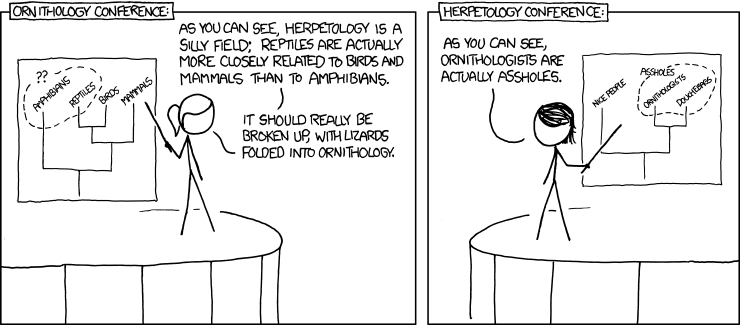
But I was wondering which of the cladograms were more parsimonious! There's not enough character traits to differentiate between the two!
Wheels · 2 March 2011
They should really call themselves ectothermotetrapodologists.
John Harshman · 2 March 2011
So why is there a herpetology? Did it just begin from leftovers, i.e. whatever the mammalogists and ornithologists didn't want? There seems no rational reason to connect the groups, except as a wastebasket discipline.
mrg · 2 March 2011
Aw, c'mon. Ichthyologists (doncha just love to spell that word?) cover both sharks and trout, but a trout is more closely related to us than it is to shark.
John Harshman · 2 March 2011
Ichthyology I can see; it's all about the water. And it's 99% teleosts anyway.
Jim Thomerson · 2 March 2011
As an ichthyologist, I twitch whenever some one points out there is no such thing as a fish. (Paraphyletic group, you know.)
Mike Elzinga · 2 March 2011
Jim Thomerson said:
As an ichthyologist, I twitch whenever some one points out there is no such thing as a fish. (Paraphyletic group, you know.)
And imagine the twitch one gets out of an electric eel.
Ravilyn Sanders · 2 March 2011
John Harshman said:
So why is there a herpetology? Did it just begin from leftovers, i.e. whatever the mammalogists and ornithologists didn't want? There seems no rational reason to connect the groups, except as a wastebasket discipline.
I think the was started by some 19th century gentleman of leisure with independent income who had an interest in snakes and he bought lots of frogs to feed them and ended up studying both. If there really was a Sir William Thorckmorton Herpeton I would be very very surprised.
Henry J · 2 March 2011
I can see why a person studying a type of life would pick subjects that are outwardly similar to each other, while skipping closer relatives that had evolved in some other direction.
mrg · 2 March 2011
Mike Elzinga said:
And imagine the twitch one gets out of an electric eel.
But ichthyologists are undeterred: "Damn the torpedoes, full speed ahead."
Ravilyn Sanders · 2 March 2011
Sorry to follow up to my own post.
Looks like this field had its origins in 1717 in Russia [1], way before systematic study of the biota. Linnaeus was just 10 years old [2] then. So looks like people just assumed reptiles and amphibians all belonged to the same "kind".
Well there's 30 minutes I'll never get back. It's as easy to lose track of time in there as it is in Celestia.
David · 2 March 2011
LOL. Having been a Curator of Herpetology (retired) at a large zoo for 20 or so years I have a couple of observations. Eventually, had fish and invertabrates added to my department because, "Well they're low and you already work with snakes and frogs." Working with low-lifes was apparently a qualification. The Director was a mammal guy. Go figure. Zoo conferences are different from academic conferences, in that a. they're mostly concerned about husbandry, genetics of small population management and conservation issues and b. all the taxonomic groups (few cladists in this diverse group)meet at the same veneu. Mixing indeviduals of diverse taxonomic interests can be intimidating to certain groups. We all would gravitate to the bar in the evening for the usual discussion of the day's dicoveries. The bird people fell asleep shortly after sundown. The mammal people lumbered off to rearrange the furniture in their rooms to acommodate their sense of place. The snake people, on the other hand, the sanke people would begin to move. With few words they would slither out on to the still warm streets of the city for adventure and phermone trailing. That was a long time ago and I've discovered that old zoo herpetologists behave like young ornithologists. David
John Harshman · 3 March 2011
I suppose that salamanders look a lot like lizards, and perhaps that might have been enough to draw in the outliers. Frogs certainly don't look much like snakes. But what a random way to construct a scientific discipline!
Steven J. Thompson · 4 March 2011
John Harshman said:
So why is there a herpetology? Did it just begin from leftovers, i.e. whatever the mammalogists and ornithologists didn't want? There seems no rational reason to connect the groups, except as a wastebasket discipline.
It's a classic parahomologous group, defined as all members of the tetrapods (at least, the recently extant ones) that have not evolved homeothermy. While frogs are fairly weird-looking, in general it's a group of cold-blooded, sprawl-legged tetrapods with (as I understand it) many clear anatomical homologies with one another that are distorted by extensive modification in birds and mammals.
From a pre-cladistic view, it's no weirder (just larger) than the traditional class "Reptilia." Of course, even from a pre-cladistic view, it's a bit weird to toss fish (itself, of course, a hopelessly paraphyletic group) into the mix.
22 Comments
Hector of Troy · 2 March 2011
LOL
Chris Lawson · 2 March 2011
Superb.
Randy · 2 March 2011
Just sent that to my old ornithology professor!
Reed A. Cartwright · 2 March 2011
The Amniote branch of the tree of life.
Left Coast Bernard · 2 March 2011
Why does your excellent web site have a photograph of a panda's head to illustrate your site's name?
I've seen a panda's head before, but I've never seen a panda's thumb, and I'd like to see one.
Please locate and post a photograph of a panda's paw that would show its thumb, at least in a blog post if not in your title area.
Thank you.
Ryan Cunningham · 2 March 2011
Eric Graham · 2 March 2011
Haha. That was really funny. I hope they end up knowing each other a little better.
Eric
John Kwok · 2 March 2011
But I was wondering which of the cladograms were more parsimonious! There's not enough character traits to differentiate between the two!
Wheels · 2 March 2011
They should really call themselves ectothermotetrapodologists.
John Harshman · 2 March 2011
So why is there a herpetology? Did it just begin from leftovers, i.e. whatever the mammalogists and ornithologists didn't want? There seems no rational reason to connect the groups, except as a wastebasket discipline.
mrg · 2 March 2011
Aw, c'mon. Ichthyologists (doncha just love to spell that word?) cover both sharks and trout, but a trout is more closely related to us than it is to shark.
John Harshman · 2 March 2011
Ichthyology I can see; it's all about the water. And it's 99% teleosts anyway.
Jim Thomerson · 2 March 2011
As an ichthyologist, I twitch whenever some one points out there is no such thing as a fish. (Paraphyletic group, you know.)
Mike Elzinga · 2 March 2011
Ravilyn Sanders · 2 March 2011
Henry J · 2 March 2011
I can see why a person studying a type of life would pick subjects that are outwardly similar to each other, while skipping closer relatives that had evolved in some other direction.
mrg · 2 March 2011
Ravilyn Sanders · 2 March 2011
Sorry to follow up to my own post.
Looks like this field had its origins in 1717 in Russia [1], way before systematic study of the biota. Linnaeus was just 10 years old [2] then. So looks like people just assumed reptiles and amphibians all belonged to the same "kind".
[1] http://www.zin.ru/labs/herplab/history.html
[2] http://en.wikipedia.org/wiki/Carl_Linnaeus
fnxtr · 2 March 2011
David · 2 March 2011
LOL. Having been a Curator of Herpetology (retired) at a large zoo for 20 or so years I have a couple of observations. Eventually, had fish and invertabrates added to my department because, "Well they're low and you already work with snakes and frogs." Working with low-lifes was apparently a qualification. The Director was a mammal guy. Go figure.
Zoo conferences are different from academic conferences, in that a. they're mostly concerned about husbandry, genetics of small population management and conservation issues and b. all the taxonomic groups (few cladists in this diverse group)meet at the same veneu. Mixing indeviduals of diverse taxonomic interests can be intimidating to certain groups.
We all would gravitate to the bar in the evening for the usual discussion of the day's dicoveries. The bird people fell asleep shortly after sundown. The mammal people lumbered off to rearrange the furniture in their rooms to acommodate their sense of place. The snake people, on the other hand, the sanke people would begin to move. With few words they would slither out on to the still warm streets of the city for adventure and phermone trailing.
That was a long time ago and I've discovered that old zoo herpetologists behave like young ornithologists.
David
John Harshman · 3 March 2011
I suppose that salamanders look a lot like lizards, and perhaps that might have been enough to draw in the outliers. Frogs certainly don't look much like snakes. But what a random way to construct a scientific discipline!
Steven J. Thompson · 4 March 2011