Image Credit
ESO (click to embiggen).
The
Gliese 581 system delivers again.
Giese 581 is a red dwarf star 20.4 light years away that until recently boasted the lightest extrasolar planet ever found. At 5 Earth masses,
Gliese 581c was not exactly a second Earth, but it and 7 Earth mass
Gliese 581d captured the worlds imagination as they seemed to be in the
habitable zone of their parent star, where liquid water can exist.
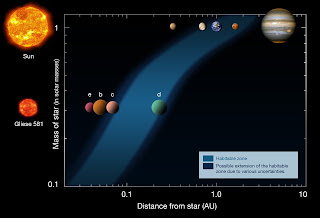
Now the smallest mass planet ever has been discovered around Gliese 581, a 1.9 mass planet Gliese 581e, presumably rocky, that screams around Gliese 581 in a little over three days. At a mere 0.03 Astronomical Units from its star, Gliese 581e is a Mercury-like world, baking in the close embrace of the Red Dwarf.
Importantly, the orbit for Gliese 581d has been refined too. It is now definitely within the habitable zone of its star. Gliese 581d is likely very unlike Earth, and it and Gliese 581c are probably
water worlds. The refinement of the orbit of 581d means it is very-likely covered in liquid water, when the planet was first described it seemed more likely it would be an
ice world (but Gliese 581c is more likely to be
Venus-like).

Unfortunately, even though Gliese 581 is so close that we can almost touch it, astronomically speaking, we won't be travelling there for a while. You can go there virtually though if you have the 3D space rending program
Celestia, I have made an ssc file for the
Gliese 581 system. If you have Celestia 1.5 and above, the program already comes with Gliese 591b, c and d (you will have to comment b and c out in my file, and comment out d in the extrasolar.ssc file as it has the old orbit).
Download the
file Wolf_562.ssc (the alternate name for Gliese 581) and put it in your Celestia extras folder and go exploring.
For the original ESO press release
go here. For a PDF of the discovery paper
go here. And a Nature News commentary
is here.
Naturally the blogosphere has already caught on. Here's
Stuart's take,
Centauri Dreams,
Dynamics of Cats,
Starts with a Bang (and his
update here),
Science After Suneclipse on how long it would take to get to Gliese 581 and the
Questionable Authority on what this means for finding alien civilizations (and how much you would weigh on Gliese 581d).
 Image Credit ESO (click to embiggen).
The Gliese 581 system delivers again. Giese 581 is a red dwarf star 20.4 light years away that until recently boasted the lightest extrasolar planet ever found. At 5 Earth masses, Gliese 581c was not exactly a second Earth, but it and 7 Earth mass Gliese 581d captured the worlds imagination as they seemed to be in the habitable zone of their parent star, where liquid water can exist.
Now the smallest mass planet ever has been discovered around Gliese 581, a 1.9 mass planet Gliese 581e, presumably rocky, that screams around Gliese 581 in a little over three days. At a mere 0.03 Astronomical Units from its star, Gliese 581e is a Mercury-like world, baking in the close embrace of the Red Dwarf.
Importantly, the orbit for Gliese 581d has been refined too. It is now definitely within the habitable zone of its star. Gliese 581d is likely very unlike Earth, and it and Gliese 581c are probably water worlds. The refinement of the orbit of 581d means it is very-likely covered in liquid water, when the planet was first described it seemed more likely it would be an ice world (but Gliese 581c is more likely to be Venus-like).
Image Credit ESO (click to embiggen).
The Gliese 581 system delivers again. Giese 581 is a red dwarf star 20.4 light years away that until recently boasted the lightest extrasolar planet ever found. At 5 Earth masses, Gliese 581c was not exactly a second Earth, but it and 7 Earth mass Gliese 581d captured the worlds imagination as they seemed to be in the habitable zone of their parent star, where liquid water can exist.
Now the smallest mass planet ever has been discovered around Gliese 581, a 1.9 mass planet Gliese 581e, presumably rocky, that screams around Gliese 581 in a little over three days. At a mere 0.03 Astronomical Units from its star, Gliese 581e is a Mercury-like world, baking in the close embrace of the Red Dwarf.
Importantly, the orbit for Gliese 581d has been refined too. It is now definitely within the habitable zone of its star. Gliese 581d is likely very unlike Earth, and it and Gliese 581c are probably water worlds. The refinement of the orbit of 581d means it is very-likely covered in liquid water, when the planet was first described it seemed more likely it would be an ice world (but Gliese 581c is more likely to be Venus-like).
 Unfortunately, even though Gliese 581 is so close that we can almost touch it, astronomically speaking, we won't be travelling there for a while. You can go there virtually though if you have the 3D space rending program Celestia, I have made an ssc file for the Gliese 581 system. If you have Celestia 1.5 and above, the program already comes with Gliese 591b, c and d (you will have to comment b and c out in my file, and comment out d in the extrasolar.ssc file as it has the old orbit).
Download the file Wolf_562.ssc (the alternate name for Gliese 581) and put it in your Celestia extras folder and go exploring.
For the original ESO press release go here. For a PDF of the discovery paper go here. And a Nature News commentary is here.
Naturally the blogosphere has already caught on. Here's Stuart's take, Centauri Dreams, Dynamics of Cats, Starts with a Bang (and his update here), Science After Suneclipse on how long it would take to get to Gliese 581 and the Questionable Authority on what this means for finding alien civilizations (and how much you would weigh on Gliese 581d).
Unfortunately, even though Gliese 581 is so close that we can almost touch it, astronomically speaking, we won't be travelling there for a while. You can go there virtually though if you have the 3D space rending program Celestia, I have made an ssc file for the Gliese 581 system. If you have Celestia 1.5 and above, the program already comes with Gliese 591b, c and d (you will have to comment b and c out in my file, and comment out d in the extrasolar.ssc file as it has the old orbit).
Download the file Wolf_562.ssc (the alternate name for Gliese 581) and put it in your Celestia extras folder and go exploring.
For the original ESO press release go here. For a PDF of the discovery paper go here. And a Nature News commentary is here.
Naturally the blogosphere has already caught on. Here's Stuart's take, Centauri Dreams, Dynamics of Cats, Starts with a Bang (and his update here), Science After Suneclipse on how long it would take to get to Gliese 581 and the Questionable Authority on what this means for finding alien civilizations (and how much you would weigh on Gliese 581d).
49 Comments
The Sanity Inspector · 22 April 2009
Wonder if there's any way of knowing if these planets rotate? I read somewhere once that planets in the "zone of habitability" around a red dwarf would be held in tidal lock, and bake on one side and freeze on the other.
Wheels · 22 April 2009
I've been looking for a reason to install Celestia again! The version in Hardy's repos is 1.5.0-1. That one has the old orbit?
fnxtr · 22 April 2009
fnxtr · 22 April 2009
r
Ian Musgrave · 22 April 2009
Ian Musgrave · 22 April 2009
Vince · 22 April 2009
OT - But two more gaps to fill :)
See www.the-scientist.com/blog/display/55653/
veri kurtarma · 23 April 2009
When will we can see that planets clear photos? Are we still very far from that technology?
Peter Henderson · 23 April 2009
mrg · 23 April 2009
lurker111 · 23 April 2009
Just as a matter of interest, where/what is Gliese 581a ???
eric · 23 April 2009
fnxtr · 23 April 2009
So what happens if they later find one closer to the star than 'a'? Out of sequence nomenclature like Saturn's rings, or do they rename them all?
amphiox · 23 April 2009
Actually, I think 'b' is used to refer to the first planet (discovered). Gliese 581a would refer to the star itself, but in common parlance most just use Gliese 581 and leave it at that.
amphiox · 23 April 2009
The planets are named in order of their discovery. Note that Gliese 581e, the newest one, is actually the closest one in (order is e, b, c, d). b was discovered first, c and d discovered at the same time, so c given to closer one in.
eric · 23 April 2009
Ineffable · 23 April 2009
It seems as if scientists are confirming the scientific hypothesises put for by Gonzalez and Richards in cosmological ID about the habitable zone and discoverability. Perhaps the posters at PT will retract their statement about Gonzalez's ID research being "vacuous" now. (I won't hold my breath though
fnxtr · 23 April 2009
... this should be good....
James F · 23 April 2009
Who controls the British Crown?
Who keeps the metric system down?
We do, we do…
Who keeps Atlantis off the maps?
Who keeps the Martians under wraps?
We do, we do…
Who holds back the electric car?
Who makes Steve Gutenberg…a star?
We do, we do…
Who robs cavefish of their sight?
Who rigs every Oscar night?
We do….We doooo!
mrg · 23 April 2009
raven · 23 April 2009
raven · 23 April 2009
If anything, the discovery of common planets around stars undermines Gonzalez's theory. We are limited right now by the power of our instruments and already a common star like Wolf/Gliese has been found to have 5 planets at a minimum, probably more.
The theory of solar system formation and our observations make it likely that most stars have solar systems.
Gonzalez's book was just Anthropic Principle meets GODDIDIT, a rehash of old material without anything new.
There are some theories that red dwarves like Gliese might be ideal for habitability. They are the most common stars in the galaxy, orders of magnitude more common than our G class sun. They also last longer by up to a thousand fold.
Our biosphere is living on borrowed time. In a billion years or so, the sun will be much hotter and we will fry.
Our galaxy isn't looking so great either. In two billion years it will collide with Andromeda, in about the largest collision at this stage of the universe. Galaxies collide all the time and ours is colliding with several right now. These are all dwarf galaxies, maybe 1/100 or less the size of ours.
Two large spiral galaxies colliding is the difference between a car running into a bunny and a car running into another car. What will happen is unclear but could well make both galaxies rather unfriendly for life. This may also be one of the last or even the last time two big spirals collide. The universe is expanding and due to dark energy this expansion is increasing in rate.
A better book than Gonazalez's would be Doomed Planet in a Doomed Galaxy.
Stanton · 23 April 2009
Flint · 23 April 2009
I may not remember this completely, but I thought Gonzalez was one of those who proposed that there is a galactic habitable zone, as well as a stellar zone, for (water-based) life as we know it. And that there is some cogent argument (that is, based on evidence) as to why this might be so.
But while Gonzalez may have been tangentially involved in this research, this by no means supports or demonstrates any "ID research". If anything, ID is simply (and artificially) plastered on after the fact. One might as well argue that "ID" is supported by the observation that (1) water tends to run downhill and concentrate in valleys; and (2) People tend to settle where water is available, and so water was intelligently designed to run downhill.
In other words, research identifying galactic zones humans would find habitable is valuable. Claiming that "therefore goddidit" is empty and vacuous.
Mike Elzinga · 23 April 2009
fnxtr · 24 April 2009
Whoa! I've been playing with Celestia all day. Douglas Adams would have loved it. Total Perspective Vortex, indeed. It's so easy to get lost....
mharri · 24 April 2009
Ineffable: Wait -- what? How again does finding exoplanets which are even more like Earth support the idea of a privileged planet?
I'm not joking. I would like a sense of how this line of reasoning works. (And please, guys, no snarky comments.)
stevaroni · 24 April 2009
fnxtr · 24 April 2009
It may support the idea of a galactic habitable zone, which in itself is zero support for PP. Basically Gonzalez et al seem to be saying we're special because we're right in this particular area of the galaxy with only a few billion other stars... typical pretzel logic.
HDX · 24 April 2009
Mike Elzinga · 24 April 2009
Wheels · 24 April 2009
James F · 24 April 2009
Flint · 24 April 2009
Mike Elzinga · 24 April 2009
Mike Elzinga · 24 April 2009
eric · 24 April 2009
raven · 24 April 2009
One of the many flaws in Gonzalez's book is his sample size. There are 200 billion-1 trillion stars in our galaxy. And who knows how many galaxies.
He is drawing sweeping conclusions based on a sample size of...1 solar system, not well studied on the ground.
We need a lot more data here.
mharri · 24 April 2009
That's what I was thinking, though I thought I might get a better sense of the disconnect if I could get the original speaker to explain slowly and methodically the reasoning; granted, many visitors of such an outlook have a weird habit of being one-post wonders. Oh, well. I picked up "galactic habitable zone" as websearch fuel; and that is still a learning opportunity.
eric · 24 April 2009
Question for the astronomers out there. If you were sitting 20 light years away and had the same telecscopes used to look at Gliese pointed at our system, what would you see? Jupiter? Jupiter, Saturn, and Uranus? None of them? All of them plus the rocky planets?
Reed · 25 April 2009
Ian Musgrave · 26 April 2009
Torbjörn Larsson, OM · 27 April 2009
Torbjörn Larsson, OM · 27 April 2009
"The number of stars that contain recent life" - that aren't excluded from containing life
fnxtr · 27 April 2009
If we are not a miracle, and the nature of matter is consistent throughout the galaxy, then life elsewhere is pretty much inevitable. Given the time and distance we have to work with, though, finding it will be pretty much impossible. Or at least highly improbable.
Henry J · 27 April 2009
And, if we are a miracle (whatever that word even means), the odds couldn't be computed from basic principles. (Miracles might or might not be unique, at the whim of the one responsible.)
Henry
fnxtr · 27 April 2009
Quite so.
elite jackson · 16 December 2009
no planet to on the Image this website is not the another Earth plant
D. P. Robin · 16 December 2009