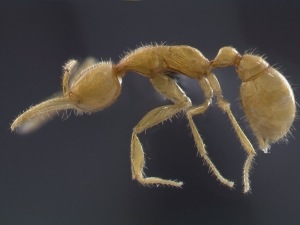
 The remarkable find was announced today in a paper by Rabeling, Manfred Verhaagh (who, a decade ago, collected and subsequently lost the elusive Martialis before he had a chance to properly examine it), and Jeremy Brown in the early edition of PNAS. If the DNA evidence is correct, Martialis is as ancient and as odd as an ant can be and still be called an ant. The lineage emerged right at the dawn of the family and provides a new line of sight back to the elusive ant ancestors.
What do we know about Martialis? Not all that much. We have a single insect that was found walking about in the leaf litter, away from its presumed nesting site. The details of its biology must be inferred from the morphology of the preserved specimen and the DNA sequence of a few genes. Until someone locates live colonies, the situation is a bit like having a well-preserved fossil with a smattering of genetic information.
The remarkable find was announced today in a paper by Rabeling, Manfred Verhaagh (who, a decade ago, collected and subsequently lost the elusive Martialis before he had a chance to properly examine it), and Jeremy Brown in the early edition of PNAS. If the DNA evidence is correct, Martialis is as ancient and as odd as an ant can be and still be called an ant. The lineage emerged right at the dawn of the family and provides a new line of sight back to the elusive ant ancestors.
What do we know about Martialis? Not all that much. We have a single insect that was found walking about in the leaf litter, away from its presumed nesting site. The details of its biology must be inferred from the morphology of the preserved specimen and the DNA sequence of a few genes. Until someone locates live colonies, the situation is a bit like having a well-preserved fossil with a smattering of genetic information.
 We can say that Martialis really is an ant and not just another wayward wingless wasp. The insect bears all the telltale traits marking the ant family: a metapleural gland on the thorax, a constricted waist segment, and an elongate first antennal segment. In Rabeling et al's analysis, DNA sequence from three nuclear genes (18S, 28S, and EF-1alpha) places Martialis outside the rest of the living ants, but only slightly. At left I have drawn up a simplified phylogeny, an amalgamation of Rabeling et al's finding and the landmark 2006 studies of Brady et al and Moreau et al.
Martialis is blind and pale, traits normally associated with subterranean species. It was collected in rainforest leaf litter, at dusk, near Manaus, Brazil. The elongate mandibles imply a predatory specialization, although on what we do not know. Rabeling et al suggest "annelids, termites, insect larvae, and other soft-bodied arthropods". The ant has a stinger, as do all the early lineages. The presence of a metaplueral gland---thought to be associated with ant social behavior---indicates that Martialis lives in colonies.
Given the antiquity of the lineage, the temptation to view Martialis as an ur-ant of sorts is strong. E.O. Wilson certainly felt that way when interviewed for a recent NYTimes article:
We can say that Martialis really is an ant and not just another wayward wingless wasp. The insect bears all the telltale traits marking the ant family: a metapleural gland on the thorax, a constricted waist segment, and an elongate first antennal segment. In Rabeling et al's analysis, DNA sequence from three nuclear genes (18S, 28S, and EF-1alpha) places Martialis outside the rest of the living ants, but only slightly. At left I have drawn up a simplified phylogeny, an amalgamation of Rabeling et al's finding and the landmark 2006 studies of Brady et al and Moreau et al.
Martialis is blind and pale, traits normally associated with subterranean species. It was collected in rainforest leaf litter, at dusk, near Manaus, Brazil. The elongate mandibles imply a predatory specialization, although on what we do not know. Rabeling et al suggest "annelids, termites, insect larvae, and other soft-bodied arthropods". The ant has a stinger, as do all the early lineages. The presence of a metaplueral gland---thought to be associated with ant social behavior---indicates that Martialis lives in colonies.
Given the antiquity of the lineage, the temptation to view Martialis as an ur-ant of sorts is strong. E.O. Wilson certainly felt that way when interviewed for a recent NYTimes article:
Dr. Wilson...is trying to contain his excitement: the 14,001st ant species has just been discovered in the soils of a Brazilian forest. He steamrolls any incipient skepticism about the ant's uniqueness -- the new species is a living coelacanth of ants, a primitive throwback to the first ant, a wasp that shed its wings and assigned all its descendants to live in earth, not their ancestral air. The new ant is so alien, Dr. Wilson explains, so unlike any known to earthlings, that it will be named as if it came from another planet.With due respect to Wilson, such a view is a mistake. Martialis has over 120 million years' separation since the ur-ant, plenty of time to develop along its own trajectory. The surviving species is not a throwback but a mix of primitive traits retained from the ancestor and unique traits acquired in the elapsed time. The same is true of most other living ants. Those impossibly long jaws, for example, are not present in any of the other early lineages nor in any of the fossils, almost certainly arising in the intervening millenia as Martialis developed a predatory specialization. And even though both Martialis and the next earliest lineage, the Leptanillines, are blind and pale, such traits evolve so readily among other ant groups (see here, here, and here) it is difficult to infer confidently that the ur-ant was also a yellow eyeless wonder.
 Rather, Martialis is important because we have a new window backward from which to view the ur-ant. This perspective, when combined with knowledge of the other early lineages (Poneromorphs and Leptanillines), will provide a stronger triangulation on the nature of the first ants. We will be able to infer with greater confidence the sequence of evolutionary events early in ant history. It gives new data where the existing knowledge was fuzzy.
As an example, the most troublesome aspect of current ant phylogenies is uncertainty surrounding the very earliest events in ant evolution. The genetic studies of Moreau (2006) and Brady et al (2006) unexpectedly fingered the subterranean Leptanilline ants as sister to all other species. Further exploration by Brady et al (2006) indicated that the Leptanilline arrangement might be an artifact of the data, leaving myrmecologists feeling a bit like we were back where we started. In Rabeling et al's work, Martialis falls in exactly the right place to clear up the confusion: the ancient age of Leptanillines is likely real, not an artifact. And Martialis is older still.
Where we go from here will depend on whether someone succeeds in finding living Martialis. The missing link now is not the ant itself but the knowledge about what it does.
Alex Wild is a biologist at the University of Illinois, where he studies the evolutionary history of various groups of insects.
Rather, Martialis is important because we have a new window backward from which to view the ur-ant. This perspective, when combined with knowledge of the other early lineages (Poneromorphs and Leptanillines), will provide a stronger triangulation on the nature of the first ants. We will be able to infer with greater confidence the sequence of evolutionary events early in ant history. It gives new data where the existing knowledge was fuzzy.
As an example, the most troublesome aspect of current ant phylogenies is uncertainty surrounding the very earliest events in ant evolution. The genetic studies of Moreau (2006) and Brady et al (2006) unexpectedly fingered the subterranean Leptanilline ants as sister to all other species. Further exploration by Brady et al (2006) indicated that the Leptanilline arrangement might be an artifact of the data, leaving myrmecologists feeling a bit like we were back where we started. In Rabeling et al's work, Martialis falls in exactly the right place to clear up the confusion: the ancient age of Leptanillines is likely real, not an artifact. And Martialis is older still.
Where we go from here will depend on whether someone succeeds in finding living Martialis. The missing link now is not the ant itself but the knowledge about what it does.
Alex Wild is a biologist at the University of Illinois, where he studies the evolutionary history of various groups of insects.
Original Paper: Rabeling, C., Brown, J. M., and Verhaagh, M. 2008. Newly discovered sister lineage sheds light on early ant evolution. Proceedings of the National Academy of Sciences. doi: 10.1073/pnas.0806187105. Other sources: Brady SG, Fisher BL, Schultz TR, Ward PS (2006) Evaluating alternative hypotheses for the early evolution and diversification of ants. Proc Natl Acad Sci USA 103:18172-18177.
Moreau CS, Bell CD, Vila R, Archibald SB, Pierce NE (2006) Phylogeny of the ants: Diversification in the age of angiosperms. Science 312:101-104. Specimen images by Rabeling & Verhaagh, used with permission
71 Comments
Wayne Francis · 22 September 2008
They are all still ants....just getting it in before the IDiots...
I love this stuff but I'm cringing on the thought on how this will be warped by creationist minds.
stevaroni · 23 September 2008
Cedric Katesby · 23 September 2008
"They are all still ants.…just getting it in before the IDiots…"
Nuts! Beat me to it.
:)
I just console myself with..."Yet more gaps in the Darwinist Religion of the so-called Tree of Life"
Ichthyic · 23 September 2008
Alex-
Is there a good, relatively recent, review paper that addresses what the current thinking is wrt to the evolution of eusocial behavior in ants?
I'm kinda curious where more "solitary" species (like some of the "bulldog" ants) are presumed to fit in at this point.
thanks
D. P. Robin · 23 September 2008
It is nice to know that there is still a place for old-fashioned naturalizing. Just kick around and see what you can find.
iml8 · 23 September 2008
wolfwalker · 23 September 2008
Fascinating stuff. I always get a kick out of "living fossils," or more precisely organisms that preserve primitive body-plans, whether they be ants, lizards, fishes, or trees.
I do want to make sure I understand, though: this gentleman found _one_ example of this ant, and never saw another one? And the one specimen he did get, he lost? Then where did the genetic data come from?
Minor afterthought: I find myself mildly irritated by comparisons of IDers to Wile E Coyote. Poor Wile E always laid his plans as best he could, but was defeated by a Power larger than himself. IDers' problem is not in their stars but in themselves: they insist on trying to change the facts to fit their ideology, and facts are not changeable things.
iml8 · 23 September 2008
stevaroni · 23 September 2008
Pete · 23 September 2008
I do want to make sure I understand, though: this gentleman found _one_ example of this ant, and never saw another one? And the one specimen he did get, he lost? Then where did the genetic data come from?
If I am reading it correctly, he found a single ant of the same species ten years ago and lost it. He just rediscovered it and still has this one.
Dolly Sheriff · 23 September 2008
...but they are all still ants!
There. feel better now?
Alex · 23 September 2008
Ichthyic:
Unfortunately for studies of incipient sociality, all known ants are truly eusocial, with a few obvious secondary losses among recent parasitic lineages. Even ants heralded for their supposed "primitive" state- such as the bulldog ants- have a division of labor into morphologically differentiated reproductive and non-reproductive castes. So we don't have much grist for a proper study of the transition to sociality.
There are a number of fossil stem-group ants (Armaniidae and Sphecomyrminae) that show signs of some sort of transition. Sphecomyrmines have a metapleural gland, suggesting group living, but their antennae are structured so as to give them some trouble with brood care. There's only so much we can do with fossils, though, as behavior doesn't preserve so well in amber.
It is *possible* that Martialis could be a subsocial species, as so little about it is known, but I'd not bet on it.
There are much better insect groups out there for studies of the evolution of eusociality. The Halictid bees show all sorts of variation in social behavior, from fully solitary to fully eusocial, with some species even having populations of both. Polistine wasps are also a great group showing a range of behavior.
Alex · 23 September 2008
For those interested, the Creationist spin is here.
Julie Stahlhut · 23 September 2008
What an amazing find (and, wow, another new putative ant subfamily!) I always love these kinds of discoveries.
But -- just "walking up to" a myrmecologist? Now we know why it's so rare. :-)
D. P. Robin · 23 September 2008
Venus Mousetrap · 23 September 2008
iml8 · 23 September 2008
iml8 · 23 September 2008
Ichthyic · 23 September 2008
. Even ants heralded for their supposed "primitive" state- such as the bulldog ants- have a division of labor into morphologically differentiated reproductive and non-reproductive castes. So we don't have much grist for a proper study of the transition to sociality.
I see. For some reason I had thought the bulldog group would be more unique. Thanks for the update.
There are much better insect groups out there for studies of the evolution of eusociality. The Halictid bees show all sorts of variation in social behavior, from fully solitary to fully eusocial, with some species even having populations of both. Polistine wasps are also a great group showing a range of behavior.
There was someone I recall when I was a grad student at Berkeley who had spent much of his time researching the evolution of eusociality in wasps and bees, (it's been quite a while now and I can't recall the name), but I found the issue fascinating.
I had assumed there would be more variability within the ants; why do you suppose this is not the case?
FL · 23 September 2008
iml8 · 23 September 2008
Where did the cool cladogram of ants come from? (NB that
I don't have subscriptions to science sites like AAAS
science.) I don't know much about the range of adaptations
in ants -- I suppose I'll have to at least skim through
Wilson's work on social insects, though it's like a hundred
times more than I need.
Something tells me that Wilson has been unusually cheery
the last few days. It's always nice to see a person in
love.
White Rabbit (Greg Goebel) http://www.vectorsite.net/gblog.html
Henry J · 23 September 2008
iml8 · 23 September 2008
Eric · 23 September 2008
eric · 23 September 2008
I have a Bio 101 question. Dr. Wild implies that the wasp-ant ancestor was a wasp, rather than some critter equally genetically distant from both, and I wanted to know why this is the expectation. Is there some wasp that we know about that hasn't changed for 120 million years?
Stanton · 23 September 2008
Alex · 23 September 2008
Eric:
Sorry I didn't clarify this in the post. Ants really *are* wasps. (So are bees, for that matter.) Wasps are an ancient group from which several more specialized lineages- including ants- evolved. This bit isn't really news- ants were always classified within the wasps in the old Linnean system, and recent, more rigorous phylogenetic analyses of both morphological and molecular data confirm that ants are just a specialized form of wasp. So the story of ant evolution is one of acquisition of new ant characters on top of an ancestral wasp state.
iml8:
The "cool cladogram" is from here. I simplified the tree from the original PNAS paper using the freeware program Mesquite, and appended some images from the myrmecos.net ant photo gallery.
Jim Thomerson · 23 September 2008
Aren't there Cretaceous fossil ants,such as Sphecomymodes, which are more intermediate in nature between living ants and other wasps?
Henry J · 23 September 2008
iml8 · 23 September 2008
eric · 23 September 2008
Alex and Stanton,
Thanks!
eric
Stanton · 23 September 2008
Ichthyic · 23 September 2008
such as the Desert and Coast horned lizards
awww, damn, I have a long history with those guys:
http://farm1.static.flickr.com/11/12970251_395f49b3b9.jpg
http://farm1.static.flickr.com/10/12886812_187ea3dace.jpg
I would often go to Joshua Tree national park in the early spring to catch them raiding the local red-ant nests.
FL · 23 September 2008
Wayne Francis · 23 September 2008
Wayne Francis · 23 September 2008
Eric, great question and Alex & Stanton great answers.
Alex · 23 September 2008
Stanton · 23 September 2008
Alex, do you have any information and pictures of Haidomyrex?
Alex · 23 September 2008
Stanton:
The original description is here:
http://antbase.org/ants/publications/8098/8098.pdf
Stanton · 23 September 2008
cronk · 23 September 2008
stevaroni · 24 September 2008
Stanton · 24 September 2008
iml8 · 24 September 2008
iml8 · 24 September 2008
eric · 24 September 2008
iml8 · 24 September 2008
Venus Mousetrap · 24 September 2008
Indeed, very nice post, Alex. I didn't know about the ant-wasp nested relationship, either, and nor it seems did those creationists. It's like finding a new species of bat and saying 'well, bats allegedly evolved from mammals'. I wonder if they'd take a bet on how much DNA an newly-discovered ant would share with a wasp, seeing as they have no reason to predict any similarity?
Frank J · 24 September 2008
paul flocken · 24 September 2008
iml8 · 24 September 2008
Wheels · 24 September 2008
What's all this fuss about ants? Everybody knows the Creator is inordinately fond of beetles!
Robin · 24 September 2008
eric · 24 September 2008
Paul Burnett · 24 September 2008
iml8 · 24 September 2008
eric · 24 September 2008
Julie Stahlhut · 24 September 2008
DavidK · 24 September 2008
The resolution to the issue regarding the origin of this ant is quite clear. Someone left a pile of dirty rags in the corner of the room and this critter was spontaneously generated, thus supporting the creationist/ID viewpoint.
iml8 · 24 September 2008
Stanton · 24 September 2008
iml8 · 24 September 2008
Cedric Katesby · 24 September 2008
That whole bit about the wasp/ant connection and the Velvet Ant info was very interesting.
I had no idea about those things before.
Thanks for digging it up and explaining it so that even a non-scientist lurker like me can understand it.
(Hanging out at the Panda. Gotta love it.)
Henry J · 24 September 2008
It's sort of like ants are to wasps as early amphibians are to fish.
Henry
Stanton · 25 September 2008
Wayne Francis · 25 September 2008
Yea I look at it like ants are to wasps like humans are to chimps. We both have been evolving for a few million years and while the ignorant might call our LCA a chimp it really wasn't.
The LCA of ants and current day wasps might look like a wasp...but then flying Ants look like wasps too.
Ichthyic · 25 September 2008
White Rabbit (Greg Goebel)
ah, your handle triggered a recent news item in my head; hope you aren't fond of the candy with the same name:
http://www.cbc.ca/consumer/story/2008/09/24/whiterabbit.html
iml8 · 25 September 2008
Ichthyic · 25 September 2008
pianoguy · 27 September 2008
iml8 · 27 September 2008