Lauri Lebo
The New Press
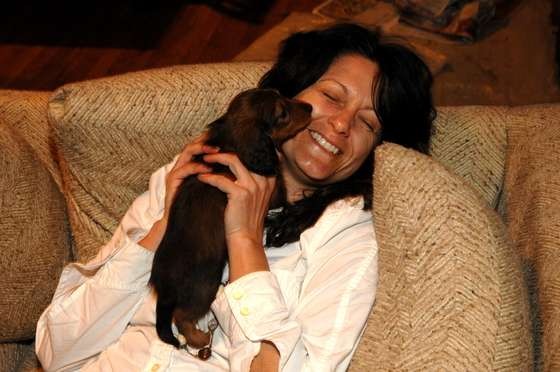
(http://laurilebo.com) I had been steadily working on analysis of an experiment that I will be presenting later this month, but Sunday afternoon a line of thunderstorms blew through here, and somewhere in there the power went out. My work laptop runs out of juice quickly when running Avida, so that's closed up. There's only so much playing with the puppy that I can handle at a time, and somehow I feel a need to do something. Several of my fellow bloggers at the Panda's Thumb have been talking about journalist Lauri Lebo's new book, "The Devil in Dover". There's about five who say that they are in various stages of writing reviews to be blogged here, there, or published in the mainstream media. And they all, to a man (yes, all of them are male), love it. About ten days ago, Lauri Lebo even gave me a personally inscribed copy (I contributed a photo for the front of the dust cover design and set up her personal website for the book). I hadn't gotten around to actually reading the book, though, until the lights and power went out, reducing my options. But I have to say that the book is good enough to wish for a power outage. I have remedied that piece of ignorance with the help of a flashlight and a couple of changes of battery and can now speak to the content in the about two hours that my personal laptop has available in its battery charge. The first thing to say is that Lauri's book (and I do hope that I am not unjustly taking liberties in our acquaintance to say "Lauri") is not just a journalist's compilation of data, but rather an intensely personal book. There are several threads of personal involvement that Lauri takes up here. Perhaps the most touching is her relationship and estrangement from her father, who converted to fundamentalist Christianity several years ago and persistently searched for signs that Lauri would also be "born again" as he had been. But also there is the personal struggle with those in her profession who misconstrue journalistic "objectivity" perversely as a charge not to speak the truth when a situation indicates that a "side" is plainly in the wrong. (Originally posted at the Austringer) And that leads to the second thing to say about Lauri's book here, which is that as a local reporter and acquaintance of most of the principal dramatis personae of the Dover-area Kitzmiller v. DASD dustup, Lauri delivers what will likely stand as the closest approach to getting inside the shoes of not only the plaintiffs, but several of the defendants as well. In particular, Lauri was able to relate to Bill Buckingham, infamous as the school board member that even the Thomas More Law Center (TMLC) repudiated, in a way that got beyond the blunt and confrontational style he was known for in the months leading up to the lawsuit. The TMLC betrayal led Buckingham to the brink of suicide, Lauri reports, and then to his early resignation from the Dover school board. Lauri's descriptions of Buckingham's frailties and foibles don't gloss over or diminish his truly monstrous behavior, but they do lend a humanizing touch to someone otherwise known primarily or only for his unswerving intolerance of the religious views of others. The third thing to say about Lauri's book is that she has managed to pretty well linearize a complex storyline involving parallel actions by many players, and this is no mean task. One can have, in a few hours of reading, an excellent overview of the chronology of events going back to tension in 2002 over a student-painted mural depicting human evolution and displayed prominently in a science classroom at Dover High School, and up to the period around the filing of the decision by Judge Jones. The centerpiece of this is the condensation of the events in the courtroom during the trial itself, for which Lauri relates that she had a front-row jury-box seat. She relates here the testimony of the plaintiffs as they had to relate to the court what harm they had suffered as a result of the school district's "intelligent design" policy. In the cases of Fred Callahan and Cyndi Sneath, these are revealed as piquant moments of eloquence and directness in the courtroom, rebutting the defense contention that the policy's statement in the classroom was brief, modest, and without further issue. The plaintiffs's expert witnesses awoke interest and respect from the journalists, while the defense's primary expert, Michael Behe, managed to turn off almost everyone present during his direct testimony. Lauri's description of the abrupt return from boredom as Eric Rothschild cross-examined Behe is worth the price of the book, laying bare the platitudes and sound bites Behe had come to rely upon as a facade resting upon, well, nothing. And here one encounters something that Lauri exposes through the book, and that is the obliviousness of the Dover school district's "intelligent design" advocates and their chosen defenders to how their statements and actions were taken by others. In Behe's case, Behe left the courtroom apparently well-convinced of having given a sterling performance, though later Lauri filed her story and was remonstrated with by her editor to lead with something positive for the defense's case that day. "No, they did nothing," she said, "Rothschild eviscerated them." The courtroom provided the denouement for the tragi-comic story of the principal "intelligent design" advocates on the school board who chose to lie rather than expose their policy to a possible temporary restraining order. The depositions of those people taken in early January, 2005 provided clear evidence that Bill Buckingham and Alan Bonsell purposely concealed information pertaining to the purchase of 60 copies of the "intelligent design" textbook, "Of Pandas and People". Steven Harvey provided the courtroom confrontation between established fact and the defense witnesses' impossible prevarications. Lauri notes again the apparent obliviousness of the witnesses to their peril, though Alan Bonsell apparently came to some realization there in the witness stand under grilling from Judge Jones himself. I think Sheila Harkins dodged a bullet here, as Lauri's description of the school board president's testimony again documents that oblivious trait, but mercifully does not convey the full bizarre spectacle that Harkins conveyed as a witness. I happened to be there, am not that merciful, and was dumbfounded that any attorney could have so ill-prepared a witness for giving testimony. Harkins chewed gum throughout her time in the stand, fidgeted nearly constantly, and sometimes answered questions while holding her face in one or both hands. The lawyers of the Thomas More Law Center did not go unobserved. Lauri provides descriptions of their part in the affair from fomenting the Dover school board's participation in a "revolution against evolution" through their sometimes lackluster courtroom performance. In particular, Richard Thompson is revealed as a man on a mission to whom all others are secondary considerations, including the people that his law firm agreed to "shield" from legal challenge. Thompson's sole concern, as related in the book, was putting a court record together to take to the Supreme Court. Given this view, it is perhaps understandable that TMLC did not take the same sort of care in preparing their witnesses that the plaintiffs' attorneys did. The witnesses weren't the real issue for Thompson, so poor posture and failure to enunciate were apparently simply not on the defense legal team radar as things to avoid. That's on the minor side; on the major side is what role, if any, did TMLC have in the concerted effort by the school board advocates for "intelligent design" to deny the plain truth that they had come to their position by first looking to incorporate creationism in the science classroom. Lauri's conclusion is unfortunately true, that we may never know what went on there, but the outcome was to propel Dover into the national spotlight. A fourth thing to say about Lauri's book is that Lauri is a masterful wordsmith and constantly comes up with descriptive gems. Her verbal acumen coupled with her comprehensive knowledge of the local milieu gives us an account that is a pleasure to delve into.
My mother taught me to love the smell of puppies' milk breath, and the feel of their bellies taut and round like hard-boiled eggs. She taught me to stretch out, my face pressed in the grass, the laundry snapping above me on the clothesline, to indulge the drowsy feeling of sunshine on the back of my head. My father pointed to the sky at night and taught me to dream of infinity. On hot summer evenings, he wrestled with his children, like kittens, in the grass until long after teh sun went down. Then we lay on our backs in the grass and watched the stars. I'd shine a flashlight into the sky, gazing at the beam of light disappearing into the dark. Millions and millions of years from now that light will reach those stars, my father told me. I'd try to follow the beam with my eyes and ponder this until I grew dizzy.
 Are there errors in the book? Of course, any book length project will collect its share of those. Most of these fall into the category of quibbles, as in Lauri referring to the National Center for Science Education's "Project Steve" as "Project Steve Steve". The other class of error is one that follows from the fact that the book is short. There simply is not enough space here to recount the involvement of all the people who contributed in some way to the remarkable events in Dover and Harrisburg in 2004 and 2005, nor to fully document those who are mentioned in the book. Lauri's choices here play to her strengths in having the local background, and this combination of focus and brevity brings a cohesion to the book that balances the cost of excluding various actors from a chance at the stage. Those would include defense experts Scott Minnich and Steve Fuller, whose testimony goes unremarked in the book [though, again, this might be a further act of mercy on Lauri's part], or the various disappearing defense witnesses, who either get brief mentions in other contexts or who go wholly without notice here.
But the book was not intended to be an encyclopedia entry, and it brings home the human experience of having to confront religious intolerance when one cares deeply about the intolerant people. It is an easy path to demonize or villainize those who chose intolerance as their approach, and Lauri avoids this simplification. The book begins and ends with Lauri's prickly and ultimately unresolved relationship with her father, who died days after the decision in the case came down. The bond of love between the two is manifest, and in some way prepares us to see that even for the rest of the folks pushing things they shouldn't, that they have a reason in their unreason to take the course they do. Conceding to their demands for intolerance is not an option, and Lauri celebrates the resolve of those who challenged the Dover school board's "breathtaking inanity" while respecting the dignity of those who partook in the inanity. It's a deeply moving account, and if you haven't yet read it, it is time to put it on your list, buy it for a friend or loved one, and otherwise pass along the word that here is a read that is both challenging and rewarding.
Do it now. Don't wait, like me, for a power outage.
Are there errors in the book? Of course, any book length project will collect its share of those. Most of these fall into the category of quibbles, as in Lauri referring to the National Center for Science Education's "Project Steve" as "Project Steve Steve". The other class of error is one that follows from the fact that the book is short. There simply is not enough space here to recount the involvement of all the people who contributed in some way to the remarkable events in Dover and Harrisburg in 2004 and 2005, nor to fully document those who are mentioned in the book. Lauri's choices here play to her strengths in having the local background, and this combination of focus and brevity brings a cohesion to the book that balances the cost of excluding various actors from a chance at the stage. Those would include defense experts Scott Minnich and Steve Fuller, whose testimony goes unremarked in the book [though, again, this might be a further act of mercy on Lauri's part], or the various disappearing defense witnesses, who either get brief mentions in other contexts or who go wholly without notice here.
But the book was not intended to be an encyclopedia entry, and it brings home the human experience of having to confront religious intolerance when one cares deeply about the intolerant people. It is an easy path to demonize or villainize those who chose intolerance as their approach, and Lauri avoids this simplification. The book begins and ends with Lauri's prickly and ultimately unresolved relationship with her father, who died days after the decision in the case came down. The bond of love between the two is manifest, and in some way prepares us to see that even for the rest of the folks pushing things they shouldn't, that they have a reason in their unreason to take the course they do. Conceding to their demands for intolerance is not an option, and Lauri celebrates the resolve of those who challenged the Dover school board's "breathtaking inanity" while respecting the dignity of those who partook in the inanity. It's a deeply moving account, and if you haven't yet read it, it is time to put it on your list, buy it for a friend or loved one, and otherwise pass along the word that here is a read that is both challenging and rewarding.
Do it now. Don't wait, like me, for a power outage.
56 Comments
DavidK · 9 June 2008
Fascinating review. I'll wait for its release.
Surely (and sadly though), you can bet the DI will come out with a rebuttal as soon as this book hits the press saying how they and ID have been wronged by this author, that she has twisted everything.
Wesley R. Elsberry · 9 June 2008
No need to wait, the book is available now.
John Kwok · 9 June 2008
Dear Wesley,
I second DavidK's reaction (In the interest of full disclosure I also have a review of Lauri's book posted at Amazon.com, but mine emphasized more the scientific testimony which Lauri does an exceptional job of recounting in her book.). As a fellow writer, I strongly commend Lauri's fine prose style and keen ear for poetic language; indeed, her prose reminds me a little of Frank McCourt's at his best.
Appreciatively yours,
John
RBH · 9 June 2008
What Lauri's book best captured for me was the effect of having a battle in the culture war fought in one's own community. For the ID Creationist movement principals -- organizations like the Thomas Moore Center, AIG, and the Disco 'Tute -- that's irrelevant: They don't much give a damn about the communities they're poisoning.
Five years ago in my local school district we had a skirmish in that war when a middle school science teacher wanted to include Wells's trash science in the curriculum. One Board of Education member, having done some research on the ID Creationist movement, opposed the proposal. His opposition was not on based scientific grounds -- he was an insurance agent -- but rather, as he said, "They say they are fighting a war. Well, they're not going to fight it here." Lauri's account of the Dover debacle perfectly illustrates what that board member foresaw.
Now we're in the war again here, and it is getting ugly. Lauri's book is a guide to what we can expect, and it's not a pretty prospect.
paul flocken · 9 June 2008
Ed Brayton · 9 June 2008
I could not agree more with Wesley's review of the book. I'm one of the folks working on a review of the book for a print publication, Free Inquiry, and I finished the book a few weeks ago. Lauri did a phenomenal job of capturing the dramatic arc of the situation because she was living it herself on several different levels simultaneously. It's not just informative, it's moving. She manages to humanize the people involved in the trial and turn names in the newspaper into multi-dimensional, real people. And that includes herself, as she details the various ways the case changed her as a journalist and a daughter as well as how it changed the community she calls home. I've read the other books on the trial. If you're only going to read one book about the trial, this is the one. And there isn't a close second.
John Kwok · 9 June 2008
John Kwok · 9 June 2008
Wesley,
A great photo of Lauri. Thanks for adding it as a fine pictorial reinforcement of what you've written.
Thanks,
John
Greg du Pille · 9 June 2008
Yes, I have to agree that the book is a good read. It was great fun reliving the sense of overwhelming impending defeat of the idea of Intelligent Design which seemed to roll inexorably through the trial that we, even in far away New Zealand, seemed to get from the reporting on Pandas Thumb. I was also very interested to read Lauri's human angles, how she had to cope with her fundamentalist father, her relationship with Bill Buckingham etc. It was also instructive to read her frustration at the journalistic requirement for so-called balance and the dilemma of what to report positively for the "losers" when one side had been so completely eviscerated
A book well worth the money, in my opinion.
wamba · 9 June 2008
Most of these fall into the category of quibbles, as in Lauri referring to the National Center for Science Education’s “Project Steve” as “Project Steve Steve”.
I'll bet that "quibble" went over very well with the Panda's Thumb gang.
A picture with a puppy? Awwww. That's cheating.
Greg Peterson · 9 June 2008
I stayed up Friday night and read the whole thing in one sitting--I literally could not put it down. If there's ever an "Inherit the Wind 2," "Devil" is the natural source material. I hope Lebo hung on to the movie rights.
Mike from Ottawa · 9 June 2008
I'd like to see Mike Argento try his hand at a book. His columns touching on the trial were hilarious, bringing appropriate ridicule down on the heads of those responsible for the breathtaking inanity.
RBH · 9 June 2008
RBH · 9 June 2008
Cengiz · 9 June 2008
Not meaning to feed the troll, but I looked at the "Quest for Right" website, and I'm confused. Do creationists generally reject quantum mechanics, and since when has particle physics been a quest to do away with god/s? I've never heard of the guy, but the author appears to be some kind of crackpot whose educational history only includes attending Richmond Professional Institute sometime before 1968 when it became Virginia Commonwealth University. Curiously, no area of study or degree/s earned are listed. Is he well-enough known among creationists that I should be aware of him, in case some fundie wants to bring him up in a debate(like the irreducible complexity goobers)? He seems to be fond of quoting the bible as "evidence" and his books are being touted as "A MASTERFUL WORK ON CREATIONISM!", so I somehow doubt that this series of his "...will not violate the so-called constitutional separation of church and state".
Carter McAdams · 9 June 2008
I've read several books on the Dover trial, each very good. Lebo's was so wonderfully personal that I lent it to my liberal Baptist friend and poet to introduce her to the creationism/evolution battle. And Lebo's road trip (avec tattoo) at the end was a great coda.
Stacy S. · 9 June 2008
You have all inspired me ... I just sent this book to my Dad for Father's Day :-)
Marion Delgado · 9 June 2008
WESLEY:
(and by implication, anyone)
I put an entry in Wikipedia on Lauri Lebo, I had to revise it and quibble a bit because some higher-up thought she was unimportant.
The thing is, I called it a stub (partial article) on a journalist. Biographical information on her is scant, other than her marriage to a beer-can collecting musician and her late father owning the station she used to DJ at. Things like DOB and where born and so on aren't available.
Anyone who knows Lauri and/or has a source of info, please either email me at marion_delgado@yahoo.com or if you do Wikipedia yourself, please expand it a bit.
Gary Hurd · 9 June 2008
Like John Kwok, I posted a review on Amazon.com. Like all of us, I greatly enjoyed her book.
And I share the hope that Mike Argento will contribute a book for us as well.
Pierce R. Butler · 9 June 2008
RBH · 10 June 2008
Marion Delgado: I've called your request to Lauri's attention.
RBH
Frank J · 10 June 2008
Philip Bruce Heywood · 10 June 2008
I'm not a U.S. citizen and took only a passing interest in the Dover bizzo. I can understand how it happened - I think - and the one good thing that comes out of these expensive diversions to no-where is to keep before the Public the fact that no-one has yet got a user-friendly tertiary Origins course together yet.
That's what I attempt to do, and I can advize readers that the bad outcome achieved by the Dover School Board or whatever it was/is, is a product of that Boards' failure to obey common sense.
I e-mailed them to the effect that the only way they could get anywhere was to come up with educational materials non-offensive to people with respect for biblical principles and mainstream science principles. I advised them that my publications were at their disposal, provided they utilized them in a spirit in keeping with said materials.
Someone has said that divine guidance is 99% sanctified common sense. That Board seems to have concentrated on the sanctified bit, but omitted the common sense.
All the defense had to do was run some of my publications, omitting overt biblical references. People out there are reasonable, and judges tend to understand a few basics.
Why ever on Earth courts of law have to decide such matters I don't comprehend; Once a school Board or whatever begins to employ mainstream materials such as I have the privelege of providing, the story will be different. There won't be a need for a trial, for beginners.
People out there tend to have basic common sense. There is common ground, and science is an area of common ground, like sport, where various cultures meet without friction.
Wesley R. Elsberry · 10 June 2008
Phillip, I've taken the liberty of creating a thread on the AtBC forum for discussion of your assertions. The discussion of that stuff should now go to this thread and will be considered off-topic here.
Continued off-topic discussion will result in placement of offenders in the moderation queue.
phantomreader42 · 10 June 2008
Frank J · 10 June 2008
Wesley R. Elsberry · 10 June 2008
OK, folks, please direct your attention back to the topic of the post.
If you want to continue other discussions, the Bathroom Wall thread is the place to take it.
John Kwok · 10 June 2008
Dear Wesley,
If I may venture slightly off topic, I merely wish to note that Ken Miller has an excellent summary of the Dover trial in his forthcoming "Only A Theory: Evolution and the Battle for America's Soul". However, as fine as Ken's summary is, it doesn't do the ample justice in capturing the mood of Dover's inhabitants as much as Lauri Lebo's book does. Furthermore, I must congratulate her in not injecting herself as much as screenwriter and film director (and Charles Darwin descendant) Matthew Chapman does in his own memoir of the trial, "40 Days, 40 Nights", which though commendable, I find slightly distasteful only because Chapman seemed to use his ancestral ties to Darwin a bit too much for self promotion, as a means of gaining access to local Dover residents like several former Dover Area School District board members (most notably Buckingham) and several plaintiffs. So, if anyone were to ask me whether Chapman's book is preferable to Lauri's, then I'd say no, that they ought to read Lauri's instead.
Appreciatively yours,
John
John Kwok · 10 June 2008
Dear Wesley,
Am delighted you decided to post your wonderful review at Amazon.com too (BTW, you may be able to post that wonderful photograph of Lauri and her dog there too.).
I recommend to all Panda's Thumb readers who enjoy yours, Gary's, and my reviews to vote yea on all three (If you're one of the usual IDiot trolls, then please don't bother voting, since yours will be nay.).
With warm regards,
John
Frank J · 10 June 2008
(trying to tie my comments to the topic at hand) I am optimistically hoping that these books about Dover will someday change the public (& media) misconception that anti-evolution activism is still about honest belief in a consistent, if evidence-free, alternate account of natural history. Reading about the "TMLC betrayal" alone should make it clear that Dover was not another "monkey trial."
BTW, I wonder if the "theory" of ID can tell us if Lebo's phrase "Project Steve Steve" was indeed an "error," or "by design."
Dr. J · 10 June 2008
I'd read Lauri Lebo's book a few weeks ago - the first on my "now that classes are out" book list and loved it. What I liked best is how personal it was - she did a great job of presenting her relationships with everyone but particularly her father and Buckingham. "Monkey Girl" probably provided a better insight into the goings-on of the trial as does the PBS video, "Judgment Day" but neither give the insights into the people involved that Lebo does. A great read, very highly recommended.
What ever came of the potential perjury charges for Buckingham and Bonsell?
Gary Hurd · 10 June 2008
A feature of Lebo's book that I didn't give adequate acknowledgement to was that unlike any other author to date (Come on Argento!), she didn't leave the scene when the trial was over. The social aftermath was as interesting to me as the build-up and trial.
Wesley R. Elsberry · 10 June 2008
About the perjury issue... AFAIK, that's still "under investigation". It will be news, briefly, if it is announced that they have dropped it or will prosecute.
Marion Delgado · 10 June 2008
Wesley:
I got a better response to the request for bio info than I would have guessed, so I am fine there.
Panda's Thumb is the place.
Marion Delgado · 10 June 2008
Mike Elzinga · 11 June 2008
I just finished Lauri’s book and I highly recommend it. She gives a more poignant picture of the emotional conflicts caused by the trial than either Edward Humes or Matthew Chapman.
The three books plus the transcripts and local newspaper articles are all complementary and necessary for getting a more complete picture.
The tattoo was a nice touch.
Thank you, Lauri.
John Kwok · 11 June 2008
Mike Elzinga · 11 June 2008
John Kwok · 11 June 2008
Gary Hurd · 11 June 2008
So far the weakest book on Dover I have read was Gordy Slack's "The Battle Over the Meaning of Everything." The best bits were the few times he mentioned he interations with other media people.
Mike Elzinga · 11 June 2008
chuck · 11 June 2008
As a former HS biology teacher I would like to know how ANY strengths and weaknesses
would fit into an HS biology class.
It's a miracle if you get through an entire 40,000 foot overview of biology in one year starting from scratch.
Mike Elzinga · 11 June 2008
Frank J · 12 June 2008
chuck · 12 June 2008
John Kwok · 12 June 2008
Dear Mike,
This is what I wrote in the concluding paragraph of my Amazon.com review of Chapman's "40 Days and 40 Nights" (It seems relevant to post it here too.):
Chapman concludes "40 Days and 40 Nights" on a most idiosyncratic, personal note, and one that he has alluded to ever since the very first page of his memoir. He contends that we should allow creationism into the science classroom, so that it can be "dissected", in much the same fashion as it was during the Kitzmiller vs. Dover Area School District trial, by allowing teachers to "explore the limitations of faith through the revelatory methods of science", and resulting in "verdicts" identical to Republican Federal Judge Jones' conclusion that Intelligent Design wasn't scientific. Emotionally, it is a sentiment that I found myself quite unexpectedly, at first, to be in complete agreement. However, on second thought, I concur with Ken Miller's observation that introducing Intelligent Design into science classrooms would be a "science stopper". It would conflate most students' understanding of what exactly is the difference between religious faith and science, though I suppose that some truly gifted students, like those attending prominent American high schools such as Alexandria, Virginia's Thomas Jefferson High School for Science and Technology, and New York City's Bronx High School of Science and Stuyvesant High School, might readily understand and appreciate these distinctions. And yet I am inclined to agree more with the harsh view articulated by distinguished British paleontologist Richard Fortey in his essay published in the January 30, 2007 issue of the British newspaper Telegraph, contending that it is an absolute waste of time arguing with Intelligent Design advocates, and that they ought to be dismissed as "IDiots"; by extension, so would be the teaching of Intelligent Design alongside evolution in a science classroom. I would rather see talented students from Thomas Jefferson, Bronx Science and Stuyvesant engage themselves fruitfully in genuine scientific research of the highest caliber, than in trying to understand the metaphysical, religious nonsense known as Intelligent Design and other flavors of creationism. I think, in hindsight, so would Charles Darwin.
In light of recent Disco Tute mendacious nonsense, I hope Chapman may reconsider (He's speaking tonight at a Center for Inquiry New York dinner which I can't attend alas, but did ask one of the organization's officers to pose my question to Chapman in my absence.).
Incidentally, my review of Ken Miller's "Only A Theory" is now up at Amazon.com. Hope you like it and vote accordingly.
Appreciatively yours,
John
william e emba · 12 June 2008
I've read each of the four books (Chapman, Humes, Slack, Lebo) plus one chapter (Irons) on the Dover trial and I recommend them all, and will continue to buy (in hardcover) and read future books on the trial. I haven't seen Miller's yet--thanks everyone for the tip.
By books I mean real books that is. I don't even bother perusing DI garbage when it makes it into book format.
As it is, several of these Dover books mentioned that no preliminary injunction against the reading of the board's statement was attempted. I distinctly remember at the time the injunction was sought and not granted, on grounds that Judge Jones found the record was confusing. Am I hallucinating, or what?
Mike Elzinga · 12 June 2008
Wesley R. Elsberry · 13 June 2008
Gary Hurd · 13 June 2008
The weird thing is that this thread seems to be changing the response tally at Amazon.com, and I don't know if that is reasonable.
I have read all the books so far on Dover. The Miller book was apparently iven to some people free and before general release. I still pay my own way.
There are people who have suddenly gone to the Amazon.com website and voted against my positive review of Lebo's book.
She wrote a good book you creato-assholes! I don't care if your side lost- it is still a good book. I also have read "Traipsing into Evolution.” As a piece of propaganda, it was a good job. That is the most I could say for it.
Wesley R. Elsberry · 14 June 2008
Publishers often send review and complimentary copies of books out pre-release. That in itself isn't cause for concern.
Back with the FTE release of "The Design of Life", FTE passed out pre-release copies, but they vetted their list to *only* send such copies to people with an IDC cheerleading history. This was in an apparent attempt to game the Amazon ratings system.
Wesley R. Elsberry · 14 June 2008
Publishers often send review and complimentary copies of books out pre-release. That in itself isn't cause for concern.
Back with the FTE release of "The Design of Life", FTE passed out pre-release copies, but they vetted their list to *only* send such copies to people with an IDC cheerleading history. This was in an apparent attempt to game the Amazon ratings system.
Theron · 16 June 2008
Thanks to all the people who recommended this book. I went out and picked it up, read it in a couple of sittings, and really enjoyed it. An excellent read.
Shebardigan · 19 June 2008
It came today from Powell's, and I can see why people phone in sick the next day because they spent the entire night reading it.
Scince Nut · 27 June 2008
I read it yesterday in 2 sittings.
Laurie was the right person, in the right place and at the right time. The nexus of these events conspired to produce a thorough and enjoyable book that presented the whole complex issue in very human and deeply personal terms. Most importantly, Laurie's writing style lends the book a readability that reaches the people of her home town who deserve the best of interpretations about the emotional crucible they had to endure.
Thank you, Laurie!
Marian L. Shatto · 26 February 2009
Last evening I began "The Devil in Dover" around 9:30 pm and finished at 2:50 am this morning. It was an enthralling read, with no good stopping place short of the final page. I appreciate the comments here. I live in the next county east from Dover, and have two friends, now retired, who were on the faculty there, so I have an intense personal interest in the incident. Lauri Lebo's descriptions of the trial and actors therein are riveting.
It appears that the referrals to federal investigators that Judge Jones made, re possible perjury charges against several of the defendents, have not gone anywhere. Is anyone aware of any update on their status? Or is this another instance where the Bush justice department dropped (hid?) the ball? Thanks!