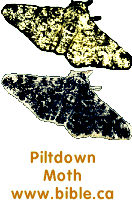
Peppered Moths: We Told You So

Posted 28 August 2007 by

The ID movement hasn't had many successes, but one area where they did pretty much succeed in causing considerable havoc was the classic textbook example of natural selection in action: the change in color of peppered moths (Biston betularia) from peppered white, to black, and back to peppered white again. Through a series of accidents that is still difficult to understand, the idea got started in the late 1990s that leading peppered moth researcher Michael Majerus had debunked Bernard Kettlewell's famous study confirming the old hypothesis that the change in peppered moth color was due to selective predation of conspicious moths by birds. This confusion, minor by itself, was massively magnified when the ID/creationists picked it up and spread it far and wide. In the 1970s-1980s, creationists used to just resort to traditional obfuscation when confronted with natural selection producing a the "designed-looking" adaptation of moth camouflage to match their changing background -- creationists would just reply "they're still moths", purposely avoiding the point of the peppered moth example. But once they heard that Kettlewell's research and hypothesis were in trouble, they declared the example a fraud, the illustrative photos a dastardly fraud, and told the world that the biology textbooks were lying to the children and that the ID movement's quack science should be given a place in schools to balance things out. I think Jonathan Wells probably considered the alleged downfall of the peppered moth his career achievement. Science journalists, forgetting the maxim "If a creationist declares victory, it doesn't necessarily mean that they've actually won" breathlessly and almost entirely uncritically repeated the basic "peppered moths debunked" storyline, almost completely neglecting the horrified objections of the actual people who knew something about the subject, the peppered moth researchers like Bruce Grant and Michael Majerus himself. Piling on was the (2002) book Of Moths and Men by New-Ager science journalist Judith Hooper, who naively took all the hubbub as an indication of reality, and added her own rumor-mongering and uninformed speculation to the mix, for example by postulating that maybe night-feeding bats somehow magically selectively predated one color of moth, and, most egregiously, inventing the idea that Kettlewell had actually deliberately faked his results, a conclusion which Hooper based on nothing but clueless armchair analysis of a few datapoints and a magical letter that somehow influenced Kettlewell the day before he actually received it (see debunking of this). Well, the press was against Kettlewell's Bird Predation Hypothesis. More than a few scientists (outside of the peppered moth community) looked askance at it. And the creationists were crowing for years. In addition, while I haven't done a systematic analysis, my sense of it is that the poor peppered moth took a serious hit in coverage in the textbooks. The only defenders, basically, were the peppered moth guys themselves, and, well, us PT/talkorigins/NCSE folks. We defended the old Biston example through thick and thin, based mostly on the novel idea that one ought to read the original research and the actual experts to get a sense of what the most likely reality is. You can see most of this long-live-the-peppered-moth stuff here, here, here, and here. It's all well and good to argue about old studies, but for the last five years or so, Michael Majerus has been working on a long-term, answer-all-the-critics experiment to re-test (yet again) the idea that selective bird predation on conspicuous moths is the primary cause of the change in color morphs of the peppered moth. It looks like he's finally finished:

Majerus Lab Evolutionary Genetics Group STOP PRESS - The text of Mike Majerus' talk given at Uppsala on 23 August is now available as a pdf file - The Peppered Moth: The Proof of Darwinian Evolution

I have emailed Majerus, he says that he will put up the powerpoint slides and photos when he gets back from a meeting next week. (So please, don't flood his email asking for these.) Here is the news story on his talk:

Moth study backs classic 'test case' for Darwin's theory For more than a century it has been cited as the quintessential example of Darwinism in action. It was the story of the peppered moth and how its two forms had struggled for supremacy in the polluted woodlands of industrial Britain. Every biology textbook on evolution included the example of the black and peppered forms of the moth, Biston betularia. The relative numbers of these two forms were supposed to be affected by predatory birds being able to pick off selectively either the black or peppered variety, depending on whether they rested on polluted or unpolluted trees. It became the most widely cited example of Darwinian natural selection and how it affected the balance between two competing genes controlling the coloration of an organism. Then the doubts began to emerge. Critics suggested that the key experiments on the peppered moth in the 1950s were flawed. Some went as far as to suggest the research was fraudulent, with the implication that the school textbooks were feeding children a lie. Creationists smelt blood. The story of the peppered moth became a story of how Darwinism itself was flawed - with its best known example being based on fiddled data. Now a Cambridge professor has repeated the key predation experiments with the peppered moth, only this time he has taken into account the criticisms and apparent flaws in the original research conducted 50 years ago. Michael Majerus, a professor of genetics at Cambridge University, has spent the past seven years collecting data from a series of experiments he has carried out in his own rambling back garden. It has involved him getting up each day before dawn and then spending several hours looking out of his study window armed with a telescope and notepad. [...] In a seminal description of his results to a scientific conference this week in Sweden, Professor Majerus gave a resounding vote of confidence in the peppered month story. He found unequivocal evidence that birds were indeed responsible for the lower numbers of the black carbonaria forms of the moth. It was a complete vindication of the peppered month story, he told the meeting. [...] While the professor has also described drawbacks to Kettlewell's methodology, he was able to address all of these concerns and even tested an idea that Hooper had raised in her book - that it was bats rather than birds responsible for moth predation - a suggestion he dismissed altogether. Professor Majerus compiled enough visual sightings of birds eating peppered moths in his garden over the seven years to show that the black form was significantly more likely to be eaten than the peppered. A statistical analysis of the results revealed a clear example of Darwinian natural selection in action. "The peppered moth story is easy to understand, because it involves things that we are familiar with: vision and predation and birds and moths and pollution and camouflage and lunch and death," he said. "That is why the anti-evolution lobby attacks the peppered moth story. They are frightened that too many people will be able to understand."

Barring the unlikely possibility of a dramatic change in the conclusions before Majerus's official publication of his results (which, we must remember, will be the official, authoritative presentation of the work), let me say it again. We Told You So. I do think that this case should be a cause of some reflection on the part of journalists and textbook publishers. Is it possible that these groups, normally skeptical of creationists, let themselves get stampeded into the "bird predation is dead!" meme by creationist propaganda? At any rate, as sure as night follows day, the ID/creationists, craven as always, are already refusing to admit they were wrong, and are instead trying to crawl unnoticed back to their old hole: "Sure it's natural selection, but they're still just moths!" A case in point:

IMHO...a couple of issues with the most recent peppered moth study. It's still a moth, and the evolution is an oscillation of populations, just like the finches of Galapagos

There it is, in black and white.

187 Comments

h3nry · 28 August 2007

Prof. Michael Ruse's latest book Darwinism and Its Discontents also offers a few pages devoted to the peppered moth example. As a note, that section is part of a chapter which addresses Piltdown Man and Haeckel's Drawings - which creationists are still using today as examples of scientific frauds.

Christophe Thill · 28 August 2007

I'm currently reading Mayr's Growth of Biological Thought. If there's one idea I got from this book, it's that modern biology is all about "populational thinking", as opposed to the "typological thinking" of the old metaphysical philosophers and the pre-scientific biologists. And the best illustration of it is the concept of species.

So, actually, whenever we hear someone, creationist or not, using such arguments as "they're still moths", "it's still a dog", etc, we know that this person has no idea about what a species is and, therefore, can be said to know nothing about biology. And we should ask "what do you mean by that?" and force the person to explain their muddled concepts, until complete embarrassment is reached...

Chip Poirot · 28 August 2007

What about the case of "Pan Sapiens Sapiens"?

We could point out that "it's still a chimp!".

5 million years of evolution have only succeeded in producing a species with minor physiological differences from other chimps. Even the major behavioral and other changes don't depart that far from those of its close cousins.

And birds are still (mostly) small feathered, bipedal bipeds.

k.e. · 28 August 2007

Comment #201237 Posted by Chip Poirot on August 28, 2007 6:09 AM (e) What about the case of “Pan Sapiens Sapiens”? We could point out that “it’s still a chimp!”. 5 million years of evolution have only succeeded in producing a species with minor physiological differences from other chimps. Even the major behavioral and other changes don’t depart that far from those of its close cousins. And birds are still (mostly) small feathered, bipedal bipeds.

But their brains aren't, somehow a whole lot of what otherwise look like humans have bird brains. Darwinism simply can't explain this. In fact the whole field is completely outside science and would be what some people might call philosophy, if you went to school. And bird poop if you didn't. Many theologians have over the centuries tried to explain this phenomenon, materialists, positive logicists and fantacians. Each has reached a different conclusion but most of them agree that chicken tastes better when cooked and that feathers will be spread all over the place if you try to pluck them before they are dead. A small fraction of them refuse to cross the road and some bird brains subscribe to the bird brain in the bird bath school of thought. A famous rooster by the name of Sigmund Fowl said that basting in a orange sauce would bring out the worst in your mother and has since been discredited as an over-rated couch salesman. He did however suggest the radical idea at the time most girls and boys want to grow up and play doctors and nurses unless they end up having 2 brains in the one bird. This was know as split birdanality or schitzonuggets, a pathological desire to describe the known and the unknown in terms of chickens entrails, a profession that went out in the western world with Julius Pollo IIIV a Roman General. The practice continues in Manila where chicken’s livers are regularly pulled out of fat tourists with terminal cancer.

Wildy · 28 August 2007

"[B]ut they're just still moths!" isn't the stupidest thing that I have heard from a creationist. The stupidest thing regarding Peppered Moths would have to be that "it isn't an example of evolution because the pollution was man made and evolution is natural".

We should be glad that they are trying to limp into a hole right now...

harold · 28 August 2007

I was always amazed at the stupidity of the "peppered moths are a fraud" argument.

Camoflaging coloration is so common in the animal world, especially among insects.

I mean, seriously, if coloration is selected for differently, some kind of change in the predation environment would be the first logical thought. Either a change in the background or a predator adaptation (or new predator). Of course something else could underly it, but those would be the first things I would think of to test.

Even if it had been true that industrial pollution didn't contribute to the selection for darker moths, something obviously did.

At the very worst, the story could have been an example of an amusing surprise - in this one case, even though there was overwhelming reason to believe that the change in background plant coloration (due to pollution) favored a darker phenotype, some unexpected convoluted explanation was found later.

However, now it seems that the simple, expected, uncontroversial explanation that was initially proposed was the correct one.

Of course, the very exact details of the original research surely can, should, and will be fine-tuned and modified.

The utter intellectual dishonesty of those who pounced on the "fraud" nonsense is pretty astonishing. This was just a very straightforward example of selection of an obvious phenotypic trait, along the lines of antibiotic resistance or breeding of miniature animals. No honest, critical thinker could have thought that, even if some other explanation than bird predation was actually found, the concept of natural selection was weakened. Unbelievable.

In retrospect I guess more people should have asked the "fraud" gang - How do YOU explain the marked changes in frequency of dark coloration?

IanR · 28 August 2007

I am always surprised at the lack of attention that David Rudge's (Public Understand. Sci. 14 (2005) 1–20) pretty thorough debunking of Hooper's fraud hypothesis gets (although I'm glad to see that Majerus references it).

David Stanton · 28 August 2007

They are still moths. And this is still an example of natural selection in action. That is all it ever was. That is all it will ever be. So what?

To construct a straw man argument that every example in biology has to be an example of speciation or marco evolution is complete nonsense. Of course we have lots of examples of those as well. This isn't one of them. It doesn't have to be.

I agree with Harold. What about all the other examples of protective coloration in insects alone? What about walking sticks that resemble sticks and katydids that mimic leaves? What about preying mantids that mimic flowers? What about all the examples of Batesian and Mullerian mimicry in insects? Is natural selection not the proper explanation for these examples as well?

Even if the moth experiment did turn out to be in some small way flawed, so what? It doesn't matter if industrial pollution was responsible for the change in allele frequency or not. It doesn't matter whether bird predation was responsible or not. The details could be different and it would still be a good example of natural selection in action. Unless of course your explanation is that God was punishing the dark moths for eating apples offered to them by snakes. That sounds kind of racist to me.

Flint · 28 August 2007

There it is, in black and white.

Which is great, but it's only step one in a long uphill grind to undo the sheer inertia of Pepper Moth Mythology. Carl Sagan illustrated the problem so well in "Demon Haunted World", when he talked about how intercessory prayer had been deployed without effect, over millennia and literally trillions of prayers. The Believers' position wasn't that prayer doesn't work, of course, it was that we have insufficient data(!) But some decades ago, someone with (amazingly enough) a vested interest in the effectiveness of intercessory prayer, did a rigged study and found that it works! Religious believers all said "we told you so" in massive unison, and published these congenial results far and wide. Science proves prayer works said all the headlines. Almost immediately after publication, the (inevitable) confirmation bias was identified, and the study was replicated many times without the methodological rigging. Nope, no effectiveness could be replicated. None. Now, do you suppose the Believers retreated to their "insufficient data" posture, upon learning that their study was rigged? Are you kidding? To this day, it's common knowledge that science proved that prayer works; this has become embedded indelibly in the mythology of the Christian experience. No amount of evidence, however exhaustive or clearly presented, has dislodged this mythology even a little bit. And we expect this new information about the peppered moth to have better luck? Making Stuff Up that we WISH were true is the human meat and potatoes. Drawing most-likely inferences from observational evidence is very much an acquired taste, one of the airs put on by the effete elite.

QuestionAndBeSkeptical · 28 August 2007

It's still just a moth. Let me know when it turns into a goat.

Meanwhile, can you cite an example of an ID type who claims that change in traits over successive generations does not occur through natural, artificial, sexual, and other selective pressures?

More obfuscation from the now admitted PT/NCSE/TO affiliation of highly dedicated crusaders for evolution.

Frank J · 28 August 2007

It’s still just a moth. Let me know when it turns into a goat.

— QuestionAndBeSelectivelyIncredulous
IOW, let you know when evolution has really been falsified.

Henry J · 28 August 2007

Should somebody point out that moths and goats are in entirely separate branches of the animal kingdom? They're both in the bilateral clade, iirc, but their mothiness and goatiness properties arose much later than their split from each other.

Steve Reuland · 28 August 2007

Meanwhile, can you cite an example of an ID type who claims that change in traits over successive generations does not occur through natural, artificial, sexual, and other selective pressures?

— QuestionAndBeSkeptical
As far as I know there aren't any, which makes their attacks on the peppered moth all the more scurrilous. It didn't matter to them whether or not the underlying process is well established (there are thousands of studies of natural selection in the wild, so we could ignore the peppered moth altogether and nothing would change), it was simply a smear-job against the scientists involved in the research and, by implication, all of evolutionary biology. The real purpose was to scream "fraud" and sow distrust of the scientific community among the public. That's what makes the ID movement quintessentially anti-science.

k.e. · 28 August 2007

Meanwhile, can you cite an example of an ID type who claims that change in traits over successive generations does not occur through natural, artificial, sexual, and other selective pressures?

And your point is? ......oh wait goats from moths. Seriously leave the parody to the experts.

Mike Z · 28 August 2007

"It’s still just a moth. Let me know when it turns into a goat."

This particular misunderstanding of evolutionary theory has always perplexed me (similar to the "show me a cat-dog" challenge). To suggest that evolutionary theory says that one species of animal would be expected to evolve into another, already existing species reveals a strange sort of confusion about the theory. I suppose it is another symptom of the typological thinking mentioned earlier in this thread -- i.e. that there is a set number of types of organisms, and so any large-scale change must involve changing from one already-established type to another.
Of course, real evolution involves all sorts of contingencies that produce unique variations never seen before. Now, we might see something like convergent evolution (roughly similar solutions to similar selection pressures) but certainly not something like the appearance of a goat lineage completely separate from the standard one we already know.

harold · 28 August 2007

Question and Be Skeptical - I wonder if you have any idea how ironic your name is. Assuming that your posts aren't parody - it's always so hard to tell.
It’s still just a moth.
There is a post immediately above by David Stanton explaining that yes, this is just an example of natural selection within a population of moths. Do you deny natural selection within species? Do you deny that this is an example?
Let me know when it turns into a goat.
I assume that this is intended as rather childish sarcasm. If I were uncharitable enough to take you literally, this would imply that you think that biologists believe that moths and goats share recent common ancestry, or indeed, that a modern moth lineage could conceivable give rise to goat descendants. But if you were really that challenged, you presumably wouldn't be able to learn the alphabet and use a keyboard. If I were to assume that this is intended as a straw man to fool unwary lurkers into mistakenly believing that scientists believe this, that would mean that you are, in essence, attempting to prey on the (even more) ignorant. Therefore, I make the charitable assumption that this is rather childish sarcasm.
Meanwhile, can you cite an example of an ID type who claims that change in traits over successive generations does not occur through natural, artificial, sexual, and other selective pressures?
This is a dissembling subject change. The topic here is that ID/creationist types made disingenuous attacks on earlier peppered moth research, and have been embarrassed by subsequent developments. You've set the bar very low. Even Michael Behe, who's works are grounded in the illogical denial that the bacterial flagellum or blood clotting system could have evolved, might not deny every instance of selection. The broader point is that ID/creationism is nonsense; even if not all "ID advocates" make fools of themselves by denying the most obvious examples of selection, this remains the case. We might make an analogy to a flat-earther who doesn't quite deny that some force called "gravity" pulls near-earth objects to the ground, even while essentially choosing a ludicrous fantasy over modern physics.
More obfuscation from the now admitted PT/NCSE/TO affiliation of highly dedicated crusaders for evolution.
You are the one who changes the subject, creates straw men, and generally obfuscates. I just read and post here; I have no official relationship to PT, NSCE, or TO, but why on earth shouldn't they be affiliated? I couldn't care less what your personal beliefs are, and strongly support your right to believe as you wish, but I am pround to be an independent crusader for good science education, respect for constitutional rights, and public policy based on mainstream science.

Conn-in_Brooklyn · 28 August 2007

I think this has a lot to do with the language esp. YEC creationists use. Often, one hears the word 'kind' used, which, from what I've witnessed, can mean anything from a 'species', to a 'family' and even a 'class' (if you're persuaded that Dinosauria should be a class) - this allows them to use the cheap rhetorical trick that "a kind can only reproduce after its own kind" without actually having to spell out what 'kind' means - is it genetic differences, structural and anatomical differences, is Psittacosaurus a different kind than Protoceratops? I think Chris Thill is right: ask a creationist "what 'kind' a Mononychus is?" & watch them funble towards an answer ...

Also, creationists tend to conflate genetic variance with structural and anatomical dissimilarity - thinking that natural selection and variation must mean noticeable structural differences in a short period of time. When you explain that we can see rapid gene variance under controlled experiments (more rapid than would occur in the wild) and eventually the kind of sturctural divergence they'd want to see would take place, though in an incredibly time span, they simply deploy the argument from personal incredulity ...

Henry J · 28 August 2007

this allows them to use the cheap rhetorical trick that “a kind can only reproduce after its own kind” without actually having to spell out what ‘kind’ means

Imnsho, the scientific term that seems to come closest to "kind" is simply "clade". The descendants of members of a clade are in that clade, after all.

K. Bledsoe · 28 August 2007

Arguments such as these also point out the general lack of understanding of the nature of science and scientific process seen among the general public. I've seen letters to the editor of the newspaper arguing that evolution has never been "proven" -- as though science is desperately and foolishly seeking one definitive "experiment" that will "prove" that evolution happens. By the same kind of thinking, creationists have exploited the Peppered Moth story in hopes that it might be one definitive "experiment" that failed to "prove" evolution, and thereby "disproves" it.

In teaching my own students about evolution, I first give it this definition: Evolution is the change in the genetics (and the traits they code for) in a population over time. This takes a lot of the fear out of the "E" word and puts it in terms that most students can talk about. After all, changes in gene ratios are something we can directly measure (thereby defusing the argument that "we can't study evolution directly"). We go through the history of evolutionary theory, from Buffon to Lamarck and Cuvier, to Darwin, to the rise of genetics, to Modern Synthesis Theory. We also talk about what "theory" means in science -- the definition that works for them is "an evidence-supported explanation for a natural phenomenon."

We then talk about population genetics and how we can see and measure genetic differences in a population over time. In some cases, as in the case of the Peppered Moth, these may be cyclic, reversible changes that nevertheless illustrate the principle of selection. It's when we see cases of long-term environmental change, such as an oncoming ice age, that the gene ratios of a population shift in ways that lead to divergence.

By the time we're done, most students at least understand what science is talking about and can talk about it themselves without breaking out into a rash, even if they still don't want to accept evolutionary theory. That's all I ask of them.

QuestionAndBeSkeptical · 28 August 2007

In teaching my own students about evolution, I first give it this definition: Evolution is the change in the genetics (and the traits they code for) in a population over time. This takes a lot of the fear out of the “E” word and puts it in terms that most students can talk about. After all, changes in gene ratios are something we can directly measure (thereby defusing the argument that “we can’t study evolution directly”). We go through the history of evolutionary theory, from Buffon to Lamarck and Cuvier, to Darwin, to the rise of genetics, to Modern Synthesis Theory. We also talk about what “theory” means in science – the definition that works for them is “an evidence-supported explanation for a natural phenomenon.”

— K. Bledsoe
Your definition of evolution is not controversial because it is diluted. The question is can such changes occur without bounds. If your answer is yes, give me an experiment to reproduce, as reproducibility will make this theory scientific. Quantify (science likes reproducibility and quantification) the number of generations necessary, and the extent of the genetic differences between the original and ultimate generations (And I mean something a little better than diverging a group of fruit flies into, umn, two groups of fruit flies, with members of one group refusing to mate with members of the other group). I could give you a scientific definition of elasticity, and all is fine. But if I then try to tell you that human beings are so elastic that you can flatten them with a steam rollar and they will return to their normal size unharmed, this is not science. If I obfuscate by mentioning how packing peanuts are elastic to a lesser extent, more nonesense.

GuyeFaux · 28 August 2007

The question is can such changes occur without bounds. If your answer is yes,give me an experiment to reproduce, as reproducibility will make this theory scientific.

The premise is a straw-man.

raven · 28 August 2007

The question is can such changes occur without bounds.
That paragon of a persecuted anti-evolutionist Caroline Crocker once said, "they are quite different from macroevolution. No one has ever seen a dog turn into a cat in a laboratory." She is right. Evolution wouldn't predict that either. Evolution says that the dog and cat shared a common ancestor probably 30 million years ago or so. When you look at the fossil record, that is just what you see. Evolution predicts that new species arise from old ones in a chain that stretches back to bacteria. Exactly what we see. From fish to humans took about 400 million years. No one saw it directly. Who is going to stay up for 400 million years and watch? Fortunately, we have a reasonably complete fossil record and DNA sequence data that agrees with it. In case you don't get it, when the average life span of a human is 77 years and a species can take a million years to evolve from one to another, it is going to be hard to document in real time.

Bill Gascoyne · 28 August 2007

The question is can such changes occur without bounds.

What mechanism do you propose to bind (limit the degree of) those changes? "Kinds"? What would prevent one "kind" from becoming another "kind" over a billion years?

Henry J · 28 August 2007

Without bounds??????

Are you kidding?

Evolution has bounds. Consider cars, airplanes, steel armor - any of those could be quite useful, but would be extremely unlikely to evolve.

Evolution is bounded in that a species can only add successive small changes to what it already has.

It can't grow a new feature just because it would be useful.

One species can't copy complex features or traits from another species (even acquiring single genes from other species is rare in animals).

A complex new feature would take a long time to evolve; I recall one estimate for eye evolution was around a half million years or so.

Those bounds are expected from evolution as presently understand. There's no evidence that current life has exceeded those limits.

There's no reason to suppose that an "intelligent designer" would have any such limits.

Henry

CJO · 28 August 2007

Sheesh.
So two populations of fruit fly diverge. We agree that the differences between the members of the two populations are the result of natural evolutionary mechanisms.

Start over with one of those populations. Repeat.

Start over. Repeat. (...)

The process is iterative, not cumulative. Your example of elasticity overlooks this distinction in order to draw your faulty conclusion.

Phatty · 28 August 2007

Props to Majerus for pointing out the flaws in Kettlewell's research and backing it up by repeating the experiment sans flaws. By the way, the fact that Majerus has confirmed the conclusions of Kettlewell's research in no way answers the question of whether Kettlewell committed fraud in his research (I don't mean to infer that Kettlewell committed fraud). Just because a conclusion is correct doesn't mean a scientist can't fudge their way to that conclusion. Similarly, just because a scientist has committed fraud in their research doesn't prove that their conclusions are false. Thus, it was unfair for creationists to ever point to Kettlewell's research (even if flawed) to support the idea that natural selection is bogus. But it's not like creationists are the first to ever attack an entire group because of the isolated actions of one of its members. In fact, I plan to do just that when I impugn the GOP based on the lewd conduct of Senator Larry Craig in the airport.

Gary Hurd · 28 August 2007

Re: Wolfwalker

Your recollection closely matched mine.

harold · 28 August 2007

QABS - I realize that you are too disturbed to absorb critical feedback, but for the sake of lurking eyes I will add to what others have pointed out. (I also realize that your motivation is probably social and political.)
Your definition of evolution is not controversial because it is diluted.
Ignoramous is a strong word, but no other word will serve here. The definition offered is one commonly used by mainstream scientists.
The question is can such changes occur without bounds.
Of course it isn't. And this time, there is no excuse of childish sarcasm. This is just a dishonest strawman. You are trying to imply a false dichotomy - either no bounds, or some magical bound that you wish for. There are plenty of bounds, of course - just not the imaginary ones that you wish for.
If your answer is yes, give me an experiment to reproduce, as reproducibility will make this theory scientific.
Here is a very cursory overview of some evidence - http://www.talkorigins.org/faqs/comdesc/
Quantify (science likes reproducibility and quantification) the number of generations necessary, and the extent of the genetic differences between the original and ultimate generations
How ironic that one of your ignorance would presume to teach science. There is a vast biochemical, molecular, and mathematical literature on rates of mutation and selection. In fact, population geneticists explored these questions in a sophisticated way before the biochemical nature of the genome was even understood.
(And I mean something a little better than diverging a group of fruit flies into, umn, two groups of fruit flies, with members of one group refusing to mate with members of the other group).
In other words, you already know that this can be demonstrated, so rather than accept reality, you'll move the goal posts. As has been pointed out, you'll have to accept experiments on organisms with short generation times if you want to observe significant speciation from an original population in a single human life time. You'll have to rely on the overwhelming molecular, biochemical, anatomic, and physiologic evidence for any series of events that can't be observed in a single human life span. At one level, you seem to have been denied even a rudimentary level of science education (yes, I know, I know - you're a "computer programmer" or "engineer" with a "genius IQ" - if you make those claims, I'll challenge you for details). At another level, you seem to know just enough to play the silly trick of trying to demand whatever special "evidence" that you are least frightened of being provided with, as an excuse to ignore the mountain of real evidence.

MPW · 28 August 2007

I'm almost ready to call "parody troll" on QuestionAndBeSkeptical. On the one hand, QABS is remarkably deadpan, persistent and, well, dull for a parodist. But those steamroller and packing peanuts analogies above? Hilarious, and almost too good to be true. If it is sincere, it's just about worthy of a place in the pantheon with "PYGMIES + DWARVES."

nickmatzke · 28 August 2007

Paul Nelson tries to hide the fact that his side trumpeted the pseudo-fact that "peppered moths don't rest on tree trunks."

Once again he demonstrates that he lacks the moral courage to suck it up and admit he and his colleagues were wrong and were actively misleading the public for a decade.

Mats · 29 August 2007

Let's see:
1. There were black moths and white moths in the beginning (different ratios)
2. There were black moths and white moths in the end (different ratios)
3. No moth evolved into a bat, or anything like that.
4. Moths only gave birth to......err....moths.
5. Natural selection is not doubted by Creation scientists.

So ..........how does the moth example serves as evidence that unguided, natural, undirected forces are responsible for all the "apparent" design in living forms?

If moths turning into moths is the best evolutionary example Darwinians can provide, then we can understand why they use the Law to prevent opposing views from being considered.

Frank J · 29 August 2007

Without bounds?????? Are you kidding?

— Henry J
Of course they're kidding. And well aware that their target audience won't get the joke. If ID/creationism were truly scientific their specification of those bounds would be converging, not diverging.

David Stanton · 29 August 2007

Mats wrote:

"Natural selection is not doubted by Creation scientists.
So ….……how does the moth example serves as evidence that unguided, natural, undirected forces are responsible for all the “apparent” design in living forms?
If moths turning into moths is the best evolutionary example Darwinians can provide, then we can understand why they use the Law to prevent opposing views from being considered."

Obviously, by itself, the moth example doesn't serve "as evidence that unguided, natural, undirecte4d forces are responsible for all the apparent design in living things." You already pointed that out yourself. It is an example of natural selection pure and simple. It is not the only example and it is not the only kind of evidence used to test evolutionary theory. Have you ever heard of genetics? Have you ever heard of comparative genomics?

Why do you insist that this one example must prove everything in evolutioaary biology to be correct? Why do you think this is the "best" example? Do you really believe that the entire foundation of evolutionary biology rests on this one piece of research? How do you interpret the excellent work done on natural selection in the Galapogos Finches, to take just one example? How do you interpret all of the genetic evidence for macroevolution?

Do you really believe that any scientist uses "the Law to prevent opposing views from being considered"? If so, aren't you afraid you will be arrested for posting this nonsense? Aren't you afraid that there are spies in your church who will rat you out to the police? You know that you have the freedom provided to you by the U.S. Constitution, the exact same document you denigrate with your mindless accusations.

harold · 29 August 2007

Mats - You truly are remarkable. All of your nonsense points were already addressed above, yet your apparent pathologic inability to absorb critical feedback caused you to post them anyway.
1. There were black moths and white moths in the beginning (different ratios) 2. There were black moths and white moths in the end (different ratios)
They weren't "black" or "white", indicating that you can't even state the simple facts correctly. However, this is the closest you came to being correct.
3. No moth evolved into a bat, or anything like that. 4. Moths only gave birth to……err….moths.
I already dealt with an exactly analogous illogical comment above. If you are trying to imply to even more ignorant others that the theory of evolution postulates that mammal descendants would arise from an insect population, and in the short term at that, then you are a dishonest person peddling a straw man. If you sincerely believe that this is what the theory of evolution would suggest, then you are at best so uninsightful that you are unable to form an accurate estimate of what others might accept. Ignorance alone would justify only lack of knowledge, not such an assumption about the knowledge of others. Do you think any sincere, intelligent person would be persuaded by... "DUUHHHHH...the moths didn't, duh, turn into bats, duhhhh"? Why would anyone bother to make such a transparently foolish statement?
5. Natural selection is not doubted by Creation scientists.
The entire point of this thread is that creationists DID make fools of themselves trying to deny the peppered moth example.
So ….……how does the moth example serves as evidence that unguided, natural, undirected forces are responsible for all the “apparent” design in living forms? If moths turning into moths is the best evolutionary example Darwinians can provide, then we can understand why they use the Law to prevent opposing views from being considered.
This cannot be construed as innocent misunderstanding; in the context of this thread, this must be interpreted as dishonesty. It was explained very clearly above that of course, the peppered moth example is indeed nothing but an illustration of natural selection acting on a population in the short term. As you know, no-one is using the "Law" to prevent other views from being considered. Indeed, I strongly support your right to privately "consider" anything you like. The fact that you posted here is proof that you are free to "consider" nonsense all day long. However, you can't violate the rights of others by having garbage taught as "science" in taxpayer funded schools.

raven · 29 August 2007

Mats the troll: If moths turning into moths is the best evolutionary example Darwinians can provide,
Well actually it isn't. We have one case where a single celled organism turned into a variety of animals (millions), insects, dinosaurs, fish, mammals, and eventually gave rise to humans. Some of these humans are even capable of asking questions about the world around them and answering them. A remarkable example of evolution that only took around a billion years.

Mike · 29 August 2007

Nick: that peppered moth animation is seriously annoying when trying to read another post. The motion keeps drawing the eye away from whatever it is reading. It would be better placed below the fold.

QuestionAndBeSkeptical · 29 August 2007

Well actually it isn’t. We have one case where a single celled organism turned into a variety of animals (millions), insects, dinosaurs, fish, mammals, and eventually gave rise to humans. Some of these humans are even capable of asking questions about the world around them and answering them.

— raven
Do you still believe in Atlantas? Santa Clause? Casper the friendly Ghost? Puff the magic dragon? Harry Potter?

QuestionAndBeSkeptical · 29 August 2007

So, do peppered moths rest on tree trunks?

It appears from this Encarta photograph that the photo is still considered worthy without footnote.

Same with Britannica

From what I understand, these moths do rest on tree trunks, when fraudulent researchers glue them there and photograph them.

harold · 29 August 2007

Brain-damaged troll -
Do you still believe in Atlantas? Santa Clause? Casper the friendly Ghost? Puff the magic dragon? Harry Potter?
Wow, that's devastating. A mature, sophisticated, evidence-based logical argument, delivered in a sensitive, collegial manner that exemplifies Christian ethics at their highest. I'm absolutely convinced. Sorry, just kidding.

harold · 29 August 2007

From what I understand, these moths do rest on tree trunks, when fraudulent researchers glue them there and photograph them.
So you do continue to deny that peppered moth colored changes are an example of natural selection, and you do continue to parrot the "fraud" line which is addressed at the top of this discussion. Do you deny all natural selection? If not, why does one rather trivial example matter? If yes, why don't you say so? You really can't come out of this one smelling good. You've claimed, on one hand, that creationists don't deny natural selection. You've claimed, on the other hand, that one rather trivial observed example is a "fraud", and that it would somehow matter for the theory of evolution if peppered moths had never existed. Which is it? Is natural selection accepted by creationists, in which case your blather about the peppered moth is nonsense? Or do you deny natural selection, and all examples of it that are put forward? I realize that you're too damaged to respond to questions in meaningful way. I pose them rhetorically.

Torbjörn Larsson, OM · 29 August 2007

QABS:
I could give you a scientific definition of elasticity, and all is fine. But if I then try to tell you that human beings are so elastic that you can flatten them with a steam rollar and they will return to their normal size unharmed, this is not science.
Others have answered your questions. But this attempt of analogy is revealing of the creationists thought process. (Or rather, attempt to avoid thinking too much.) I would like to use it as a model for how to systematically arrive to an answer. First, we should always ask if the analogy is applicable. (Well, it is supposed so in your tag, isn't it?) I assume that elasticity is supposed to illustrate the inertia in changing the genome in a population. So far, so good. We also know that evolution is a process, here putatively analogous to indefinitely stretching an elastic material. It is not a fixed piece of matter ("rubber", "packing peanuts") akin to a fixed size population. Here your attempt lost applicability. Instead we need to see if we can make the analogy applicable to an ongoing process. Thus we have three requirements on our model - it should exhibit elasticity, it should be indefinitely malleable, and the population size should be changeable. If we don't fulfill the two later requirements, we are moving the goalposts. A model that immediately comes to my mind is a liquid. Let us take this out for a spin: - A river would symbolize the population under selection or drift, channeled for selection processes and haphazardly spreading or going over barriers under near neutral drift. [As in any analogy it isn't perfect, but you get the idea.] - Obviously the inertia of viscosity helps it adapt smoothly by allowing stream lines. [In real life the inertia would vary, perhaps be so syrupy as to randomly prevent some flow ways, et cetera. But here we are talking rough analogy.] - The population (water mass) can change size. [Evaporation, rain - again not perfect.] Still good. With a little bit of thinking, I'm sure you see that the current location for a specific water volume "population" would be analogous to a trait. This is promising since while the analogy obviously isn't the theory it seems to have properties in common with it. You could go on and think about analogies to abiogenesis (sources for rivers), speciation (forks in rivers), et cetera. So while your inability to question and be skeptical combined with your, um, inelastic view of populations and traits combined to fail you in finding a proper analogy, it was easy to pick up your dropped ball and take it the whole way. It also helped that the goalposts weren't moved during the analysis. Question and being skeptical doesn't magically appear just because you say so. You must actually do it.

Steviepinhead · 29 August 2007

Question and B.S.:

Do you still believe in Atlantas?

Yes. Thanks for asking. Multiple Atlantas do exist. Not only is this a well-known city in Georgia, but its also the name of several other towns in the U.S. alone. The name derives from the female given name "Atalanta," after the Grecian huntress-goddess. It has nothing to do with the mythical island civilization Atlantis or with the ocean in which said civilization was allegedly located. You can't even get your puerile efforts at sarcasm correct. But now you do know something that you didn't used to. Keep up that trend for--well, for a very long time, probably, based on your current "performance"--and then you'll be welcome back here once you have something to say that proceeds from a base of knowledge rather than ignorance.

Gerard Harbison · 29 August 2007

It’s still just a moth. Let me know when it turns into a goat.

— QuestionAndBeSkeptical
Let me just follow up with the killer argument If moths turned into goats, why are there still moths!!!

Henry J · 29 August 2007

Re "If moths turned into goats, why are there still moths!!!"

Cause somebody got their goat, so more moths were needed.

AC · 29 August 2007

Do you still believe in Atlantas? Santa Clause? Casper the friendly Ghost? Puff the magic dragon? Harry Potter?

— CranksThinkSkepticismAndCredulityAreSynonyms
Still? That you consider evolutionary theory comparable to fantastic fiction is no indictment of evolutionary theory. On the contrary, it is at least an indictment of your intellectual honesty, and possibly of your very ability to reason as well. Hopefully it was merely rhetoric—and you merely a troll—rather than what passes for serious argument in your mind.

AC · 29 August 2007

Multiple Atlantas do exist....

— Steviepinhead
Well played. :)

David Stanton · 29 August 2007

QABS wrote:

"From what I understand, these moths do rest on tree trunks, when fraudulent researchers glue them there and photograph them."

What possible difference could it make where they did or did not rest? If the photographs were taken in the lab, would you say the study was invalid because the moths could never open the door? Differential predation by birds has been confirmed as the selection agent. I'm sure the new paper will document exactly what the substrates involved were and their relative importance. So what?

How does this make the researchers "fraudulent"? Do you have any evidence that they were incorrect in their conclusions? Why does it matter to you? Would the validity of natural selection undermine your world view in some way?

Frank J · 29 August 2007

Yes. Thanks for asking. Multiple Atlantas do exist.

— Steviepinhead
I think he/she meant "Atlantus." I definitely believe that it's off the coast of Cape May, NJ.

Anthony · 29 August 2007

I don't understand. ID/YEC say they accept microevolution but they reject the examples. Any ideas?

mark · 29 August 2007

From what I understand, these moths do rest on tree trunks, when fraudulent researchers glue them there and photograph them.
I think it's been a few years now since somebody decided to take a look for himself and...yes, indeed, there were the moths, perched as described and shown in the photographs. But that was part of someone's research, something Creationists react to like vampires to garlic.
Do you still believe in Atlantas? Santa Clause? Casper the friendly Ghost? Puff the magic dragon? Harry Potter?
Why, yes, of course--plus Eden, the other guy who shows up at Christmas every year claiming to bear a gift for me, the Holy Ghost (actually, he and Caspar are the same individual), dinosaurs on board the Ark, and Satan. And if you liked dead moths prepared for photographs illustrating how they appear in nature, you must love dioramas showing cave man kids riding dinosaurs!

Steviepinhead · 29 August 2007

Speaking of the Santa "Clause"...

This almost sounds constitutional: is it anything like the Commerce Clause or the Due Process Clause?

At the minimum, Santa "Clause" has a certain, oh, legalistic tone to it. I sincerely hope that Mr. Santa isn't in trouble with Mrs. Santa...

Or maybe Columbus had a ship on his interrupted voyage to the East Indies that our adulterated histories have neglected to mention: the Nina, the Pinta, and the Santa Clause?

I hope you didn't just misspell "Santa Claws," like in one of those seasonal slasher movies...

David Stanton · 29 August 2007

Anthony,

Some creationists say they accept microevolution, but in actuality they reject all of science, the scientific method and naturalism in general. So, many of them are just lying because they think it will make them appear more open-minded.

Some creationists are probably trying to force a false dichotomy between micro and macro evolution in order to cast doubt on the latter without having to deal with the overwhelming evidence for the former. Too bad for them that there is no hard and fast distinction between the two and the evidence for both is overwhelming.

Of course there is no generalization that accounts for all in the big tent, but these ideas might explain at least some of this nonsense.

nickmatzke · 29 August 2007

Nick: that peppered moth animation is seriously annoying when trying to read another post. The motion keeps drawing the eye away from whatever it is reading. It would be better placed below the fold.

Well, it is supposed to be annoying... An ignorant creationist writes,

From what I understand, these moths do rest on tree trunks, when fraudulent researchers glue them there and photograph them.

You unbelievable hack. Read the Majerus paper linked in the opening post. Peppered moths, in the wild, observed undisturbed, rest on tree trunks naturally about 1/3 of the time. Determining this was part of the point of his study. Resting under large branches is somewhat more common, but (a) birds can fly and feed under branches perfectly well, (b) moss and lichens grow on both trunks and branches, (c) pollution effects both places, so what's the problem? A 10 year vicious creationist witchhunt against the peppered moth photos with defamatory claims like "Piltdown moth" does not actually add up to a convincing case against the photos.

PvM · 29 August 2007

So, do peppered moths rest on tree trunks?

Yes, are you not familiar with the research in these matters? What a lousy skeptic you must be.

PvM · 29 August 2007

The best nonsense comes from evolution defender, Salvador Cordova who, in an apparent attempt to ridicule logic states that

Regarding the peppered moths, there is always the nasty side of the story which Darwinists fail to appreciate. If there are varieties of traits within a species, the variety is suggestive of absence of selection, not presence of it. Selection is the enemy of diversity. Thus if varieties have persisted, selection cannot account for the variety, thus selection is a flimsy explanation for what is observed. Appeals to balancing selection, etc. have proven insufficient to rescue Darwinism from the obvious consequence of Fisher’s fundamental theorem of natural selection. One simply cannot explain diversity through a mechanism which works by extinguishing diversity.

Shudder....

PvM · 29 August 2007

It's fascinating how ignorance of science and evolutionary sciences seems to be so prevalent amongst ID proponents, especially those of the YEC variation.

hoary puccoon · 30 August 2007

Sorry, Steviepinhead. Fossils of Sanctacaris (imagine italics. My computer is limited) common name, Santa Claws, were discovered in Cambrian deposits by Desmond Morris, of the Royal Ontario Museum, in the 1980's.
So, yes, scientists are the ones who believe in Santa Claws.

hoary puccoon · 30 August 2007

I know Sal Cordova has seen, if not understood, The Origin of Species. Could he possibly have failed to notice that the first two chapters are devoted to varieties within species? If this were 'a nasty side of the story' why on earth would Darwin have put it so blatantly front and center?
I simply cannot reconcile what Cordova writes with honest ignorance.

Mats · 30 August 2007

Obviously, by itself, the moth example doesn’t serve “as evidence that unguided, natural, undirected forces are responsible for all the apparent design in living things.” You already pointed that out yourself. It is an example of natural selection pure and simple.
Natural selection operating in nature is not controversial. What is controversial is the belief that NS can do what darwinists say it can, meanigly, to generate the complexity present in living forms.
It is not the only example and it is not the only kind of evidence used to test evolutionary theory. Have you ever heard of genetics? Have you ever heard of comparative genomics?
Genetic? Sure. Jump started by creationist Gregory Mendel. Genomic comparation? Doesn't help to provide the evidence that unguided, undirected, natural forcs of nature can create the bio-systems present in nature.
Do you really believe that the entire foundation of evolutionary biology rests on this one piece of research?
Ño, but since this is used as "evidence for evolution", it's important to realize that this does not help to expain the origins of moths, trees and scietific observers, which is what evolutionism aims to explain. The fact that moths give rise to moths doesn't say anything as to the origins of the said moth.
How do you interpret the excellent work done on natural selection in the Galapogos Finches, to take just one example?
Natural selection is not controversial. Read above.
How do you interpret all of the genetic evidence for macroevolution?
There is no genetic evidence that suports the notion that natural forms are the result of an unguided, undirected, natural process.
Do you really believe that any scientist uses “the Law to prevent opposing views from being considered”?
I believe that many evolutionary scientists use the Law to prevent facts that disagree with unguided evolutionism to be heard.
You know that you have the freedom provided to you by the U.S. Constitution, the exact same document you denigrate with your mindless accusations.
I did not criticize the US Constitution. I criticized the unscientific extrapolation that unguided evolutionists make out of the moth event. Moths turning into moths doesn't explain where do moths come from.

Frank J · 30 August 2007

Some creationists are probably trying to force a false dichotomy between micro and macro evolution in order to cast doubt on the latter without having to deal with the overwhelming evidence for the former. Too bad for them that there is no hard and fast distinction between the two and the evidence for both is overwhelming.

— David Stanton
Recently I started 3 threads on Talk.Origins with specific questions on the "whats" and "whens" of biological design actuation events that presumably occur in lieu of "macroevolution." I didn't ask for detailed molecule-by-molecule "hows", as anti-evolution activists demand before they concede evolution, but just simple testable statements from IDers, even if they were not necessarily confident about them. In particular, did some (all?) of such design actuation events occur in vivo (e.g. a radical rearrangement of cellular chemistry) or in vitro (new cells from nonliving matter). The question was open to IDers, classic creationists, even "evolutionists" who could provide a reference to quotes from the former. I did not want vague suggestions such as Meyer's Cambrian or Behe's malaria parasite. I got nothing. Nothing. Not a peep out of YECs (or pseudo-YECs like Salvador) who supposedly think that many design actuations occurred over a few hours’ time a few 1000 years ago. I specifically asked that no one try to change the subject to the pathetic “ID is not a mechanistic theory” nonsense. Of course one person did just that. The result is that ID apparently has nothing more than it did 11 years ago, which is that the first cell might have been designed ~4 billion years ago, and it has been “maybe evolution” ever since (it’s still not clear if the “turning on of genes” is supposed to be “simple evolution”, as in one or 2 point mutations or not – IDers are deliberately vague). And they have even tried to backpedal from that (presumably because it’s easily testable). Read between their lines, people. “Ignorant” or not they are shouting that we are right.

hoary puccoon · 30 August 2007

Mats, no one here is interested in using "the Law to prevent facts that disagree with unguided evolutionism [sic] to be heard."
If you really thought that was true, you would be too afraid of legal repercussions to post here, since you are certainly presenting arguments against modern evolutionary theory. On the contrary, the whole purpose of Panda's Thumb is to allow both sides of the evolution-creation debate to be heard, without subjecting anyone to unfair pressure.
The only place in which scientists are using "the Law" to restrict debate is in public school science classes. Presenting creationism (or, for that matter, Hindu cosmology or any other religious doctrine) to public school children in the guise of science is a violation of the establishment clause of the U.S. Constitution, and an infringement of the rights of parents to give their children the religious instruction they believe is best.
If you would like creationism to be accepted as standard scientific theory, you are perfectly free to talk about it, write about it, and hold meetings about it to achieve your goal. If creationism is ever accepted as standard science, you may be sure that the full force of the law will be exercised to allow it to be taught in public school classrooms.
But until that time, trying to force creationism into public school classrooms is, in fact, a denigration of the U.S. Constitution, and a violation of the rights of U.S. citizens.
So, go right on arguing here, or in any other appropriate forum, against evolution. Most of the bloggers here stand foursquare for your right to do so.
Just don't try to have your views taught to children in U.S. public schools until they have gained acceptance in the scientific community.

hoary puccoon · 30 August 2007

Friend of FTk asks, "has anyone checked Majerus’ results for themselves?"
And answers, "of course not."

Okay. So the creationist position is, until I've sold my home, bought another one with a 'rambling back garden,' in a considerably more expensive country, of which I am not a citizen, and spent 'seven years collecting data from a series of experiments' that involve, 'getting up each day before dawn and then spending several hours looking out of [the] window armed with a telescope and notepad,' I can't accept Majerus's results as accurate.

Okay, that seems fair enough. And until the creationists produce the talking snake, the burning bush, and the archangel Michael, complete with his wings and the head of the dragon he slew, I can't accept their results as accurate, either.

I think we've got a deal, here.

Tim Hague · 30 August 2007

The fact that moths give rise to moths doesn’t say anything as to the origins of the said moth.

— Mats
It's quite amusing that you've chosen this example 'moths give rise to moths' - do you know what the differences are between a moth and a butterfly? Do you think you could easily distinguish the two?

Genomic comparation? Doesn’t help to provide the evidence that unguided, undirected, natural forcs of nature can create the bio-systems present in nature.

— Mats
I assume you mean genomic comparison, which provides extremely strong evidence of common descent - reinforcing all the other lines of evidence that suggest the same thing. Anticipating the next question - could this not be common design? Probably not. Just one reason why not (with an example) - because genomic comparison also shows that chimps and humans share some of the same genetic flaws (for example the broken vitamin c gene). It shows that the human genetic flaws are more similar to the chimp genetic flaws than they are the genetic flaws of other great apes. Which begs the question - why would a 'designer' design a broken gene in humans, chimps and other great apes, and then also design it so that this useless, non-functional bit of DNA would be more similar to the chimp's bit of useless DNA than the other great ape's bit of useless DNA? Especially when you consider that if this gene actually worked it would be very useful to us indeed. It's not just the broken genes that are more similar - the working genes are more similar as well. And the bits of non-functional DNA in between. The only explanation that fits the facts is that humans, chimps and the other apes shared a common ancestor, and that the human and chimp lines have diverged more recently. I'm not sure what you mean by 'unguided' and 'undirected'. The process of evolution is 'guided' by many things - including the environment a population finds itself in and the ancestry of the individuals in a population. Individuals within the population may experience 'unguided' random mutations in their germ cells, increasing the diversity of the population via their offspring (unless the mutations are strongly deleterious, resulting in death or sterility). A combination of the environmental conditions and the diversity within the population may result in the 'guidance' of natural selection being applied. The population will also always be subjected to 'unguided' genetic drift, regardless of whether it's under a particular selection pressure or not. Each individual organism will be 'guided' by it's ancestry - it only has the available genetic raw material that it inherited from its parents. This whole process will be 'guided' at a more fundamental level by the various laws of physics, and limitations of what is chemically possible.

David Stanton · 30 August 2007

Mats wrote:

"What is controversial is the belief that NS can do what darwinists say it can, meanigly, to generate the complexity present in living forms."

So what has that got to do with the moth experiment? Absolutely nothing. I can provide you with many references on the evolution of complexity. Maybe you will accept this evidence and maybe you will not, but that is certainly not the issue here.

"Genomic comparation? Doesn’t help to provide the evidence that unguided, undirected, natural forcs of nature can create the bio-systems present in nature."

Actually the evidence from comparative genomics is exactly what one would predict if unguided natural forces created the diversity of life that we see on the planet today. The conclusion is not affected by ignorance of the evidence. I can provide you with many references that dsemonstrate the valifity of macroevolution (or you can just read the Talk Origins archive).

"Ño, but since this is used as “evidence for evolution”, it’s important to realize that this does not help to expain the origins of moths, trees and scietific observers, which is what evolutionism aims to explain. The fact that moths give rise to moths doesn’t say anything as to the origins of the said moth."

No it doesn't. It isn't meant to. It never was. Why do you insist that it must? It is evidence for natural selection not evidence for evolution. Try to keep up. If you claim there are no people with red hair and I say yes there are, my sister has red hair, you cannot claim that there is no evidence that she is my sister and think you have won the argument.

"Natural selection is not controversial. Read above."

So why do you find in necessary to try to demean the research that demonstrates it with dishonest accusations if you really agree with the conclusions?

"There is no genetic evidence that suports the notion that natural forms are the result of an unguided, undirected, natural process."

This is the default assumption and it is consistent with all the evidence. If you believe that there is some guiding force or plan at work, it is up to you to provide the evidence. What is the intelligence involved? Where did it come from? What is the ultimate goal? Where is the evidence? Please, enlighten us. Once again, there is a wealth of genetic evidence, you are just ignoring it.

"I believe that many evolutionary scientists use the Law to prevent facts that disagree with unguided evolutionism to be heard."

How could this possibly be true, even theoretically? How could the law poossibly prevent facts from being heard? Does the law censor your comments here? Does the law censor comments in your tax-free church? Could the law possibly prevent anyone from sequencing any gene they wanted and reporting the results? The cry of oppression is often heard as an excuse form those with no evidence to support their claims.

"I did not criticize the US Constitution. I criticized the unscientific extrapolation that unguided evolutionists make out of the moth event. Moths turning into moths doesn’t explain where do moths come from."

You did criticize the Constitution by implying that upholding it is somehow improper. And yet this is the same document that give you the freedom that you deny you have. That is a very hypocritical argument. And no "unguided evolutionists" try to say that the moth experiment is anything but an example of natural selection. You are the only one with that delusion.

harold · 30 August 2007

Mats - I try to assume mistakes, ignorance, even delusion or psychological problems before I break out words like "dishonesty". At this point, though, you have repeated mis-stated what others have said. Your dissembling comments merely group together "big words" that you hope will look impressive, presumably for the detriment of some even more ignorant reader. You are, most likely, an individual dedicated to a fantasy of a harsh, authoritarian "Biblical rule" in the US (if you bother to dispute this I will merely embarrass you by forcing you to either answer or ignore questions about individual "issues"). You entertain the delusion that parroting the style of legal and academic discourse, in a meaningless way, will help you to manipulate others and gain power.
Natural selection operating in nature is not controversial.
Then natural selection in a peppered moth population is not controversial. You have no further reason to comment on this thread.
What is controversial is the belief that NS can do what darwinists say it can, meanigly, to generate the complexity present in living forms.
This is meaningless statement, and a factually incorrect one. "Complexity" can be either a subjective term, or a term used in certain branches of mathematics. It would probably be a safe generalization to say that genetic variability during reproduction can and does increase "complexity", subjectively defined, and natural selection could increase or decrease the subjective "complexity" of a population. But there is little reason to bother with the word "complexity" in this context.
Genetic? Sure. Jump started by creationist Gregory Mendel.
At best this would be a moronic argument from authority, as if all the seventeenth century beliefs of Gallileo should be endorsed because he "jump-started" physics. But it's worse than that. Gregor Mendel was a Catholic monk. I'm willing to bet that your values system assigns Catholics to "hell". Current Catholic doctrine is not creationist (and it was not Biblical literalist in the times of Mendel). How does your argument make you look now?
Genomic comparation? Doesn’t help to provide the evidence that unguided, undirected, natural forcs of nature can create the bio-systems present in nature.
Look at all the meaningless big words. Genetics and biochemistry provide overwhelming evidence for the common descent of modern life. The only other explanation would be that common descent was being mimicked by magic. Typically, you attempt to conflate the theory of evolution with hypotheses of abiogenesis. The theory of evolution does not explain how cellular and post-cellular life initially began, it describes how it evolves. That's why it's called "the theory of evolution". Please don't write back a lying condradiction of that. Nothing could be more pointless than to try to "win" an argument against "evolution" by trying to twist the meaning of the term "evolution" into your own silly strawman.
Ño, but since this is used as “evidence for evolution”, it’s important to realize that this does not help to expain the origins of moths, trees and scietific observers, which is what evolutionism aims to explain.
This is one of the most desperate, frightened, conniving, ridiculous things I have read from a creationist, and that's saying a lot. A simple example of natural selection can't be shown unless it explains the origin of life?
The fact that moths give rise to moths doesn’t say anything as to the origins of the said moth
Actually, of course, the theory of evolution is grounded in the fact that offspring come from parents. Creationism proposes that some moths were magically poofed out of nothing.
There is no genetic evidence that suports the notion that natural forms are the result of an unguided, undirected, natural process.
"Unguided" and "undirected" are subjective, anthropomorphic terms. Genetics provides overwhelming evidence that life shares common descent and the diversity of life arises through natural processes.
I believe that many evolutionary scientists use the Law to prevent facts that disagree with unguided evolutionism to be heard.
Repeating a crazy lie over and over again does not make it true. There are thousands of articles, web sites, conferences, discussions, etc, discussing creationist nonsense, right this very minute. Which "law" do these "evolutionists" use? Jurisdiction, article, and section please. Who has been arrested? Let me know so that I can stop them. I may be impatient with your nonsense, I may state my subjective opinion that it seems to reflect denial, delusions, and what I perceive as dishonesty, but that does not change my unflinching support of your right to express it.
I did not criticize the US Constitution.
How should the US be governed? According to the US Constitution, or according to the "Biblical law" of Leviticus and Deuteronomy?

David Stanton · 30 August 2007

P.S.

Actually, moths don't give rise to moths, they give rise to caterpillars. Caterpillars give rise to moths (and butterflies to).

GV · 30 August 2007

Actually, the population always included black moths and white moths - this is not evolution at all, merely an oscillation of populations based on natural selection. No new genes, no new structures, no new anything! Majerus overstates the case quite significantly: "If the rise and fall of the peppered moth is one of the most visually impacting and easily understood examples of Darwinian evolution in action, it should be taught. It provides after all: The Proof of Evolution."

If this is some of the best proof that evolutionists have, I'll keep my options open. Majerus' atheistic religion is getting in the way of his science. Plus, his "experiment" in his backyard is not statistically valid, as any statistician will tell you. It is amazing what evolutionists will do to logic and science in the name of atheism and to defend Darwin... simply amazing!

GV

nickmatzke · 30 August 2007

Huh? I have a pretty clear memory of what happened, and it didn’t seem hard for me to understand at all. In 1998, Majerus wrote a book that among other things criticized Kettlewell’s methods in his peppered-moth experiments. Biologist Jerry Coyne then wrote a review of that book for Nature which heavily emphasized Majerus’s critique of Kettlewell and downplayed the fact that even as Majerus was rightly criticizing Kettlewell’s methodology, Majerus’s studies had nevertheless strongly supported Kettlewell’s conclusions. The meme that “the peppered moth example has been debunked” comes almost entirely from creationists quote-mining Coyne’s review.

It's not quite that simple, Coyne was relying on the recent review article by Sargent, Craig, and Millar, which was more about industrial melanism in moths in general than in the peppered moth specifically. I think the accident that Coyne read Majerus in a hypercritical mode, after just having read Sargent et al., produced his florid review in Nature, which then provided grist for further "the revolution has come" hype in the media and in creationist circles. In other news, Wells has joined the attempted creationist coverup of the fact that peppered moths do rest on tree trunks. Get a load of this logic:

In his August 23 lecture, Majerus summarized his results as follows: “I have had occasion to spend time carefully scrutinizing the trunks, branches and twigs of a limited set of trees at the experimental site. During this time I have found 135 peppered moths, resting in what I have no reason to presume are not their freely chosen natural resting sites… i) The majority (50.4%) of moths rest on lateral branches. ii) Of the moths on lateral branches, the majority (89%) rest on the lower half of the branch. iii) A significant proportion of moths (37%) do rest on tree trunks (so Kettlewell wasn’t so wrong in releasing his moths onto tree trunks)…” Majerus concludes: “While the results may be somewhat biased towards lower parts of the tree, due to sampling technique, I believe that they give the best field evidence that we have to date of where peppered moths spend the day.”22 What’s wrong with this picture? In the seven years during which Majerus was peering out his window, far more than 135 peppered moths visited his back yard, but (as previous research showed) he couldn’t see most of them because they were resting high in the upper branches of his trees. Those he could see from the ground represented only a tiny fraction of the total.

The "previous research" was Majerus's previous results, which always showed that moths sometimes rested on tree trunks! I call shenanigans!

nickmatzke · 30 August 2007

Actually, the population always included black moths and white moths

This is probably false. Black moths were completely unknown until a single example was collected in 1848 I think, and black moths spread out from the Manchester region as if from a point origin. Majerus discusses this extensively in his 1998 book, but creationists, ideologically committed to "variation within the kind", are determined to ignore the best evidence available and just repeat their old talking points without any respect for data or truth. Shame on you.

Mary Mallon's Ghost · 30 August 2007

In other words, you already know that this can be demonstrated, so rather than accept reality, you’ll move the goal posts.

— harold
The referenced experiment moved the goal posts, closer, to achieve the desired result. Devout evolutionists, when they aren't fudging data and photographs, use living, breathing definitions. Akin to a middle aged man who claims to be able to slam dunk a basketball, and when he finds he's not as athletic as his claims indicated, simple lowers the basket. Speciation occurs when Japanese women refuse to mate with North Korean "garlic eaters".

Once again he demonstrates that he lacks the moral courage to suck it up and admit he and his colleagues were wrong and were actively misleading the public for a decade.

— nickmatzke
Exactly. And all of the text book publishers.

We have one case where a single celled organism turned into a variety of animals (millions), insects, dinosaurs, fish, mammals, and eventually gave rise to humans. Some of these humans are even capable of asking questions about the world around them and answering them.

— raven
Nice story to fit the facts. Predict what species will look like to 1,000,000 years. Science can predict the future, not just "explain" the past. Evolutionism is a religion, not science.

harold · 30 August 2007

GV -
If this is some of the best proof that evolutionists have, I’ll keep my options open
BWAHAHAHAHAHAHAHAHAHAHAHAHAHAHAHA! Another whack-a-mole creationist. Thanks for conceding. It's been explained a hundred times in this thread that it's just a rather trivial example. What a laugh the defense mechanism they're using today is. First they called a simple example of natural selection a "fraud". Then it was shown not to be fraud, not that it ever mattered. So now it's "Sob! It still doesn't pwove evowution a miwwion percent!" Nobody said it did. Nobody remotely presented it as the "best proof of evolution", did they? But it is a nice, simple example of relatively short term natural selection. Creationists were upset by that. Creationists denied it. Now you have to deal with it. But I feel safe GUARANTEEING that you will keep your mind and your options very, very CLOSED, indeed.

Glen Davidson · 30 August 2007

Nice story to fit the facts. Predict what species will look like to 1,000,000 years. Science can predict the future, not just “explain” the past. Evolutionism is a religion, not science.

Then tell me where the next lightning strike will hit in a given area, say, Central Park. That's science, make the predictions. I brought that sort of example up to Paul Nelson, and predictably he ignored it. You guys are easy to predict, for you know so little, and what you do know is twisted and wrong through propandistic nonsense repeated by the ignorant. And we can predict the aspects of evolution in the future, so long as nothing changes too much (that is, human-made changes can't interfere overmuch, as they no doubt will for centuries, at least). We wouldn't accept evolution if its many predictions were not fulfilled, including many predictions about observations which would be made regarding past evolution. IOW, why don't you learn some science, instead of repeating the lies of the creos/IDists? Glen D http://tinyurl.com/2kxyc7

raven · 30 August 2007

Evolution makes predictions of vital importance to humans every day.

We know that any antibiotic, antiviral, herbicide, insecticide, anticancer drug, anti-anything will sooner or later result in their targets becoming resistant. GMO crops such as BT corn etc., new antibiotics, are all managed using evolutionary principles to slow down the emergence of resistance in the target pests.

Evolution also predicts that monocultures would have problems with pathogens. Which they do.

Evolution has also predicted that emerging diseases would be a problem. IIRC, humans now make up 50% of the large animal biomass on this planet. A plum target for any enterprising disease. A guy wrote a book a few decades ago predicting that emerging diseases would arise to fill that niche. When HIV appeared, he says he thought that would be it. Later he said he is still waiting.

It's possible that 21st century medicine might short circuit the next rounds of epidemics. In the evolutionary arms race, we now have a new tool, called intelligence.

That is why the creo attack on science and biology is so stupid. Knowledge of evolution only matters if you want to eat, stay well, and live a long time.

And the contribution of the fundies to anything positive is.....????? I mean aside from murdering a few MDs here and there, taking up space on message boards demonstrating their ignorance, lack of education, lack of sanity, and ability to lie, while trying to overthrow the US government. And oh yeah, making Xians look like idiot slime molds.

Frank J · 30 August 2007

Presenting creationism (or, for that matter, Hindu cosmology or any other religious doctrine) to public school children in the guise of science is a violation of the establishment clause of the U.S. Constitution, and an infringement of the rights of parents to give their children the religious instruction they believe is best.

— hoary puccoon
The activists, at least of the ID variety, have figured out a way around that – alas too late for Dover: Just “critically analyze” (actually misrepresent) evolution, and conveniently exempt all other failed alternatives from critical analysis. Of course there’s that nagging problem of “all the same players,” that Judge Jones was astute enough to put on record. But even if there were all new players, with no connection to “cdesign proponentsists,” the curious singling out of evolution, and the misrepresentation, while not necessarily legal problems, would be completely unacceptable for science education anywhere, not just public schools. And sooner or later that would catch up to them. Pardon me for helping anti-evolution activists, but here’s how they can get their pseudoscience taught in public school science class: Without any mention of creation or design, “critically analyze” both evolution and some “naturalistic” alternative that “looks a lot like creationism,” namely that of Schwabe or Senapathy. With little trouble students can see that the “weaknesses” of evolution do not necessarily support the conclusions of the alternative, or anything remotely like it. Then they can easily see that, while evolution has many strengths, the alternative, which denies common descent, has no strengths at all, and far more weaknesses than evolution. The teacher can then show that the “weaknesses” of evolution invariably require cherry picking evidence, baiting and switching concepts (e.g. evolution vs. abiogenesis), redefining terms (e.g. “macroevolution”) or liberal quote mining. But no such manipulation is needed to show the fatal flaws of the alternative. Most students will then privately conclude that “creationism” has been refuted, and many will also conclude that anti-evolution activists are trying to pull a fast one. Of course anti-evolution activists would never allow that much honesty and openness, so my help will be refused.

raven · 30 August 2007

Nice story to fit the facts. Predict what species will look like to 1,000,000 years. Science can predict the future, not just “explain” the past. Evolutionism is a religion, not science.
That is simple. A million years from now, the biosphere will be different. Many species will have produced decendant species even if they themselves are still around. Evolution occurs every day all around us. Why do you think you look different from your parents and siblings? The creo prediction is also simple. Nothing will happen because evolution doesn't exist. We will just lose species to extinction with no replacements as the biosphere runs down to nothing. Most of them also fervently believe and hope god will show up real soon and murder everyone and sterilize the earth so they can stop trying to live their miserable, empty, meaningless lives. The exact path of future evolution is contingent on countless future events few of which we can know about and most of which we can't even guess about.

Science Avenger · 30 August 2007

Harold said: Look at all the meaningless big words.
My favorite was "comparation".
GV asserted: Plus, his “experiment” in his backyard is not statistically valid, as any statistician will tell you.
Well, I'm a statistician, and I would say no such thing. Are you a statistician? Do you even know how to express statistical validity? Or is this just more comparation from the ignorant peanut gallery. And as has been asked before, what is it with conservatives and the obsession with scare quotes? The experiment was a real experiment, not sort of an experiment. I'm beginning to believe these guys do this to cover for their lack of evidence backing the insinuation that the word in question is somehow not as it has been presented. So what better way to sow doubt without having to support your claim than by just putting scare quotes around every word with which you disagree.

raven · 30 August 2007

I’m beginning to believe these guys do this to cover for their lack of evidence
Naw, these are just trolls. Probably not even cultists much less Xians. The moderators really need to do some weeding of the PT garden. My 4 emails from two diferent mail programs all got bounced so it looks like their email system is not functioning.

Glen Davidson · 30 August 2007

Science can predict the future, not just “explain” the past.

One other thing: As even you admit, science explains the past. Now, what is the simple reason that ID and creationism aren't science? Because they explain nothing about the past, merely saying that things are a certain way because God, or "the Designer", made it that way, which isn't even close to a "design explanation" (we have at least partial explanations for why designers make things as they do, at least in the great majority of "real cases" of design). ID makes absolutely no useful predictions about the future, either, but most certainly it doesn't tell us why the geological column is as it is, nor why "genetic clocks" correlate fairly well with the fossil evidence. Modern evolutionary theory is the only explanation for the success of the DNA clock, for only it predicts that mutation rates will be fairly steady as well as providing the raw material for change. ID tells us absolutely nothing about evolution, except that we'd better quit questioning the ways of the "Designer". Glen D http://tinyurl.com/2kxyc7

Lars · 30 August 2007

But it is a nice, simple example of relatively short term natural selection. Creationists were upset by that. Creationists denied it. Now you have to deal with it.

— harold
When have creationists ever denied natural selection? From what I've read, natural selection (shifts in proportion of heritable traits in a population, due to differential reproduction) is completely uncontroversial. If you have examples of creationists saying NS does not occur, please give citations. What is disputed by creationists is the claim that natural selection + random mutation, without any input from a personal creator, produced new organs, body plans, cellular machines, wings, and eyes. Observations of melanism in peppered moths contribute nothing to answering that question. I see people (metaphorically) rolling their eyes at the "it's still a moth" objection. But I haven't seen anyone respond to it substantively. Getting from shifts in the proportion of light moths and dark moths within a species to the origin of new species (and higher taxa all the way up!) requires a big leap. Even if that leap is justified, it is not justified by the peppered moth experiment. So the "it's still a moth" objection deserves to be answered without scorn. But if scorn is all you have... maybe it's time to reconsider your conclusions.

raven · 30 August 2007

I see people (metaphorically) rolling their eyes at the “it’s still a moth” objection. But I haven’t seen anyone respond to it substantively.
We have several times. Look at the fossil record. The earth is covered with fossils, in places miles deep. Look at the DNA sequence data, anatomy, embryology, and so on. Macroevolution is just microevolution X N. There is a little more to it with species selection etc. but that will do. If that isn't enough, you stay up for the next few million years and watch. We have other things to do. You are just making the argument from incredulity or ignorance. "I can't see how my foot evolved from a fin so god exists." Great, glad to hear it. You are done now, god is proven and you can go out and play.

harold · 30 August 2007

Lars
harold wrote:
But it is a nice, simple example of relatively short term natural selection. Creationists were upset by that. Creationists denied it. Now you have to deal with it.
When have creationists ever denied natural selection? From what I’ve read, natural selection (shifts in proportion of heritable traits in a population, due to differential reproduction) is completely uncontroversial. If you have examples of creationists saying NS does not occur, please give citations.
First of all, if you don't deny natural selection, then you have no reason to comment on this thread. You must have very poor reading comprehension. The point of this thread, the point of my post, is that creationists denied this specific example of natural selection. And now you have to deal with it. With this example. Different peppered moth coloration traits were selected for in different environmental conditions. Do you really have the nerve to claim that creationists haven't denied and attacked this simple example of natural selection? I don't appreciate having my meaning twisted. Of course, twisted meaning or not, I easily can provide you with a link of a creationist denying the role of natural selection. Indeed, I can provide you with one of a creationist denying/distorting natural selection in general, as he denies this example in particular. You could have found it yourself. http://www.uncommondescent.com/intelligent-design/an-eloquent-but-bogus-non-review-by-dawkins/ By the way, of course you deny natural selection if you're a creationist. Or you deny genetics, biochemistry, cell biology and molecular biology. Or you deny both. You have to deny one or the other.

harold · 30 August 2007

Lars - By the way, I said this to one of the other creationist posters.
You are, most likely, an individual dedicated to a fantasy of a harsh, authoritarian “Biblical rule” in the US (if you bother to dispute this I will merely embarrass you by forcing you to either answer or ignore questions about individual “issues”). You entertain the delusion that parroting the style of legal and academic discourse, in a meaningless way, will help you to manipulate others and gain power.
It was confirmed by lack of denial the first time. I suspect it's true of you as well. Speak up and deny it and prove me wrong, if you can, but remember, I will press for specifics. Other creationists out there to whom this applies, consider it addressed to you as well. I support your right to believe and express garbage, of course.

Henry J · 30 August 2007

Re "I see people (metaphorically) rolling their eyes at the “it’s still a moth” objection. But I haven’t seen anyone respond to it substantively."

It's also still Lepidoptera, Endopterygota, Neoptera, Pterygota, Insecta, Hexapoda, Arthropoda, Bilateria, Animal (Metazoa), and Eukaryote.

Er, so what?

hoary puccoon · 30 August 2007

Okay, Lars, here goes, without sneering--
As Nick Matzke points out, "black moths were completely unknown until a single example was collected in 1848 I think, and black moths spread out from the Manchester region as if from a point origin."

So, what you are really asking about is why moths haven't turned into something completely different in the last 160 years. The answer is, evolution simply doesn't work that fast. I'm sure you're familiar with the base-pairing mechanism of DNA, which insures that a DNA copy will be quite close to the original. On top of that, the cell has natural mechanisms to catch any errors that do occur. On top of THAT, any mutations that aren't caught by the error-correction, and that result in a very different phenotype, generally don't survive to reproduce (in other words, they are weeded out by natural selection.) Given those three conditions, evolution should be expected to proceed very slowly, by a gradual accumulation of tiny changes. And that's exactly what we do see.
To expect a species to change into some radically different kind of animal in 160 years is like expecting a cross-country hiker to move as fast as a jet plane. In the time it takes a jet plane to fly over a hiker, there won't be any evidence that the hiker is traveling. But if you come back a week later, the hiker could be a hundred miles down the trail.
The trouble is that creatures who live at most a hundred years can't come back 'a week later' in geologic time. We have to rely on the fossil record, the physics of radioactive decay, and the internal evidence of DNA mutations. As it happens, these three completely different measures give precisely congruent results. And the results all point to living creatures changing very slowly, but very radically, over long periods of time.

Peter Henderson · 30 August 2007

Here's the explanation for the above research Nick, straight from the horse's mouth so to speak: http://blogs.answersingenesis.org/aroundtheworld/2007/08/30/evolutionists-and-peppered-moths%e2%80%94in-the-news-again/

When I was a teacher back in Australia (in the 1970s), this was claimed to be one of the best examples of evolution in action. But I always explained to my students that this was just an example of natural selection in action—which has nothing to do with molecules-to-man evolution.

Well, an evolutionist has revived the peppered moth research and claims to have verified the initial conclusions. This is being touted once again as great evidence for molecules-to-man evolution—but read the article carefully. It has NOTHING to do with evolution, per se—it is just an example of numbers of variations of a kind of moth changing because of birds that eat them. AiG has many articles on its website explaining natural selection and that it is NOT molecules-to-man evolution.

So there you have it: "But they're still just moths" I'd love to see someone like yourself Nick, debate Ham. It would be interesting to witness the outcome. I know respected scientists like you refuse to do so, but such an exercise done well would speak volumes to Christians who are being fed this type of nonsense from Ham and others.

Steviepinhead · 30 August 2007

Hoary puccoon, while I am reliably informed that the name of the little Cambrian arthropod Sanctacaris translates into something along the lines of, er, "Holy Shrimp," I am also reliably informed (via Wickipedia) that "originally Sanctacaris was called informally 'Santa Claws'."

I concede that my petard is now at a higher elevation that formerly it was.

Even a pinhead learns something new everyday.

Though creaIDiots do their best to buck this trend.

fnxtr · 30 August 2007

S.P.H:

I just finished reading SJG's "Wonderful Life", and yes, 'sanctacaris' was indeed intended to translate "Santa Claws".

Torbjörn Larsson, OM · 30 August 2007

Mary MG
Predict what species will look like to 1,000,000 years. Science can predict the future, not just “explain” the past. Evolutionism is a religion, not science.
You have a peculiar definition of prediction, which has nothing to do with scientific predictions from theory. And a peculiar term for evolutionary biology. Theory predict which observations we can make whether those observations are made yesterday or tomorrow. But no theory can predict the future, i.e. describe what will happen in every detail. And that, incidentally, is a prediction. :-) First, one prediction from quantum mechanics is that fundamental processes have a statistical description. QM combines determinism in the form of causal and irreversible action of wavefunctions with nondeterminism in the form of stochastic outcomes of observations. Second, one prediction from classical mechanics is that non-integrable processes have an unpredictive outcome. Chaos and similar phenomena prohibits predicting "the future" of specific configurations of objects in every detail. (For example, you can see which configurations will or will not be part of a strange attractor in chaos. But you will not be able to predict the trajectory the object follows.) Evolutionary biology is a science by any definition - accepted by biologists and other scientists. Among other predictions it makes is that we can't predict which traits will survive in the future, just precisely because we can't predict the future of environments, populations et cetera in detail. There are some predictions pertaining future life we can make though. First, single cell life has always been the largest, most successful populations. This will likely continue. Second, the biosphere will degrade on a time scale of 10^9 years due to increased heat flow from the sun. It will be a competition between our sun or the impending galactic collisions with Andromeda when we merge at about 2*10^9 years doing us in, if nothing else has. (We know that the atmosphere itself will last that long, so it's not the problem here.) So there you have it, two simple predictions on species.

Torbjörn Larsson, OM · 30 August 2007

Ehrm, um, oops - I read some other commenters complain that comments are mounted in spite of error messages that used to mean they don't pass the comment script. Oh, well, at least the last copy got the broken link fixed.
Wickipedia
Not to hoist an uncomfortable petard any higher, but I propose we take this half-formed suggestion all the way to "Wickedpedia". I'm sure the creationist agrees on public license formats. :-P [But perhaps it was meant to be Vickipedia? She sure is a fickle girl in spite of showing off some alluring, um, articles.]

Science Avenger · 30 August 2007

Lars said: I see people (metaphorically) rolling their eyes at the “it’s still a moth” objection. But I haven’t seen anyone respond to it substantively.
OK, try this on for size. All this argument amounts to is a semantic game. You can still apply the term "moth" to what you see. So what? It's just a word, it doesn't define reality. I can refuse to call those beings "chimps", "humans" and "gorillas" and instead call them all "apethings". By what standard would you call that wrong? They're genetically 95% identical, and that's enough. But there is no significance to me doing so. See, when you say "it's still a moth", the question begged is "how do you define 'moth'?", and what is your answer? Unless you are going to use the porn defense (I can't define it but I know it when I see it), the only way you can objectively define the term is genetically. But no two moths are genetically identical, so that leaves you drawing an arbitrary line across the genetic landscape, so it is basically meaningless. The other standard is the interbreeding standard, but creationists are loathe to allow this because 1) it destroys their notion of "kinds", and 2) evolution across this macro threshold has been observed both in the wild (finches) and in the lab (guppies, fruit flys).

AC · 30 August 2007

Getting from shifts in the proportion of light moths and dark moths within a species to the origin of new species (and higher taxa all the way up!) requires a big leap.

— Lars
No, it requires a vast number of small leaps, similar to that which would change a moth's coloration. This is a critical concept for understanding evolutionary theory. A mutant light-colored moth offspring might merely be a dark-colored moth, but its descendants, far into the future, might be something quite different. Or they might still be "just moths". It depends on the variables that drive evolution.

Lars · 30 August 2007

First, let me say that I appreciate that several people responded to my comment in a short time. Let it not be said that my questions were ignored.

But it is a nice, simple example of relatively short term natural selection. Creationists were upset by that. Creationists denied it. Now you have to deal with it.

— harold
When have creationists ever denied natural selection? From what I’ve read, natural selection (shifts in proportion of heritable traits in a population, due to differential reproduction) is completely uncontroversial. If you have examples of creationists saying NS does not occur, please give citations.

First of all, if you don’t deny natural selection, then you have no reason to comment on this thread. My reason for commenting is that this moth study is being overwhelmingly presented as a victory for Darwinism, i.e. for the proposition that NS+RM produced the full variety of life on earth; yet the study only shows that NS occurs. This is a common, misleading conflation in the debate. Again, I believe the great majority of creationists (and ID proponents) would affirm that NS occurs.

You must have very poor reading comprehension. The point of this thread, the point of my post, is that creationists denied this specific example of natural selection.

I admit I apparently (assuming your present explanation of your point is true, which I do assume) misunderstood your point. I think it was a natural interpretation (the antecedent of "it" was somewhat up for grabs), but I cede that you meant something different. And I agree that the (initial) point of this thread was what you say it was.

And now you have to deal with it. With this example. Different peppered moth coloration traits were selected for in different environmental conditions. Do you really have the nerve to claim that creationists haven’t denied and attacked this simple example of natural selection?

I know that many creationists, and some Darwinists, have attacked the peppered moth example for various reasons, e.g. for the flaws that Majerus himself still admits it had. So no, I do not claim that creationists haven't attacked the peppered moth example. It's NOT clear to me that creationists have attacked the peppered moth story as an example of NS. They attacked the initial study, e.g. for the flaws that Majerus himself still admits it had. So, do I claim (until I see evidence to the contrary) that creationists haven't denied that the peppered moth story is an example of NS. Of course a few could have, but I haven't seen any examples, and I've seen many examples of creationists who affirm NS in general.

I don’t appreciate having my meaning twisted.

An unintentional misunderstanding. Happens to all of us; debate about hot topics certainly requires patience. I apologize though, for taking you as saying something you didn't mean. Assuming you didn't. But your next paragraph makes me think my interpretation was somewhat justified.

Of course, twisted meaning or not, I easily can provide you with a link of a creationist denying the role of natural selection. Indeed, I can provide you with one of a creationist denying/distorting natural selection in general, as he denies this example in particular. You could have found it yourself. http://www.uncommondescent.com/intelligent-design/an-eloquent-but-bogus-non-review-by-dawkins/

As it happens, I read that post when it came out. And I don't see a creationist denying NS there. If you could quote the lines that you believe represent a creationist denying NS, we can proceed from there. If the "creationist" you're referring to is Sal Cordova, the closest thing I see is him saying that NS is not responsible for the variety of forms of dogs, nor for the variety of living things in general. He says (citing Mae Wan Ho) that "Natural selection is the enemy of diversity" and innovation... not that NS does not occur. If this is what you're referring to, your allegation is a common Darwinist conflation of a straw man ("NS does not occur") with non-Darwinism ("NS+RM is not responsible for the variety of living things"). ... which was the point of my original comment (and GV's): Darwinists are crowing that this is a defeat for creationists. At best, it may be a defeat for anyone who attacked the bird-predation hypothesis. I haven't read up enough on that area to know which creationists, if any, did that. (Hooper, described by Matzke as a New-Ager, is unlikely to be a creationist, certainly not a prototypical one.) I'm willing to allow that some creationists may have been wrong about bird predation. But my point is that Majerus' talk blows his results way out of proportion in a typical Darwinian way: his observations, which merely demonstrate NS, are called "The Proof of Evolution".

By the way, of course you deny natural selection if you’re a creationist. Or you deny genetics, biochemistry, cell biology and molecular biology. Or you deny both. You have to deny one or the other.

I'm having a hard time isolating specifics out of this to respond to. I don't believe a creationist has to deny that NS occurs (few if any do), or that genes exist and are hereditary, etc. E.g. Behe (whom you would probably label a creationist) doesn't deny any of those things. If you could lay out specific propositions (what part of genetics?) that you believe are incompatible with creationism, or if you could explain why you think a creationist must deny that NS occurs, I will try to respond.

By the way, I said this to one of the other creationist posters. You are, most likely, an individual dedicated to ...

It was confirmed by lack of denial the first time. I suspect it’s true of you as well. Speak up and deny it and prove me wrong, if you can, but remember, I will press for specifics. Other creationists out there to whom this applies, consider it addressed to you as well. Harold, this is McCarthyesque thought-police mentality. It doesn't say much for your confidence in the evidence for your arguments. I have some suspicions about your philosophical commitments too, but I don't think it's appropriate to use them to dismiss any arguments that you put forward on logical or empirical grounds.

Christophe Thill · 31 August 2007

Lars:

"Getting from shifts in the proportion of light moths and dark moths within a species to the origin of new species (and higher taxa all the way up!) requires a big leap."

Oh does it? I can think of quite a few reasonable scenarios. Of course they involve some sort of "big leap", but nothing extraordinary.

What if the polluting factories closed everywhere, replaced by clean ones, except in one region (for cost reasons, let's say)? The white moths would regain dominance almost everywhere, perhaps even driving the black ones to extinction. The polluted zone would keep a black population. Both populations would be separated geographically, and stop mixing. Once reproductive isolation is there, you can count on some well known process (adaptation, genetic drift...) tu accumulate differences on each side, until two new species are there.

And what if one of the two varieties became "racist", was afraid of the other one and refused to mate with it? Same result.

And what if the fall season became extremely rainy, washing away all the grime? The black variety would mostly live its adult life during the drier times, and hide (or die) after it. And that would be when the white moths enter the stage and have their mating season. Again, two new species at the end of the road.

But there's one thing I would like to know. It seems that the black moth appeared in mid-19th century, as some sort of mutation (I'm not a pro, this might not be the exact word, but it looks like one to me). What happened to the white moths? Did they go somewhere else, find some niche, or disappear completely? And when they reappered, was it a new mutation, or did they just come out of hiding, or back from holidays? I think it's an interesting point, but I don't have this information.

"I don’t believe a creationist has to deny that NS occurs"

Well, it all depends on what you call "natural selection". Bringing back again the Mayr refrence, it is useful to remnd that not everybody agree on the term. Creationists will likely admit a "corrective" selection, that weeds out ill-shaped and grossly unfit individuals. They have for centuries. But the "creative", properly Darwinian selection, the one that shapes new species little byllittle (see above), of course they reject.

hoary puccoon · 31 August 2007

At least Lars acknowledged in a general way that some of us tried to give thoughtful answers to his questions. That's better than no acknowledgment at all. It still leaves me thinking that he wasn't really interested in why moths can't turn into something radically different in a few decades. But it's a lot better than not even knowing if the creationist bothered to check back, which is the usual response I've had.

On a similar topic, Frank J gave a long, thoughtful response to something I wrote, which I never acknowledged. Yes, it would be fine if the evolution-creation debate could be taught honestly. Student would undoubtedly come away impressed with the evolution side. A fact I find interesting, which apparently is mentioned by some teachers, is that scientists had already given up on the bible as literal, scientific truth by the end of the 1700's, decades before The Origin of Species-- in fact, before Charles Darwin was born. The conflict between evolution and a literal interpretation of the bible was generated in the 1890's, after Darwin died. So the idea that disproving some aspect of evolution proves the literal truth of the bible is a red herring in every way.

Sir_Toejam · 31 August 2007

I know respected scientists like you refuse to do so, but such an exercise done well would speak volumes to Christians who are being fed this type of nonsense from Ham and others.

they aren't being FORCE fed. one wonders why they CHOOSE to listen to obvious hucksters and idiots like Ham, and refuse to listen to the people who actually do this kind of research for a living. i swear, it's like a whole bunch of morons got together and decided to let the town idiot construct all the buildings, instead of listening to the advice of an actual building contractor. bottom line, it's BEEN DONE, and you're wrong, it doesn't make a lick of difference to the people who would choose to listen to Ham in the first place.

Sir_Toejam · 31 August 2007

Again, I believe the great majority of creationists (and ID proponents) would affirm that NS occurs.

then why are they always so anxious (see Jonathan Wells, for a recent example), to prove something that "only shows natural selection" is a "hoax", eh? you don't understand how evolution works, you don't understand the creationist mindset, and you have a long way to go before getting clear on either, evidently. good luck with that.

Jon Fleming · 31 August 2007

From what I understand, these moths do rest on tree trunks, when fraudulent researchers glue them there and photograph them.

— QABS
Actually, there are no known cases off fraudulent researchers gluing moths to tree trunks. But Majerus' research, as exposed in the tables and photos of his PowerPoint presentation now available from his site makes it clear that they do rest on tree trunks of their own volition.

Sir_Toejam · 31 August 2007

Actually, there are no known cases off fraudulent researchers gluing moths to tree trunks.

the origins of the myth that Kettlewell glued moths to tree trunks to somehow "fudge" his data came from a picture in the original article where he had evidently pinned/glued a moth to a tree in order to get a clear picture for the article. had absolutely NOTHING to do with any of the actual data collected for the original article. so, no, there was no fraud committed.

Sir_Toejam · 31 August 2007

My reason for commenting is that this moth study is being overwhelmingly presented as a victory for Darwinism,

and yet, if you had the slightest bit of reading comprehension, you would see that it is in fact, not being presented that way at all. it's just another case example among literally thousands. it was just an early one, that's all. It's the CREATIONISTS that give this all the hype, since it is a common example found in many textbooks, along with lots of others, btw. and, no, you are giving far too much credit to creationists when you even THINK that they had the same issues with kettlewell's study that majerus did. so, if you wonder why people are getting pissed off at you, no need to wonder - you are misrepresenting EVERY SINGLE ISSUE on both sides, no less.

Jon Fleming · 31 August 2007

I’m sure the new paper will document exactly what the substrates involved were and their relative importance. So what?

— David Stanton
I've extracted a few high points and pictures from the script and presentation and posted them at PPT file and data now available. The documentation is as you expected.

David Stanton · 31 August 2007

Jon,

Thanks for the info. From the data one can easily determine the exact proportion of moths resting on specific substrates. Of course, as I pointed out earlier, this is completely irrelevant. No matter where they rest, moths will be subject to bird predation against a background that could be altered by industrial soot. Just another red herring creationist ploy to try to obsure the fact tht this is solid research with a verified result.

One more time, just to be clear: this is one example of one process that is sometimes important in evolution. It doesn't matter if the author originally overstated the importance of this one piece of work. It doesn't matter whether selection is the only process important in evolution or not. It doesn't matter if the moths are still moths or not. Selection is real and the results of this experiment are real. Deal with it. Or better yet, do your own research on the topic.

raven · 31 August 2007

My reason for commenting is that this moth study is being overwhelmingly presented as a victory for Darwinism,
Peppered moths is one tiny data point in millions and millions. After 150 years the data set is so large and overwhelming no one person even knows how large it is. If you have ever seen anyone die of an infectious disease or cancer, chances are high they were a victim of Darwinian evolution of the pathogen. Chemo and radiation can work well to kill tumor cells. Almost always a few genetically resistant cells survive and repopulate the patient. Surprise, the survivors are now resistant to whatever they were treated with before. Eventually when all options are exhausted, the patient dies. This process of metastatic cancer cell evolution is expected, planned for, and kills about 1/2 million people in the USA every year. What is famous about Peppered Moths is that it is an example of Xian cultist creo LYING. Creos always lie. How else are they going to pretend that a few pages of bronze age mythology that is completely wrong on the facts represents a very old, very complicated, very large universe.

Lars · 31 August 2007

Re "I see people (metaphorically) rolling their eyes at the “it’s still a moth” objection. But I haven’t seen anyone respond to it substantively." It’s also still Lepidoptera, Endopterygota, ... and Eukaryote. Er, so what?

— HenryJ
Exactly... (See the "So What?" section of Wells' response to Majerus' talk.) The point is this shift in proportions within a population of a minor phenotypic change is touted as "the proof of evolution". More below about extrapolation from the evidence to the evolutionary claim...

Okay, Lars, here goes, without sneering–

— hoary puccoon
Thank you! This gives me some hope that I am not just wasting my time here.

So, what you are really asking about is why moths haven’t turned into something completely different in the last 160 years.

No... I understand that the theory predicts evolution will happen slowly. What I am asking is how we know we can extrapolate from minor changes to major ones just by multiplying time. For example, I can jump 12 inches into the air. I can then extrapolate from that to claiming I can reach the moon by gradual accumulation of the same mechanism... moon travel = jumping x N. But the extrapolation is obviously unjustified. A ladder or staircase would help, if it can be plausibly shown that the staircase exists and is navigable to the destination. Responding to Dawkins' Climbing Mount Improbable and others, Behe goes into this in detail with the staircase analogy in Edge of Evolution. In order to avoid rehashing tired arguments, maybe it would be best to take that as a starting point. (I'm sure EoE has been trashed here, but the Darwinist reviews I've seen so far [e.g. the Dawkins NYT review that Cordova was responding to, see above] fail to address his points.) However, I think many would agree that this blog comments area is a noisy place to continue an orderly discussion, and usually too short-lived to get very far in a debate. I would very much like to follow up with individuals who are open to patient debate. My email is larsspam at huttar dot net. Or if you can recommend a quieter blog forum where we can continue this conversation, that would be fine too.

Given those three conditions, evolution should be expected to proceed very slowly, by a gradual accumulation of tiny changes. And that’s exactly what we do see.

We see tiny changes. We see gradual accumulation of a few of them. What we don't see is formation of whole new systems; yet the moth is touted as "the proof of evolution."

We have to rely on the fossil record, the physics of radioactive decay, and the internal evidence of DNA mutations. As it happens, these three completely different measures give precisely congruent results.

HP, I trust you're not trying to be dishonest here; but "precisely congruent results" would be a very tough claim to try to defend. You have no doubt heard that there are serious problems with the paucity of transitional forms in fossil record (see Gould); and molecular evidence from DNA is often inconsistent with all plausible phylogenetic hypotheses (Nelson gives references here). Despite the three lines of evidence you refer to, evolutionary biologists are often in the dark regarding the evolutionary age of a particular species or of particular genetic information. See here, here, and here for examples. So "precisely congruent results" does not stand up to scrutiny.

So, actually, whenever we hear someone, creationist or not, using such arguments as “they’re still moths”, “it’s still a dog”, etc, we know that this person has no idea about what a species is and, therefore, can be said to know nothing about biology. And we should ask “what do you mean by that?” and force the person to explain their muddled concepts, until complete embarrassment is reached...

— Christophe Thill
Jumping to the conclusion that your opponents are ignorant is a good way to get them to stop listening to you. But I agree that asking them what they mean (and listening to the answer) can be very helpful in moving forward. If you asked me what I meant by that (my reference to the "it's still a moth" comment) I would say it has little to do with species. Let me concede, first, that I (like many creationists) was once pretty firm on the idea that species cannot arise by NS+RM alone. Now, having learned more about the lack of consensus on how a species is defined, and the amount of variation that RM+NS does appear to be capable of given the experimental evidence (see Edge of Evolution re: malaria), I think it's conceivable that the tiny changes that can accumulate by evolution could result in a difference that might get labeled as a species change. I don't know if it's happened, but until I learn more I'm open to the possibility that it has. The point remains, Darwinian evolution claims that not only species, but all the higher taxa originated simply via RM+NS. This claim is unsupported by the peppered moth example, yet the latter is labeled "The Proof of Darwinian Evolution." This is what I mean by, "It's still a moth," and this concern remains unaddressed. I would have more confidence in the honesty of Darwinism proponents if they would admit that the title of Majerus' talk is a false claim; or would explain why it is not false. (And weaseling about the meaning of "Darwinian evolution", to say that it doesn't necessarily involve natural origin of higher taxa or new complex systems, is just another way of dodging the issue.) Even though the question of species is not as central to the controversy as, say, phylum, species is the easiest level at which to raise the question, since Darwin put that term in his famous title. However I hope we can agree that quibbling over the definition of species does not address the main controversial question: could complex new systems arise solely via RM+NS?

Lars · 31 August 2007

Re "I see people (metaphorically) rolling their eyes at the “it’s still a moth” objection. But I haven’t seen anyone respond to it substantively." It’s also still Lepidoptera, Endopterygota, ... and Eukaryote. Er, so what?

— HenryJ
Exactly... (See the "So What?" section of Wells' response to Majerus' talk.) The point is this shift in proportions within a population of a minor phenotypic change is touted as "the proof of evolution". More below about extrapolation from the evidence to the evolutionary claim...

Okay, Lars, here goes, without sneering–

— hoary puccoon
Thank you! This gives me some hope that I am not just wasting my time here.

So, what you are really asking about is why moths haven’t turned into something completely different in the last 160 years.

No... I understand that the theory predicts evolution will happen slowly. What I am asking is how we know we can extrapolate from minor changes to major ones just by multiplying time. For example, I can jump 12 inches into the air. I can then extrapolate from that to claiming I can reach the moon by gradual accumulation of the same mechanism... moon travel = jumping x N. But the extrapolation is obviously unjustified. A ladder or staircase would help, if it can be plausibly shown that the staircase exists and is navigable to the destination. Responding to Dawkins' Climbing Mount Improbable and others, Behe goes into this in detail with the staircase analogy in Edge of Evolution. In order to avoid rehashing tired arguments, maybe it would be best to take Behe's staircase chapter as a starting point. (I'm sure EoE has been trashed here, but the Darwinist reviews I've seen so far [e.g. the Dawkins NYT review that Cordova was responding to] fail to address his points.) However, I think many would agree that this blog comments area is a noisy place to continue an orderly discussion, and usually too short-lived to get very far in a debate. I would very much like to follow up with individuals who are open to patient debate. My email is larsspam at huttar dot net. Or if you can recommend a quieter blog forum where we can continue this conversation, that would be fine too.

Given those three conditions, evolution should be expected to proceed very slowly, by a gradual accumulation of tiny changes. And that’s exactly what we do see.

We see tiny changes. We see gradual accumulation of a few of them. What we don't see is formation of whole new systems; yet the moth is touted as "the proof of evolution."

We have to rely on the fossil record, the physics of radioactive decay, and the internal evidence of DNA mutations. As it happens, these three completely different measures give precisely congruent results.

HP, I trust you're not trying to be dishonest here; but "precisely congruent results" would be a very tough claim to try to defend. You have no doubt heard that there are serious problems with the paucity of transitional forms in fossil record (see Gould); and molecular evidence from DNA is often inconsistent with all plausible phylogenetic hypotheses (Nelson gives references here). Despite the three lines of evidence you refer to, evolutionary biologists are often in the dark regarding the evolutionary age of a particular species or of particular genetic information. See here, here, and here for examples. So "precisely congruent results" does not stand up to scrutiny.

So, actually, whenever we hear someone, creationist or not, using such arguments as “they’re still moths”, “it’s still a dog”, etc, we know that this person has no idea about what a species is and, therefore, can be said to know nothing about biology. And we should ask “what do you mean by that?” and force the person to explain their muddled concepts, until complete embarrassment is reached...

— Christophe Thill
Jumping to the conclusion that your opponents are ignorant is a good way to get them to stop listening to you. But I agree that asking them what they mean (and listening to the answer) can be very helpful in moving forward. If you asked me what I meant by that (my reference to the "it's still a moth" comment) I would say it has little to do with species. Let me concede, first, that I (like many creationists) was once pretty firm on the idea that species cannot arise by NS+RM alone. Now, having learned more about the lack of consensus on how a species is defined, and the amount of variation that RM+NS does appear to be capable of given the experimental evidence (see Edge of Evolution re: malaria), I think it's conceivable that the tiny changes that can accumulate by evolution could result in a difference that might get labeled as a species change. I don't know if it's happened, but until I learn more I'm open to the possibility that it has. The point remains, Darwinian evolution claims that not only species, but all the higher taxa originated simply via RM+NS. This claim is unsupported by the peppered moth example, yet the latter is labeled "The Proof of Darwinian Evolution." This is what I mean by "it's still a moth," (admittedly a very abbreviated phrase and ambiguous without context, but it has now been explained) and this concern remains unaddressed. I would have more confidence in the honesty of Darwinism proponents if they would admit that the title of Majerus' talk is a false claim; or would explain why it is not false. (And weaseling about the meaning of "Darwinian evolution", to say that it doesn't necessarily involve natural origin of higher taxa or new complex systems, is just another way of dodging the issue.) Even though the question of species is not as central to the controversy as, say, phylum, species is the easiest level at which to raise the question, since Darwin put that term in his famous title. However I hope we can agree that quibbling over the definition of species does not address the main controversial question: could complex new systems arise solely via RM+NS?

Lars · 31 August 2007

Re "I see people (metaphorically) rolling their eyes at the “it’s still a moth” objection. But I haven’t seen anyone respond to it substantively." It’s also still Lepidoptera, Endopterygota, ... and Eukaryote. Er, so what?

— HenryJ
Exactly... (See the "So What?" section of Wells' response to Majerus' talk.) The point is this shift in proportions within a population of a minor phenotypic change is touted as "the proof of evolution". More below about extrapolation from the evidence to the evolutionary claim...

Okay, Lars, here goes, without sneering–

— hoary puccoon
Thank you! This gives me some hope that I am not just wasting my time here.

So, what you are really asking about is why moths haven’t turned into something completely different in the last 160 years.

No... I understand that the theory predicts evolution will happen slowly. What I am asking is how we know we can extrapolate from minor changes to major ones just by multiplying time. For example, I can jump 12 inches into the air. I can then extrapolate from that to claiming I can reach the moon by gradual accumulation of the same mechanism... moon travel = jumping x N. But the extrapolation is obviously unjustified. A ladder or staircase would help, if it can be plausibly shown that the staircase exists and is navigable to the destination. Responding to Dawkins' Climbing Mount Improbable and others, Behe goes into this in detail with the staircase analogy in Edge of Evolution. In order to avoid rehashing tired arguments, maybe it would be best to take Behe's staircase chapter as a starting point. (I'm sure EoE has been trashed here, but the Darwinist reviews I've seen so far [e.g. the Dawkins NYT review that Cordova was responding to] fail to address his points.) However, I think many would agree that this blog comments area is a noisy place to continue an orderly discussion, and usually too short-lived to get very far in a debate. I would very much like to follow up with individuals who are open to patient debate. My email is larsspam at huttar dot net. Or if you can recommend a quieter blog forum where we can continue this conversation, that would be fine too.

Given those three conditions, evolution should be expected to proceed very slowly, by a gradual accumulation of tiny changes. And that’s exactly what we do see.

We see tiny changes. We see gradual accumulation of a few of them. What we don't see is formation of whole new systems; yet the moth is touted as "the proof of evolution."

We have to rely on the fossil record, the physics of radioactive decay, and the internal evidence of DNA mutations. As it happens, these three completely different measures give precisely congruent results.

HP, I trust you're not trying to be dishonest here; but "precisely congruent results" would be a very tough claim to try to defend. You have no doubt heard that there are serious problems with the paucity of transitional forms in fossil record (see Gould); and molecular evidence from DNA is often inconsistent with all plausible phylogenetic hypotheses (Nelson gives references here). Despite the three lines of evidence you refer to, evolutionary biologists are often in the dark regarding the evolutionary age of a particular species or of particular genetic information. See here, here, and here for examples. So "precisely congruent results" does not stand up to scrutiny.

So, actually, whenever we hear someone, creationist or not, using such arguments as “they’re still moths”, “it’s still a dog”, etc, we know that this person has no idea about what a species is and, therefore, can be said to know nothing about biology. And we should ask “what do you mean by that?” and force the person to explain their muddled concepts, until complete embarrassment is reached...

— Christophe Thill
Jumping to the conclusion that your opponents are ignorant is a good way to get them to stop listening to you. But I agree that asking them what they mean (and listening to the answer) can be very helpful in moving forward. If you asked me what I meant by that (my reference to the "it's still a moth" comment) I would say it has little to do with species. Let me concede, first, that I (like many creationists) was once pretty firm on the idea that species cannot arise by NS+RM alone. Now, having learned more about the lack of consensus on how a species is defined, and the amount of variation that RM+NS does appear to be capable of given the experimental evidence (see Edge of Evolution re: malaria), I think it's conceivable that the tiny changes that can accumulate by evolution could result in a difference that might get labeled as a species change. I don't know if it's happened, but until I learn more I'm open to the possibility that it has. The point remains, Darwinian evolution claims that not only species, but all the higher taxa originated simply via RM+NS. This claim is unsupported by the peppered moth example, yet the latter is labeled "The Proof of Darwinian Evolution." This is what I mean by "it's still a moth," (admittedly a very abbreviated phrase and ambiguous without context, but it has now been explained) and this concern remains unaddressed. I would have more confidence in the honesty of Darwinism proponents if they would admit that the title of Majerus' talk is a false claim; or would explain why it is not false. (And weaseling about the meaning of "Darwinian evolution", to say that it doesn't necessarily involve natural origin of higher taxa or new complex systems, is just another way of dodging the issue.) Even though the question of species is not as central to the controversy as, say, phylum, species is the easiest level at which to raise the question, since Darwin put that term in his famous title. However I hope we can agree that quibbling over the definition of species does not address the main controversial question: could complex new systems arise solely via RM+NS?

Lars · 31 August 2007

Re "I see people (metaphorically) rolling their eyes at the “it’s still a moth” objection. But I haven’t seen anyone respond to it substantively." It’s also still Lepidoptera, Endopterygota, ... and Eukaryote. Er, so what?

— HenryJ
Exactly... (See the "So What?" section of Wells' response to Majerus' talk.) The point is this shift in proportions within a population of a minor phenotypic change is touted as "the proof of evolution". More below about extrapolation from the evidence to the evolutionary claim...

Okay, Lars, here goes, without sneering–

— hoary puccoon
Thank you! This gives me some hope that I am not just wasting my time here.

So, what you are really asking about is why moths haven’t turned into something completely different in the last 160 years.

No... I understand that the theory predicts evolution will happen slowly. What I am asking is how we know we can extrapolate from minor changes to major ones just by multiplying time. For example, I can jump 12 inches into the air. I can then extrapolate from that to claiming I can reach the moon by gradual accumulation of the same mechanism... moon travel = jumping x N. But the extrapolation is obviously unjustified. A ladder or staircase would help, if it can be plausibly shown that the staircase exists and is navigable to the destination. Responding to Dawkins' Climbing Mount Improbable and others, Behe goes into this in detail with the staircase analogy in Edge of Evolution. In order to avoid rehashing tired arguments, maybe it would be best to take Behe's staircase chapter as a starting point. (I'm sure EoE has been trashed here, but the Darwinist reviews I've seen so far [e.g. the Dawkins NYT review that Cordova was responding to] fail to address his points.) However, I think many would agree that this blog comments area is a noisy place to continue an orderly discussion, and usually too short-lived to get very far in a debate. I would very much like to follow up with individuals who are open to patient debate. My email is larsspam at huttar dot net. Or if you can recommend a quieter blog forum where we can continue this conversation, that would be fine too.

Given those three conditions, evolution should be expected to proceed very slowly, by a gradual accumulation of tiny changes. And that’s exactly what we do see.

We see tiny changes. We see gradual accumulation of a few of them. What we don't see is formation of whole new systems; yet the moth is touted as "the proof of evolution."

We have to rely on the fossil record, the physics of radioactive decay, and the internal evidence of DNA mutations. As it happens, these three completely different measures give precisely congruent results.

HP, I trust you're not trying to be dishonest here; but "precisely congruent results" would be a very tough claim to try to defend. You have no doubt heard that there are serious problems with the paucity of transitional forms in fossil record (see Gould); and molecular evidence from DNA is often inconsistent with all plausible phylogenetic hypotheses (Nelson gives references here). Despite the three lines of evidence you refer to, evolutionary biologists are often in the dark regarding the evolutionary age of a particular species or of particular genetic information. See here, here, and here for examples. So "precisely congruent results" does not stand up to scrutiny.

So, actually, whenever we hear someone, creationist or not, using such arguments as “they’re still moths”, “it’s still a dog”, etc, we know that this person has no idea about what a species is and, therefore, can be said to know nothing about biology. And we should ask “what do you mean by that?” and force the person to explain their muddled concepts, until complete embarrassment is reached...

— Christophe Thill
Jumping to the conclusion that your opponents are ignorant is a good way to get them to stop listening to you. But I agree that asking them what they mean (and listening to the answer) can be very helpful in moving forward. If you asked me what I meant by that (my reference to the "it's still a moth" comment) I would say it has little to do with species. Let me concede, first, that I (like many creationists) was once pretty firm on the idea that species cannot arise by NS+RM alone. Now, having learned more about the lack of consensus on how a species is defined, and the amount of variation that RM+NS does appear to be capable of given the experimental evidence (see Edge of Evolution re: malaria), I think it's conceivable that the tiny changes that can accumulate by evolution could result in a difference that might get labeled as a species change. I don't know if it's happened, but until I learn more I'm open to the possibility that it has. The point remains, Darwinian evolution claims that not only species, but all the higher taxa originated simply via RM+NS. This claim is unsupported by the peppered moth example, yet the latter is labeled "The Proof of Darwinian Evolution." This is what I mean by "it's still a moth," (admittedly a very abbreviated phrase and ambiguous without context, but it has now been explained) and this concern remains unaddressed. I would have more confidence in the honesty of Darwinism proponents if they would admit that the title of Majerus' talk is a false claim; or would explain why it is not false. (And weaseling about the meaning of "Darwinian evolution", to say that it doesn't necessarily involve natural origin of higher taxa or new complex systems, is just another way of dodging the issue.) Even though the question of species is not as central to the controversy as, say, phylum, species is the easiest level at which to raise the question, since Darwin put that term in his famous title. However I hope we can agree that quibbling over the definition of species does not address the main controversial question: could complex new systems arise solely via RM+NS?

Lars · 31 August 2007

Re "I see people (metaphorically) rolling their eyes at the “it’s still a moth” objection. But I haven’t seen anyone respond to it substantively." It’s also still Lepidoptera, Endopterygota, ... and Eukaryote. Er, so what?

— HenryJ
Exactly... (See the "So What?" section of Wells' response to Majerus' talk.) The point is this shift in proportions within a population of a minor phenotypic change is touted as "the proof of evolution". More below about extrapolation from the evidence to the evolutionary claim...

Okay, Lars, here goes, without sneering–

— hoary puccoon
Thank you! This gives me some hope that I am not just wasting my time here.

So, what you are really asking about is why moths haven’t turned into something completely different in the last 160 years.

No... I understand that the theory predicts evolution will happen slowly. What I am asking is how we know we can extrapolate from minor changes to major ones just by multiplying time. For example, I can jump 12 inches into the air. I can then extrapolate from that to claiming I can reach the moon by gradual accumulation of the same mechanism... moon travel = jumping x N. But the extrapolation is obviously unjustified. A ladder or staircase would help, if it can be plausibly shown that the staircase exists and is navigable to the destination. Responding to Dawkins' Climbing Mount Improbable and others, Behe goes into this in detail with the staircase analogy in Edge of Evolution. In order to avoid rehashing tired arguments, maybe it would be best to take Behe's staircase chapter as a starting point. (I'm sure EoE has been trashed here, but the Darwinist reviews I've seen so far [e.g. the Dawkins NYT review that Cordova was responding to] fail to address his points.) However, I think many would agree that this blog comments area is a noisy place to continue an orderly discussion, and usually too short-lived to get very far in a debate. I would very much like to follow up with individuals who are open to patient debate. My email is larsspam at huttar dot net. Or if you can recommend a quieter blog forum where we can continue this conversation, that would be fine too.

Given those three conditions, evolution should be expected to proceed very slowly, by a gradual accumulation of tiny changes. And that’s exactly what we do see.

We see tiny changes. We see gradual accumulation of a few of them. What we don't see is formation of whole new systems; yet the moth is touted as "the proof of evolution."

We have to rely on the fossil record, the physics of radioactive decay, and the internal evidence of DNA mutations. As it happens, these three completely different measures give precisely congruent results.

HP, I trust you're not trying to be dishonest here; but "precisely congruent results" would be a very tough claim to try to defend. You have no doubt heard that there are serious problems with the paucity of transitional forms in fossil record (see Gould); and molecular evidence from DNA is often inconsistent with all plausible phylogenetic hypotheses (Nelson gives references here). Despite the three lines of evidence you refer to, evolutionary biologists are often in the dark regarding the evolutionary age of a particular species or of particular genetic information. See here, here, and here for examples. So "precisely congruent results" does not stand up to scrutiny.

So, actually, whenever we hear someone, creationist or not, using such arguments as “they’re still moths”, “it’s still a dog”, etc, we know that this person has no idea about what a species is and, therefore, can be said to know nothing about biology. And we should ask “what do you mean by that?” and force the person to explain their muddled concepts, until complete embarrassment is reached...

— Christophe Thill
Jumping to the conclusion that your opponents are ignorant is a good way to get them to stop listening to you. But I agree that asking them what they mean (and listening to the answer) can be very helpful in moving forward. If you asked me what I meant by that (my reference to the "it's still a moth" comment) I would say it has little to do with species. Let me concede, first, that I (like many creationists) was once pretty firm on the idea that species cannot arise by NS+RM alone. Now, having learned more about the lack of consensus on how a species is defined, and the amount of variation that RM+NS does appear to be capable of given the experimental evidence (see Edge of Evolution re: malaria), I think it's conceivable that the tiny changes that can accumulate by evolution could result in a difference that might get labeled as a species change. I don't know if it's happened, but until I learn more I'm open to the possibility that it has. The point remains, Darwinian evolution claims that not only species, but all the higher taxa originated simply via RM+NS. This claim is unsupported by the peppered moth example, yet the latter is labeled "The Proof of Darwinian Evolution." This is what I mean by "it's still a moth," (admittedly a very abbreviated phrase and ambiguous without context, but it has now been explained) and this concern remains unaddressed. I would have more confidence in the honesty of Darwinism proponents if they would admit that the title of Majerus' talk is a false claim; or would explain why it is not false. (And weaseling about the meaning of "Darwinian evolution", to say that it doesn't necessarily involve natural origin of higher taxa or new complex systems, is just another way of dodging the issue.) Even though the question of species is not as central to the controversy as, say, phylum, species is the easiest level at which to raise the question, since Darwin put that term in his famous title. However I hope we can agree that quibbling over the definition of species does not address the main controversial question: could complex new systems arise solely via RM+NS?

Lars · 31 August 2007

Re "I see people (metaphorically) rolling their eyes at the “it’s still a moth” objection. But I haven’t seen anyone respond to it substantively." It’s also still Lepidoptera, Endopterygota, ... and Eukaryote. Er, so what?

— HenryJ
Exactly... (See the "So What?" section of Wells' response to Majerus' talk.) The point is: this shift in proportions within a population of a minor phenotypic change is touted as "the proof of evolution". More below about extrapolation from the evidence to the evolutionary claim...

Okay, Lars, here goes, without sneering–

— hoary puccoon
Thank you! This gives me some hope that I am not just wasting my time here.

As Nick Matzke points out, “black moths were completely unknown until a single example was collected in 1848 I think, and black moths spread out from the Manchester region as if from a point origin.”

OK... but I don't see how this relates to my comment.

So, what you are really asking about is why moths haven’t turned into something completely different in the last 160 years.

No... I understand that the theory predicts evolution will happen slowly. What I am asking is how we know we can extrapolate from minor changes to major ones just by multiplying time. For example, I can jump 12 inches into the air. I can then extrapolate from that to claiming I can reach the moon by gradual accumulation of the same mechanism over a long period of time... moon travel = jumping x N. But the extrapolation is obviously unjustified. A ladder or staircase would help, if it can be plausibly shown that the staircase exists and is navigable (no big gaps) to the destination. Responding to Dawkins' Climbing Mount Improbable and others, Behe goes into this topic in detail with the staircase analogy in Edge of Evolution. In order to avoid rehashing tired arguments, maybe it would be best to take Behe's staircase chapter as a starting point. (I'm sure EoE has been trashed here, but the Darwinist reviews I've seen so far [e.g. the Dawkins NYT review that Cordova was responding to] fail to address his points.) However, I think many would agree that this blog comments area is a noisy place to continue an orderly discussion, and usually too short-lived to get very far in a debate. I would very much like to follow up with individuals who are open to patient debate. My email is larsspam at huttar dot net. Or if you can recommend a quieter blog forum where we can continue this conversation, that would be fine too.

Given those three conditions, evolution should be expected to proceed very slowly, by a gradual accumulation of tiny changes. And that’s exactly what we do see.

Yes, we see tiny changes. We see gradual accumulation of a few of them. What we don't see is formation of whole new systems; yet the moth is touted as "the proof of evolution." So I agree with you that what we see with the peppered moth is consistent with what one can expect from the evolutionary hypothesis. But then, so is a rock sitting in the dirt... it doesn't contradict Darwinism in any way. However the "it's still a moth" objection isn't about consistency; it's about the "Proof of Evolution" claim. Majerus didn't title his talk, "The Peppered Moth: Consistent with Darwinian Evolution." (Some will be bothered by the word "proof", and I agree, empirical science is rarely about proofs. I'm just repeating Majerus' wording. But the objection still holds when people claim that the peppered moth experiment demonstrates or supports evolution.)

We have to rely on the fossil record, the physics of radioactive decay, and the internal evidence of DNA mutations. As it happens, these three completely different measures give precisely congruent results.

HP, I trust you're not trying to be dishonest here; but "precisely congruent results" would be a very tough claim to try to defend. You have no doubt heard that there are serious problems with the paucity of transitional forms in fossil record (see Gould); and molecular evidence from DNA is often inconsistent with all plausible phylogenetic hypotheses (Nelson gives references here). Despite the three lines of evidence you refer to, evolutionary biologists are often in the dark regarding the evolutionary age of a particular species or of particular genetic information. See here, here, and here for examples. So "precisely congruent results" does not stand up to scrutiny.

Lars · 31 August 2007

Re "I see people (metaphorically) rolling their eyes at the “it’s still a moth” objection. But I haven’t seen anyone respond to it substantively." It’s also still Lepidoptera, Endopterygota, ... and Eukaryote. Er, so what?

— HenryJ
Exactly... (See the "So What?" section of Wells' response to Majerus' talk.) The point is: this shift in proportions within a population of a minor phenotypic change is touted as "the proof of evolution". More below about extrapolation from the evidence to the evolutionary claim...

Okay, Lars, here goes, without sneering–

— hoary puccoon
Thank you! This gives me some hope that I am not just wasting my time here.

As Nick Matzke points out, “black moths were completely unknown until a single example was collected in 1848 I think, and black moths spread out from the Manchester region as if from a point origin.”

OK... but I don't see how this relates to my comment.

So, what you are really asking about is why moths haven’t turned into something completely different in the last 160 years.

No... I understand that the theory predicts evolution will happen slowly. What I am asking is how we know we can extrapolate from minor changes to major ones just by multiplying time. For example, I can jump 12 inches into the air. I can then extrapolate from that to claiming I can reach the moon by gradual accumulation of the same mechanism over a long period of time... moon travel = jumping x N. But the extrapolation is obviously unjustified. A ladder or staircase would help, if it can be plausibly shown that the staircase exists and is navigable (no big gaps) to the destination. Responding to Dawkins' Climbing Mount Improbable and others, Behe goes into this topic in detail with the staircase analogy in Edge of Evolution. In order to avoid rehashing tired arguments, maybe it would be best to take Behe's staircase chapter as a starting point. (I'm sure EoE has been trashed here, but the Darwinist reviews I've seen so far [e.g. the Dawkins NYT review that Cordova was responding to] fail to address his points.) However, I think many would agree that this blog comments area is a noisy place to continue an orderly discussion, and usually too short-lived to get very far in a debate. I would very much like to follow up with individuals who are open to patient debate. My email is larsspam at huttar dot net. Or if you can recommend a quieter blog forum where we can continue this conversation, that would be fine too.

Given those three conditions, evolution should be expected to proceed very slowly, by a gradual accumulation of tiny changes. And that’s exactly what we do see.

Yes, we see tiny changes. We see gradual accumulation of a few of them. What we don't see is formation of whole new systems; yet the moth is touted as "the proof of evolution." So I agree with you that what we see with the peppered moth is consistent with what one can expect from the evolutionary hypothesis. But then, so is a rock sitting in the dirt... it doesn't contradict Darwinism in any way. However the "it's still a moth" objection isn't about consistency; it's about the "Proof of Evolution" claim. Majerus didn't title his talk, "The Peppered Moth: Consistent with Darwinian Evolution." (Some will be bothered by the word "proof", and I agree, empirical science is rarely about proofs. I'm just repeating Majerus' wording. But the objection still holds when people claim that the peppered moth experiment demonstrates or supports evolution.)

We have to rely on the fossil record, the physics of radioactive decay, and the internal evidence of DNA mutations. As it happens, these three completely different measures give precisely congruent results.

HP, I trust you're not trying to be dishonest here; but "precisely congruent results" would be a very tough claim to try to defend. You have no doubt heard that there are serious problems with the paucity of transitional forms in fossil record (see Gould); and molecular evidence from DNA is often inconsistent with all plausible phylogenetic hypotheses (Nelson gives references here). Despite the three lines of evidence you refer to, evolutionary biologists are often in the dark regarding the evolutionary age of a particular species or of particular genetic information. See here, here, and here for examples. So "precisely congruent results" does not stand up to scrutiny.

Lars · 31 August 2007

Re "I see people (metaphorically) rolling their eyes at the “it’s still a moth” objection. But I haven’t seen anyone respond to it substantively." It’s also still Lepidoptera, Endopterygota, ... and Eukaryote. Er, so what?

— HenryJ
Exactly... (See the "So What?" section of Wells' response to Majerus' talk.) The point is: this shift in proportions within a population of a minor phenotypic change is touted as "the proof of evolution". More below about extrapolation from the evidence to the evolutionary claim...

Okay, Lars, here goes, without sneering–

— hoary puccoon
Thank you! This gives me some hope that I am not just wasting my time here.

As Nick Matzke points out, “black moths were completely unknown until a single example was collected in 1848 I think, and black moths spread out from the Manchester region as if from a point origin.”

OK... but I don't see how this relates to my comment.

So, what you are really asking about is why moths haven’t turned into something completely different in the last 160 years.

No... I understand that the theory predicts evolution will happen slowly. What I am asking is how we know we can extrapolate from minor changes to major ones just by multiplying time. For example, I can jump 12 inches into the air. I can then extrapolate from that to claiming I can reach the moon by gradual accumulation of the same mechanism over a long period of time... moon travel = jumping x N. But the extrapolation is obviously unjustified. A ladder or staircase would help, if it can be plausibly shown that the staircase exists and is navigable (no big gaps) to the destination. Responding to Dawkins' Climbing Mount Improbable and others, Behe goes into this topic in detail with the staircase analogy in Edge of Evolution. In order to avoid rehashing tired arguments, maybe it would be best to take Behe's staircase chapter as a starting point. (I'm sure EoE has been trashed here, but the Darwinist reviews I've seen so far [e.g. the Dawkins NYT review that Cordova was responding to] fail to address his points.) However, I think many would agree that this blog comments area is a noisy place to continue an orderly discussion, and usually too short-lived to get very far in a debate. I would very much like to follow up with individuals who are open to patient debate. My email is larsspam at huttar dot net. Or if you can recommend a quieter blog forum where we can continue this conversation, that would be fine too.

Given those three conditions, evolution should be expected to proceed very slowly, by a gradual accumulation of tiny changes. And that’s exactly what we do see.

Yes, we see tiny changes. We see gradual accumulation of a few of them. What we don't see is formation of whole new systems; yet the moth is touted as "the proof of evolution." So I agree with you that what we see with the peppered moth is consistent with what one can expect from the evolutionary hypothesis. But then, so is a rock sitting in the dirt... it doesn't contradict Darwinism in any way. However the "it's still a moth" objection isn't about consistency; it's about the "Proof of Evolution" claim. Majerus didn't title his talk, "The Peppered Moth: Consistent with Darwinian Evolution." (Some will be bothered by the word "proof", and I agree, empirical science is rarely about "proofs." I'm just quoting Majerus' wording. But the "it's still a moth" objection still holds when people claim that the peppered moth experiment demonstrates or supports evolution.)

We have to rely on the fossil record, the physics of radioactive decay, and the internal evidence of DNA mutations. As it happens, these three completely different measures give precisely congruent results.

HP, I trust you're not trying to be dishonest here; but "precisely congruent results" would be a very tough claim to try to defend. You have no doubt heard that there are serious problems with the paucity of transitional forms in fossil record (see Gould); and molecular evidence from DNA is often inconsistent with all plausible phylogenetic hypotheses (Nelson gives references here). Despite the three lines of evidence you refer to, evolutionary biologists are often in the dark regarding the evolutionary age of a particular species or of particular genetic information. See here, here, and here for examples. So "precisely congruent results" does not stand up to scrutiny.

Lars · 31 August 2007

Re "I see people (metaphorically) rolling their eyes at the “it’s still a moth” objection. But I haven’t seen anyone respond to it substantively." It’s also still Lepidoptera, Endopterygota, ... and Eukaryote. Er, so what?

— HenryJ
Exactly... (See the "So What?" section of Wells' response to Majerus' talk.) The point is: this shift in proportions within a population of a minor phenotypic change is touted as "the proof of evolution". More below about extrapolation from the evidence to the evolutionary claim...

Okay, Lars, here goes, without sneering–

— hoary puccoon
Thank you! This gives me some hope that I am not just wasting my time here.

As Nick Matzke points out, “black moths were completely unknown until a single example was collected in 1848 I think, and black moths spread out from the Manchester region as if from a point origin.”

OK... but I don't see how this relates to my comment.

So, what you are really asking about is why moths haven’t turned into something completely different in the last 160 years.

No... I understand that the theory predicts evolution will happen slowly. What I am asking is how we know we can extrapolate from minor changes to major ones just by multiplying time. For example, I can jump 12 inches into the air. I can then extrapolate from that to claiming I can reach the moon by gradual accumulation of the same mechanism over a long period of time... moon travel = jumping x N. But the extrapolation is obviously unjustified. A ladder or staircase would help, if it can be plausibly shown that the staircase exists and is navigable (no big gaps) to the destination. Responding to Dawkins' Climbing Mount Improbable and others, Behe goes into this topic in detail with the staircase analogy in Edge of Evolution. In order to avoid rehashing tired arguments, maybe it would be best to take Behe's staircase chapter as a starting point. (I'm sure EoE has been trashed here, but the Darwinist reviews I've seen so far [e.g. the Dawkins NYT review that Cordova was responding to] fail to address his points.) However, I think many would agree that this blog comments area is a noisy place to continue an orderly discussion, and usually too short-lived to get very far in a debate. I would very much like to follow up with individuals who are open to patient debate. My email is larsspam at huttar dot net. Or if you can recommend a quieter blog forum where we can continue this conversation, that would be fine too.

Given those three conditions, evolution should be expected to proceed very slowly, by a gradual accumulation of tiny changes. And that’s exactly what we do see.

Yes, we see tiny changes. We see gradual accumulation of a few of them. What we don't see is formation of whole new systems; yet the moth is touted as "the proof of evolution." So I agree with you that what we see with the peppered moth is consistent with what one can expect from the evolutionary hypothesis. But then, so is a rock sitting in the dirt... it doesn't contradict Darwinism in any way. However the "it's still a moth" objection isn't about consistency; it's about the "Proof of Evolution" claim. Majerus didn't title his talk, "The Peppered Moth: Consistent with Darwinian Evolution." (Some will be bothered by the word "proof", and I agree, empirical science is rarely about "proofs." I'm just quoting Majerus' wording. But the "it's still a moth" objection still holds when people claim that the peppered moth experiment demonstrates or supports evolution.)

We have to rely on the fossil record, the physics of radioactive decay, and the internal evidence of DNA mutations. As it happens, these three completely different measures give precisely congruent results.

HP, I trust you're not trying to be dishonest here; but "precisely congruent results" would be a very tough claim to try to defend. You have no doubt heard that there are serious problems with the paucity of transitional forms in fossil record (see Gould); and molecular evidence from DNA is often inconsistent with all plausible phylogenetic hypotheses (Nelson gives references here). Despite the three lines of evidence you refer to, evolutionary biologists are often in the dark regarding the evolutionary age of a particular species or of particular genetic information. See here, here, and here for examples. So "precisely congruent results" does not stand up to scrutiny. By the way, I've been trying to post this reply many times, and I keep getting an error. Is it just me? There is a red-outlined box that looks like it's supposed to give the text of the error message, but there's nothing in it. However I have no problems getting a preview. Are my posts too long?

Lars · 31 August 2007

Re "I see people (metaphorically) rolling their eyes at the “it’s still a moth” objection. But I haven’t seen anyone respond to it substantively." It’s also still Lepidoptera, Endopterygota, ... and Eukaryote. Er, so what?

— HenryJ
Exactly... (See the "So What?" section of Wells' response to Majerus' talk.) The point is: this shift in proportions within a population of a minor phenotypic change is touted as "the proof of evolution". More below about extrapolation from the evidence to the evolutionary claim...

Okay, Lars, here goes, without sneering–

— hoary puccoon
Thank you! This gives me some hope that I am not just wasting my time here.

As Nick Matzke points out, “black moths were completely unknown until a single example was collected in 1848 I think, and black moths spread out from the Manchester region as if from a point origin.”

OK... but I don't see how this relates to my comment.

So, what you are really asking about is why moths haven’t turned into something completely different in the last 160 years.

No... I understand that the theory predicts evolution will happen slowly. What I am asking is how we know we can extrapolate from minor changes to major ones just by multiplying time. For example, I can jump 12 inches into the air. I can then extrapolate from that to claiming I can reach the moon by gradual accumulation of the same mechanism over a long period of time... moon travel = jumping x N. But the extrapolation is obviously unjustified. A ladder or staircase would help, if it can be plausibly shown that the staircase exists and is navigable (no big gaps) to the destination. Responding to Dawkins' Climbing Mount Improbable and others, Behe goes into this topic in detail with the staircase analogy in Edge of Evolution. In order to avoid rehashing tired arguments, maybe it would be best to take Behe's staircase chapter as a starting point. (I'm sure EoE has been trashed here, but the Darwinist reviews I've seen so far [e.g. the Dawkins NYT review that Cordova was responding to] fail to address his points.) However, I think many would agree that this blog comments area is a noisy place to continue an orderly discussion, and usually too short-lived to get very far in a debate. I would very much like to follow up with individuals who are open to patient debate. My email is larsspam at huttar dot net. Or if you can recommend a quieter blog forum where we can continue this conversation, that would be fine too.

Given those three conditions, evolution should be expected to proceed very slowly, by a gradual accumulation of tiny changes. And that’s exactly what we do see.

Yes, we see tiny changes. We see gradual accumulation of a few of them. What we don't see is formation of whole new systems; yet the moth is touted as "the proof of evolution." So I agree with you that what we see with the peppered moth is consistent with what one can expect from the evolutionary hypothesis. But then, so is a rock sitting in the dirt... it doesn't contradict Darwinism in any way. However the "it's still a moth" objection isn't about consistency; it's about the "Proof of Evolution" claim. Majerus didn't title his talk, "The Peppered Moth: Consistent with Darwinian Evolution." (Some will be bothered by the word "proof", and I agree, empirical science is rarely about "proofs." I'm just quoting Majerus' wording. But the "it's still a moth" objection still holds when people claim that the peppered moth experiment demonstrates or supports evolution.)

We have to rely on the fossil record, the physics of radioactive decay, and the internal evidence of DNA mutations. As it happens, these three completely different measures give precisely congruent results.

HP, I trust you're not trying to be dishonest here; but "precisely congruent results" would be a very tough claim to try to defend. You have no doubt heard that there are serious problems with the paucity of transitional forms in fossil record (see Gould); and molecular evidence from DNA is often ignored for being inconsistent with all plausible phylogenetic hypotheses (Nelson gives references here). Despite the three lines of evidence you refer to, evolutionary biologists are often in the dark regarding the evolutionary age of a particular species or of particular genetic information. See here, here, and here for examples. So "precisely congruent results" does not stand up to scrutiny. By the way, I've been trying to post this reply many times, and I keep getting an error. Is it just me? The error page says "An error occurred", and below there is a red-outlined box that looks like it's supposed to give the text of the error message. But there's nothing in the box. However I have no problems getting a preview. Are my posts too long?

Lars · 31 August 2007

Re "I see people (metaphorically) rolling their eyes at the “it’s still a moth” objection. But I haven’t seen anyone respond to it substantively." It’s also still Lepidoptera, Endopterygota, ... and Eukaryote. Er, so what?

— HenryJ
Exactly... (See the "So What?" section of Wells' response to Majerus' talk.) The point is: this shift in proportions within a population of a minor phenotypic change is touted as "the proof of evolution". More below about extrapolation from the evidence to the evolutionary claim...

Okay, Lars, here goes, without sneering–

— hoary puccoon
Thank you! This gives me some hope that I am not just wasting my time here.

As Nick Matzke points out, “black moths were completely unknown until a single example was collected in 1848 I think, and black moths spread out from the Manchester region as if from a point origin.”

OK... but I don't see how this relates to my comment.

So, what you are really asking about is why moths haven’t turned into something completely different in the last 160 years.

No... I understand that the theory predicts evolution will happen slowly. What I am asking is how we know we can extrapolate from minor changes to major ones just by multiplying time. For example, I can jump 12 inches into the air. I can then extrapolate from that to claiming I can reach the moon by gradual accumulation of the same mechanism over a long period of time... moon travel = jumping x N. But the extrapolation is obviously unjustified. A ladder or staircase would help, if it can be plausibly shown that the staircase exists and is navigable (no big gaps) to the destination. Responding to Dawkins' Climbing Mount Improbable and others, Behe goes into this topic in detail with the staircase analogy in Edge of Evolution. In order to avoid rehashing tired arguments, maybe it would be best to take Behe's staircase chapter as a starting point. (I'm sure EoE has been trashed here, but the Darwinist reviews I've seen so far [e.g. the Dawkins NYT review that Cordova was responding to] fail to address his points.) However, I think many would agree that this blog comments area is a noisy place to continue an orderly discussion, and usually too short-lived to get very far in a debate. I would very much like to follow up with individuals who are open to patient debate. My email is larsspam at huttar dot net. Or if you can recommend a quieter blog forum where we can continue this conversation, that would be fine too.

Given those three conditions, evolution should be expected to proceed very slowly, by a gradual accumulation of tiny changes. And that’s exactly what we do see.

Yes, we see tiny changes. We see gradual accumulation of a few of them. What we don't see is formation of whole new systems; yet the moth is touted as "the proof of evolution." So I agree with you that what we see with the peppered moth is consistent with what one can expect from the evolutionary hypothesis. But then, so is a rock sitting in the dirt... it doesn't contradict Darwinism in any way. However the "it's still a moth" objection isn't about consistency; it's about the "Proof of Evolution" claim. Majerus didn't title his talk, "The Peppered Moth: Consistent with Darwinian Evolution." (Some will be bothered by the word "proof", and I agree, empirical science is rarely about "proofs." I'm just quoting Majerus' wording. But the "it's still a moth" objection still holds when people claim that the peppered moth experiment demonstrates or supports evolution.)

We have to rely on the fossil record, the physics of radioactive decay, and the internal evidence of DNA mutations. As it happens, these three completely different measures give precisely congruent results.

HP, I trust you're not trying to be dishonest here; but "precisely congruent results" would be a very tough claim to try to defend. You have no doubt heard that there are serious problems with the paucity of transitional forms in fossil record (see Gould); and molecular evidence from DNA is often ignored for being inconsistent with all plausible phylogenetic hypotheses (Nelson gives references here). Despite the three lines of evidence you refer to, evolutionary biologists are often in the dark regarding the evolutionary age of a particular species or of particular genetic information. See here, here, and here for examples. So "precisely congruent results" does not stand up to scrutiny. By the way, I've been trying to post this reply many times, and I keep getting an error. Is it just me? The error page says "An error occurred", and below there is a red-outlined box that looks like it's supposed to give the text of the error message. But there's nothing in the box. However I have no problems getting a preview. Are my posts too long?

Lars · 31 August 2007

Re "I see people (metaphorically) rolling their eyes at the “it’s still a moth” objection. But I haven’t seen anyone respond to it substantively." It’s also still Lepidoptera, Endopterygota, ... and Eukaryote. Er, so what?

— HenryJ
Exactly... (See the "So What?" section of Wells' response to Majerus' talk.) The point is: this shift in proportions within a population of a minor phenotypic change is touted as "the proof of evolution". More below about extrapolation from the evidence to the evolutionary claim...

Okay, Lars, here goes, without sneering–

— hoary puccoon
Thank you! This gives me some hope that I am not just wasting my time here.

As Nick Matzke points out, “black moths were completely unknown until a single example was collected in 1848 I think, and black moths spread out from the Manchester region as if from a point origin.”

OK... but I don't see how this relates to my comment.

So, what you are really asking about is why moths haven’t turned into something completely different in the last 160 years.

No... I understand that the theory predicts evolution will happen slowly. What I am asking is how we know we can extrapolate from minor changes to major ones just by multiplying time. For example, I can jump 12 inches into the air. I can then extrapolate from that to claiming I can reach the moon by gradual accumulation of the same mechanism over a long period of time... moon travel = jumping x N. But the extrapolation is obviously unjustified. A ladder or staircase would help, if it can be plausibly shown that the staircase exists and is navigable (no big gaps) to the destination. Responding to Dawkins' Climbing Mount Improbable and others, Behe goes into this topic in detail with the staircase analogy in Edge of Evolution. In order to avoid rehashing tired arguments, maybe it would be best to take Behe's staircase chapter as a starting point. (I'm sure EoE has been trashed here, but the Darwinist reviews I've seen so far [e.g. the Dawkins NYT review that Cordova was responding to] fail to address his points.) However, I think many would agree that this blog comments area is a noisy place to continue an orderly discussion, and usually too short-lived to get very far in a debate. I would very much like to follow up with individuals who are open to patient debate. My email is larsspam at huttar dot net. Or if you can recommend a quieter blog forum where we can continue this conversation, that would be fine too.

Given those three conditions, evolution should be expected to proceed very slowly, by a gradual accumulation of tiny changes. And that’s exactly what we do see.

Yes, we see tiny changes. We see gradual accumulation of a few of them. What we don't see is formation of whole new systems; yet the moth is touted as "the proof of evolution." So I agree with you that what we see with the peppered moth is consistent with what one can expect from the evolutionary hypothesis. But then, so is a rock sitting in the dirt... it doesn't contradict Darwinism in any way. However the "it's still a moth" objection isn't about consistency; it's about the "Proof of Evolution" claim. Majerus didn't title his talk, "The Peppered Moth: Consistent with Darwinian Evolution." (Some will be bothered by the word "proof", and I agree, empirical science is rarely about "proofs." I'm just quoting Majerus' wording. But the "it's still a moth" objection still holds when people claim that the peppered moth experiment demonstrates or supports evolution.)

We have to rely on the fossil record, the physics of radioactive decay, and the internal evidence of DNA mutations. As it happens, these three completely different measures give precisely congruent results.

HP, I trust you're not trying to be dishonest here; but "precisely congruent results" would be a very tough claim to try to defend. You have no doubt heard that there are serious problems with the paucity of transitional forms in fossil record (see Gould); and molecular evidence from DNA is often ignored for being inconsistent with all plausible phylogenetic hypotheses (Nelson gives references here). Despite the three lines of evidence you refer to, evolutionary biologists are often in the dark regarding the evolutionary age of a particular species or of particular genetic information. See here, here, and here for examples. So "precisely congruent results" does not stand up to scrutiny. By the way, I've been trying to post this reply many times, and I keep getting an error. Is it just me? The error page says "An error occurred", and below there is a red-outlined box that looks like it's supposed to give the text of the error message. But there's nothing in the box. However I have no problems getting a preview. Are my posts too long?

Lars · 31 August 2007

Re "I see people (metaphorically) rolling their eyes at the “it’s still a moth” objection. But I haven’t seen anyone respond to it substantively." It’s also still Lepidoptera, Endopterygota, ... and Eukaryote. Er, so what?

— HenryJ
Exactly... (See the "So What?" section of Wells' response to Majerus' talk.) The point is: this shift in proportions within a population of a minor phenotypic change is touted as "the proof of evolution". More below about extrapolation from the evidence to the evolutionary claim...

Okay, Lars, here goes, without sneering–

— hoary puccoon
Thank you! This gives me some hope that I am not just wasting my time here.

As Nick Matzke points out, “black moths were completely unknown until a single example was collected in 1848 I think, and black moths spread out from the Manchester region as if from a point origin.”

OK... but I don't see how this relates to my comment.

So, what you are really asking about is why moths haven’t turned into something completely different in the last 160 years.

No... I understand that the theory predicts evolution will happen slowly. What I am asking is how we know we can extrapolate from minor changes to major ones just by multiplying time. For example, I can jump 12 inches into the air. I can then extrapolate from that to claiming I can reach the moon by gradual accumulation of the same mechanism over a long period of time... moon travel = jumping x N. But the extrapolation is obviously unjustified. A ladder or staircase would help, if it can be plausibly shown that the staircase exists and is navigable (no big gaps) to the destination. Responding to Dawkins' Climbing Mount Improbable and others, Behe goes into this topic in detail with the staircase analogy in Edge of Evolution. In order to avoid rehashing tired arguments, maybe it would be best to take Behe's staircase chapter as a starting point. (I'm sure EoE has been trashed here, but the Darwinist reviews I've seen so far [e.g. the Dawkins NYT review that Cordova was responding to] fail to address his points.) However, I think many would agree that this blog comments area is a noisy place to continue an orderly discussion, and usually too short-lived to get very far in a debate. I would very much like to follow up with individuals who are open to patient debate. My email is larsspam at huttar dot net. Or if you can recommend a quieter blog forum where we can continue this conversation, that would be fine too.

Given those three conditions, evolution should be expected to proceed very slowly, by a gradual accumulation of tiny changes. And that’s exactly what we do see.

Yes, we see tiny changes. We see gradual accumulation of a few of them. What we don't see is formation of whole new systems; yet the moth is touted as "the proof of evolution." So I agree with you that what we see with the peppered moth is consistent with what one can expect from the evolutionary hypothesis. But then, so is a rock sitting in the dirt... it doesn't contradict Darwinism in any way. However the "it's still a moth" objection isn't about consistency; it's about the "Proof of Evolution" claim. Majerus didn't title his talk, "The Peppered Moth: Consistent with Darwinian Evolution." (Some will be bothered by the word "proof", and I agree, empirical science is rarely about "proofs." I'm just quoting Majerus' wording. But the "it's still a moth" objection still holds when people claim that the peppered moth experiment demonstrates or supports evolution.)

We have to rely on the fossil record, the physics of radioactive decay, and the internal evidence of DNA mutations. As it happens, these three completely different measures give precisely congruent results.

HP, I trust you're not trying to be dishonest here; but "precisely congruent results" would be a very tough claim to try to defend. You have no doubt heard that there are serious problems with the paucity of transitional forms in fossil record (see Gould); and molecular evidence from DNA is often ignored for being inconsistent with all plausible phylogenetic hypotheses (Nelson gives references here). Despite the three lines of evidence you refer to, evolutionary biologists are often in the dark regarding the evolutionary age of a particular species or of particular genetic information. See here, here, and here for examples. So "precisely congruent results" does not stand up to scrutiny. By the way, I've been trying to post this reply many times, and I keep getting an error. Is it just me? The error page says "An error occurred", and below there is a red-outlined box that looks like it's supposed to give the text of the error message. But there's nothing in the box. However I have no problems getting a preview. Are my posts too long?

Lars · 31 August 2007

Re "I see people (metaphorically) rolling their eyes at the “it’s still a moth” objection. But I haven’t seen anyone respond to it substantively." It’s also still Lepidoptera, Endopterygota, ... and Eukaryote. Er, so what?

— HenryJ
Exactly... (See the "So What?" section of Wells' response to Majerus' talk.) The point is: this shift in proportions within a population of a minor phenotypic change is touted as "the proof of evolution". More below about extrapolation from the evidence to the evolutionary claim...

Okay, Lars, here goes, without sneering–

— hoary puccoon
Thank you! This gives me some hope that I am not just wasting my time here.

As Nick Matzke points out, “black moths were completely unknown until a single example was collected in 1848 I think, and black moths spread out from the Manchester region as if from a point origin.”

OK... but I don't see how this relates to my comment.

So, what you are really asking about is why moths haven’t turned into something completely different in the last 160 years.

No... I understand that the theory predicts evolution will happen slowly. What I am asking is how we know we can extrapolate from minor changes to major ones just by multiplying time. For example, I can jump 12 inches into the air. I can then extrapolate from that to claiming I can reach the moon by gradual accumulation of the same mechanism over a long period of time... moon travel = jumping x N. But the extrapolation is obviously unjustified. A ladder or staircase would help, if it can be plausibly shown that the staircase exists and is navigable (no big gaps) to the destination. Responding to Dawkins' Climbing Mount Improbable and others, Behe goes into this topic in detail with the staircase analogy in Edge of Evolution. In order to avoid rehashing tired arguments, maybe it would be best to take Behe's staircase chapter as a starting point. (I'm sure EoE has been trashed here, but the Darwinist reviews I've seen so far [e.g. the Dawkins NYT review that Cordova was responding to] fail to address his points.) However, I think many would agree that this blog comments area is a noisy place to continue an orderly discussion, and usually too short-lived to get very far in a debate. I would very much like to follow up with individuals who are open to patient debate. My email is larsspam at huttar dot net. Or if you can recommend a quieter blog forum where we can continue this conversation, that would be fine too.

Given those three conditions, evolution should be expected to proceed very slowly, by a gradual accumulation of tiny changes. And that’s exactly what we do see.

Yes, we see tiny changes. We see gradual accumulation of a few of them. What we don't see is formation of whole new systems; yet the moth is touted as "the proof of evolution." So I agree with you that what we see with the peppered moth is consistent with what one can expect from the evolutionary hypothesis. But then, so is a rock sitting in the dirt... it doesn't contradict Darwinism in any way. However the "it's still a moth" objection isn't about consistency; it's about the "Proof of Evolution" claim. Majerus didn't title his talk, "The Peppered Moth: Consistent with Darwinian Evolution." (Some will be bothered by the word "proof", and I agree, empirical science is rarely about "proofs." I'm just quoting Majerus' wording. But the "it's still a moth" objection still holds when people claim that the peppered moth experiment demonstrates or supports evolution.)

We have to rely on the fossil record, the physics of radioactive decay, and the internal evidence of DNA mutations. As it happens, these three completely different measures give precisely congruent results.

HP, I trust you're not trying to be dishonest here; but "precisely congruent results" would be a very tough claim to try to defend. You have no doubt heard that there are serious problems with the paucity of transitional forms in fossil record (see Gould); and molecular evidence from DNA is often ignored for being inconsistent with all plausible phylogenetic hypotheses (Nelson gives references here). Despite the three lines of evidence you refer to, evolutionary biologists are often in the dark regarding the evolutionary age of a particular species or of particular genetic information. See here, here, and here for examples. So "precisely congruent results" does not stand up to scrutiny. By the way, I've been trying to post this reply many times, and I keep getting an error. Is it just me? The error page says "An error occurred", and below there is a red-outlined box that looks like it's supposed to give the text of the error message. But there's nothing in the box. However I have no problems getting a preview. Are my posts too long?

Lars · 31 August 2007

Re "I see people (metaphorically) rolling their eyes at the “it’s still a moth” objection. But I haven’t seen anyone respond to it substantively." It’s also still Lepidoptera, Endopterygota, ... and Eukaryote. Er, so what?

— HenryJ
Exactly... (See the "So What?" section of Wells' response to Majerus' talk.) The point is: this shift in proportions within a population of a minor phenotypic change is touted as "the proof of evolution". More below about extrapolation from the evidence to the evolutionary claim...

Okay, Lars, here goes, without sneering–

— hoary puccoon
Thank you! This gives me some hope that I am not just wasting my time here.

As Nick Matzke points out, “black moths were completely unknown until a single example was collected in 1848 I think, and black moths spread out from the Manchester region as if from a point origin.”

OK... but I don't see how this relates to my comment.

So, what you are really asking about is why moths haven’t turned into something completely different in the last 160 years.

No... I understand that the theory predicts evolution will happen slowly. What I am asking is how we know we can extrapolate from minor changes to major ones just by multiplying time. For example, I can jump 12 inches into the air. I can then extrapolate from that to claiming I can reach the moon by gradual accumulation of the same mechanism over a long period of time... moon travel = jumping x N. But the extrapolation is obviously unjustified. A ladder or staircase would help, if it can be plausibly shown that the staircase exists and is navigable (no big gaps) to the destination. Responding to Dawkins' Climbing Mount Improbable and others, Behe goes into this topic in detail with the staircase analogy in Edge of Evolution. In order to avoid rehashing tired arguments, maybe it would be best to take Behe's staircase chapter as a starting point. (I'm sure EoE has been trashed here, but the Darwinist reviews I've seen so far [e.g. the Dawkins NYT review that Cordova was responding to] fail to address his points.) However, I think many would agree that this blog comments area is a noisy place to continue an orderly discussion, and usually too short-lived to get very far in a debate. I would very much like to follow up with individuals who are open to patient debate. My email is larsspam at huttar dot net. Or if you can recommend a quieter blog forum where we can continue this conversation, that would be fine too.

Given those three conditions, evolution should be expected to proceed very slowly, by a gradual accumulation of tiny changes. And that’s exactly what we do see.

Yes, we see tiny changes. We see gradual accumulation of a few of them. What we don't see is formation of whole new systems; yet the moth is touted as "the proof of evolution." So I agree with you that what we see with the peppered moth is consistent with what one can expect from the evolutionary hypothesis. But then, so is a rock sitting in the dirt... it doesn't contradict Darwinism in any way. However the "it's still a moth" objection isn't about consistency; it's about the "Proof of Evolution" claim. Majerus didn't title his talk, "The Peppered Moth: Consistent with Darwinian Evolution." (Some will be bothered by the word "proof", and I agree, empirical science is rarely about "proofs." I'm just quoting Majerus' wording. But the "it's still a moth" objection still holds when people claim that the peppered moth experiment demonstrates or supports evolution.)

We have to rely on the fossil record, the physics of radioactive decay, and the internal evidence of DNA mutations. As it happens, these three completely different measures give precisely congruent results.

HP, I trust you're not trying to be dishonest here; but "precisely congruent results" would be a very tough claim to try to defend. You have no doubt heard that there are serious problems with the paucity of transitional forms in fossil record (see Gould); and molecular evidence from DNA is often ignored for being inconsistent with all plausible phylogenetic hypotheses (Nelson gives references here). Despite the three lines of evidence you refer to, evolutionary biologists are often in the dark regarding the evolutionary age of a particular species or of particular genetic information. See here, here, and here for examples. So "precisely congruent results" does not stand up to scrutiny. By the way, I've been trying to post this reply many times, and I keep getting an error. Is it just me? The error page says "An error occurred", and below there is a red-outlined box that looks like it's supposed to give the text of the error message. But there's nothing in the box. However I have no problems getting a preview. Are my posts too long?

Mark Duigon · 31 August 2007

Regarding prediction in science:
I just read an item (Science magazine, subscription required) about the reconstructed ancestral protein study by Ortlund, Bridgham, Redinbo, & Thornton. Thornton was quoted, "That really blew our minds, that we were able to predict the functional effect of these mutations that occurred over 400 million years ago."

Lars · 31 August 2007

Re "I see people (metaphorically) rolling their eyes at the “it’s still a moth” objection. But I haven’t seen anyone respond to it substantively." It’s also still Lepidoptera, Endopterygota, ... and Eukaryote. Er, so what?

— HenryJ
Exactly... (See the "So What?" section of Wells' response to Majerus' talk.) The point is: this shift in proportions within a population of a minor phenotypic change is touted as "the proof of evolution". More below about extrapolation from the evidence to the evolutionary claim...

Okay, Lars, here goes, without sneering–

— hoary puccoon
Thank you! This gives me some hope that I am not just wasting my time here.

As Nick Matzke points out, “black moths were completely unknown until a single example was collected in 1848 I think, and black moths spread out from the Manchester region as if from a point origin.”

OK... but I don't see how this relates to my comment.

So, what you are really asking about is why moths haven’t turned into something completely different in the last 160 years.

No... I understand that the theory predicts evolution will happen slowly. What I am asking is how we know we can extrapolate from minor changes to major ones just by multiplying time. For example, I can jump 12 inches into the air. I can then extrapolate from that to claiming I can reach the moon by gradual accumulation of the same mechanism over a long period of time... moon travel = jumping x N. But the extrapolation is obviously unjustified. A ladder or staircase would help, if it can be plausibly shown that the staircase exists and is navigable (no big gaps) to the destination. Responding to Dawkins' Climbing Mount Improbable and others, Behe goes into this topic in detail with the staircase analogy in Edge of Evolution. In order to avoid rehashing tired arguments, maybe it would be best to take Behe's staircase chapter as a starting point. (I'm sure EoE has been trashed here, but the Darwinist reviews I've seen so far [e.g. the Dawkins NYT review that Cordova was responding to] fail to address his points.) However, I think many would agree that this blog comments area is a noisy place to continue an orderly discussion, and usually too short-lived to get very far in a debate. I would very much like to follow up with individuals who are open to patient debate. My email is larsspam at huttar dot net. Or if you can recommend a quieter blog forum where we can continue this conversation, that would be fine too.

Given those three conditions, evolution should be expected to proceed very slowly, by a gradual accumulation of tiny changes. And that’s exactly what we do see.

Yes, we see tiny changes. We see gradual accumulation of a few of them. What we don't see is formation of whole new systems; yet the moth is touted as "the proof of evolution." So I agree with you that what we see with the peppered moth is consistent with what one can expect from the evolutionary hypothesis. But then, so is a rock sitting in the dirt... it doesn't contradict Darwinism in any way. However the "it's still a moth" objection isn't about consistency; it's about the "Proof of Evolution" claim. Majerus didn't title his talk, "The Peppered Moth: Consistent with Darwinian Evolution." (Some will be bothered by the word "proof", and I agree, empirical science is rarely about "proofs." I'm just quoting Majerus' wording. But the "it's still a moth" objection still holds when people claim that the peppered moth experiment demonstrates or supports evolution.)

We have to rely on the fossil record, the physics of radioactive decay, and the internal evidence of DNA mutations. As it happens, these three completely different measures give precisely congruent results.

HP, I trust you're not trying to be dishonest here; but "precisely congruent results" would be a very tough claim to try to defend. You have no doubt heard that there are serious problems with the paucity of transitional forms in fossil record (see Gould); and molecular evidence from DNA is often ignored for being inconsistent with all plausible phylogenetic hypotheses (Nelson gives references here). Despite the three lines of evidence you refer to, evolutionary biologists are often in the dark regarding the evolutionary age of a particular species or of particular genetic information. See here, here, and here for examples. So "precisely congruent results" does not stand up to scrutiny. By the way, I've been trying to post this reply many times, and I keep getting an error. Is it just me? The error page says "An error occurred", and below there is a red-outlined box that looks like it's supposed to give the text of the error message. But there's nothing in the box. However I have no problems getting a preview. Are my posts too long?

QuestionAndBeSkeptical · 31 August 2007

Thornton was quoted, “That really blew our minds, that we were able to predict the functional effect of these mutations that occurred over 400 million years ago.”

— Mark Duigon
Sounds as useful as a model of the stock market that can predict stock prices on any date for any stock, so long as that date occurred in the past.

Steviepinhead · 31 August 2007

Next thing on your agenda, Lars: learn not to push the "Post" button fourteen zillion times.

While this interface occasionally gets cranky, and I have occasionally complained about it, it's not that cranky.

Seeing your repeated inability to comprehend that the peppered moth is NOT held up by "evolutionists" as the be-all and end-all proof of "macro-evolution" REPEATED over and over goes beyond crankiness into sheer blackboard skreeking rudeness.

Then there's your inability to comprehend what's claimed to be "congruent" and not about the various methods of tracking common descent.

Then there's your quote-mining of Gould and insistence on paying obeisance to many-times debunked con artists...

Then there's...

well, one could go on and on.

But you already did, so let's not.

Bettinke? Oh, Bettinke?

Science Avenger · 31 August 2007

Lars said: What I am asking is how we know we can extrapolate from minor changes to major ones just by multiplying time.
Because no one has, as yet, come up with any evidence that there is anything to stop that from occurring. If I demonstrate I am able to walk across the street, it is justified to conclude that I can walk across town, until evidence to the contrary appears. Quaint stories in dusty old books that mention "kinds" don't count.
For example, I can jump 12 inches into the air. I can then extrapolate from that to claiming I can reach the moon by gradual accumulation of the same mechanism… moon travel = jumping x N. But the extrapolation is obviously unjustified.
What's obvious about it? It is only unjustified because of the fact that gravity pulls us back to where we started. It is such facts that are missing from creationist objections to macroevolution.

Science Avenger · 31 August 2007

Questionandbeskeptical said: Sounds as useful as a model of the stock market that can predict stock prices on any date for any stock, so long as that date occurred in the past.
But it isn't limited to the past, it is just limited to the near future. That, and what makes something a scentific prediction isn't when the outcome occurred, but rather when the outcome was known. For example, the prediction that tiktaalik would be found right where the scientists found it, was a good validation of evolutionary theory, irrespective of the fact that the fossil was millions of years old. Contrast this with ID, which makes no predictions at all, except when they hear the answer first.

ben · 31 August 2007

For example, I can jump 12 inches into the air. I can then extrapolate from that to claiming I can reach the moon by gradual accumulation of the same mechanism… moon travel = jumping x N. But the extrapolation is obviously unjustified.
Obviously, since you only have something to jump off of the first time. How about the better analogy of changing a digital image one pixel at a time? Is it an unjustified extrapolation to posit that one might change a picture of a bacteria into a picture of an elephant by this process?

Glen Davidson · 31 August 2007

For example, I can jump 12 inches into the air. I can then extrapolate from that to claiming I can reach the moon by gradual accumulation of the same mechanism… moon travel = jumping x N. But the extrapolation is obviously unjustified.

The typical "science by analogy" method of pseudoscience. Of course the real lesson from Lars is that one can't climb a flight of stairs because no one can step up 10 feet. To be sure, there are phenomena which are not cumulative, but just as surely, the IDCist doesn't bother with the fact that genetic changes accumulate, nor indeed with the fact that not all small genetic changes are phenotypically small. But I guess we can't marvel that pseudoscientists don't discuss science properly. Glen D http://tinyurl.com/2kxyc7

bob · 31 August 2007

Lars,

The analogy you give is incorrect. We know about gravity and we know that jumps aren't additive. One jump does not add to another. Mutation are additive. Once a mutation is fixed in the population, it is in all members of the population. So if I could jump twelve inches off the ground and stay there, and then jump again, then yes, I could reach the moon.

Yes, this demonstrates evolution perfectly. It show that the change in the accumulative phenotype of a population is a result of differential survival of individuals in the population.

bob

Lars · 31 August 2007

Re "I see people (metaphorically) rolling their eyes at the “it’s still a moth” objection. But I haven’t seen anyone respond to it substantively." It’s also still Lepidoptera, Endopterygota, ... and Eukaryote. Er, so what?

— HenryJ
Exactly... (See the "So What?" section of Wells' response to Majerus' talk.) The point is: this shift in proportions within a population of a minor phenotypic change is touted as "the proof of evolution". More below about extrapolation from the evidence to the evolutionary claim...

Okay, Lars, here goes, without sneering–

— hoary puccoon
Thank you! This gives me some hope that I am not just wasting my time here.

As Nick Matzke points out, “black moths were completely unknown until a single example was collected in 1848 I think, and black moths spread out from the Manchester region as if from a point origin.”

OK... but I don't see how this relates to my comment.

So, what you are really asking about is why moths haven’t turned into something completely different in the last 160 years.

No... I understand that the theory predicts evolution will happen slowly. What I am asking is how we know we can extrapolate from minor changes to major ones just by multiplying time. For example, I can jump 12 inches into the air. I can then extrapolate from that to claiming I can reach the moon by gradual accumulation of the same mechanism over a long period of time... moon travel = jumping x N. But the extrapolation is obviously unjustified. A ladder or staircase would help, if it can be plausibly shown that the staircase exists and is navigable (no big gaps) to the destination. Responding to Dawkins' Climbing Mount Improbable and others, Behe goes into this topic in detail with the staircase analogy in Edge of Evolution. In order to avoid rehashing tired arguments, maybe it would be best to take Behe's staircase chapter as a starting point. (I'm sure EoE has been trashed here, but the Darwinist reviews I've seen so far [e.g. the Dawkins NYT review that Cordova was responding to] fail to address his points.) However, I think many would agree that this blog comments area is a noisy place to continue an orderly discussion, and usually too short-lived to get very far in a debate. I would very much like to follow up with individuals who are open to patient debate. My email is larsspam at huttar dot net. Or if you can recommend a quieter blog forum where we can continue this conversation, that would be fine too.

Given those three conditions, evolution should be expected to proceed very slowly, by a gradual accumulation of tiny changes. And that’s exactly what we do see.

Yes, we see tiny changes. We see gradual accumulation of a few of them. What we don't see is formation of whole new systems; yet the moth is touted as "the proof of evolution." So I agree with you that what we see with the peppered moth is consistent with what one can expect from the evolutionary hypothesis. But then, so is a rock sitting in the dirt... it doesn't contradict Darwinism in any way. However the "it's still a moth" objection isn't about consistency; it's about the "Proof of Evolution" claim. Majerus didn't title his talk, "The Peppered Moth: Consistent with Darwinian Evolution." (Some will be bothered by the word "proof", and I agree, empirical science is rarely about "proofs." I'm just quoting Majerus' wording. But the "it's still a moth" objection still holds when people claim that the peppered moth experiment demonstrates or supports evolution.)

We have to rely on the fossil record, the physics of radioactive decay, and the internal evidence of DNA mutations. As it happens, these three completely different measures give precisely congruent results.

HP, I trust you're not trying to be dishonest here; but "precisely congruent results" would be a very tough claim to try to defend. You have no doubt heard that there are serious problems with the paucity of transitional forms in fossil record (see Gould); and molecular evidence from DNA is often ignored for being inconsistent with all plausible phylogenetic hypotheses (Nelson gives references here). Despite the three lines of evidence you refer to, evolutionary biologists are often in the dark regarding the evolutionary age of a particular species or of particular genetic information. See here, here, and here for examples. So "precisely congruent results" does not stand up to scrutiny. By the way, I've been trying to post this reply many times, and I keep getting an error. Is it just me? The error page says "An error occurred", and below there is a red-outlined box that looks like it's supposed to give the text of the error message. But there's nothing in the box. However I have no problems getting a preview. Are my posts too long?

Lars · 31 August 2007

Re "I see people (metaphorically) rolling their eyes at the “it’s still a moth” objection. But I haven’t seen anyone respond to it substantively." It’s also still Lepidoptera, Endopterygota, ... and Eukaryote. Er, so what?

— HenryJ
The point is: this shift in proportions within a population of a minor phenotypic change is touted as "the proof of evolution". More below about extrapolation from the evidence to the evolutionary claim...

Okay, Lars, here goes, without sneering–

— hoary puccoon
Thank you! This gives me some hope that I am not just wasting my time here.

As Nick Matzke points out, “black moths were completely unknown until a single example was collected in 1848 I think, and black moths spread out from the Manchester region as if from a point origin.”

OK... but I don't see how this relates to my comment.

So, what you are really asking about is why moths haven’t turned into something completely different in the last 160 years.

No... I understand that the theory predicts evolution will happen slowly. What I am asking is how we know we can extrapolate from minor changes to major ones just by multiplying time. For example, I can jump 12 inches into the air. One might then extrapolate from that to claiming I can reach the moon by gradual accumulation via the same mechanism over a long period of time... travel to the moon = jumping x N. But the extrapolation is obviously unjustified. A ladder or staircase would help, if it can be plausibly shown that the staircase exists and is navigable (no big gaps) to the destination. Responding to Dawkins' Climbing Mount Improbable and others, Behe goes into this topic in detail with the staircase analogy in Edge of Evolution. In order to avoid rehashing tired arguments, maybe it would be best to take Behe's staircase chapter as a starting point. (I'm sure EoE has been trashed here, but the Darwinist reviews I've seen so far [e.g. the Dawkins NYT review that Cordova was responding to] fail to address his points.) However, I think many would agree that this blog comments area is a noisy place to continue an orderly discussion, and usually too short-lived to get very far in a debate. I would very much like to follow up with individuals who are open to patient debate. My email is larsspam at huttar dot net. Or if you can recommend a quieter blog forum where we can continue this conversation, that would be fine too.

Given those three conditions, evolution should be expected to proceed very slowly, by a gradual accumulation of tiny changes. And that’s exactly what we do see.

Yes, we see tiny changes. We see gradual accumulation of a few of them. What we don't see is formation of whole new systems; yet the moth is touted as "the proof of evolution." So I agree with you that what we see with the peppered moth is consistent with what one can expect from the evolutionary hypothesis. But then, so is a rock sitting in the dirt... it doesn't contradict Darwinism in any way. However the "it's still a moth" objection isn't about consistency; it's about the "Proof of Evolution" claim. Majerus didn't title his talk, "The Peppered Moth: Consistent with Darwinian Evolution." (Some will be bothered by the word "proof", and I agree, empirical science is rarely about "proofs." I'm just quoting Majerus' wording. But the "it's still a moth" objection still holds when people claim that the peppered moth experiment demonstrates or supports evolution.)

We have to rely on the fossil record, the physics of radioactive decay, and the internal evidence of DNA mutations. As it happens, these three completely different measures give precisely congruent results.

HP, I trust you're not trying to be dishonest here; but "precisely congruent results" would be a very tough claim to try to defend. You have no doubt heard that there are serious problems with the paucity of transitional forms in fossil record (see Gould); and molecular evidence from DNA is often ignored for being inconsistent with all plausible phylogenetic hypotheses (Nelson gives references here). Despite the three lines of evidence you refer to, evolutionary biologists are often in the dark regarding the evolutionary age of a particular species or of particular genetic information. See here, here, and here for examples. So "precisely congruent results" does not stand up to scrutiny. By the way, I've been trying to post this reply many times, and I keep getting an error. Is it just me? The error page says "An error occurred", and below there is a red-outlined box that looks like it's supposed to give the text of the error message. But there's nothing in the box. However I have no problems getting a preview. Are my posts too long?

Lars · 31 August 2007

Re "I see people (metaphorically) rolling their eyes at the “it’s still a moth” objection. But I haven’t seen anyone respond to it substantively." It’s also still Lepidoptera, Endopterygota, ... and Eukaryote. Er, so what?

— HenryJ
The point is: this shift in proportions within a population of a minor variation is touted as "the proof of evolution". More below about extrapolation from the evidence to the evolutionary claim...

Okay, Lars, here goes, without sneering–

— hoary puccoon
Thank you! This gives me some hope that I am not just wasting my time here.

As Nick Matzke points out, “black moths were completely unknown until a single example was collected in 1848 I think, and black moths spread out from the Manchester region as if from a point origin.”

OK... but I don't see how this relates to my comment.

So, what you are really asking about is why moths haven’t turned into something completely different in the last 160 years.

No... I understand that Darwin's theory predicts that major changes will take a long time (millions of years). What I am asking is how we know that we can extrapolate from minor changes to major ones just by multiplying time. For example, most people can jump 6 inches into the air in under 2 seconds. One might then extrapolate from that to claiming one can reach the moon by gradual accumulation via the same mechanism over a long period of time... travel to the moon = jumping x N. But the extrapolation is obviously unjustified. A ladder or staircase would help, if it can be plausibly shown that the staircase exists and is navigable (no big gaps) to the destination. Responding to Dawkins' Climbing Mount Improbable and others, Behe goes into this topic in detail with the staircase analogy in Edge of Evolution. In order to avoid rehashing tired arguments, maybe it would be best to take Behe's staircase chapter as a starting point. (I'm sure EoE has been trashed here, but the Darwinist reviews I've seen so far [e.g. the Dawkins NYT review that Cordova was responding to] fail to address his points.) However, I think many would agree that this blog comments area is a noisy place to continue an orderly discussion, and usually too short-lived to get very far in a debate. I would very much like to follow up with individuals who are open to patient debate. My email is larsspam at huttar dot net. Or if you can recommend a quieter blog forum where we can continue this conversation, that would be fine too.

Given those three conditions, evolution should be expected to proceed very slowly, by a gradual accumulation of tiny changes. And that’s exactly what we do see.

Yes, we see tiny changes. We see gradual accumulation of a few of them. What we don't see is formation of whole new systems; yet the moth is touted as "the proof of evolution." So I agree with you that what we see with the peppered moth is consistent with what one can expect from the evolutionary hypothesis. But then, so is a rock sitting in the dirt... it doesn't contradict Darwinism in any way. However the "it's still a moth" objection isn't about consistency; it's about the "Proof of Evolution" claim. Majerus didn't title his talk, "The Peppered Moth: Consistent with Darwinian Evolution." (Some will be bothered by the word "proof", and I agree, empirical science is rarely about "proofs." I'm just quoting Majerus' wording. But the "it's still a moth" objection still holds when people claim that the peppered moth experiment demonstrates or supports evolution.)

We have to rely on the fossil record, the physics of radioactive decay, and the internal evidence of DNA mutations. As it happens, these three completely different measures give precisely congruent results.

HP, I trust you're not trying to be dishonest here; but "precisely congruent results" would be a very tough claim to try to defend. You have no doubt heard that there are serious problems with the paucity of transitional forms in fossil record (see Gould); and molecular evidence from DNA is often ignored for being inconsistent with all plausible phylogenetic hypotheses (Nelson gives references here). Despite the three lines of evidence you refer to, evolutionary biologists are often in the dark regarding the evolutionary age of a particular species or of particular genetic information. See here, here, and here for examples. So "precisely congruent results" does not stand up to scrutiny. By the way, I've been trying to post this reply many times, and I keep getting an error. Is it just me? The error page says "An error occurred", and below there is a red-outlined box that looks like it's supposed to give the text of the error message. But there's nothing in the box. However I have no problems getting a preview. Are my posts too long?

David Stanton · 31 August 2007

Lars wrote:

"Yes, we see tiny changes. We see gradual accumulation of a few of them. What we don’t see is formation of whole new systems ..."

For the thirteenth time, yes that is exactly what the evidence indicates. Please read the Talk Origins archive entitled 29 Evidences for Macroevolution. If, after reading that, you can still make this claim, I guess someone might care to discuss it with you, or not. In any event, as long as you continue to ignore all of the evidence you should not be surp[rised if some label you as ignorant. And since this has already been pointed out to you many times, some will choose to label you willfully ignorant.

Can you come up with one single reason why mutations should not be cumulative? Can give one reason why random mutation and natural selection could not produce anything new? Can you give any reason why unequivical demonstration of one of the most important processes in evolution is not evidence for evolution? Can you give any reason why you couldn't be bothered to check to see that your post had made it through after the first ten attempts before you tried another three times?

Could someone pleas remove the twelve repeat posts from this thread. Is this behavior against the rules or not?

W. Kevin Vicklund · 31 August 2007

Lars: For future reference, comments containing more than 4 links are held for moderation.

hoary puccoon · 31 August 2007

Lars--

Okay, so you reposted numerous times. I have problems with computers, too.

The particular point I made which you disagreed with was saying, "the fossil record, the physics of radioactive decay, and the internal evidence of DNA mutations... give precisely congruent results."

Perhaps I should have said, "highly correlated results." In fact, when any two of these dating techniques disagree, red flags go up all over the place, and scientists immediately go to work finding out why there's a discrepancy. The last three links you gave are examples of the kind of issues that arise.

Those examples are pretty mild, incidentally, compared with the fights that went on when, IIRC, Sherwin Washburn and Allan Wilson in Calif. (I'm doing this off the top of my head) declared the human-chimp split occurred around 5 million years ago. At that time, everyone was sure that Ramapithicus, at 25 or so million years old, was a human ancestor. But the scientists fought it out, until Ramapithicus's own discoverers uncovered evidence that it was ancestral to orangutans, not humans. The subsequent convergence on 5 or 6 million years ago for the human-ape split (based on all three dating techniques) was a true agreement, not scientists forming a politically-motivated united front.

In contrast to the scientists' efforts to-- literally-- turn over every stone to make sure they're correct, you're offering an analogy that is simply wrong. I hope you'll be willing to admit that and drop it. Evolution really is more like the hiker who goes a long way by taking millions of tiny steps than like someone going to the moon by taking millions of tiny jumps. The hiker can go a long way up-- but only if there's a mountain there to climb, step by slow step. And s/he can go a long, long way North or South, into very different terrain. It just takes time.

I probably can't respond to anything you post in return because I have a very busy weekend ahead, but I hope you take this post in the constructive spirit in which I intended it.

Lars · 31 August 2007

Re "I see people (metaphorically) rolling their eyes at the “it’s still a moth” objection. But I haven’t seen anyone respond to it substantively." It’s also still Lepidoptera, Endopterygota, ... and Eukaryote. Er, so what?

— HenryJ
The point is: this shift in proportions within a population of a minor variation is touted as "the proof of evolution". More below about extrapolation from the evidence to the evolutionary claim...

Okay, Lars, here goes, without sneering–

— hoary puccoon
Thank you! This gives me some hope that I am not just wasting my time here.

As Nick Matzke points out, “black moths were completely unknown until a single example was collected in 1848 I think, and black moths spread out from the Manchester region as if from a point origin.”

OK... but I don't see how this relates to my comment.

So, what you are really asking about is why moths haven’t turned into something completely different in the last 160 years.

No... I understand that Darwin's theory predicts that major changes will take a long time (millions of years). What I am asking is how we know that we can extrapolate from minor changes to major ones just by multiplying time. For example, most people can jump 6 inches into the air in under 2 seconds. One might then extrapolate from that to claiming one can reach the moon by gradual accumulation via the same mechanism over a long period of time... travel to the moon = jumping x N. But the extrapolation is obviously unjustified. A ladder or staircase would help, if it can be plausibly shown that the staircase exists and is navigable (no big gaps) to the destination. Responding to Dawkins' Climbing Mount Improbable and others, Behe goes into this topic in detail with the staircase analogy in Edge of Evolution. In order to avoid rehashing tired arguments, maybe it would be best to take Behe's staircase chapter as a starting point. (I'm sure EoE has been trashed here, but the Darwinist reviews I've seen so far [e.g. the Dawkins NYT review that Cordova was responding to] fail to address his points.) However, I think many would agree that this blog comments area is a noisy place to continue an orderly discussion, and usually too short-lived to get very far in a debate. I would very much like to follow up with individuals who are open to patient debate. My email is larsspam at huttar dot net. Or if you can recommend a quieter blog forum where we can continue this conversation, that would be fine too.

Given those three conditions, evolution should be expected to proceed very slowly, by a gradual accumulation of tiny changes. And that’s exactly what we do see.

Yes, we see tiny changes. We see gradual accumulation of a few of them. What we don't see is formation of whole new systems; yet the moth is touted as "the proof of evolution." So I agree with you that what we see with the peppered moth is consistent with what one can expect from the evolutionary hypothesis. But then, so is a rock sitting in the dirt... it doesn't contradict Darwinism in any way. However the "it's still a moth" objection isn't about consistency; it's about the "Proof of Evolution" claim. Majerus didn't title his talk, "The Peppered Moth: Consistent with Darwinian Evolution." (Some will be bothered by the word "proof", and I agree, empirical science is rarely about "proofs." I'm just quoting Majerus' wording. But the "it's still a moth" objection still holds when people claim that the peppered moth experiment demonstrates or supports evolution.)

We have to rely on the fossil record, the physics of radioactive decay, and the internal evidence of DNA mutations. As it happens, these three completely different measures give precisely congruent results.

HP, I trust you're not trying to be dishonest here; but "precisely congruent results" would be a very tough claim to try to defend. You have no doubt heard that there are serious problems with the paucity of transitional forms in fossil record (see Gould); and molecular evidence from DNA is often ignored for being inconsistent with all plausible phylogenetic hypotheses (Nelson gives references here). Despite the three lines of evidence you refer to, evolutionary biologists are often in the dark regarding the evolutionary age of a particular species or of particular genetic information. See here, here, and here for examples. So "precisely congruent results" does not stand up to scrutiny. By the way, I've been trying to post this reply many times, and I keep getting an error. Is it just me? The error page says "An error occurred", and below there is a red-outlined box that looks like it's supposed to give the text of the error message. But there's nothing in the box. However I have no problems getting a preview. Are my posts too long?

Lars · 31 August 2007

Re "I see people (metaphorically) rolling their eyes at the “it’s still a moth” objection. But I haven’t seen anyone respond to it substantively." It’s also still Lepidoptera, Endopterygota, ... and Eukaryote. Er, so what?

— HenryJ
The point is: this shift in proportions within a population of a minor variation is touted as "the proof of evolution". More below about extrapolation from the evidence to the evolutionary claim...

Okay, Lars, here goes, without sneering–

— hoary puccoon
Thank you! This gives me some hope that I am not just wasting my time here.

As Nick Matzke points out, “black moths were completely unknown until a single example was collected in 1848 I think, and black moths spread out from the Manchester region as if from a point origin.”

OK... but I don't see how this relates to my comment.

So, what you are really asking about is why moths haven’t turned into something completely different in the last 160 years.

No... I understand that Darwin's theory predicts that major changes will take a long time (millions of years). What I am asking is how we know that we can extrapolate from minor changes to major ones just by multiplying time. For example, most people can jump 6 inches into the air in under 2 seconds. One might then extrapolate from that to claiming one can reach the moon by gradual accumulation via the same mechanism over a long period of time... travel to the moon = jumping x N. But the extrapolation is obviously unjustified. A ladder or staircase would help, if it can be plausibly shown that the staircase exists and is navigable (no big gaps) to the destination. Responding to Dawkins' Climbing Mount Improbable and others, Behe goes into this topic in detail with the staircase analogy in Edge of Evolution. In order to avoid rehashing tired arguments, maybe it would be best to take Behe's staircase chapter as a starting point. (I'm sure EoE has been trashed here, but the Darwinist reviews I've seen so far [e.g. the Dawkins NYT review that Cordova was responding to] fail to address his points.) However, I think many would agree that this blog comments area is a noisy place to continue an orderly discussion, and usually too short-lived to get very far in a debate. I would very much like to follow up with individuals who are open to patient debate. My email is larsspam at huttar dot net. Or if you can recommend a quieter blog forum where we can continue this conversation, that would be fine too.

Given those three conditions, evolution should be expected to proceed very slowly, by a gradual accumulation of tiny changes. And that’s exactly what we do see.

Yes, we see tiny changes. We see gradual accumulation of a few of them. What we don't see is formation of whole new systems; yet the moth is touted as "the proof of evolution." So I agree with you that what we see with the peppered moth is consistent with what one can expect from the evolutionary hypothesis. But then, so is a rock sitting in the dirt... it doesn't contradict Darwinism in any way. However the "it's still a moth" objection isn't about consistency; it's about the "Proof of Evolution" claim. Majerus didn't title his talk, "The Peppered Moth: Consistent with Darwinian Evolution." (Some will be bothered by the word "proof", and I agree, empirical science is rarely about "proofs." I'm just quoting Majerus' wording. But the "it's still a moth" objection still holds when people claim that the peppered moth experiment demonstrates or supports evolution.)

We have to rely on the fossil record, the physics of radioactive decay, and the internal evidence of DNA mutations. As it happens, these three completely different measures give precisely congruent results.

HP, I trust you're not trying to be dishonest here; but "precisely congruent results" would be a very tough claim to try to defend. You have no doubt heard that there are serious problems with the paucity of transitional forms in fossil record (see Gould); and molecular evidence from DNA is often ignored for being inconsistent with all plausible phylogenetic hypotheses (Nelson gives references here). Despite the three lines of evidence you refer to, evolutionary biologists are often in the dark regarding the evolutionary age of a particular species or of particular genetic information. See here, here, and here for examples. So "precisely congruent results" does not stand up to scrutiny. By the way, I've been trying to post this reply many times, and I keep getting an error. Is it just me? The error page says "An error occurred", and below there is a red-outlined box that looks like it's supposed to give the text of the error message. But there's nothing in the box. However I have no problems getting a preview. Are my posts too long?

Henry J · 31 August 2007

The point is this shift in proportions within a population of a minor phenotypic change is touted as “the proof of evolution”. More below about extrapolation from the evidence to the evolutionary claim…

No, it's not, as several people have already pointed out. It is but one of the huge number of pieces of evidence for the ToE. A theory is supported not by single data points, but by consistent pattern(s) across all the relevant data points formed by the evidence. Henry

David Stanton · 31 August 2007

Lars wrote:

"precisely congruent results” would be a very tough claim to try to defend. You have no doubt heard that there are serious problems with the paucity of transitional forms in fossil record (see Gould); and molecular evidence from DNA is often ignored for being inconsistent with all plausible phylogenetic hypotheses (Nelson gives references here)."

Are you serious? Are you aware of all of the fossil evidence and all of the genetic evidence regarding the evoluton of Cetaceans?

Why do you think transitional forms and genetic dats is relevant to a discussion about moths? You just couldn't find any way to dismiss the evidence for natural selection so now you are trying to move on to something else.

David Stanton · 31 August 2007

Great, now there are fifteen copies of this nonsense.

David Stanton · 31 August 2007

Lars,

Have you ever heard of Cetaceans? Do you know that all of the fossil evidence and all of the genetic evidence are consistent and that all of the evidence points to the fact that Cetaceans are descended for Artiodactyls? How do you explain the concordance of independent data sets? Why do you insist on trying to change the subject from microevolution in moths to macroevolution? Do you really not believe in natural selection?

By the way, Nick's point was that something new was produced by random mutations in the moths and it was an adaptive change in some generations as well. Why do you deny that random mutation and natural selection can have cumulative effects? Why do you use inapproproiate analogies to support your ideas instead of evidence?

Lars · 31 August 2007

Re "I see people (metaphorically) rolling their eyes at the “it’s still a moth” objection. But I haven’t seen anyone respond to it substantively." It’s also still Lepidoptera, Endopterygota, ... and Eukaryote. Er, so what?

— HenryJ
The point is: this shift in proportions within a population of a minor variation is touted as "the proof of evolution". More below about extrapolation from the evidence to the evolutionary claim...

Okay, Lars, here goes, without sneering–

— hoary puccoon
Thank you! This gives me some hope that I am not just wasting my time here.

As Nick Matzke points out, “black moths were completely unknown until a single example was collected in 1848 I think, and black moths spread out from the Manchester region as if from a point origin.”

OK... but I don't see how this relates to my comment.

So, what you are really asking about is why moths haven’t turned into something completely different in the last 160 years.

No... I understand that Darwin's theory predicts that major changes will take a long time (millions of years). What I am asking is how we know that we can extrapolate from minor changes to major ones just by multiplying time. For example, most people can jump 6 inches into the air in under 2 seconds. One might then extrapolate from that to claiming one can reach the moon by gradual accumulation via the same mechanism over a long period of time... travel to the moon = jumping x N. But the extrapolation is obviously unjustified. A ladder or staircase would help, if it can be plausibly shown that the staircase exists and is navigable (no big gaps) to the destination. Responding to Dawkins' Climbing Mount Improbable and others, Behe goes into this topic in detail with the staircase analogy in Edge of Evolution. In order to avoid rehashing tired arguments, maybe it would be best to take Behe's staircase chapter as a starting point. (I'm sure EoE has been trashed here, but the Darwinist reviews I've seen so far [e.g. the Dawkins NYT review that Cordova was responding to] fail to address his points.) However, I think many would agree that this blog comments area is a noisy place to continue an orderly discussion, and usually too short-lived to get very far in a debate. I would very much like to follow up with individuals who are open to patient debate. My email is larsspam at huttar dot net. Or if you can recommend a quieter blog forum where we can continue this conversation, that would be fine too.

Given those three conditions, evolution should be expected to proceed very slowly, by a gradual accumulation of tiny changes. And that’s exactly what we do see.

Yes, we see tiny changes. We see gradual accumulation of a few of them. What we don't see is formation of whole new systems; yet the moth is touted as "the proof of evolution." So I agree with you that what we see with the peppered moth is consistent with what one can expect from the evolutionary hypothesis. But then, so is a rock sitting in the dirt... it doesn't contradict Darwinism in any way. However the "it's still a moth" objection isn't about consistency; it's about the "Proof of Evolution" claim. Majerus didn't title his talk, "The Peppered Moth: Consistent with Darwinian Evolution." (Some will be bothered by the word "proof", and I agree, empirical science is rarely about "proofs." I'm just quoting Majerus' wording. But the "it's still a moth" objection still holds when people claim that the peppered moth experiment demonstrates or supports evolution.)

We have to rely on the fossil record, the physics of radioactive decay, and the internal evidence of DNA mutations. As it happens, these three completely different measures give precisely congruent results.

HP, I trust you're not trying to be dishonest here; but "precisely congruent results" would be a very tough claim to try to defend. You have no doubt heard that there are serious problems with the paucity of transitional forms in fossil record (see Gould on the lack of support for gradualism; or h-e-r-e on the sudden appearance of almost every animal phylum ever to exist, in the lower Cambrian layer of the fossil record); and molecular evidence from DNA is often ignored for being inconsistent with all plausible phylogenetic hypotheses (Nelson gives references here). Despite the three lines of evidence you refer to, evolutionary biologists are often in the dark regarding the evolutionary age of a particular species or of particular genetic information. See here, here, and here for examples of major surprises and unknowns in the evolutionary timeline. You can't have "precisely congruent results" when you don't have data, and especially when you have data that disagrees with the theory's predictions. By the way, I've been trying to post this reply many times, and I keep getting an error. Is it just me? The error page says "An error occurred", and below there is a red-outlined box that looks like it's supposed to give the text of the error message. But there's nothing in the box. However I have no problems getting a preview. Are my posts too long?

Lars · 31 August 2007

Oh great... I see now that I've posted umpteen copies of my comment. Apologies, everybody. Mea maxima culpa.

I'm pretty sure that after the first error or two, I checked to make sure my comment hadn't appeared on the page. I guess either I had failed to refresh, or else my comments only started getting posted after subsequent submissions.

Any chance of getting a moderator to delete all copies of that post but the last? I kept updating it as I went along. Thanks...

Again, apologies to everybody for the noise. I am duly embarrassed and repent in dust and ashes.

PvM · 31 August 2007

No… I understand that Darwin’s theory predicts that major changes will take a long time (millions of years). What I am asking is how we know that we can extrapolate from minor changes to major ones just by multiplying time.

By careful observations that show how evolutionary processes over these time frames take place following Darwinian routes. By showing that genetic networks and proteins are highly open to Darwinian evolution. While of course far more complex than showing a change in a single nucleotide, science has shown how macroevolution has unfolded. An exciting finding is how variation in regulatory genes can introduce evolutionary change

PvM · 31 August 2007

on the sudden appearance of almost every animal phylum ever to exist, in the lower Cambrian layer of the fossil record

Sudden is a misleading concept, in fact most of these appearances can be traced back to earlier times. In fact, Valentine, one of the foremost experts on the Cambrian and often misquoted by creationists, has argued that Darwinian processes seem to very well explain the Cambrian explosion. Remember, the Cambrian extends over millions if not tens of millions of years. A careful analysis of thsee fossils shows how the many 'phyla' were quite similar in many aspects.

PvM · 31 August 2007

The point is: this shift in proportions within a population of a minor variation is touted as “the proof of evolution”. More below about extrapolation from the evidence to the evolutionary claim…

It is touted as 'a proof of evolution' in other words, it shows that evolution happens and explains what mechanisms play a role. However, the suggestion that science ends here is clearly misleading.

Lars · 1 September 2007

HP, thanks for your reply. I appreciate your constructive and generous attitude.

Okay, so you reposted numerous times. I have problems with computers, too.

— hoary puccoon
:*S

The particular point I made which you disagreed with was saying, “the fossil record, the physics of radioactive decay, and the internal evidence of DNA mutations… give precisely congruent results.” Perhaps I should have said, “highly correlated results.”

Thanks.

In fact, when any two of these dating techniques disagree, red flags go up all over the place, and scientists immediately go to work finding out why there’s a discrepancy. The last three links you gave are examples of the kind of issues that arise. Those examples are pretty mild, incidentally, compared with the fights that went on when, IIRC, Sherwin Washburn and Allan Wilson in Calif. (I’m doing this off the top of my head) declared the human-chimp split occurred around 5 million years ago. At that time, everyone was sure that Ramapithicus, at 25 or so million years old, was a human ancestor. But the scientists fought it out, until Ramapithicus’s own discoverers uncovered evidence that it was ancestral to orangutans, not humans. The subsequent convergence on 5 or 6 million years ago for the human-ape split (based on all three dating techniques) was a true agreement, not scientists forming a politically-motivated united front.

OK. I'm not familiar with the Washburn-Wilson/Ramapithicus fight. What I do know is that whenever I hear news about data that contradicts what you would expect from evolutionary theory... for example, when genes for complex systems are discovered to have been present long before they were expressed (as in shark ancestors having Hox gene function for fingers, or sea anemones having vertebrate-like introns), evolutionists express surprise but never allow the obvious question: is the theory wrong? Indeed, as shown here, they are careful to distance themselves from any possibility of non-Darwinian heresy... a disclaimer that would not be necessary unless you're publishing evidence that goes against the theory and you're afraid of the repercussions.

you’re offering an analogy that is simply wrong. I hope you’ll be willing to admit that and drop it.

I hope I would be willing to drop it if it were shown to be wrong or unjustified. But I doubt the analogy is really what's up for dispute, since Dawkins uses essentially the same analogy in Climbing Mount Improbable: you can't jump or climb straight up the cliff side of a mountain to the top, but if there is a gradual sloping path, the climb is quite possible given enough time. What we more likely disagree about is whether gradual sloping path(s) leading to the summit exist and are navigable. One can certainly imagine a mountain where there is no such navigable path ... arguably Mount Everest is one, unless you have special equipment for rock climbing and cold weather survival. The moon is a more clear-cut example: we certainly cannot reach it by jumping, but we can reach it by other mechanisms. Taking this back to the issue at hand, Majerus has shown that jumping occurs, and has called it The Proof of Travel to the Moon (or the Summit of Everest if you prefer). If he had called it A Possible Mechanism for Travel to the Moon, that would be different. But since he (and Darwinists in general) claim that Darwinism is not only possible but true ("unassailable", "undeniable", "fact", etc.), the scientific community should require some evidence of a staircase / hiking trail. If there is not clear evidence of such a navigable staircase, an unbiased scientist should be open to the possibility that the summit / the Moon was reached by other mechanisms. And even if such evidence did exist, an unbiased scientist should admit that Majerus' title is unjustified.

I probably can’t respond to anything you post in return because I have a very busy weekend ahead,

Understood... I'm in the same boat. Would like to correspond on email though, where the pace can be slower.

but I hope you take this post in the constructive spirit in which I intended it.

Yes indeed. I obviously still don't agree with your position, but I'm greatly encouraged that there is a possibility of discussing the evidence in a reasonable way.

David Stanton · 1 September 2007

Lars,

Sorry for my harsh tone. I thought you were doing that on purpose. The same thing obviously happened to me, so it is likely that you are completely blameless. There seems to be some problem with the text you are using. When I cut and pasted from your post my post did not go through (at least not right away). I have no cut and paste in this post, we'll see if it goes through.

In any event, you seem to have drastically underestimated the vast volume of genetic evidence for macroevolution. If I were you, I wouldn't trust any nonsense I read on creationist websites. This is a very complex field of science that requires years of study in order to properly understand. For now, let's just say that your characterizations are wildely inaccurate.

I would recommend the Talk Origins archive concerning plagarized errors and Cetacean evolution as a good starting point. It contains rebuttals of common creationist talking points.

David Stanton · 1 September 2007

Lars Wrote:

"What I do know is that whenever I hear news about data that contradicts what you would expect from evolutionary theory… for example, when genes for complex systems are discovered to have been present long before they were expressed (as in shark ancestors having Hox gene function for fingers, or sea anemones having vertebrate-like introns), evolutionists express surprise but never allow the obvious question: is the theory wrong?"

With all due respect, that doesn't even make any sense. If scientists were afraid of evidence disproviing their theory, why whould you have ever heard of these results in the first place? The truth is that scientists, in general, are sincerely seeking the truth and are always willing to revise their theories in the light of new evidence. That is in fact the way in which science has progressed for hundreds of years now.

No real scientist has any strong emotional investment in any particular theory (unless perhaps it is their own). Any scientist that I know, (including myself), would be more that happy to disprove Darwin's ideas. That is how you become rich and famous in science.

The truth is that many of the discoveries in biology have caused Darwin's ideas to be refined and extended over time. The truth is that random mutation and natural selection has never been disproven as a mechanism for micro and macroevolution despite repeated attempts. Not bad for a hundred and fifty year old theory proposed before the beginning of modern genetics.

Why do you think that Hox genes in sharks is a problem for "Darwinism"? Why do you think that introns in anemones is a problem for evolutionary theory? Why do you think this data was published in the first place if scientists are so afraid of it?

David Stanton · 1 September 2007

Lars,

As has already been pointed out, your analogy is fundamentally flawed. Mutation and selection are cumulative processes. You do not have to start over at the beginning every time as you do when you jump. This is a creationist fallacy, don't but into it.

What sequence do you think it would be impossible to produce given enough rounds of mutation and selection? Are you aware of all of the molecular mechanisms that increase genetic variation? Are you aware of all of the different types of selection and their complex interactions? Why do you think that your analogy is better that the analogy of walking across the country?

David Wilson · 1 September 2007

Let’s see: 1. There were black moths and white moths in the beginning (different ratios)

— Mats
In the beginning "The earth was without form and void, and darkness was upon the face of the deep." (Genesis 1:2). I see nothing there about any moths at all, white or black, being present "in the beginning". If, by "beginning", however, you are referring to a time shortly before the proportion of dark moths began to increase, then I would be very interested to know what your evidence for this claim is. There is no known record in the (quite extensive) entomological literature of the 17th or 18th century (or earlier) of anyone having observed a dark peppered moth before the turn of the 19th century. According to E.B. Ford, in the 4th edition of his book Ecological Genetics (p.329), there is a a single specimen of the dark peppered moth in the William Jones collection in the Department of Entomology at Oxford University which is known to have been captured before 1811. This is by far the earliest date of capture known for any specimen of dark peppered moth. We can infer from the moth's subsequent history that some dark peppered moths probably did appear from time to time before the start of the industrial revolution, but also that their descedents (if any) would have quickly died out. And for all we know the frequency of their appearance may have been as low as one every decade or so.

Actually, the population always included black moths and white moths

— nickmatzke
This is probably false. ...

Careful. The mutation rate to the Carbonaria allele might well have been high enough to maintain a small percentage of black moths in the population at all times. If the percentage were sufficiently low, there is no reason to expect that early entomologists would have detected them.

Black moths were completely unknown until a single example was collected in 1848 I think, ...

See above. The oft-quoted date of 1848 is derived from a letter of one R.S.Edelston to the 1864-65 issue of The Entomologist (vol 2, p.150). I have a photocopy of this, which reads as follows, in its entirety:

Amphydasis betularia. --- Some sixteen years ago the "negro" aberration of this common species was almost unknown; more recently it has been had by several parties. Last year I obtained the eggs of a female of the common form, which had been in cop. with a "negro" male : the larvae I fed on willow, and this year had some remarkably pretty aberrations, the connecting-link between the "negro" and the usual form, but far before either as regards beauty : I placed some of the virgin females in my garden, in order to attract the males, and was not a little surprised to find that most of the visitors were the "negro" aberration : If this goes on for a few years the original type of A. betularia will be extinct in this locality.

We can see from this that Edelston must have become aware of the existence of the black moths some time around 1848, but whether he captured any, or, if he did, how many, appears to me to be pretty much pure conjecture (or perhaps the effect of Chinese whispers in the transmission of the story).

J. Biggs · 1 September 2007

Lars, I believe that your repost reaches a new PT record. (I counted 24 similar posts). Does anyone else find it strange that Lars can be constructed out of SALvadoR. Lars's posts remind me of Sal's so much that I have a hard time believing they are different people, but I could be wrong. My apologies Lars if I am.

CJO · 1 September 2007

Mutation and selection are cumulative processes.

Yes, but more fundamentally, evolution is an iterative process. I said in an earlier comment, "iterative not cumulative," but that probably should have been "not just cumulative." (I can't think of a good antonym for "iterative." "One-step process," I guess --but maybe there's a term that gets at the distinction I'm trying to make?) Creationists exploit the blurring of this distinction with their bad analogies like jumping (Lars) or elasticity (QaBS). As far as the somewhat surprising findings of "advanced" regulatory sequences in "primitive" genomes, perhaps Lars would share his views on how, exactly, this is a problem for evolution, and what, exactly, creationist explanations make of it. Like all creationist argumentation, it sounds to me like "heads I win, tails you lose." If there are no precursor structures, the creationist says "Aha! de novo creation." If there are precursors, we are treated to "frontloading" or "common design." Lacking a unified picture (well, childishly denying that one exists), creationists are free to make it up as they go along, while scientists have to do the hard (but infinitely more interesting) work of fitting the pieces into a coherent whole and actually, you know, explaining things.

Henry J · 1 September 2007

One can certainly imagine a mountain where there is no such navigable path [...]

There probably are unclimbable "mountains" on the genetic "landscape" - but unless there's some evidence that something is on the top of one of them, why worry about it?

If there is not clear evidence of such a navigable staircase, an unbiased scientist should be open to the possibility that the summit / the Moon was reached by other mechanisms.

Is there evidence that scientists in general aren't willing to consider such things, if actual evidence for them were to actually be described and verified? Of course they won't seriously consider such a thing just because somebody speculates about it - one needs the relevant evidence first. Henry

Science Avenger · 2 September 2007

Lars said: If there is not clear evidence of such a navigable staircase, an unbiased scientist should be open to the possibility that the summit / the Moon was reached by other mechanisms.
I know of no scientist who isn't open to other possibilities. The question is whether some particular possibility has provided any evidence making it science-worthy. Has it been stated in an objective way? Is it consistent with the findings in other fields? Has it been subjected to falsifiable testing? If the answer to all three is no, and further, if it's true that the questions of the nature of the possibility are deemed off limits to inquiry, then no, this possibility is not going to be treated very seriously. That is, if I posited that some biological feature, say, oh I don't know, a bacterial flagellum, just to pick something weird, had appeared, not by virtue of evolutionary processes, but rather by being beamed onto the bacteria via Spock's lab from the Starship Enterprise, there would be many questions to answer as to how this transporter works, where this ship came from, and so forth. Dodging such questions sets off the pseudoscience alarms. I also note with interest that you didn't address my argment against the "A moth is still a moth" equivocation. Not unexpected really, I've yet to have a creationist deal with it.

Richard Boyne · 4 September 2007

I've been thinking a lot about that whole "still a moth" argument. When you think about it, all the decendants of the peppered moth should be considered "just moths" for the sake of monophyly. If not, then "moth" would be a paraphyletic group, assuming it isn't already. Also, that trip to the moon analogy is perhaps not as accurate as it could be, since evolution is not directed to one point. It would be better to say that an accumulation of tiny steps could take you to many other points in the solar system - a bit like adaptive radiation. Anyway, that's enough of me me being pedantic.

Sir_Toejam · 5 September 2007

OK. I’m not familiar with the Washburn-Wilson/Ramapithicus fight.

of course not. doubtless you aren't familiar with 99.9999% of the actual scientific debate that has gone on in the field of evolutionary biology and paleontology within the last 10 years, let alone the last 150. you CAN fix that, but i rarely find your type truly interested in the actual science. Instead, you prefer to pound your fists on your spit-glued soapbox. so why should anyone care about what you *think* about science again?

Nick (Matzke) · 21 September 2007

David Wilson -- thanks. I got 1848 from Majerus's 1998 book. Majerus knows E.B. Ford's Ecological Genetics intimately, I imagine he would have mentioned the 1811 reference if it were real, perhaps he knows something we don't?

The creationists can't be entirely blamed for the "it's just a change in proportions" claim, because Kettlewell himself promoted that view in his book on Industrial Melanism. The title was "Industrial Melanism: A Recurring Necessity" or something. Most of the experts nowadays seem to think this "recurrence" theme was unnecessary AFAICT. Majerus (1998) gives a fairly extensive argument that carbonaria forms radiated out from the Manchester region in the 1800s, indicating that even if the occasional dark mutant had popped up before (which I have no reason to doubt), it only "took" once they started to really crank the soot out into the atmosphere.

Lars · 7 October 2007

Hello again. I promise to press "Submit" just once this time. At least for today. Yes, this post and comment area have grown cold. Apologies to those who have given thoughtful replies, that I have not stayed in the conversation. My previous posts took a lot of time and energy, both in reading and responding. I've been reluctant to let too much time get sucked into this. I'm back now though, to respond to at least a couple of the comments addressed to me. We'll see how far I get.
Steviepinhead: Seeing your repeated inability to comprehend that the peppered moth is NOT held up by "evolutionists" as the be-all and end-all proof of "macro-evolution"
How is Majerus' talk, "The Peppered Moth: The Proof of Darwinian Evolution", not an example of the peppered moth being held up by Darwinists as a proof of macroevolution? It is clear from the text of his talk that Majerus is not just claiming proof of microevolution. If you dispute that point, we can take it up, but I think it's unmistakable from reading the PDF.
Then there's your inability to comprehend what's claimed to be "congruent" and not about the various methods of tracking common descent. Then there's your quote-mining of Gould and insistence on paying obeisance to many-times debunked con artists... Then there's... well, one could go on and on. But you already did, so let's not.
If you have specifics you would like to bring up, I'll be happy to try to address them. Again, though, I would prefer to do it one-on-one, e.g. by email: lars at huttar dot net
J. Biggs: Lars's posts remind me of Sal's so much that I have a hard time believing they are different people, but I could be wrong. My apologies Lars if I am.
No problem... I take that as a compliment. But I'm not him.

Lars · 7 October 2007

Science Avenger:
Lars said: What I am asking is how we know we can extrapolate from minor changes to major ones just by multiplying time.
Because no one has, as yet, come up with any evidence that there is anything to stop that from occurring.
First, that is a pretty low hurdle. Majerus' assertion, like that of most Darwinists, is that evolution has not only been shown to be a sufficient explanation for the diversity of life, but also has been demonstrated by the evidence (fossil, molecular, etc.) to have occurred. I'm asking how it has been demonstrated, or how it could even happen in theory. You seem to be saying that the theory should be accepted by default, if there is no evidence to the contrary. "How can we know...?" "Because no one has, as yet, come up with any evidence that there is anything to stop that from occurring." That would be indefensible if taken literally. But there is evidence that there is something to stop macroevolution from occurring. For example, Behe's analysis (Edge of Evolution) of the types of mutations that have accumulated in HIV, E. coli, and the malaria parasite in their known history. He argues that only tiny, simple changes have accumulated (not just occurred) despite trillions of generations of the organisms. This is more generations than can ever have occurred in the history of mammals on earth by the largest estimates. Therefore, it seems highly improbable that the diversity of mammals, for example, happened via RM+NS alone, during the history of the earth. You may disagree with Behe's analysis, as no doubt many on Panda's Thumb have. But the claim that there is no evidence against macroevolution having occurred is one you would have to defend.
If I demonstrate I am able to walk across the street, it is justified to conclude that I can walk across town, until evidence to the contrary appears.
Let's accept your analogy, but modify it to more closely reflect the Darwinist claim: you're walking blindfolded, with no purpose (e.g. to get across town) in mind, and no sense of your environment except one simple function: what is "fitter" by some measure. Yes, some such pedestrians (out of many) will occasionally make it across the street without getting run over. But, depending on the topography and size of the town, and the amount of traffic, it's questionable whether anyone would make it "across town" (however we define that criterion). Some might, depending on the specifics of the scenario, but it wouldn't go without saying. Let me ask you: what would satisfy you as "evidence to the contrary"? How about evidence that some variations of a species die out without ever spreading their particular mutations through a population? (Presumably we all agree this has occurred.) To me, that would not disprove evolutionary claims, but it would be the kind of evidence that would disallow uncritical acceptance of the micro-to-macro extrapolation.
For example, I can jump 12 inches into the air. I can then extrapolate from that to claiming I can reach the moon by gradual accumulation of the same mechanism: moon travel = jumping x N. But the extrapolation is obviously unjustified.
What's obvious about it? It is only unjustified because of the fact that gravity pulls us back to where we started. It is such facts that are missing from creationist objections to macroevolution.
I think I made it clear in my post that the critical issue is whether (under what circumstances) small steps can accumulate, vs. being lost. That's why I also brought up the staircase and ladder analogies. My point was, is it like just jumping, or is it like jumping on a staircase? Behe also puts this issue front-and-center in both DBB and EoE. I don't know what creationist objections you're referring to, but the point is this: the possibility of accumulation is discussed in depth by non-Darwinists, but is found (to the degree claimed by Darwinists) to be implausible. Until the Darwinist side demonstrates that it can and has occurred, talking about "The Proof of Evolution" is unwarranted.

David Stanton · 7 October 2007

Lars,

There are several theoretical reaasons why large-scale changes can be expected to be produced by the same processes that produce small-scale changes in evolution.

First, selection can be cumulative. If the environment does not change for long poeriods of time, the many beneficial mutations that provide a selective advantage in that envrionment will most likely be preserved by natural selection. Selection does not start from scratch every generation. Indeed, it must start from that which already exists, which is most likely already adaopted to the environment and proven to be successful in that environment.

Second, the same types of genetic systems that control biochemistry also control phenotype and development. No fundamentally new genetic mechanisms are required for large-scale changes. The same well-understood mechanisms of mutation are sufficiient to produce genetic variation for small and large-scale changes.

Third, because of the complex interactions in developmental pathways, even small genetic changes can have large phenotypic effects. That means that, once again, the same well-understood genetic mechanisms that are demonstrably responsible for small-scale changes can produce large-scale changes quite easily.

The evidence does indeed suggest that such processes are both necessary and sufficient to produce the large-scale changes that are required in order to form the current structure of the tree of life. The relatively new field of evolutionary development (evo/devo) is helping to unravel the types of genetic pathways that have been involved. Scientists do not just accept the simple answer, they are always seeking to increase our knowledge. Everything we learn points to the fact that natural processes have produced the diversity of life we see around us.

Popper's Ghost · 7 October 2007

Majerus’ assertion, like that of most Darwinists

There are no "Darwinists".

I’m asking how it has been demonstrated

Go take a course in evolutionary biology.

Popper's Ghost · 7 October 2007

Yes, some such pedestrians (out of many) will occasionally make it across the street without getting run over. But, depending on the topography and size of the town, and the amount of traffic, it's questionable whether anyone would make it "across town" (however we define that criterion). Some might, depending on the specifics of the scenario, but it wouldn't go without saying.

In biology, there are numerous species with a set of relationships that are just what we would expect if they were the result of common descent. In other words, we do find pedestrians on the other side of town. ID says in effect that, despite not having any reason to think that they couldn't have wandered there, they must have been transported by a supernatural intelligence.

Popper's Ghost · 7 October 2007

Steviepinhead: Seeing your repeated inability to comprehend that the peppered moth is NOT held up by "evolutionists" as the be-all and end-all proof of "macro-evolution"

How is Majerus' talk, "The Peppered Moth: The Proof of Darwinian Evolution", not an example of the peppered moth being held up by Darwinists as a proof of macroevolution? First, "an example ... a proof" is nothing at all like "the be-all and end-all proof". Second, dark and light Peppered Moths interbreed. Sheesh.

Popper's Ghost · 7 October 2007

And of course as Raven stated earlier: "Peppered moths is one tiny data point in millions and millions. After 150 years the data set is so large and overwhelming no one person even knows how large it is."

The utter inability of creationists to rationally cogitate gets so tiresome.

Popper's Ghost · 7 October 2007

It is clear from the text of his talk that Majerus is not just claiming proof of microevolution.

What is wrong with these people? The term "macro" doesn't appear in the paper, and the only occurrences of "species" pertain to the birds that eat the moths and "The individuals in a species show variation". Majerus is claiming proof of Darwinian evolution -- that's what the title says. Being an informed fellow, he doesn't make an irrelevant distinction between "microevolution" and "macroevolution".

the claim that there is no evidence against macroevolution having occurred is one you would have to defend

Sigh. The occurrence of macroevolution is supported by massive amounts of evidence. And not even Behe is so idiotic as to have claimed that no macroevolution has ever occurred.

Lars · 7 October 2007

Sir_Toejam:

My reason for commenting is that this moth study is being overwhelmingly presented as a victory for Darwinism,

and yet, if you had the slightest bit of reading comprehension, you would see that it is in fact, not being presented that way at all.
Please explain how Majerus' title, "The Peppered Moth: The Proof of Darwinian Evolution", is not presenting the moth study as a victory for Darwinism.

Popper's Ghost · 7 October 2007

Please explain how Majerus’ title, “The Peppered Moth: The Proof of Darwinian Evolution”, is not presenting the moth study as a victory for Darwinism.

STJ, who doesn't call himself that anymore, answered that in his post back in August that you're quoting from. Stop trolling.

Popper's Ghost · 7 October 2007

if you had the slightest bit of reading comprehension

Or honesty. As is typical of these stomach turning trolling creationist scum, Lars moves from "is being overwhelmingly presented as a victory for Darwinism" to "Majerus’ title ... presenting the moth study as a victory for Darwinism" -- a totally different proposition.

Popper's Ghost · 7 October 2007

My reason for commenting is that this moth study is being overwhelmingly presented as a victory for Darwinism, i.e. for the proposition that NS+RM produced the full variety of life on earth

The "i.e." here is a lie or stupidity. Majerus merely says that this is a proof that Darwinian evolution does occur; he says nothing about "the full variety of life on earth". Notably, the title doesn't mention "Darwinism" -- that's a word employed by dishonest cretins like Lars.

Popper's Ghost · 7 October 2007

BTW, Lars the moron troll, your statement "yet the study only shows that NS occurs" simply echoes the first sentence of Nick's piece: "the classic textbook example of natural selection in action". Whether or not you wasted your time, you certainly wasted the time of others with your stupidity.

David Stanton · 7 October 2007

Lars,

Take a look at the recent thread on the evolution of Mammalian molars to see how small genetic changes can generate large morphological differences in micro and macroevolution.

Torbjörn Larsson, OM · 7 October 2007

Lars: That was at least three Submits. :-)
But there is evidence that there is something to stop macroevolution from occurring. For example, Behe’s analysis (Edge of Evolution)
Behe doesn't address evolution but a strawman of his own invention. And if you don't understand that, at least you could understand that when he claims no new protein-to-protein binding sites, scientists have found several in all cases. Further, his generation numbers are off with many decades, since he doesn't acknowledge the molecular data showing evolutionary lineages. As it is, the claim stands. There is no scientific evidence of mechanisms that stops speciation. And, I might add, it is you who have the burden of evidence, since evolution is a 150 year old default.
it’s questionable whether anyone would make it “across town”
Your attempt of bad analogy confuses you. Evolution isn't random, because of selection. You would be better off if you say that some cars prefer to run down individuals with specific colors, and give your pedestrians some paint to try out as they go about. But most of all, your pedestrians would have to stop and procreate on the walkway after each street crossing, with the ones having most children getting a larger share of the gene pool. Fitness is another term for breeding rate. Do you want to stay away from public sex for some reason? :-P This is the same mistake you did with your bad attempt of analogy with jumping. You chose descriptions where nothing changes because you don't want it to change, as you chose descriptions where evolution is non-selective because you want it to be completely random. If breeding rate overcomes attrition in the streets, the population of pedestrians will survive its walk. If not, they go extinct. IIRC 99.9 % of all species have gone extinct. And new ones have have taken their places. In your terms, at times some of the populations separate when running in street corners and take other routes. That you can't sort out this simple analogy tells me that you have no real understanding of (and perhaps no will to understand) evolutionary theory. So why criticize it?
That’s why I also brought up the staircase and ladder analogies.
There is no constraining "ladder", no great chain of being. Your blindfolded walk in a town is closer, but not a lot. Remember the 99.9 % extinction? There is no master plan, and species must be able to adapt and speciate, or nobody would be here today to watch the wonders of nature and find out how they come to be.

Torbjörn Larsson, OM · 7 October 2007

"Further, his generation numbers are off with many decades, since he doesn’t acknowledge the molecular data showing evolutionary lineages."

I just realized that Behe's game plan for his woo is an excellent example of circular reasoning. He assumes what he wants to prove.

"species must be able to adapt and speciate, or nobody would be here today"

Must, when we take the data into account.

PvM · 7 October 2007

Please explain how Majerus’ title, “The Peppered Moth: The Proof of Darwinian Evolution”, is not presenting the moth study as a victory for Darwinism.

By actually reading the study and realizing that this study shows natural selection in action. Natural selection was the essential novelty proposed by Darwin to explain the fact of evolution. Where you went wrong is confuse this with "i.e. for the proposition that NS+RM produced the full variety of life on earth;".

guess that settles it · 2 July 2009

Genes give the information of how to make a given organism. Without nature already possessing the ability to translate this information it would be useless.

It's a chicken and egg scenario.

I can give you a book that tells how to make an airplane... how long til it becomes an airplane?... What you propose 'nature' does by 'nature' is irrational. A universe that constructed itself..(and so far from 'nothing') a gene code that coded itself.. food that tastes good for what reason? Of what evolutionary use is consciousness?... An automaton would be more successful. All of evolution's arguments fall back on themselves in circular fashion -- 'It exists because it was successful... it doesn't exist cause it wasn't successful'..

How can science go on calling these fossils 'simple'. None of them are.. and a vast number still live in the exact form they were in millions of years ago.. how many ice ages ago? How many times was the majority of animal species wiped out? Did evolution shrug it off and start over?... it seems not.. Can we agree a mammoth is an elephant?... so what's the big change? Wasn't it funny when we found spearheads in their hide and edible meat?

How about those caterpillars? - marvels of evolution.. going through the entire cycle from caterpillar to butterfly in days.. Do you really think that this was developed by natural selection?

How many tries does it take for a mutation to be beneficial? It would be safe to assume that near an infinite number of failed attempts would happen before success.. considering it's just random mutation. A zebra afterall doesn't know that his predator the lion is color blind and that (as the theory goes) he gets vertigo from the zebras standing close together. How many polka dot zebras and checkerboard zebras had to happen before the current pattern. You would think at least one ghastly design out of all the species and infinite progression of changes would exist... one skittish polka dot zebra hiding in the bushes.. but nope. Not a one.

Science would think that the praying mantis and the stick bugs were formed by millions of years of adaptation to environment. Sounds reasonable at first, but let me imagine what happened... so these insects must have had 100's of 1000's, or even MILLIONS of failed designs to finally come up with one that camouflaged them to their surroundings. Genetic screw up praying mantis's shaped in round, and fat - and every imaginable way until FINALLY by happenstance one praying mantis ACCIDENTALLY was born shaped looking similar to a twig on the tree he was on.... and my god it must have happened.. and then the one evolutionary accidentally advanced praying mantis screwed up one day and was eaten anyway, and evolution and its millions of years of work was LOST! Afterall it had nothing to guide it's development but simply TRIAL AND ERROR. - hit and miss evolution is a cruel developer indeed.

And what of the world itself?

There's no 'reason' the world should have abundant water for us across the world, have large plains to grow crops, and level areas for our cities - it could have just as well have been rocky from one end to the other - im sure there's worlds out there like that - there's no reason for us to have abundant trees that we coincidentally needed for our tendency of using paper pulp for building houses and for our sunday papers and books and forms etc, no reason for it to work out that we have abundant fossil fuels for our gas guzzling machines - we could have reached a point where we wanted to travel from area to area... but there simply was no feasible idea that would facilitate it - a technological dead end... you live in a convenient world where 'there's always an answer'.... yet.. no one seems to understand how conspicuous that idea is.... in an accidental world without a mind behind it.. there would not 'always be an answer'..

These are but a few of the limitless problems with the idea of a universe which makes itself.. -

just remember: Man has 98% of the genes a chimp has....

man also has 76% of the genes a banana has.

could we have found the missing link?

guess that settles it · 2 July 2009

Genes give the information of how to make a given organism. Without nature already possessing the ability to translate this information it would be useless.

It's a chicken and egg scenario.

I can give you a book that tells how to make an airplane... how long til it becomes an airplane?... What you propose 'nature' does by 'nature' is irrational. A universe that constructed itself..(and so far from 'nothing') a gene code that coded itself.. food that tastes good for what reason? Of what evolutionary use is consciousness?... An automaton would be more successful. All of evolution's arguments fall back on themselves in circular fashion -- 'It exists because it was successful... it doesn't exist cause it wasn't successful'..

How can science go on calling these fossils 'simple'. None of them are.. and a vast number still live in the exact form they were in millions of years ago.. how many ice ages ago? How many times was the majority of animal species wiped out? Did evolution shrug it off and start over?... it seems not.. Can we agree a mammoth is an elephant?... so what's the big change? Wasn't it funny when we found spearheads in their hide and edible meat?

How about those caterpillars? - marvels of evolution.. going through the entire cycle from caterpillar to butterfly in days.. Do you really think that this was developed by natural selection?

How many tries does it take for a mutation to be beneficial? It would be safe to assume that near an infinite number of failed attempts would happen before success.. considering it's just random mutation. A zebra afterall doesn't know that his predator the lion is color blind and that (as the theory goes) he gets vertigo from the zebras standing close together. How many polka dot zebras and checkerboard zebras had to happen before the current pattern. You would think at least one ghastly design out of all the species and infinite progression of changes would exist... one skittish polka dot zebra hiding in the bushes.. but nope. Not a one.

Science would think that the praying mantis and the stick bugs were formed by millions of years of adaptation to environment. Sounds reasonable at first, but let me imagine what happened... so these insects must have had 100's of 1000's, or even MILLIONS of failed designs to finally come up with one that camouflaged them to their surroundings. Genetic screw up praying mantis's shaped in round, and fat - and every imaginable way until FINALLY by happenstance one praying mantis ACCIDENTALLY was born shaped looking similar to a twig on the tree he was on.... and my god it must have happened.. and then the one evolutionary accidentally advanced praying mantis screwed up one day and was eaten anyway, and evolution and its millions of years of work was LOST! Afterall it had nothing to guide it's development but simply TRIAL AND ERROR. - hit and miss evolution is a cruel developer indeed.

And what of the world itself?

There's no 'reason' the world should have abundant water for us across the world, have large plains to grow crops, and level areas for our cities - it could have just as well have been rocky from one end to the other - im sure there's worlds out there like that - there's no reason for us to have abundant trees that we coincidentally needed for our tendency of using paper pulp for building houses and for our sunday papers and books and forms etc, no reason for it to work out that we have abundant fossil fuels for our gas guzzling machines - we could have reached a point where we wanted to travel from area to area... but there simply was no feasible idea that would facilitate it - a technological dead end... you live in a convenient world where 'there's always an answer'.... yet.. no one seems to understand how conspicuous that idea is.... in an accidental world without a mind behind it.. there would not 'always be an answer'..

These are but a few of the limitless problems with the idea of a universe which makes itself.. -

just remember: Man has 98% of the genes a chimp has....

man also has 76% of the genes a banana has.

could we have found the missing link?

Dave Luckett · 2 July 2009

I'd leave that one up, if I were moderating. I have rarely seen such a museum-quality specimen. Incomprehension, ignorance, incredulity and misrepresentation, of course, but in this case combined with a very close approach to pathological unreason. Reality must be a very strange and threatening place for a mind like this. No wonder its owner chooses not to live there.

DS · 2 July 2009

guess (I guess that is its first name) wrote:

"How many tries does it take for a mutation to be beneficial?"

Anywhere between one and about one hundred million. Why, how many "tries" do you think you get? You do realize that some mutations can become beneficial when the environment changes without any new mutations required right?

Guess that settles it, this guy knows nothing and thinks that his own incredulity is proof positive of everything he chooses to believe. Now why would you post this nonsense on a two year old thread about moths?

guess that settles it · 2 July 2009

Typical.

just random insults... always showing your true selves.

So... with 1 to 100 million tries (considering a random event has no mind or reason to base it's decision on... it would be far closer to the 100 million.. and beyond.. but anyway)

lets go with 100 million. If an animal had to attempt 100 million attempts before it stumbled upon decent camouflage... do you really think that simply because the other 99,999,999 tries were bad attempts, they would definitely go extinct from that one flaw? - How about the 100's of millions of attempts for EVERY single development in every single species? Where are they? Evolution lives off of the circular reasoning that all mutations that aren't beneficial become extinct. Has science had a tendency of finding a use for all of the characteristics of animals if we study them long enough? Evolution lives off the idea that it must be useful... because it survived - that is circular reasoning folks. There's nothing to say that a bad development wouldn't be carried on - millions and millions of them even... because the species would try to live.

And if 100's of millions of attempts at every single change were to take place.. where are the fossils. I know scientist's like to say 'that's difficult... fossils require specific situations to form.' - well, letsee - you had 100's of millions of years with every form of climate condition. Every species that exists not only would have millions upon millions of transitional form SUCCESSES but millions * millions of failed forms.

They aren't there.

fnxtr · 2 July 2009

Wow.

Dude, "Incomprehension, ignorance, incredulity and misrepresentation, of course, but in this case combined with a very close approach to pathological unreason" are not insults, they're observations, and accurate ones.

You clearly have no clue what you are talking about.

"How about the 100’s of millions of attempts for EVERY single development in every single species? Where are they?"

In the alleles, if they were neutral or beneficial. Why don't you look just like your dad?

"Evolution lives off of the circular reasoning that all mutations that aren’t beneficial become extinct."

Wrong again. You apparently have never heard of neutral mutations.

"There’s nothing to say that a bad development wouldn’t be carried on - millions and millions of them even… because the species would try to live."

Context is everything.

When Canadian troops when to the middle east, the only camo they had was green. Not helpful there. Likewise, a snowshoe hare is just coyote food in the Okanagan.

Species don't "try to live". Individuals eat, breed, and try not to get killed. The ones that have adaptations appropriate for their current environment get to do that. Some developments just aren't detrimental enough to be eliminated. That's why we get hemorrhoids and bad backs.

"you had 100’s of millions of years with every form of climate condition."

Yup. And pretty much the only ones that preserve fossils are ones that were mud at the time, and accessible to us now. That narrows it down a bit.

Go read a book, and come back and argue when you understand the material.

Or... pretend the theory of evolution doesn't exist (yet). What's your explanation? Of all life? (No points for guessing, everyone, I think we can all see what's coming...)

DS · 2 July 2009

guess wrote:

"Lets go with 100 million."

OK let's. How many ants do you think that there are in the world? Here is a hint, there are probably over one hundred million ants in a square mile in the tropics. So then, by your own reasoniing there should be millions of beneficial of mutations every generation in ants alone. Why is this a problem for you? Of course most mutations will not be beneficial, or at least not until the eoinvironment changes, so what? How many ants do you think die every day? They are not very intelligently designed you know. And most mutations certainly would not leave any fossil evidence. Why do you think that they should?

Now how about viruses or bacteria. How many of them do you think that there are? If one in one hundred million mutations are beneficial we will be in lots of trouble. There could be pandemics and lots of terrrible diseases. Oh wait, there are. Go figure.

And just for your information, there are literally thousands of transitional forms. How do you explain their existence?

More importantly, got any comments about the peppered moths that were the topic of this discussion two years ago?

stevaroni · 2 July 2009

guess wrote: “Lets go with 100 million.”

The problem I always have with creationists is that for some reason, none of them can do math. They always spout off about astronomical odds, yet they never actually add up the numbers to see if they really mean anything. So lets go with 1 in a 100 million, guess. That's 1 in 10^8th. Now, conservatively estimating, you have about 10^14 cells in your body right now. Let's say you catch the flu, cause it's been going around (I, myself, have been miserable for a week). Let's say every millionth cell in your body is infected. Let's say that every infected cell will produce a hundred more viruses (most of which will not succeed in reinfecting). Let's say that the viral cycle takes 12 hours. Again, all of these are very conservative estimates And still even with these numbers, given guess's 1/10^8 mutation rate, there are still 2000 mutations every single day in just one flu sufferer. Now, multiply by being sick for a week. That's 14000 mutations. Now, multiply by the number of Americans that will develop some level of flu this summer, about half a million. That's about 7 trillion mutations in one flu season in one country. Clearly, guess, I am not impressed by your idea of "rare".

Stanton · 2 July 2009

stevaroni said:

guess wrote: “Lets go with 100 million.”

The problem I always have with creationists is that for some reason, none of them can do math. They always spout off about astronomical odds, yet they never actually add up the numbers to see if they really mean anything.
If you take creationists' stupid math (il)logic, one should expect that winning the lottery breaks every known law of physics. In fact, one should wonder why creationists aren't brain-explodingly mystified whenever someone wins at Bingo, poker or go fish.

Dave Lovell · 2 July 2009

guess that settles it said: There's nothing to say that a bad development wouldn't be carried on - millions and millions of them even... because the species would try to live.
Ironic you should pick this thread to make this point. Once upon a time a poor Peppered Moth was born suffering from a small corruption in its parents genes, a mutation, or what you would call a "bad development". It had no effect on it, and it became parent to a particularly lucky line of moths that had a better than average survival rate. Slowly, in each generation, more moths carried the "bad development" without it affecting them, just by the luck of the draw. Their luck ran out when they become so common they started breeding with their cousins, and some of the next generation came out black. These guys had it tough and died young. They were less likely to live long enough to reproduce. They were often eaten in their sleep, standing out like sore thumbs as they slept on pale tree trunks. The "bad development" stopped becoming more common, not just by luck, but as a result of selection pressures because it could now be called "bad". Then things changed. Trees got covered in soot. Breeding with your cousin became a good thing if your cousin also had the "bad development". Now the pale moths had it tough, and they produced less offspring. The "bad development" suddenly became good, and much more common as a result of selection pressure. Simple. Then the trees started to become less sooty again. Evolution never stops.

stevaroni · 2 July 2009

I said... The problem I always have with creationists is that for some reason, none of them can do math.

Maybe I was too harsh. After all, these numbers are pretty big. I'm probably using macromath here, and maybe creationists only believe in micromath, ya know, like they believe in microevolution.

DS · 2 July 2009

guess wrote:

"Every species that exists not only would have millions upon millions of transitional form SUCCESSES but millions * millions of failed forms. They aren’t there."

Sure they are. We call them coal, oil, gas, peat, etc. What's your point?

You do know that there are three hundred million people in the United States and over six billion in the world right? You do know that a human male can produce hundreds of thousands of sperm per day right?

stevaroni · 2 July 2009

guess wrote: “Every species that exists not only would have millions upon millions of transitional form SUCCESSES but millions * millions of failed forms. They aren’t there.”

Huh? Last time I went out into the street, there were decidedly few brontosaurus, tyranasaurs, homo ergasters, or woolly mammoths wandering around. Actually, aside from roaches and turtles, there are precious few animals from the fossil record to be found in the modern world. Apparently, they were all, ultimately, failures.

zynga farmville · 18 February 2010

i was starting to reckon i might end up being the sole guy that cared about this, at least at this point i discover i'm not loco :) i'll make it a point to examine a number different articles right after i get a bit of caffeine in me, it is really very hard to read with out my coffee, adios for now :)