Over on UD,
Paul Nelson claims that he is representing the "Darwinian tree of life" position correctly when he asserts that the tree must trace to a
single cell, not just a single species:
Recently, PZ Myers accused me of lying about the views of molecular evolutionist W. Ford Doolittle in a debate on Canadian public television. Before I respond to PZ's baseless charge, let's see what mental image the following proposition generates:
All organisms on Earth have descended from a single common ancestor.
I'll bet "single common ancestor" caused you to picture a discrete cell. And if you opened a college biology textbook, to the diagram depicting Darwin's Tree of Life, you'd find that same image.
Moreover, if someone asked you to summarize the arguments for the single-Tree topology, you'd say (for instance) that multiple independent originations of the same basic biochemistry --- e.g.,
the 64 trinucleotide genetic code --- are too unlikely. It's far more parsimonious to postulate a single cell as the universal ancestor of life.
That's the historical topology Jerry Coyne described for Canadian television viewers, which he accepts, and which W. Ford Doolittle does not.
Now, one may equivocate, and say that by "single common ancestor" Doolittle actually means an indefinitely large population of organisms, but such word-jigging is shameful.
Hey Paul -- Do yourself a favor and take a look a few phylogenetic trees. For example,
this one:
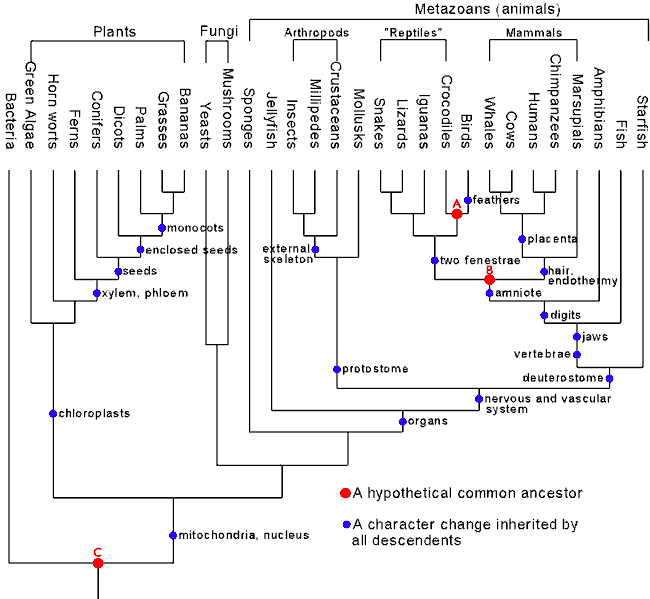
Ask yourself:
a) How many nodes (branching points) are in that tree above the root? (I count about 30)
b) How many of them would, to evolutionary biologists, represent a
single organism?
c) How many would represent a
species?
d) What? They would
all represent a species -- thousands or millions of individual organisms or more -- and not a single individual?
e) Why, then, would anyone who had thought about it for a moment (I know creationists don't usually do this, but bear with me for a second) think that the root of the tree represents a single physical cell instead of a "species" (or whatever approximation of a species you want to apply to prokaryotes).
f) Finally, does a picture of a dinosaur in a phylogeny indicate that the authors of the diagram think that there was one single ancestral dinosaur organism for the lineage in question?
And while you're at it:
g) Now consider this ancestral species, the Last Common Ancestor (LCA). Would evolutionary biologists say that it is the same thing as the very first replicator? Or would they say that the LCA was itself the product of a long evolutionary history?
h) Does WF Doolittle think that the standard genetic code evolved independently several times?
i) WF Doolittle actually does accept universal common ancestry for known extant life in a pretty strong way, doesn't he?
You had better figure these sorts of things out at some point, considering that you have written a creationism textbook, "
Explore Evolution", which you and the Discovery Institute are clearly aiming at the public schools, which makes this Doolittle-based argument, and which is clearly designed for a lawsuit where you will presumably try to defend this stuff. I'm just saying.
148 Comments
Henry J · 12 July 2007
Maybe I'm confused, but isn't it likely that for a strictly asexual species, that living members of that species would have a common ancestral individual? (Granted that wouldn't apply to sexual species.)
Henry
Glen Davidson · 12 July 2007
Well see, you envisioned a single cell during your pathetic science training (Paul projects, though it's probably true for many elementary schoolkids), and thus it must be a single cell (gee Paul, what about all the scenarios which have life pre-existing the first cell?). Learn what science really says? Surely you jest.
Of course there's another aspect to it. Paul is the opposite of a scientist, he insists upon top-down explanations while working from what is accessible (that is, evidence) is subject to negation from his top-down beliefs.
So like most or all metaphysicians, you have to begin with the simple and the single, or more or less, God. The single cell is what he conceives our God to be (how can anyone think without thinking God?), for it is at least relatively simple (as we suppose the first cell to be) and it is single. What, viruses, DNA exchanges, cells appearing from non-cells? No, it has to be his hierarchy, simple, unscientific, and quasi-religious. He thinks in terms of one source, and if it isn't really One like his three gods, well, then he can disregard the evidence and all science based on that evidence.
Evolution fails to live up to his preconceptions. Thus he has a mandate to rid the world of it, for how is the world to contradict his beliefs?
Glen D
http://geocities.com/interelectromagnetic
Steviepinhead · 12 July 2007
But, Henry. Wouldn't that founding individual--even assuming that we might agree there was only one--itself have been, during its lifetime, just one of a bunch of critters descended in turn from another, earlier such individual.
And so on, and so on...
PZ has a discussion of this same misconception over on Pharyngula (odd that it doesn't show up below as a TrackBack...) which probably expresses the idea better than me.
Even if we go all the way back to a (hypothetical, and I don't mean to confine the as-yet-unconstrained possibilites by picking this example) solution of self-catalyzing chemical reactants/products cycling around, just on the verge of becoming the first "replicator," isn't it more likely than not--even if there's only one such fortuitous pocket of reactants-on-the-cusp-of-replicating on the whole planet?--that the emergent replicator is something more like a gradient of interacting molecules--a "population" of sorts--than anything that could be called a single cell or entity?
Put less elliptically, and admitting that the image is probably now a simplistic one, I've never thought of a "soup" as a singleton.
Aaron · 12 July 2007
Henry, just because genes aren't recombined during asexual reproduction, doesn't mean such organisms never exchange genetic information. Genes were likely bouncing all over the place between cells in a manner not linked to reproduction (think of bacterial plasmids, for instance). So our genetic legacy still traces back to a diverse population.
I second the notion to read PZ's take (link).
Nick (Matzke) · 12 July 2007
Popper' Ghost · 12 July 2007
Gary Hurd · 12 July 2007
Woese, Carl
1998 "The universal ancestor" PNAS Vol. 95, Issue 12, 6854-6859, June 9
Woese, Carl
2002 "On the evolution of Cells" PNAS Vol. 99 13:8742-8747, June 25
These two articles should be always referenced when this sort of stupidity is presented by creationists. Basic version, there were extremely high exchanges of genetic material (of what ever kind) following the quite probable multiple origins of life. This alone makes it impossible to disentangle existing genomes to discover the "original" common ancestor. The selective environment was diverse and the organisms were promiscuous.
The notion of "frustrated" origins of life have actually gained some geochemical support in, Rosing, Minik T. and Robert Frei
2004 "U-rich Archaean sea-floor sediments from Greenland --- indications of >3700 Ma oxygenic photosynthesis" Earth and Planetary Science Letters, 217 237-244 (online 6 December 03. Incidently, this is also additional evidence against the creationist's farce of an oxygenated early earth still promoted by J. Wells.
Popper' Ghost · 12 July 2007
Coin · 12 July 2007
These two articles should be always referenced when this sort of stupidity is presented by creationists. Basic version, there were extremely high exchanges of genetic material (of what ever kind) following the quite probable multiple origins of life.
So just to be sure, what you're describing here is the same thing is horizontal gene transfer, right?
Popper' Ghost · 12 July 2007
ShanghaiJohnnyP · 12 July 2007
Ha Sa Moke Um Boom Di Yea!!
Hi Sa Moke Um Boom!!
A Ling Ting Tong
Trying To sing This Song
Singing Ha Sa Moke Um Boon Di Yea!!
Hi Sa Moke Um Boom!!
Salvador T. Cordova · 12 July 2007
ShanghaiJohnnyP · 12 July 2007
Somewhere,Beyond the Sea.
Somewhere Watching For Me,
My Lover Stands On golden Sands
and Watches The Ships That Go Sailing.
Somewhere,Beyond the Sea.
She's There Waiting For Me.
If I Could Fly Like Birds on High,
Then Straight To Her Arms I'll Go Sailing.
It's Far,Beyond the Stars,
It's Near Beyond the Moon,
I Know Beyond A Doubt,
My Heart Will Lead Me There Soon.
We'll Meet,I Know We'll Meet,
Beyond the Shore.
We'll Kiss Just as Before.
Happy we'll Be Beyond the Sea,
And Never Again I'll Go Sailing.
So Long sailing.
Bye Bye Sailing.
Au Revior Captain.
So Long Ensign.
Bye Bye Sailing.
"Beyond the Sea".Performed by The Late;Great;Still alive Somewhere Bobby Darin.
Born Robert Walden Cassotto,1936.
Died 1973.
I Think That We'll all Be A Lot Better Off If We
Only Would Pour Ourselves a Snifter of Brandy,
Fire Up A Good Dominican or Hondutran Cigar,
Put Ray Charles'"Goergia on My Mind"
or Bobby darin's"Beyond the Sea"on The Stereo,
Then Sit Back;Relax and Get Jiggy With it!!
Paul Nelson · 12 July 2007
PvM · 12 July 2007
In fact Darwin stated that there may be one or several common ancestors. Let's not be confused by Sal's quote mining.
David B. Benson · 12 July 2007
My (non-biologist) understanding is that prokyrotes oft transmit genetic materials to other prokyrotes, when these happen to meet.
So characteristic X might be transmitted this way.
(By the way, prokyrote isn't in the spell-checker. Hope I spelled it right.)
Paul Nelson · 12 July 2007
David,
If character X is horizonally transmitted, it will be phylogenetically unreliable for the history of the population of cells as cells. Horizontal transmission of genes greatly complicates inferences to common ancestry.
That's why I left horizontal or lateral transfer out of my little thought experiment. It only complicates matters, and does not solve the fundamental phylogenetic conundrum about the origin of characters used to infer organismal common ancestry.
Nick (Matzke) · 12 July 2007
Paul,
1. Read about "coalescence" and combine this with the existence of sex-like mechanisms in unicells. Your assumptions in your comment are wrong. Even in an old-fashioned "Neo-Darwinian" model there is no reason to think a common ancestral species had to derive from one single cell.
2. Yes, the tree is accurate to a high degree of precision. No measurement in science is perfect of course. If you have data that gives an alternative tree, you had darn well better give the tree similarity statistics while you're at it, or you're just another foolish creationist who thinks that a few discrepant measurements trump a strong signal supported by thousands of them.
I suppose one could argue that endosymbiosis is not explicitly depicted or that snakes have lost the digits that their ancestor had, but these sorts of things are a well-accepted part of modern evolutionary theory. And remember, this is a species tree.
3. Since I nicely answered your questions, please answer mine.
Nick (Matzke) · 12 July 2007
Glen Davidson · 12 July 2007
Glen Davidson · 12 July 2007
raven · 12 July 2007
Nick (Matzke) · 12 July 2007
Paul Nelson · 12 July 2007
Nick (Matzke) · 12 July 2007
Paul -- you missed my main question. Do evolutionary biologists think that the nodes in that tree represent an individual organism or a species?
Glen Davidson · 12 July 2007
And by the way, Paul, primarily lateral (the vertical is almost always a part of it in metazoans) transfer of traits is very well understood in vertebrates, including in humans. Do you think that the spread of lactose tolerance in human populations meant replacement of those populations?
Yet there isn't the slightest bit of trouble posed by this to human phylogenetic determinations. It is simply a positively selected trait which spread through those populations, becoming part of the history of life and of the human genome. Indeed, it is simply marked as a positively selected trait when the genome is studied.
I know it's pointless, but I'll still say that it behooves Paul to for once study evolution in order to understand it (not to accept, but to actually understand for once), and not to mine it for (usually pathetic) criticisms of same.
Glen D
http://geocities.com/interelectromagnetic
Glen D · 12 July 2007
Paul Nelson · 12 July 2007
PZ Myers · 12 July 2007
Errm, no, it wasn't.
There was no discrete character that suddenly marks the appearance of a new species. There is an accumulation of a constellation of genetic traits in a whole population of animals. There was no first chordate, not as an individual. There was a population of prechordate animals that contained certain alleles in the gene pool, and the distribution of those alleles shifted over time, and the suite of chordate characters emerged gradually over many generation and many individuals.
What you are promoting is a naive version of the hopeful monster idea.
Nick (Matzke) · 12 July 2007
So you *do* think that those nodes represent individual organisms! Incredible!
Here's a thought experiment for you. Take a species. Divide into two subpopulations via some catastrophe in the middle. In the first subpopulation, molecular character 1 arises on gene A. In the second population, molecular character 2 arises on gene B. Each character spreads to a high frequency in its respective subpopulation. Then, migration or environmental recovery brings the two subpopulations back together. Mating/conjugation occurs and suddenly 20% or so of the population now has characters 1+2, but without anyone ever having inherited 1+2 from an single individual organism with 1+2.
In other words, a single character can trace back to a single organism, but the inference that ALL shared characters therefore trace back to the SAME single organism is wrong, wrong, wrong.
Longhorn · 12 July 2007
Paul Nelson, I have ancestors that are fish. So do you. I have ancestors that are bacteria. So do you. I have ancestors that are rodent-like mammals. So do you. I share common ancestors with dolphins. I share common ancestors with all the animals and plants that are alive today. So do you. If you trace my ancestry way way back, you will find that some of my ancestors are bacteria.
Longhorn · 12 July 2007
Paul Nelson wrote:
"1. Character X evolved once, i.e., in a particular cell (call it Ur-X), early in the history of the population. Any other cell possessing X must therefore have descended from Ur-X. In this case, the population stems from a single physical cell.
2. Character X evolved more than once: n + 1 times, independently. No single physical cell can be implicated as the progenitor organism, at least for character X.
If (2) is the case, however, character X is phylogenetically unreliable, and we can't say whether the population shares common ancestry or not. Common descent may, or may not, be true."
I'm not sure if I see your point. But here is what happened: I share common ancestors with all the fish that are alive today. It is not as if a cell got started 1 billion years ago, and it evolved into all fish. And then another cell got started 500,000 years ago, and it evolved into all humans. All the fish alive today share common ancestors with all the humans that are alive today. The most recent common ancestor that I share with the goldfish that are alive today live over 500 million years ago.
Now I don't know whether a discrete single cell is the common ancestor of all the organisms that are alive today or whether it is hard to talk about a single cell that is the common ancestor of all the organisms that are alive today. But all the humans, cats, dogs, dolphins, monkeys, flowering plants and bacteria that are alive today share common ancestors.
RBH · 12 July 2007
Art · 12 July 2007
David Stanton · 12 July 2007
Paul,
Take a closer look at the tree. In cladistics, synapomorphies define clades not nodes. Some of the nodes as labeled as "hypothetical common ancestors" but not one node is labeled as the place where a new character arose.
Nick and PZ are correct. The nodes represent reproductive isolation and branching due to genetic divergence following reproductive isolation. This may occur in the absence of any initial morphological or even genetic differences.
And by the way, lateral gene transfer and introgression of mitochondrial genomes, etc. can pose significant problems for phylogenetic reconstruction. That is why multiple independent data sets are desirable.
Incorygible · 12 July 2007
A recent popular biology book I read (can't remember which) made the obvious but important point -- especially relevant to this argument -- that the number of ancestors one actually has increases exponentially with the number of generations removed. This is important to bear in mind, since staring at phylogenetic trees tends to trick our brains into envisioning the reverse. The book was discussing the mitochondrial 'Eve', and how it did not imply that all humans were descended from this one woman in the same fashion as her Biblical namesake would suggest. Rather, when we all trace our lineages back far enough -- to the point where each of us actually has thousands of human ancestors whose genetic material would eventually, in some fashion, end up in us -- she is one of them.
Paul, from which single common human ancestor are you and your siblings derived? Let's make this easy and restrict the discussion to your last common ancestor living on or about the year 1900. Or do you think that perhaps around that time there was a pool of humans, themselves largely unrelated (one would hope), who unknowingly, unwittingly -- and perhaps unwillingly (if only they could have known!) -- were the ancestral gene pool of one Paul Nelson and his real or imagined siblings? Is it not conceivable that some heritable trait (a difficulty discerning symbols from that which they represent, perhaps?) originated in just one of those 4, 8 or 16 ancestors, and is now shared by you and your immediate family? However, what if by some stroke of genetic 'luck' that trait is not shared by your first cousin's family? If we agree that one common ancestor produced the trait in all descendants who share it, is that one individual the sole common ancestor of note -- the lone progenitor of all descendants in the Nelson clan? For that matter, is he/she not also a common ancestor of your first cousin's family , which nevertheless lacks the trait? Do you see how there might be many, many individuals with messy relationships portrayed by simple lines, nodes and pretty pictures? If not, perhaps you might wish to explore it some more.
Gary Hurd · 12 July 2007
Gary Hurd · 12 July 2007
Incorygible · 12 July 2007
To make what I'm getting at exceedingly simple -- though it is intuitively obvious to most everyone who has really 'explored evolution' -- imagine that the hypothetical Nelson trait I describe becomes a defining feature of a diverse branch of life existing on this planet a million years from now (*shudder*). For example, let it take the place of "mitochondria, nucleus" in the blue dot at the base of Nick's tree. There is most certainly one 'Ur-Nelson' individual back to which all derived descendants can trace the origin of that trait. But we're talking about the LUCA. Is the actual LUCA of those descendants a single individual or a population of more than one individual? (Here the mitochondrial Eve and the y-chromosome 'Adam' provide good analogs, by the way.) In other words, if we were to gather up all the DNA existing in Nelson descendants a million years from now, could we find one ancestral individual -- a single LUCA -- that contained it all (even if we were to ignore mutations that had occurred subsequent to the LUCA)? The Ur-Nelson doesn't fit that bill in the slightest. For humans, it takes two to tango, so the answer is obvious (think the biblical Adam and Eve if you're unclear about that one). Now if bacteria have even more intricate and messy choreography when it comes to gene transfer, and if the swapping of genetic material for the proto-life on this planet was probably more messy and complicated still, odds are the entire ancestral basis for existing life on this planet was probably never localized within anything we might call a single cell.
Gary Hurd · 12 July 2007
RBH · 13 July 2007
Popper's Ghost · 13 July 2007
Popper's Ghost · 13 July 2007
Sir_Toejam · 13 July 2007
hoary puccoon · 13 July 2007
Aside from Popper's Ghost's use of stupid and moron (with which I have some sympathy. How many times, now, has Sal been told that biologists don't worship Darwin?) this thread is a wonderful example of discussing a scientific issue, not just slamming creationists. It would be good to remember when creationists complain that these threads are only profanity and griping.
Of course, it would help a lot if Paul Nelson would read Popper's Ghost's entry #187475 and acknowledge his point. That's the way science works. Researchers correct their mistakes and move on. If that's not the way ID works, then it simply isn't science.
Nick (Matzke) · 13 July 2007
What's really a shame is that Paul didn't realize the error he was making until after he put it into his creationist textbook Explore Evolution, which the Discovery Institute is now going to push into the public schools.
Sir_Toejam · 13 July 2007
Frank J · 13 July 2007
Popper's Ghost · 13 July 2007
Popper's Ghost · 13 July 2007
Rolf Aalberg · 13 July 2007
Marek 14 · 13 July 2007
Incorygible: Wasn't that book Dawkins's "The Ancestor's Tale"? I remember that he discussed these things in there.
Might be the best popular book dealing with ancestors I read.
Paul Nelson · 13 July 2007
PZ Myers · 13 July 2007
Popper's Ghost · 13 July 2007
Popper's Ghost · 13 July 2007
Popper's Ghost · 13 July 2007
Popper's Ghost · 13 July 2007
Raging Bee · 13 July 2007
Hello, Sal. Are you going to apologize for equating my words with the (alleged) surgical mutilation of innocent children? If not, why should we take you seriously as anything but a hateful scapegoating liar?
Paul: as long as you're posting here with impunity (again), why do you feel the need to move a proposed discussion onto a forum we all know to be much less tolerant of us than we are of you?
Paul Nelson · 13 July 2007
Incorygible · 13 July 2007
Okay, Paul. I have an idea. Why don't you make it VERY clear to EVERYONE in the ID "Big Tent" that a cursory understanding of genetics and phylogeny demonstrates that living organisms on this planet cannot possibly trace their lineage back to a single individual. For example, the genetic material contained within existing humans could NEVER have been contained within one lone Ur-Human (perhaps we could give him a certain proper name?). That's likely to shake a few of your erstwhile supporters, methinks. In the meantime, we and all those woefully inaccurate evolution books (including the Ancestor's Tale -- thanks Marek, that was probably the one) will be there waiting for the people who might be up to exploring the concepts underlying all those pretty pictures. I would wager a good number of them might actually be able to grasp something analogous to a simple family tree. For example, they might understand the fact that although my brother and I do not share a single individual LUCA, we are nevertheless the products of obvious common descent.
Longhorn · 13 July 2007
Paul Nelson wrote:
"In other words, if the theory of common descent means that all organisms trace their ancestry to a single physical cell, that theory is false. The first populations of cells on Earth contained many organisms which did not share common ancestry from any single cell. Thus, there never was a universal common ancestor, if that means a particular discrete organism.
This is exactly what Doolittle and Woese have been arguing vigorously for nearly a decade. As you put it, 'the inference that ALL shared characters therefore trace back to the SAME single organism is wrong, wrong, wrong.'"
------------
Here is an important question: Was there a specific cell on earth about 3.8 billion years ago that is the common ancestor of every other organism to live on earth? First, some people believe that there were subsequent cells on earth that didn't leave descendants that are as complex as plants. In other words, different cells formed on different parts of the planet at different times and some of those cells did not leave descendants that are at all complex. Here is a quote from Ernst Mayr in which he addresses the issue of whether life may have originated repeatedly:
"Astronomical and geophysical evidence indicate that the Earth originated about 4.6 billion years ago. At first the young Earth was not suitable for life, owing to the heat and exposure to radiation. Astronomers estimate that it became liveable about 3.8 billion years ago, and life apparently originated about that time, but we do not know what the first life looked like. Undoubtedly, it consisted of aggregates of macromolecules able to derive substance and energy from surrounding inanimate molecules and from the sun's energy. Life may well have originated repeatedly at this early stage, but we know nothing about this. If there have been several origins of life, the other forms have since become extinct. Life as it now exists on Earth, including the simplest bacteria, was obviously derived from a single origin. This is indicated by the genetic code, which is the same for all organisms, including the simplest ones, as well as by many aspects of cells, including microbial cells. The earliest fossil life was found in strata about 3.5 billion years old. These earliest fossils are bacterialike, indeed they are remarkably similar to some blue-green bacteria and other bacteria that are still living" (p. 40).
However, for the sake of argument, let's assume that life did not originate repeatedly on earth. Let's assume that there was one and only origination of life. In other words, in a single square foot on earth the self-replicators changed into life, and said life is the ancestor of every other organism to have lived on earth. Here is the question: What did this original life look like? Was it a single cell? I don't know. AT this moment in time, no person knows exactly which series of events resulted in the first cell forming on earth. It is an important question, and we should keep working on it.
But, Paul, it is important to understand that regardless of the structure of the first life on earth, I share common ancestors with all the daisies that are alive today, and I have ancestors that are fish and amphibians. You seem to be suggesting that this is not the case. It is the case. And it is very important.
Of course, some people believe that an intelligent super being turned inert matter directly into the first human that lived on earth. In other words, at time T there were no humans on earth. And then a super being used a power and turned some of the dust on earth ---- poof! ---- directly into the first human so that at time T + .2 seconds there was one human on earth. And then the super being removed a rib from this human, and from this rib the super being made the second human. But this didn't happen. People who believe this are wrong. All the humans descended from ape-like organisms. In fact, all the humans that have lived on earth have ancestors that are fish and bacteria.
Finally, I think it reasonable to believe that a single cell is the ancestor of all the organisms that are alive today. Because before you have two cells you need one cell. But another possibility is that multiple cells formed in close proximity to each other, and that they then came close together and formed into something more singular. And a third possibility is that there was life before a cell evolved. Maybe self-replicating RNA wasn't really cellular in nature, but we should call that RNA "life."
Popper's Ghost · 13 July 2007
harold · 13 July 2007
Popper's Ghost · 13 July 2007
Popper's Ghost · 13 July 2007
nickmatzke · 13 July 2007
Incorygible · 13 July 2007
drakvl · 13 July 2007
Paul: Your original objection seems to be the use of "ancestor," as in "last universal common ancestor," to describe a population. I can understand; this is not the common usage of the word. However, scientists are rather infamous for using a nonscientific word differently in a scientific context -- especially physicists, but biologists do it, too. Ever hear the story of how the cell got its name? A guy was looking through a microscope at cork, which appeared to be divided up into tiny compartments, resembling cells in a monastery.
Similarly, biologists have this huge ongoing metaphor with evolution and its terminology. The whole evolutionary tree -- looks a lot like a family tree, doesn't it? And yet family trees describe relationships between individuals, and the evolutionary tree describes relationships between populations. They're fundamentally different objects describing different relationships, yet there's just enough similarity that the evolutionary tree is a useful intellectual tool for simplifying a bunch of information into a smaller set of information, making the data more easily handled. Biologists, understanding full well the scientific context, can afford to relax a bit, and use language which would be confusing to the layperson -- such as describing a population as being an "ancestor." But they know the difference just as well as physicists know that gluons ("glue-ons") aren't manufactured by Elmer's.
demallien · 13 July 2007
I imagine that Paul Nelson still gets all hot and bothered trying to work out which came first, the chicken or the egg...
Popper's Ghost · 13 July 2007
Popper's Ghost · 13 July 2007
Paul Nelson · 13 July 2007
fnxtr · 13 July 2007
Okay, this layman still doesn't get it.
Mr. Nelson:
If Explore Evolution really isn't just religious prosletysing, why is it so important to you that it be used as a teaching aid to young, impressionable students, especially since most of the mainstream scientific community thinks it's a bunch of crap? I've never heard of this happening with any other 'controversial' idea.
Please explain. Thank you.
Salvador T. Cordova · 13 July 2007
Salvador T. Cordova · 13 July 2007
Incorygible · 13 July 2007
Popper's Ghost · 13 July 2007
Popper's Ghost · 13 July 2007
Wesley R. Elsberry · 13 July 2007
Popper's Ghost · 13 July 2007
drakvl · 13 July 2007
Sal: What are you talking about? Of course Darwin may have said things which were wrong. That's why it's called scientific progress -- it doesn't start in a perfect state! All that matters is how good Darwin's basic arguments are, and how well they extend to other circumstances. I mean, every groundbreaking theory has holes. Newton didn't anticipate the speed of light being constant in all reference frames; Einstein's field equations don't make good predictions on the quantum level. Even Euclid is considered to be woefully lacking according to modern standards of mathematical rigor. It seems you expect the first to be the greatest, which is having it totally backwards.
Wesley R. Elsberry · 13 July 2007
I should note that being called as a hostile witness is something that I've given some consideration to, myself. I've published on the topic and have been a pretty high-profile critic. I recall the questioning I got on my first outing with ID back in 1997, so I'm taking that as a guide to where the hostile questions would come from and be about. I think I'm ready.
Popper's Ghost · 13 July 2007
PvM · 13 July 2007
Sal, once again, evolution's best defender...
Glen Davidson · 13 July 2007
Glen Davidson · 13 July 2007
Glen Davidson · 13 July 2007
Nick (Matzke) · 13 July 2007
What Incorygible said.
Paul, I would be happy to have us point out the flaws in your new textbook on the exploreevolution.com website in an unmoderated discussion. Given the past history of discussions on DI-run blogs etc., I won't get my hopes up for this actually happening.
Frank J · 13 July 2007
Glen Davidson · 13 July 2007
Raging Bee · 13 July 2007
Paul Nelson pretends thusly:
I'm serious about setting up a moderation-free discussion at the Explore Evolution website.
I'll ask you again: why not have that discussion HERE? You know as well as we do that there's no moderation, and no censorship.
Gary Hurd · 13 July 2007
Popper's Ghost · 13 July 2007
Popper's Ghost · 13 July 2007
Popper's Ghost · 13 July 2007
Wesley R. Elsberry · 13 July 2007
We've got a dedicated thread for the "Explore Evolution" discussion at AtBC.
I've put up the press release on AtBC in response to someone wondering how to request a review copy, something that they said they couldn't find on the DI's website. Probably ought to have the web guru in DI-land fix that oversight.
Popper's Ghost · 13 July 2007
David B. Benson · 13 July 2007
I noticed, many comments ago on this thread, a misconception which I can correct. The issue is the number of ancestors, as a function of reverse time. So, I have two parents and they had two parents each, so I had four grandparents, etc. We have the geometric series
1 2 4 8 16 32 ...
which gives rise to the temptation that this continues indefinitely. Not so. Eventually the erstwhile number of ancestors exceeds the population size at some time depth. This is made a bit simpler by assuming a fixed population size, say 2048 individuals. Then at eleven generations back everybody was one of my ancestors and I never had any more than everybody at twelve generations back.
Popper's Ghost · 13 July 2007
David B. Benson · 13 July 2007
Popper's Ghost --- It wasn't Paul nor a regular here.
But you are welcome to read the entire thread yourself to find out the poster's handle...
Frank J · 13 July 2007
Popper's Ghost · 13 July 2007
Incorygible · 13 July 2007
Incorygible · 13 July 2007
Popper's Ghost · 13 July 2007
Popper's Ghost · 13 July 2007
rimpal · 13 July 2007
David B. Benson · 13 July 2007
incorygible --- Thanks for the prompt reply. I should have been more careful to scribe apparent misconception. And I certainly wasn't disagreeing with your main point.
But I do need to correct both you and Glen D. Here goes:
ancestor, n. 1. One from whom a person is descended, esp. at a distance of time; a forefather.
Note this is a binary relationship; either King David is an ancestor of Jesus of Nazareth or he is not. The number of paths possible between descendant and remote ancestor does not matter. Thus in counting ancestors one has to be more careful than either you, or Glen D, or I have been, if one wants accuracy.
So I should revise my earlier comment to state that at the eleventh generation back, one has between 2 and 2048 ancestors, inclusive.
I suppose this is quite a small matter given the subject of this thread.
Popper' Ghost · 13 July 2007
Dave Carlson · 13 July 2007
Paul Nelson and Sal Cordova are no longer with us. - D. Carlson
. . .
Oh wait, I'm sorry. I forgot which site this is.
David B. Benson · 13 July 2007
Popper's Ghost --- Then why didn't you just ignore it?
I don't find it a quibble.
The maximum likelyhood time estimate, based on genetics, (see Alex Templeton's recent papers), is that H. sapiens sapiens left Africa for Southwest Asia and the rest of the world about 135,000 years ago. Assume that date is exact. Assume 20 years per generation is correct.
Do I really have 2 raised to the 6750 power ancestors at that remove? No, probably five hundred to a few thousand.
While I suppose most who post here on PT understand this, it is a point easily misunderstood, or misinterpreted, and perhaps needs greater care than is ordinarily given.
If either incorygible or Glen D find that apologies are due, then I freely extent my apologies in advance, assuming my problem is my reading entirely and their writing not at all.
Sir_Toejam · 13 July 2007
Sir_Toejam · 13 July 2007
Sir_Toejam · 13 July 2007
Sir_Toejam · 13 July 2007
PvM · 13 July 2007
Let's not trouble Sal with asking him to do real science or research.
Sir_Toejam · 13 July 2007
_Arthur · 14 July 2007
I wasn't familiar with the term "Muller's Ratchet", so here it is:
http://en.wikipedia.org/wiki/Mullers_ratchet
My own favorite asexual organism, (not a pop singer) is the dandelion.
There are papers that claim that dandelions sometimes reverse their apomixis, and revert to sexual reproduction, allowing to fix charachters. Dandelions aggregate species is well-adapted to lawns.
Scott · 14 July 2007
Thanks to all the PT regulars for this discussion. As an interested layman and sometime lurker, it's actually quite enlightening. While it's great to learn a linear narrative of a subject (in this case, individual vs population, and the true "fuzziness" of the apparently "sharp" junctures in a cladogram), it also helps to learn how a subject can be misunderstood, what points were missed, and so avoid those misunderstandings.
While it seems that education is wasted on creationists, it sure helps the rest of us.
Thanks! :-)
P.S. The word "cladogram" is not in your spell checker's dictionary.
Paul Nelson · 15 July 2007
ben · 15 July 2007
PvM · 15 July 2007
Doc Bill · 15 July 2007
Exploring Evilution, or Purple Pandas Redeux, is ripe for the shredding.
Even a "lively, open and honest" exchange between EE's authors and the scientific denizens of the internet would be unprecedented on a creationist website.
Paul will report back that there are technical issues that will prevent an unmoderated discussion thread, not enough bandwidth, higher priority work for the web master to do, against policy or any trumped-up excuse one may imagine, but one thing will be clear: it won't be Paul's fault; he tried.
Longhorn · 15 July 2007
Paul wrote: "Either those traits arose from unique spatiotemporal events, with the probabilities of singleton occurrences, or they did not (with associated higher probabilties). If the latter is the case, the tree of life comes apart from the bottom up."
I have ancestors that are fish. Whatever we find out about the series of events that resulted in the first cell forming on earth, and whatever we find out about the structure of the first "life" on earth, I realize that I have ancestors that are fish. Here is a link to some of the kinds of information that has enabled some people to determine that I have ancestors that are fish:
http://www.talkorigins.org/faqs/comdesc/
It is reasonable to believe that one cell that formed on earth bout 3.8 billion years ago is the ancestor of every other organism that has lived on earth. A second possibility is that other cells formed subsequently to the first cell, and that the other cells did not leave descendants as complex as plants. A third possibility is that the first life was self-replicating RNA rather than something cellular in structure. Finally, perhaps a number of life forms formed at the very same moment in time, each life form physically touching at least one other life form. And perhaps this cluster of entities is the ancestral population of all the organisms that are alive today. But whichever of those events occurred, or whether some other event occurred, I have ancestors that are fish and so do you. And that is very important.
Moreover, if a number of simple life forms formed at the very same moment in time, each of the forms touching at least one other form, it is not the case that one life form in this cluster evolved into humans while another evolved into fish. The whole cluster together would have evolved into all the complex organisms that have lived on earth, first evolving into fish, then into amphibians, then into reptiles and then into mammals. Here is a link to some of the kinds of information that has enabled some people to determine this:
http://www.talkorigins.org/faqs/comdesc/
Laser · 15 July 2007
ben, in addition to wanting the "discussion" at a venue that he can control, Paul also wants it at a venue where the "Amen chorus" of UD sycophants will post. That would give an innocent bystander the impression that there really is a "controversy", because there would be all these people debating the book, some on one side, some on the other. For him, it's all about style, since there is no substance.
Bruce Thompson GQ · 15 July 2007
Scott · 15 July 2007
Paul Nelson wrote:
You still don't seem to get it. I'm no expert, but even I can follow the simple arguments here. Yes, LUCA was probably a "species". Yes, the members of that population shared traits. But, most members also had relatively unique traits, traits shared by only a few members of the "species". But keep in mind that the "naturalistic" argument, even of abiogenisis, is one of gradualism. Very gradual gradualism. No scientist is seriously suggesting that all of a sudden, *poof*, there was the first cell. No strong contender has emerged yet, but there is good evidence for possible non-biotic replicators. Gradually, these replicators became better and more efficient at replication. The population of replicators evolved, as better replicators were able to make more copies of themselves than earlier replicators. Slowly, eventually the pool of replicators began to look more and more like the first thing we would recognize today as an early "cell". Was there a single pre-biotic replicator that acquired just one single mutation that finally turned it into a true "cell"? Possibly. Presumably such an entity would be dramatically better at using the local resources as the non-biotic replicators, and so would drive all other non-biotic replicators to "extinction". But probably not. The line between pre-biotic and biotic replicators is probably a wide and fuzzy one, just like the line between species is a wide and fuzzy one. That's the whole point of this thread (or one of the main points). Just as there was no single event that separated one species from another, there was probably no single event that separated pre-biotic from biotic replicators. The entire "population" evolved together slowly, gradually. In fact, it's possible that population of replicators wandered over the biotic "boundary" *and back again* several times. Second, invoking Darwin's ignorance to "prove" that God created life is laughable. My meager understanding is that Darwing had no inkling of DNA or molecular mechanisms for replication. Our knowledge has grown a lot since then. We now know that non-biotic replicators are possible. We've demonstrated such. Today, it is not such a stretch to leap the gap from a non-biotic replicator to a biotic one. In Darwin's day, such a leap was not possible. The gap was too large. Finally, you seem to think that Darwin's Origin of Species is the "Bible" of Biology. Just as people believe a literal, never-changing interpretation of the Bible, so you seem to think that scientists hold a literal, never-changing interpretation of whatever Darwin wrote. So, Darwin (as a trained theologian) invoked the Creator for something he could not explain. What does that prove? What significance do you think that has for Science today? Why do you think Darwin's belief (even if it was a literal statement of his beliefs and not merely a metaphor for "the process that brought about the first cell") is the last word in abiogenis?Glen Davidson · 15 July 2007
Glen Davidson · 15 July 2007
David B. Benson · 15 July 2007
Glen D --- While with the parenthetical comment, I suppose your wording can be interpreted in a correct manner, there may be some who would not do so, thinking something like "Kind David is my ancestor 25,000 times over," whatever they might mean by that.
Proper application of reason begins with careful definitions and attempts to proceed from there. Given the readership here, it is possible that at least one reader needed, after that four-way exchange, to actually see the definition.
Finally, I must wonder about the state of mind of somebody who would post that comment regarding what amounts to a tempest in a teapot. Hmmm...
Glen D · 15 July 2007
David B. Benson · 15 July 2007
Glen Davidson · 15 July 2007
David B. Benson · 15 July 2007
Moses · 15 July 2007
Popper's Ghost · 17 July 2007
Popper's Ghost · 17 July 2007
Popper's Ghost · 17 July 2007
Popper's Ghost · 17 July 2007
Popper's Ghost · 17 July 2007
Popper's Ghost · 17 July 2007
Tyrannosaurus · 17 July 2007
Have Paul Nelson or any of the ID-Creos ever heard of "emergence" and complexity from simplicity? Well may be the only emergence they know of is the one they call POOF!
What a bunch of malicious spreaders of ignorance to suit their own preconceptions and desires these people are.
Glen Davidson · 17 July 2007
Oh Paul, I just had to ask another question of you, because I don't see why the embarrassing stream of questions you can't answer should end just because you ignore them.
Why do you suppose that the patterns of evolution differ significantly between eukaryotes which essentially breed "within species", and prokaryotes which share DNA "across species"? I mean, evolution predicts that the patterns would differ, based on the differing mechanisms, while "design" would predict, well, what?
And of course, what is so obvious, the fact that there is no actual break between "macroevolution" and "microevolution" (the scare quotes are because of the abuse IDists make of those terms) is not true simply of eukaryotes, it is true of prokaryotes as well. That is to say, your "designer" happens to "design" prokaryotes as if they had evolved according to known prokaryotic mechanisms of recombination, and your "designer" also "designs" eukaryotes as if they had evolved according to eukaryotic mechanisms of recombination.
My my, isn't that another tremendous miracle that you can sock away into your list of miracles? I mean, of course evolution isn't possible (you know, due to souls and other theological reasons), but miraculous coincidence of design with what would be expected from evolution, those are dime a dozen.
Poof, poof, and more poof. We asked for "proof", but "poof" is even better, isn't it? And you can even predict God's miracles, just use evolutionary theory to make the predictions, and you know that God will follow it's dictates.
But then, is God really God, or is he somehow some little slave of evolutionary predictions? See how nice I am, Paul, I'm giving you some good material to work into your previous fantasies. Maybe you can discover some even greater God, the one that orders your silly little God (and note, I'm not calling all theists' gods silly, just these ridiculous IDC/creo "designers") to follow the dictates of evolution.
Glen D
http://geocities.com/interelectromagnetic
Steviepinhead · 17 July 2007
That Sal.
Unlike the rest of us, who can claim to have benefitted from at least the occasional fortunate accident along the way, in Sal's case it's not "from the goo to you"--
--it's just "from the goo to goo."
Slime all the way down.
slpage · 21 July 2007
ordova:
"I agree. Darwin had stupid ideas. No question."
Well, Cordova, you would be the person to go to when discussing stupid ideas, that much is certain. How can evolution explain the fusing of ribs to the sternum, right Sal? Why, this would require a reorganization of the abdominal viscera!
LOL!
Laughing AT you....
ben · 30 November 2007
Hi Larry
pete dunkelberg · 5 July 2008
hey Nick, greetings from the library. I like my pc much better than this ine but mine was stolen. So I lost all my files - a couple years worth of emails, downloads and lots of photos and etc etc. The box was missing the side panel so that the circuit boards are visible also missing the front panel that is just for looks. So it may be hard to pawn (but not the nice monitor)so it may become someone's personal computer -- neighbiors are suspect but no evidence. so the crew won't hear from me fopr a while. Jeeze what a lousy screen I am working on. For some reason speloling errors are not marked and the screen is a bit hard to read. there is an interesting paper in nature on inferring the evolutionary history of protein folding if I got it right on a quick look. One Eric Smith in The Scientist writes something about Evolution's ""real problem"" meaning OOL. Seems to be a complexity enthusiast but he concludes that life started from something simpler than what it now is - duh.
In Barnes and Nobel I have not seen Behe DBB or othe rbook on the shelves recrerntly -- two days ago I saw dbb remeindered.