Luskin is correct to point out that seismologists have made a design inference. What Luskin fails to tell you is that the design inference has little relevance to Intelligent Design's "Design Inference". Let me explain why Luskin's claim shows that Intelligent Design has failed to address some of the many criticisms raised, and that ID's concessions have rendered it to be scientifically vacuous. See also SETI, archeology and other sciences at Skeptico's blog for why Luskin's arguments fail. In the past I and various others have pointed out how ID argues that on the one hand science excludes design inferences and on the other hand that science has successfully applied design inferences in such areas as archeology, criminology etc. The solution for this apparent contradiction is simple: When ID refers to design inference, they are actually talking about the "Design Inference" proposed by Dembski. This "Design Inference" differs in many important ways from how science applies its design inferences. The most important one is that Dembski's "Design Inference" attempts, with limited success, to detect design through elimination while science, with considerable success, eliminates hypothesis by matching positive signatures. The example proposed by Luskin is not different. Notice that the seismologists did not apply the "Design Inference" which would have required various steps to be taken: First of all the signal has to be shown to be 'specified', secondly, the signal has to be complex which requires that the signal cannot be explained by known regularity or chance occurrences. One could argue that the specification criterion is met by a comparison with previous known nuclear tests but that would be cheating."North Korean Nuclear Test Forces Seismologists to Make a Design Inference".
Source: William Dembski Intelligent Design as a Theory of Information (sic) So how about complexity?Specifications are the independently given patterns that are not simply read off information. By contrast, the "bad" patterns will be called fabrications. Fabrications are the post hoc patterns that are simply read off already existing information.
— Dembski
But this raises a significant problem for ID as it either will have to accept both nuclear explosions as well as natural earthquakes as 'specified', or neither one will meet the specification requirement. That a design inference is not necessarily the result of intelligent agency, is something that most ID activists simply overlook and yet Dembski was clear on this as was pointed out by Del RatzschWhat is it for a possibility to be identifiable by means of an independently given pattern? A full exposition of specification requires a detailed answer to this question. Unfortunately, such an exposition is beyond the scope of this paper. The key conceptual difficulty here is to characterize the independence condition between patterns and information. This independence condition breaks into two subsidiary conditions: (1) a condition to stochastic conditional independence between the information in question and certain relevant background knowledge; and (2) a tractability condition whereby the pattern in question can be constructed from the aforementioned background knowledge. Although these conditions make good intuitive sense, they are not easily formalized. For the details refer to my monograph The Design Inference.
Del Ratzsch in "Nature, Design, and Science:The Status of Design in Natural Science", SUNY Press, 2001. More recently Ryan Nichols pointed out that Dembski has made a significant concession"I do not wish to play down or denigrate what Dembski has done. There is much of value in the Design Inference. But I think that some aspects of even the limited task Dembski set for himself still remains to be tamed." "That Dembski is not employing the robust, standard, agency-derived conception of design that most of his supporters and many of his critics have assumed seems clear."
Source: Ryan Nichols, The Vacuity of Intelligent Design TheoryBefore I proceed, however, I note that Dembski makes an important concession to his critics. He refuses to make the second assumption noted above. When the EF implies that certain systems are intelligently designed, Dembski does not think it follows that there is some intelligent designer or other. He says that, "even though in practice inferring design is the first step in identifying an intelligent agent, taken by itself design does not require that such an agent be posited. The notion of design that emerges from the design inference must not be confused with intelligent agency" (TDI, 227, my emphasis).
Certainly, such a specification would also render the signal to be simple rather than complex as it can be shown to match a known regularity. Intelligent Design however relies on an absence of known regularities to infer its 'Design Inference'. So assume seismologists detect a particular event, the conclusion is that whether the event was a natural earthquake or a nuclear explosion, a design inference can be made. In the former case, the designer involves the natural processes in the interior of the earth, in the latter, the natural processes of nuclear fission, set in motion by a nuclear bomb. Luskin's example also shows why the paper by Wilkins and Elsberry titled The advantages of theft over toil: the design inference and arguing from ignorance is still very relevant as the authors show that 'design' involves two different categories: "... the ordinary kind based on a knowledge of the behavior of designers, and a "rarefied" design, based on an inference from ignorance, both of the possible causes of regularities and of the nature of the designer".What's more, the competing possibilities that were excluded must be live possibilities, sufficiently numerous so that specifying the possibility that was actualized cannot be attributed to chance. In terms of probability, this means that the possibility that was specified is highly improbable. In terms of complexity, this means that the possibility that was specified is highly complex.
— Dembski
So lets compare how science infers design and compare this with how ID infers 'Design'.Intelligent design theorist William Dembski has proposed an "explanatory filter" for distinguishing between events due to chance, lawful regularity or design. We show that if Dembski's filter were adopted as a scientific heuristic, some classical developments in science would not be rational, and that Dembski's assertion that the filter reliably identifies rarefied design requires ignoring the state of background knowledge. If background information changes even slightly, the filter's conclusion will vary wildly. Dembski fails to overcome Hume's objections to arguments from design.
Using compressional and shear wave data from known events, PNNL researchers have built statistical models that describe what energy waves look like for earthquakes and for explosions. "When we have a new event coming down the line and we don't know what it is, we can ask if its energy waves most closely match the earthquake model or the explosion model," said PNNL's Dale Anderson, principal investigator on this project. In addition to creating statistical models for each discriminant, PNNL researchers are adding a new twist by mathematically combining the discriminants into a model to more accurately identify a seismic event. These models account for uncertainty in measuring individual seismic discriminants. "The better we can estimate a discriminant, such as depth, the less uncertainty we will have in the final decision about the type of event," said Debbie Carlson, a PNNL mathematician working with Anderson.
 Seismograms show the amplitude of shear energy (Lg) is larger for an earthquake than for an explosion. Scientists at PNNL are using compressional (represented by Pg) and shear wave data from seismic events to build statistical models that will ultimately help distinguish earthquakes from explosions. Source
Similarly on Seismic Monitoring Techniques Put to a Test scientist Bill Walter explains how science detects 'foul play'.
First of all scientists have access to a large variety of data but for the moment I shall limit the available data to seismology. The first indication of a nuclear explosion is when the actual seismogram differs from typical seismograms found in the region.
Seismograms show the amplitude of shear energy (Lg) is larger for an earthquake than for an explosion. Scientists at PNNL are using compressional (represented by Pg) and shear wave data from seismic events to build statistical models that will ultimately help distinguish earthquakes from explosions. Source
Similarly on Seismic Monitoring Techniques Put to a Test scientist Bill Walter explains how science detects 'foul play'.
First of all scientists have access to a large variety of data but for the moment I shall limit the available data to seismology. The first indication of a nuclear explosion is when the actual seismogram differs from typical seismograms found in the region.
 Scientists then look at P and S waves. P waves are compression waves and S waves are transverse or shear waves. Based on scientific principles, one would expect that explosions will show large P waves and weak S waves and earthquakes would show just the opposite.
So when P to S amplitudes are measured, scientists can determine quickly if the event is natural or 'designed'
Scientists then look at P and S waves. P waves are compression waves and S waves are transverse or shear waves. Based on scientific principles, one would expect that explosions will show large P waves and weak S waves and earthquakes would show just the opposite.
So when P to S amplitudes are measured, scientists can determine quickly if the event is natural or 'designed'
 And finally scientists compare the seismogram with earlier seismograms of similar events.
 It should be clear by now that seismologists do not conclude 'we cannot find any regularity or chance explanations, thus designed', but rather rely on comparisons with known events, both natural and 'designed'.
 Seismic signal on vertical components of broadband stations operated by the IPE, BP filter 0.8-2.8 Hz.
and
Seismic signal on vertical components of broadband stations operated by the IPE, BP filter 0.8-2.8 Hz.
and  Seismic record (large version)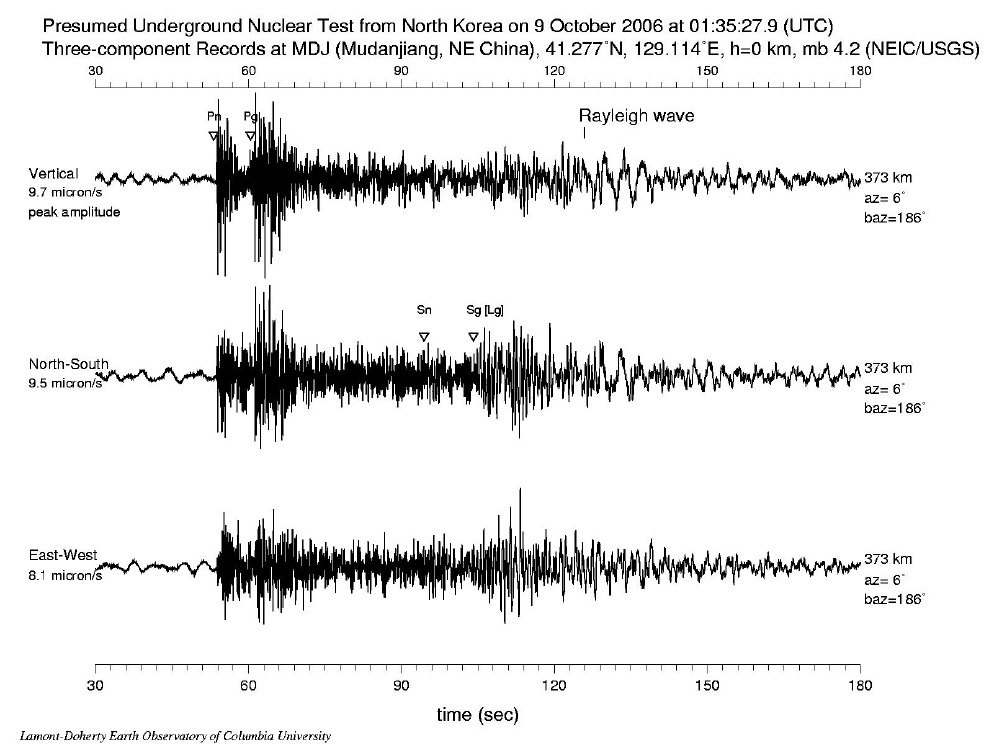
16 Comments
MarkP · 3 November 2006
Glen Davidson · 3 November 2006
That's excellent commentary on the differences between how design is really inferred, and the "Design Inference".
It's such an odd claim, though, to say that design was inferred from the seismogram. Is Luskin supposing that a natural nuclear explosion would create a different signature? But of course this gets to the crux of the "design detection", one simply considers the physics of the event causing the seismic signature, and matches the two. We infer "design" behind the signature of a nuclear blast because "natural" nuclear explosions don't happen on earth. And we recognize nuclear weaponry via "natural means" alone, since we know about the "design" of things by understanding the limitations of the causal events giving rise to them.
How did we really know that the N. Korean blast was nuclear? Not via the seismograph alone, but by picking up radioactive material which indicated that it wasn't a conventional blast. On the small end of the scale, we don't infer the design of the explosive entirely by seismography, because we can't reliably distinguish between a large conventional blast and a small nuclear blast by seismic waves. We might infer agency whether the blast was conventional or nuclear, but we would know nothing about the design itself (we'd say the blast was "by design", but that's just what we say when human agency is involved).
Anyhow, isn't this just like an IDist? Casey only wants to say "it was designed". Any real scientist wants to know what the design is, and makes inferences about the device's design by using the known facts and principles of physics to learn about what this particular design happens to entail. Luskin doesn't tell us how Behe's IC and Dembski's EF are supposed to allow us to understand what the design was and how it created the explosion, the end is only to say "it was designed". We are stuck with "naturalism" to tell us anything about the design of the bomb, as indeed we had to rely on "naturalism" to detect the bomb in the first place.
Luskin's writing for the rubes, of course. He wants to leave the impression that we don't allow for design detection, even though design detection happens all of the time. We are, in fact, only unwilling to "detect design" where no evidence of it exists, and he happily conflates ruling out design based upon the (lack of) evidence with ruling out design in general.
In the metaphysical ID sense, everything involved with the detection of N. Korea's nuclear device is very natural, including its design. We assumed that God was not tampering with the evidence when we took seismic readings. The parameters for a nuclear explosion were taken to adhere to human and physical limitations.
We actually assume that supernovae are not caused by N. Koreans, partly because we rely upon the limitations of the "designers" to recognize design. Are we to believe that N. Koreans created life because there are some resemblances between human design and organisms? No, we do not know any living intelligences capable of producing life, any more than we know of any capable of setting off supernovae. This is the non-design inference, that when we lack evidence of a capability by known designers, we do not assign phenomena to this a hypothetical "design" capability that is lacking among known designers. But I guess it might be convenient to blame the N. Koreans for Hurricane Katrina, since we know that they are able to organize complex phenomena, which is what Katrina was.
Epistemologically and epistemically, the non-design inference comes first. We do not ascribe causality of a phenomenon that we don't understand to known designers (not unless they are spatially or otherwise associated with the phenomenon, and then only tentatively), let alone to unknown designers. By turning epistemology on its head, the IDists want to make the unknown the responsibility of unknown designers, meaning that responsibility for lightning (still poorly understood in its origination) can yet be given over to Thor.
The worst twist of the scientific process is taking a known "natural process" (not fully known, but so much is known), like evolution, ignoring the need to explain what current theory explains (phylogenetic trees, fossils, genes), and claiming that their unknown designer ought not to be understood to act like known designers, but to produce phenomena entirely as evolutionary processes are predicted to produce. This would be like explaining the N. Korean explosion based not upon our understanding of nuclear devices made by known processes and intellects, rather to Thor, Satan, or Jesus. After all, why should the N. Korean explosion be explained according to "natural processes", if the development of life is not?
If "naturalistic" prediction and post-diction are not used to determine not only the "natural processes" but also "design processes", we would never be able to determine the designs the N. Koreans are up to.
Glen D
http://tinyurl.com/b8ykm
Glen Davidson · 3 November 2006
Steviepinhead · 3 November 2006
One doesn't even have to think in terms of stellar combustion or supernovas to come up with "natural" nuclear reactions.
It is well-accepted that there have actually been such self-sustaining nuclear reactions in deposits of sufficiently-rich radiocative ores (this is just the first of many google links that come up when searching "natural nuclear reaction"):
http://www.ocrwm.doe.gov/factsheets/doeymp0010.shtml .
At least three separate "fossil" reactions are known at this one site. They occurred over a billion years ago without, so far as is known, the intervention of any intelligent agency.
Why is it that, every time the IDiots come up with some candidate "intelligent design" event, nature turns out to have beaten them to it?
One might almost imagine that these wing-nuts have ticked off some Meta-Entity somewhere, who is enjoying the heck out of inspiring them to advance inflated claims, only to then take great delight in pricking them.
Popper's ghost · 3 November 2006
David B. Benson · 3 November 2006
I can imagine a seismologist using the word 'design'. The events are due to earthquakes, man-made explosions, or one of a few other possible causes. Distinguishing man-made explosions from earthquakes, nearby cave-ins or landslides is fairly easy, as this post indicates.
But all the seismologist reports I have read, maybe half a dozen, use the word 'explosion' solely for a man-made, sometimes unintentional, explosion, chemical in the ones I have read up to this post.
David B. Benson · 3 November 2006
Oops! I meant I CANNOT imagine...
secondclass · 3 November 2006
'Rev Dr' Lenny Flank · 3 November 2006
Peter · 3 November 2006
Dembski is an example of a George Carlin joke: "Let's make language a total impediment to understanding."
Dembski has almost certainly read a fair share of post-modern analysis, historiography and or criticism because he basically nails the style. He doesn't want to talk about what he's done. He wants to intimidate us into believing that he knows what he's writing about by using jargon. The Stoekel paper and Richard Dawkin's critiques of po-mo acadmemia in The Devil's Chaplain often come to mind when I read Dembski.
It's a bit ironic that a champion of the "people's" belief in the cosmic babysitter cant' even convey his thoughts in clear populist English.
Henry J · 3 November 2006
Re "He says that, "even though in practice inferring design is the first step in identifying an intelligent agent, taken by itself design does not require that such an agent be posited."
About that claim of design not implying a designer: first time I read that it struck me as nonsensical. Still does. Am I missing something?
Henry
PvM · 4 November 2006
Design not implying a designer basically states that even though something may be 'designed' agency can still include natural designers such as selection.
People have pointed this out for quite some time. Dembski's comments may have been lost on his ID followers.
Stuart Weinstein · 4 November 2006
"I can imagine a seismologist using the word 'design'. The events are due to earthquakes, man-made explosions, or one of a few other possible causes. Distinguishing man-made explosions from earthquakes, nearby cave-ins or landslides is fairly easy, as this post indicates.
But all the seismologist reports I have read, maybe half a dozen, use the word 'explosion' solely for a man-made, sometimes unintentional, explosion, chemical in the ones I have read up to this post."
In addition to magnitude, appearance of the P and S coda and other things mentioned above, seismologists can categorize earthquakes by the nature of their CMT (centroid moment tensor).
The CMT tells you the nature of the source. The vast bulk of naturally occuring earthquakes have CMT's that are consistent with double-couple fault mechanisms as predicted from basic elastic dislocation theory. However, it is certainly possible to have a large isotropic component which can either be "explosive" or "implosive". For small yeild explosions the CMT may be difficult to determine, but not impossible. The CTBTO maintains a global seismic network including seismic arrays, which could allow analysts to make such distinctions.
My take, is that the test was a dud. The radioactivity that was detected indcates that radioactive materials were involved, but the small yeild (I have no idea how the Ruskies came up with 15kt) indicates the explosion fizzeled.
If it was a low yeild nuke, sort of an atomic hand grenade, then there is much to worry about. But so far all joiners of the nuclear club joined with 1940's style nukes.
Another possibility is that NK purposely detonated a radiological device with the purpose of getting everyone hot and bothered.
Popper's ghost · 4 November 2006
Popper's ghost · 4 November 2006
Mark Duigon · 7 November 2006
It's not just you, MarkP and others who who noted Dembski's obfuscatory style of writing--Dembski likely wants people to be confused and to blame themselves if his points seem not not make any sense.
When I first read Dembski's stuff on information, the first thing that came to my mind was "What about seismic signals?" They clearly are not "designed" regardless of whether they are created by earthquakes, nuclear bombs, or explsions set off in seismic exploration. I thought particularly about seismic exploration, where properties of unseen, subsurface geologic media can be inferred from the behavior of the seismic signals. Lots of information there, which we can tease out of complex waves because we have studied the effects of rock properties on wave velocity and transmission, etc.--having drilled, cored, and done laboratory testing as well as field testing.
Similarly, there is a lot of information contained in other time-series graphs, such as flow of a karst spring, decline in ground-water levels, and more. We can pull out the information they contain for the reason Pim pointed out--we have studied these phenomena, not just in themselves, but in relation to a multitude of related properties.