
Due to popular demand I have made some more charts that are slightly more complex than the hominin cranial capacity chart from
yesterday's post.
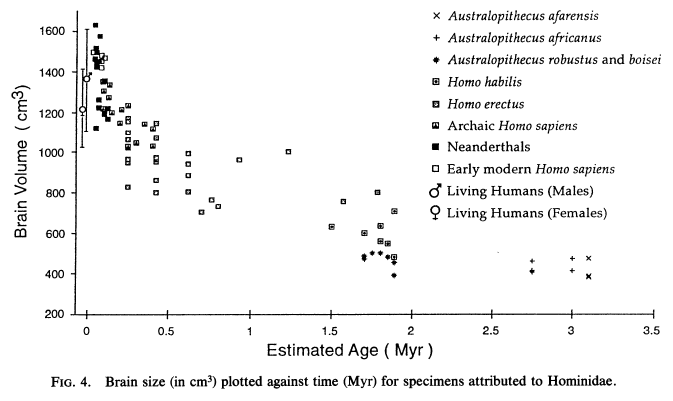
In the first chart, I have taken the "favored" taxonomic labels for each specimen from
De Miguel and Henneberg (2001). Many specimens have been put in different species or different genera by different taxonomists, but these are supposed to represent something like the consensus, as the authors judged it in 2000.
Australopithecus fossils are in red with various symbols, early
Homo fossils (
Homo habilis and others just labeled "early
Homo" or "
Homo") are in orange,
H. erectus is in green, and the asundry variations on
Homo sapiens are in blue.

The vertical bars on the right side represent the variation in cranial capacity for modern human males and females, taken from the
McHenry et al. 1994 chart.
We can see here a point made by
an actual anthropologist in the comments to the other post, which is that cranial capacity is not constantly increasing in every species. By eyeball inspection, it looks like there was a surge between
Australopithecus -
Homo habilis -
Homo erectus, then stasis for 500,000 years in erectus, then another surge over the last million years (but note that this has leveled off -- modern humans actually have smaller brains than Neandertals). Of course (and I emphasize), eyeball inspection is not a statistical analysis, and even a statistical analysis of stasis and change in hominin species would require some decisions about which taxa are "good species", and this turns out to be a rather difficult thing to decide for many specimens (see below). The models that De Miguel and Henneberg fit to the data indicate that if one take the broad view across all of the species for millions of years, swamping out local events and local stasis, there is a pretty consistent exponential growth trend.
One nice feature of this chart is that we can place creationist claims in a quantitative context and see if they are meaningful. As I
mentioned last week, Casey Luskin of the Discovery Institute likes to manufacture a "gap" in the hominin fossil record by citing papers that prefer to label
Homo habilis as
Australopithecus habilis. That accomplished, he dusts his hands and declares that that is the spot that God intervened (er, "the designer") to create the
clearly human
Homo erectus and its impressive 800 ml cranial capacity. Presumably this is also the spot where Luskin thinks the Intelligent Designer created proto-humans with 48 chromosomes which just happen to match the great ape chromosomes.*
Anyway, what actually happens to the evidence if we switch the labels on
habilis? I've done just that in this chart:

See, there's no fossil evidence for human evolution now!
More fun with labels
It is often written that hominin taxonomy is contentious, with "lumpers" and "splitters" arguing about where to draw lines and what counts as a fossil "species." I often wonder if this argument is useful activity, since really, the only people who actually think that fossil species should always be distinct and morphologically discontinuous from other species are the creationists. With evolution, species are
not permanently stable entities, and here and there they are going to intergrade with other species. It's just a fact of life that some species are going intergrade, and thus going to be impossible to describe completely with typological labeling. Some specimens will fall in group A, some in B, and some in-between.
Part of the paradox here is that taxonomy will be especially difficult where the evidence for gradual evolutionary change is especially good. I think you can see this somewhat in this next chart. Here, I have created a category called "multiple", which applies to any specimen that received more than one species designation according to De Miguel and Henneberg 2001.

Of course, this isn't perfect, since some of the species names causing some of the "multiples" are no longer in use and wouldn't be considered "live" controversies in paleoanthropology. And there are some specimens given vague labels like "early
Homo" that probably indicate taxonomic uncertainty, but this was the only designation available so I left them as-is. On the other hand, there does appear to be quite a bit of confusion about the boundary between
Australopithecus and
Homo, and about the differences between
H. erectus and early
H. sapiens.
The Excel spreadsheet is probably too big to upload on PT given our constant bandwidth issues, but I have emailed it to a number of people (my email is: matzkeATncseweb.org). It is not particularly "nice" looking at the moment, of course, but feel free to use/modify it for nonprofit educational purposes, with attribution. Someone with some bandwidth might even upload it on their website.
Notes
* Luskin
postulates that the non-evolved 48-chromosome human ancestor then evolved into the 46-chromosome modern human through chromosome fusion, thus miraculously explaining away Kenneth Miller's argument that the fused chromosome in humans is evidence of common ancestry with the apes. I Am Not Making This Up. Here is Luskin's graphic:

I suppose he thinks the Intelligent Designer created the
endogenous retroviruses and
plagiarized errors we share with apes in the human genome also, just to be clever.
28 Comments
Philip Bruce Heywood · 30 September 2006
O.K., do some other species by way of comparison to find out what this data means in terms of speciation. E.g., Run all the permutations & combinations on cranial capacity in donkeys and horses and see whether we can't "prove" that dankeys are evolving into horses. Incidentally, a bullock has a brain that we can make a meal from, but only desperate men make a meal from an entire crow - which comes in more intelligent than any bullock. Find what a species is, first; then you are entitled to hypothesize on the origin therof.
Thought Provoker · 30 September 2006
Nick,
As always, you have provided very good and thought provoking information.
However, I will make the prediction that your A. habilis chart will be immediately quote-mined and offered as evidence that you, yourself, provided proof that Luskin was right after all.
David B. Benson · 30 September 2006
Nick, this is a very useful exercise for me! As I read it, there is no evidence for H. erectus more recent than about 75,000 years ago, but there is more recent evidence of Archaic H. sapiens. Did I pick that off correctly?
mplavcan · 30 September 2006
Nick:
Gotta run some errands tonight, so I can't comment extensively, but the chart is exactly the point to make. As a note, I wasn't taking issue with you, but only with one assumption of De Miguel and Henneberg.
You will note that the most obvious inflection is between early Homo and H. heidelbergensis. At that point, not only does brain size change, but relative brain size changes too (there are pubs on this, but I'm at home and don't have the refs at my fingertips -- I've seen the material, and it's real). For our creationist friends, the transition along the Homo lineage is quite gradual. Even people who eat sleep and live these things have trouble finding a clean demarcation. This is one of the strongest cases of a non "punctuational" transition out there (but there are others, cf Cantius, Omoyids, Hyopsodus, Hyracotherium etc.). Great job.
mplavcan · 30 September 2006
Mr. Heywood:
Huh? OK, let's just ignore the bullock brains comment, which makes no sense at all in this Universe. Has it occurred to you that those of us in the profession have not asked these questions? Do you actually assume that we are THAT stupid? The issue of morphological divergence and speciation has been extensively investigated, and continues to be an active area of investigation.
To give you an idea (if you are even interested in hearing it), you can divide the investigations between those looking at phylogentic distance (relatedness), morphological and ecological divergence, and those documenting temporal transitions in the fossil record. Both are well known. Of particular interst for this thread, there are a number of well-known transitions in the fossil record for a diversity of morphological features. Just go to a library (thing with books and journals), and look in such things as Paleobiology, Paleontology, the the Journal of Vertebrate Paleontology, and a multitude of publically available paleontology edited volumes covering the topic. Please, it's actually kind of fun.
Richard Simons · 30 September 2006
Anton Mates · 30 September 2006
waldteufel · 30 September 2006
Click on Mr. Philip Bruce Heywood's name on his posts, and you will be taken to a website that shows what a wacko his is. I wouldn't engage him in intellectual debate, because he should not be distracted from getting back on his medication.
Once again Nick, thanks for your thought provoking graphs.
Anton Mates · 30 September 2006
Oh, I've seen the website. I can't tell you exactly what was on it because my visual cortex and frontal lobes started fighting with knives afterwards, but I have seen it.
djlactin · 1 October 2006
Torbjörn Larsson · 1 October 2006
Ooo, pretty colors! Yes, this is going to be the creo diagram.
Really interesting that it is hard to see neandertal larger cranial capacity here. It seems mostly to follow sapiens when eye-balling. (The best statistic method there is - no pesky numbers to falsify ones ideas. :-)
Following 'splitters', two of the three of four color-suggested groups with long record start out flatter and increase in the end. (Again pounding my naive expectation of a power relation from complexity and/or selfsimilarity instead of an exponential.)
Philip Bruce Heywood · 1 October 2006
Jings, Anton, by the sounds of it, you get a similar reaction to www.creationtheory.com as you get to NEW SCIENTIST. Dangerous, allright, this up-to-date stuff. Was it you that was telling us that Species does not carry the implication, Special, or was that Larson Toejam or another of the Reference Committee? I went to look up Species afterwards, and couldn't find it. Then someone told me that in some dictionaries it isn't an entry in its own right. It is found under, er, guess which word?
Can't say I'm acquainted with Kevin McGowan. He has an intrepid cuisine. Shag and crow I haven't tried. My regards to him, but tell him, will you, that he should listen more to some of the people at T/O. He made a mistake. That crow he told you about tasted like blue-jay because, would you believe, it WAS blue-jay! There's a continuous gradation between crows, blue-jays, and various other avian forms, such as the no-bul bul bul. Lots of the latter have been observed flocking towards T/O!
Blorf · 1 October 2006
Should this be submitted to TalkOrigins, or do they not have the FTP space for so detailed a debunk?
Can I have some of what Heywood's having? I'm in pain and he is very obviously not....
Bob O'H · 1 October 2006
djlactin - To me it looks like you're overinterpreting the plot (don't worry, you've in good company. Sewell Wright did the same with some moth data). I've just drawn the plot on the log scale, and I can't see a pattern.
I think what's causing this is the gaps along the X axis, which splits the curve (which has an increasing slope) into segments, and you try to see each part as following a straight line. But the gaps accentuate this. This may also be informative about the way that the specimins are split into taxa, but I'll have to look at that more carefully...
Bob
Xris (Flatbush Gardener) · 1 October 2006
One striking visual pattern is the vertical lines: Clusters of data at "specific dates" like 2.5 mya. I presume that these are nominal dates for the ages of the fossils, but also that there's some range of uncertainty, or margins of error, in the dating. If horizontal lines or bars or another representation than points were used, I wonder of the "gaps" would disappear?
dr.steveb · 1 October 2006
Wonderful.
It might be educational and/or interesting to put in modern great apes such as the Chimpanzee species, other relatively intelligent current species (dolphins, dog, and of course octopus).
Also, the male/female issue is going to come up; female lower on average mean and median, with of course large overlap. Is "correcting" for body height and/or BMI of any utility and validity?
Anton Mates · 1 October 2006
RBH · 1 October 2006
David B. Benson · 1 October 2006
Xris, the deeper the time, the bigger the error bars. The 2.5 million year date is a nominal one. I don't know what the error bars ought to be at that deep time, but your idea is a good one. Imagine error bars about a quarter of a million years on each side to see that, as far as there is good data now, there are no missing links.
Mike · 1 October 2006
B. Spitzer · 1 October 2006
Henry J · 1 October 2006
I'm pretty sure there was a discussion here of heritability of taste a while back? (Either here or on AtBC?)
But I can't seem to find it offhand.
The upshot, iirc, is that "tastes like chicken" originated in early tetrapods, and got inherited by any subsequent lineage that didn't evolve its biochemistry in some other direction since then.
Henry
Torbjörn Larsson · 1 October 2006
"I think that's called the Inter-Optic Trauma test --- does something hit you between the eyes?"
:-) That happens to me a lot. (Not least in the physical sense, since as I mentioned on the other thread I am wide between my eyes. ;-)
It happened here too. This time Nick mentioned a paper on the original thread where they put as the (later confirmed) null hypotheses "that the changes over time are a result of one process". With that framing, my wild speculations on power relationships seems a lot more demanding, disregarding the lumpers vs splitters ideas. Now I also think the exponential relationship is the most natural one.
windy · 3 October 2006
Really interesting that it is hard to see neandertal larger cranial capacity here. It seems mostly to follow sapiens when eye-balling. (The best statistic method there is - no pesky numbers to falsify ones ideas. :-)
Remember that Neanderthal brain is only said to be larger than the modern human brain, not that of Paleolithic H. sapiens (afaik).
djlactin · 4 October 2006
I have added trendlines for each species to the graphs (it's easy to do, a simple EXCEL function). What I found is that the brain volume increases over time for each lineage for which time-duration is sufficient, and that the lines are remarkably parallel (roughly 125 mL/MY) except for Neantertals (nearly 1700 mL/MY [!!]), and modern H. sapiens (350 mL/MY). Note that time coverage for the last two is comparatively short.
In brief: the Australopithecus spp. sit roughly on one slowly-rising line; the H. habilis line is parallel to this but jacked up by about 200mL within the interval of overlap; the H. erectus line is roughly parallel to this but jacked by roughly another 300mL; The archaic Homo line is parallel to this but jacked up by about 300mL more. The H. sapiens line is about 300mL above this.
The trend is for up-sloping lines which overlap in time, with each line about 250-300 mL higher than the preceding one during the interval of coexistence. (Except for the extremely anomalous neandertal lineage.)
This apparent quantization of line elevations can be interpreted 2 ways:
1) The trend in increasing brain size shows several saltation events of about 250mL magnitude
OR
2) fossil hominin taxonomy is based on brain volume and 250 mL is the minimum value for declaration that 2 populations are 'in fact' 2 species.
I'd post the graph but it's Nick's baby.
Jeffrey K McKee · 5 October 2006
Brain size is interesting and informative, but it is brain size for body size -- encephalization -- among mammals that really matters.
Many mammals have become more encephalized in the Pliocene/Pleistocene, including humans, horses, and baboons. Others have not (e.g. most carnivores, rodents, bovids, etc.) But even if one did a plot of encephalization quotients (EQ), only hominins have had a dramatic and continuous growth of the EQ.
Especially considering other evolving traits of the hominins, there ain't no stasis, and their ain't no punctuation. The debate over H. habilis vs. A. habilis is simply one of nomenclature that demonstrates how fuzzy the transition was ... no big leap.
On the other hand, the exponential transition of hominin brain size took, say 3 million years. That is a much shorter timespan than the "Cambrian Explosion," and thus in the vastness of geological time, could be considered to be a punctuated event.
Cheers,
Jeff
Nick (Matzke) · 9 October 2006
Heh, this blog has now been mentioned on a spanish language blog:
http://memecio.blogspot.com/2006/10/aumento-gradual-de-capacidad-craneal.html
Henry J · 10 October 2006
No hablo español!