 For some time I have been annoyed that charts of the changing cranial capacity of fossil hominin skulls are not more common. There is this chart online at the Talk.Origins Fossil Hominids FAQ, derived from this 1994 PNAS paper, but that is about it. I wanted to make my own chart, but there was no easy way to get all of the relevant data. Then, this week, I ran into this amazing paper (De Miguel and M. Henneberg 2001*), which conviently included a 29-page Appendix listing every known published measurement of a hominin skull older than 10,000 years old.
While killing my brain cells by listening to the radio broadcast of the ID movement
For some time I have been annoyed that charts of the changing cranial capacity of fossil hominin skulls are not more common. There is this chart online at the Talk.Origins Fossil Hominids FAQ, derived from this 1994 PNAS paper, but that is about it. I wanted to make my own chart, but there was no easy way to get all of the relevant data. Then, this week, I ran into this amazing paper (De Miguel and M. Henneberg 2001*), which conviently included a 29-page Appendix listing every known published measurement of a hominin skull older than 10,000 years old.
While killing my brain cells by listening to the radio broadcast of the ID movement 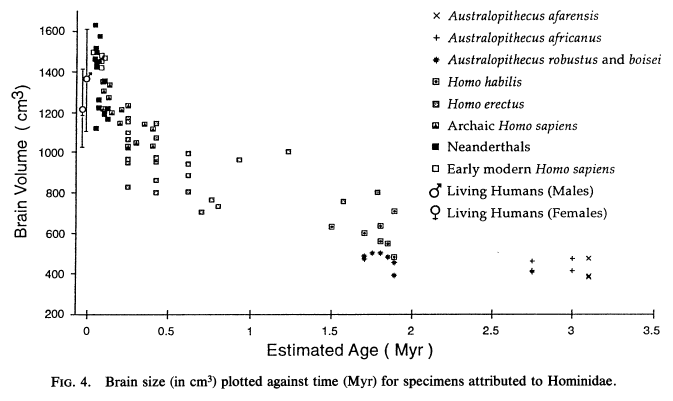 It seems to me that every popular-level discussion of human evolution should use this sort of chart as much as possible. Creationists should be embarrassed and ashamed about the huge mass of evidence they ignore every time they fail to mention the stunning, overwhelming, transitional, gradual, nature of the hundreds of ancient fossil skulls that have been discovered since Darwin and Huxley postulated apelike ancestors for humans back in the 1800s. The evidence is simply an astonishing confirmation of evolution, and the endless pages of creationist diatribes about the lack of transitional hominid fossils are revealed to be mere verbal obfuscation when compared to this simple chart. I suspect that in the entire history of creationist/ID writings, not one of them has been brave enough to show a chart like this to their readers, and then continue to maintain that there are no transitional fossils between humans and their apelike ancestors. Icons of Evolution doesn't do it. Of Pandas and People doesn't do it. But I would be happy to be proven wrong.
De Miguel and Henneberg are the same people who authored the 2004 paper "Hominins are a single lineage: brain and body size variability does not reflect postulated taxonomic diversity of hominins." Here is the abstract:
It seems to me that every popular-level discussion of human evolution should use this sort of chart as much as possible. Creationists should be embarrassed and ashamed about the huge mass of evidence they ignore every time they fail to mention the stunning, overwhelming, transitional, gradual, nature of the hundreds of ancient fossil skulls that have been discovered since Darwin and Huxley postulated apelike ancestors for humans back in the 1800s. The evidence is simply an astonishing confirmation of evolution, and the endless pages of creationist diatribes about the lack of transitional hominid fossils are revealed to be mere verbal obfuscation when compared to this simple chart. I suspect that in the entire history of creationist/ID writings, not one of them has been brave enough to show a chart like this to their readers, and then continue to maintain that there are no transitional fossils between humans and their apelike ancestors. Icons of Evolution doesn't do it. Of Pandas and People doesn't do it. But I would be happy to be proven wrong.
De Miguel and Henneberg are the same people who authored the 2004 paper "Hominins are a single lineage: brain and body size variability does not reflect postulated taxonomic diversity of hominins." Here is the abstract:
Whether or not you agree with scrapping hominin taxonomy (major plus: it would vastly reduce creationists' ability to transmogrify pedestrian taxonomic hairsplitting into wild declarations of the absense of transitional hominin fossils), a result like this should make it hard for anyone to take seriously the idea that there are major discontinuities in the hominin fossil record. But strangely, this paper is not cited in Casey Luskin's 2005 analysis of hominid evolution (which I discussed briefly last week). This has not stopped Luskin from keeping up his argument for the special creation of humans by citing the allegedly drastic size difference between Australopithecus and Homo, as he has done several times by putting up this graphic from Hawks et al. (2000)***:Henneberg and de Miguel (2004). "Hominins are a single lineage: brain and body size variability does not reflect postulated taxonomic diversity of hominins." Homo. 55(1-2), pp. 21-37. Fossil hominin taxonomy is still debated, chiefly due to the fragmentary nature of fossils and the use of qualitative (subjective) morphological traits. A quantitative analysis of a complete database of hominin cranial capacities (CC, n = 207) and body weight estimates (Wt, n = 285), covering a period from 5.1 ma (millions of years) to 10 ka (thousands of years) shows no discontinuities through time or geographic latitude. Distributions of residuals of CC and Wt around regressions on date and latitude are continuous and do not differ significantly from normal. Thus, with respect to these characteristics, all hominins appear to be a single gradually evolving lineage.
 Hmm. Is comparing two fossils the best way to assess the question of whether or not there is a huge gap in the hominin fossil record? Lucky for us, Henneberg and de Miguel (2004) put their spiffy database to use, and plot both hominin cranial capacity and body mass in Figure 1:
 This chart is a little more complex to interpret. The top set of points is cranial capacity, corresponding to the vertical axis on the left. This is essentially the same data that I plotted above -- it just plots on a straight line here because the authors are using a logarithmic scale for the y-axis.
The bottom set of points is body mass, corresponding to body weight in kilograms (right-hand axis). This is also on a log scale. There are two interesting scientific points here: (1) cranial capacity increased disproportionately compared to a slower increase in body weight during human evolution (which everyone hopefully knew already) and, (2), in fact, contra Luskin, the fossil evidence makes the increase in body mass look pretty darn gradual also.
P.S.: I would like to generate my own spiffy plots of hominin body weight estimates over time, but the dataset seems to have been published in this annoyingly rare publication:
This chart is a little more complex to interpret. The top set of points is cranial capacity, corresponding to the vertical axis on the left. This is essentially the same data that I plotted above -- it just plots on a straight line here because the authors are using a logarithmic scale for the y-axis.
The bottom set of points is body mass, corresponding to body weight in kilograms (right-hand axis). This is also on a log scale. There are two interesting scientific points here: (1) cranial capacity increased disproportionately compared to a slower increase in body weight during human evolution (which everyone hopefully knew already) and, (2), in fact, contra Luskin, the fossil evidence makes the increase in body mass look pretty darn gradual also.
P.S.: I would like to generate my own spiffy plots of hominin body weight estimates over time, but the dataset seems to have been published in this annoyingly rare publication:
Here is the WorldCat entry for the series. If anyone happens to have it handy, please email me a scan at matzkeATncseweb.org if you get a chance. Notes * The paper is: C. De Miguel and M. Henneberg (2001). "Variation in hominid brain size: How much is due to method?" Homo 52(1), pp. 3-58. In this paper, the authors, Carmen de Miguel and Maciej Henneberg of the Department of Anatomical Sciences, University of Adelaide, Australia, conducted a study of the experimental error in researcher measurements of cranial capacity. Although I am not discussing this in detail here, this question is interesting in itself. Basically the authors found that the error is substantial, and due to numerous sources such as different reconstructions of mushed skulls, but (creationists, take note!) despite these errors, the time variable explains 89% of the variance in the dataset. The error is significant, but is still overwhelmed by the time-dependent trend:De Miguel and Henneberg (1999). "Variation in hominid body size estimates: Do we know how big our ancestors were?" Perspectives in Human Biology, 4(1), pp. 65-80.
The authors conclude that their study supports previous studies indicating that the change in cranial capacity can be explained by "a typical Darwinian mechanism" of exponential increase in a quantitative trait under selection. (Creationists, take note again: "exponential increase" does not mean "sudden" -- think of compound interest.) ** Summary of ID Sun Dome broadcast: same ol', same ol', but the radio hosts narrated the event like it was a football game, which was hilarious -- "Wow, Bob, Jonathan Wells sure answered a lot of tough questions just now, didn't he?" "Yes, Shelly, isn't this pure science great? This is really impressive stuff we're hearing, and it's all science, not religion!" "Oh, and isn't it awful how the textbooks and public schools are lying to kids?" "Up next is the famous Michael Behe, but first we're going to watch a segment from this amazing ID video, which you can get free by signing up with Physicians and Surgeons for Scientific Integrity." "What's that website again, Bob?"...etc. This is a paraphrase, but I Am Not Making This Up.) *** See also this recent debunking at afarensis.When the entire time span of more than 3 Ma is analysed jointly, the date (= time) is responsible for the major portion (89%) of the variation in hominid cranial capacity, while taxa on their own are responsible for a minor portion of this variation (5%), the rest being errors of estimates. (De Miguel and M. Henneberg 2001, p. 16)
88 Comments
RM · 30 September 2006
Very nice diagram, indeed. What I hope will be added in the future is where various creationists put in the line showing the sudden appearance of men as distinct from apes.
But then I remember that to a substantial number of that group it is the X axis which is wrong. If the earth is 6-10 thousand years old all of Nick's dots would be lumped together at the right margin of the diagram.
Tiax · 30 September 2006
"It seems to me that every popular-level discussion of human evolution should use this sort of chart as much as possible."
Here's how I would frame the argument. First, point out that a 'gap' in the fossil record is a point along the vertical axis that falls within the range of the sizes at which you can draw a horizantal line from the left side of the graph to the right without hitting any points. Then, tell the person asserting that there is a gap to take the image, and draw such a line. Next, explain that a meaningful gap is one where not only can you draw a thin line, but you can fit a bar of significant width.
Philip Bruce Heywood · 30 September 2006
Well- presented charts. They demonstrate something but there are at least three obvious riders:
1). The history of Science is littered with scores of discarded "proofs" as compelling as these.
2). For many species (not to mention higher taxa)in the fossil record, there is no substantial fossil evidence of ordered, sequential, gradual transition, one to another. There is not one proveable gradual transition between what can categorically be said to be different species. What we do have is some sort of a mystifying semblance in the fossil record of life being unfolded in sequence, and it is apparent by studying these sequences that species were employed in some deeply practical way in the revelation of those that followed. A proper title for this could be Evolution, simply meaning, a sequential unrolling or staged revelation.
3). Science wes never served by loud hollering about something when the information isn't all in. Now the graphs above may be accurate and meaningful. When we see them discussed and (shock! horror!) criticized by cool-minded and detatched people, especially by people whose place in their academic community isn't threatened if they don't repeat the "correct" views, then we will sit up and listen to the independent umpire. It is obvious at the outset that statistics such as these will tend to be presented in a way not prejudicial to the personal beliefs of the statistician. The graphs may be accurate. If so, good luck; and if not, good luck. The laws of Science stand regardless. Dogs won't be giving birth to cats anytime soon, and your great uncle will never be any more like a chimp than will his nephew.
wolfwalker · 30 September 2006
Beautiful work, Nick. Thanks much for taking the time.
That first graph reminds me of the first time I saw the Hawaii Center for Volcanology's nifty graph of age vs. distance for the Hawaiian volcano chain. It's as much a killer argument against YECism as your graph is against "no transitional hominids."
The second chart is interesting for an entirely different reason: why is the correlation coefficient for body mass so much lower than the coefficient for cranial capacity?
I'd also be curious to see both charts broken down further by genus: Ardipithecus, Australopithecus, Paranthropus, and Homo.
ben · 30 September 2006
Mod · 30 September 2006
ben · 30 September 2006
Etymological point taken, but I meant usage within the field being discussed. PBH's was just another lame attempt to weaken a theory he doesn't like by redefining its own terminology in a way that seems to support his perspective, similar to the strawman of evolution having anything to do with dogs giving birth to cats. Which would be pretty cool, as an aside. That would pretty much blow both sides of the argument right out of the water, wouldn't it?
Kim · 30 September 2006
Nick, would you mind to share the data with me, the way to estimate whether two size variables change relative to each other is to produce a log-log plot, and perform a linear model 2 regression on the log-log data (either Reduced Major Axis or Major Axis). If there is a relative change, the slope will deviate from x = y.
Kim · 30 September 2006
Oeps, somewhat to quick. I had to mention that a slope of one is expected is both size measurements are in the same magnitude, if one is quadratic or cubed, or any wierd cmbination of that, the slope is expected to change accordingly, but in a predictable manner.
Larry Gilman · 30 September 2006
The diagram is a thing of beauty, Nick. It fills a pedagogical need and is going to be reproduced many times. A worthy "icon of evolution," and not one that people like Wells are going to be able to swiftboat easily. Thanks for doing the homework.
By the way, isn't it a fairly weak argument (if Henneberg and de Miguel are making it) that continuity in a fossil set of two summary or bulk characteristics---cranial volume and body weight---points to a single lineage? Didn't paleontologists used to arrange the Eohippus-->Equus series as a single lineage on bulk continuity grounds---smooth-looking variation of size and form---only to find out later that these fossils are really chronologically ordered samples from different twigs of a ramifying bush? So the continuity of size and weight numbers for hominins does not seem, from where I'm sitting up here in the peanut gallery ("I'm an engineer, not a biologist!"), to argue against a bush-like taxonomy. More precisely, could it be said that the failure of this data to "reflect postulated taxonomic diversity of hominins" is neither here nor there? That one would not necessarily expect such diversity to be manifest as discontinuities in these parameters?
Is this mere amateurish confusion on my part, or does it resemble any real concern in the field?
Regards,
Larry
Kim · 30 September 2006
Nick, the fastest way is probably to contact the authors for a pdf of the article you want.....
Philip Bruce Heywood · 30 September 2006
Hey Ben., if it's too much to look up the meaning of a word in a dictionary, and too much to look up science history and find out what various and respected scientists have thought about things, why cloud the issue? In fact, there were and are respected scientists who did and do question whether one species can give birth to another. Some of these scientists were/are evolutionary biologists and palaeontologists.
Bob O'H · 30 September 2006
Kim - the two size variables are plotted on the log scale in the second figure, so cranial capacity is increasing more rapidly. To be more formal, the equations are:
log(CC) = a_C + b_C*Time
log(Wt) = a_W + b_W*Time
or CC = a_C*(Time^b_C) and Wt = a_W*(Time^b_W). So, the ratio is CC/Wt=, or on the log scale
log(CC) - log(Wt) = (a_C - a_W) + (b_C - b_W)*Time
From the graphs it's clear that b_C > b_W, so the ratio is increasing with time.
Gah! The paper doesn't give the estimated curve for weight. For cranial capacity, the coefficient is 0.254 (in a slightly different model). I don't know if the coefficient for weight can be found elsewhere in the literature.
Bob
N.Wells · 30 September 2006
Nick,
My thanks too - that's a lovely graph.
Could you please make available the Excel file with the data? The reason I ask is that although simply seeing the graph will be important in most teaching situations, I think it would be even more effective in classes that are teaching about graphing (either math classes or biology classes) - teachers might like to use this as a multiple-purpose exercise where the students encounter the results by plotting them and then discuss the sort of issues raised by Tiax in comment 136043.
Alann · 30 September 2006
I wonder if you can successfully impregnate a dog with a fertilized cat embryo just to keep creationist from using the inane dog->cat analogy.
As for great uncles, making some assumptions for the mathematics (only 4 million years, 1 generation every 20 years) they are typically 0.001% more chimp (actually the common chimp-human ancestor) like than their great nephew.
Salvador T. Cordova · 30 September 2006
k.e. · 30 September 2006
Don't worry Sal your CC doesn't actually indicate brain size, empty space possibly, have you considered exercising your brain to beef it up?
Try getting it to do sit ups while you wait for the demise of 'Darwinism' there should be plenty of room.
Have a naive day.
Nick (Matzke) · 30 September 2006
Nick (Matzke) · 30 September 2006
I think the reactions of the creationists in this thread are beautiful and show exactly the main point in this debate -- they talk about scientific evidence, but they actually don't care one whit about it. This was the same point demonstrated with the immune system cross at the Dover trial. They are just willfully oblivious to data.
Here, with the data right in front of them, you can see them switching over to denial mode. There is nothing they can say scientifically, so they just desperately grasp at conspiracy theories or desperate hopes that the data will all disappear one day because scientists have been wrong before. Or "cats don't give birth to dogs."
We even have this one creationist repeating ignorant ID/creationist talking points about the lack of transitional fossils, even when the data are right in front of him!!
Creationists, whatever happened to your high-minded jabber about the importance of the data? Why haven't creationists ever put this sort of chart up in their books and lectures? Are you afraid of what your followers will think?
qetzal · 30 September 2006
Nick (Matzke) · 30 September 2006
Nick (Matzke) · 30 September 2006
KevinD · 30 September 2006
There is a bit of confusion between regression and correlation going on here. First I am not sure why Henneberg and de Miguel (in figure 1 from their 2004 paper shown above) present a figure derived from a regression analysis and then present numerical statistics from a correlation analysis.
There is a simple mathematical relationship between a correlation coefficient and the slope coefficient in a linear regression. However the two coefficients measure different things.
A regression coefficient is measuring the slope of a line. The larger the coefficient the more rapidly the dependent/Y variable increases as the independent/X variable increases.
A correlation coefficient is measuring the tightness of fit to the line. The line can have any slope.
Figure 1 presented here does not compare the slopes of the lines at all. It is merely reporting a strong and positive relationship of both cranial capacity and body mass with date. The slope of the lines on figure 1 are both unit dependent and as cranial capacity and mass are measured in different units and on different axes you can't conclude that one slope is larger than the other from the information given here (I haven't looked at the paper itself).
To compare the slopes you could do one of a couple of things. Kim's suggestion of reduced major axis regression will tell you about the allometric relationship of cranial capacity and mass. I think you would have to convert cranial capacity to brain mass (which should be straightforward) so that both variables would be measured in the same units. An alternative is to do an analysis of covariance in which you look at the relationship of cranial capacity to date and then include body mass as a covariate. This would tell you if any of the increase in cranial capacity is explained by date after you take body mass into account.
The difference in size of the correlation coefficients is interesting. As Nick states, the lower r value for body mass could be the result of an inherently larger measurement error in estimating body mass from fossils than in estimating cranial capacity. Alternatively it might mean that body mass varies more with local environment than cranial capacity.
Nick (Matzke) · 30 September 2006
mplavcan · 30 September 2006
I'm a little surprised that this stuff is not more familiar to a wider audience (point taken -- we who teach this stuff need to stop assuming that "everybody knows THAT"...). The data presented here are very familiar to most anthropologists, and there has been a running argument about how to interpret it for many years. You need to keep in mind that the chart includes several different taxa that are not uniformly distributed through time, and overlap each other an several cases. Therefore, even though the graph clearly and unambiguously demonstrates a TREND for an increase in brain size over time, it is not accurate in representing variation in rates of change within each taxon over time. This leads to some taxa with relatively "stable" brain size values (in some cases this can be attributed to a narrow time range or small sample size in the early taxa), and others, as in the Homo series, showing a gradual transition with no clear boundary in this character between taxa. I believe that Steve Leigh published a paper in the American Journal of Physical Anthropology in the mid-1990's using spline regressions (linear regression is not necessarily appropriate for the above data), concluding that the data are inadequate to determine the exact rate of change in cranial capacity. [For those creationists reading, please save yourself the embarrassment of thereby claiming that the data are punctuational -- this will only demonstrate the you have no idea of what you are talking about.]
The suggestion that the chart is evidence that hominins represent a single species is not particularly strong, because it relies on a single character -- a perilous proposition in any phylogenetic or taxonomic analysis. A glance at Paranthropus and Australopithecus skulls side by side should convince anyone except a die-hard ideologue (*ahem*) that these are different taxa by any common zoological standard. Nevertheless, the point that cranial capacity does not provide an unambiguous trait for delimiting species is not particularly contentious.
As for Mr Cordova's comment about radiometric dating -- give me a break. Do you have even the slightest inkling of just how stupid and insulting that comment is? That Cremo and Thompson BS in Forbidden Archeology is utter crap. The "evidence" in that book has been refuted so many times that it is difficult to read it simply because it is so boring at this point (it used to be funny, but any joke looses its humor after being repeated a thousand times). The dates used in the above graph have been derived from multiple sites by multiple independent labs using multiple dating techniques, and have been INTENSELY scrutinized, re-analyzed, re-dated and re-tested over decades. If the dating techniques were so bad, then the data above would come out as a noisy, random blob -- garbage in, garbage out. And don't give that crap about people selecting dates to correspond to their preconceived notions of the evolutionary scenario. Most folks in this business would love nothing more than to get solid data that would overthrow an accepted view. The reality is that bad dates are just that -- bad.
Scott Hatfield · 30 September 2006
Nick:
Scott Hatfield here! Sure wish I could afford to join you guys at NCSE. This was a tremendous post! I of course swiped your graph for use in my high school science class. Wonderfully persuasive! Keep up the good work....SH
Greg · 30 September 2006
I was wondering, were these dates done with traditional carbon 14 dating or something else. It didn't really specify in the abstract. Thank you.
Torbjörn Larsson · 30 September 2006
Nick, really nice job! This time you have exceled your usual high standard posting.
Though I think there has been a lot said about 'hypothesis testing' by regression lines, it seems hard to fit anything else than an exponential growth here. That is perhaps strongly indicative of a gradual hypothesis - wouldn't we expect a power law relationship if the growth had been by observing markedly different species from a bushy evolutionary tree? Perhaps mplavcan can explain why not.
It is amazing that we are still on the growth portion of cranial capacity. After all, the body mass grows slower, and the pelvic/foetus construction to handle birth should have tough constraints to work with.
Tiax, nice take on "a gap" definition.
RBH · 30 September 2006
RBH · 30 September 2006
Nick (Matzke) · 30 September 2006
Nick (Matzke) · 30 September 2006
MarkP · 30 September 2006
I wonder if the creationists can explain to me why my cat yawns the same way I do when they trot out their ignorant tripe.
Anton Mates · 30 September 2006
Bob O'H · 30 September 2006
Anton Mates · 30 September 2006
Dave Carlson · 30 September 2006
Nick (Matzke) · 30 September 2006
waldteufel · 30 September 2006
Thanks for the very interesting graphs. I've already saved them and plan to send to my son and a couple of friends who are also interested in matters biological.
Philip Bruce Heywood sure sounds like a Kent Hovind sock puppet.
RBH · 30 September 2006
Sir_Toejam · 30 September 2006
wolfwalker · 30 September 2006
One other point regarding the creationist moldy-oldie of asking about "carbon dating of fossils": fossils can't be dated using carbon-14 at all. Radiocarbon dating works only on unaltered organic remains. Fossils such as most of the specimens in Nick's data are dated using other techniques.
Greg · 30 September 2006
afarensis, FCD · 30 September 2006
I wouldn't mind a copy of the spreadsheet myself (and if possible the two articles you mentioned). Thanks for mentioning my debunking of Luskin!
mplavcan · 30 September 2006
Nick:
Sorry, but the assertion that one should see de facto variation in brain size and body size if there is taxonomic diversity in extinct species is simply wrong. Speciation in primates, as with many other mammals, is not necessarily correlated with morphological divergence in a particular set of characters. For example, I have craniometric data on about 150 species of primates. Plotting body size estimates versus cranial size estimates most often yields a slurry blob, with little taxonomic differentiation. Often times in anthropology, analyses will focus on taxonomic distinctions between gorillas and chimps alone, but an argument can be made that these are relic taxa from a wider past radiation, and do not represent a good model for a radiation (the argument can be made the other way though). Anyhow, the general rule is that when using just a few characters, one should expect to underestimate diversity in the fossil record. Conversely, multivariate analysis (usually discriminant functions) using larger character arrays often can yield separation amongst closely related taxa. But that is a case where one has multiple characters. Furthermore, when dealing with the fossil record, one has to make a clear distinction between the ability to statistically detect significant differences in a character amongst living species, versus whether taxonomic differentiation in a character is great enough to sort taxa accurately into discrete groupings. Brain size and body size alone are relatively poor indicators of taxonomic diversity for this purpose.
Another thing to keep in mind here is that we are not dealing with hominin body size in the above graph. That has been estimated using various remains -- cranial, dental and postcranial. The body mass estimates in some cases are highly uncertain, with very large standard errors. Therefore, taxonomic conclusions based on estimates of body mass simply introduce an additional level of error variance into the analysis. Taxonomic assessments inevitably include as much metric and qualitative data derived directly from the remains as possible.
The number of taxa that should be recognized in hominin evolution is currently hotly debated. For example, a paper just came out in the Journal of Human Evolution demonstrating that Australopithecus anamensis and A. afarensis represent a smooth transition. However, even the authors of the paper did not agree on how to deal with the taxa in terms of nomenclature, as stated in the paper (hey, they were honest!). Other debates currently center on the taxonomic status of Homo ergaster/erectus/georgicus/habilis/antecessor/heidelbergensis and a few others. This reflects the fact that a lot of new fossils have been found, and our understanding of human evolution has grown more sophisticated, leading to confusion abut how typological, categorical names should be applied to a complex branching pattern of transitional forms. Regardless, the relationship between brain size and body size does not play a singular role in most of these debates (though the character is used in some cases).
So the question of whether all that mess that you see in that graph is variation within a basic type is true at one level, and silly at another. Virtually everyone agrees that the data set above includes some forms that represent an anagenetic lineage, even though there is debate about whether some of those forms should be named as species, subspecies, or whatever. But it also contains forms that the overwhelming majority of paleoanthropologists recognize as unambiguously separate species that are not anagenetically related (e.g. compare any Paranthropus versus any Australopithecus).
David B. Benson · 30 September 2006
A typical method of dating older materials is indeed via the strata. Then it is sometimes possible to use other radio-dating methods, or geochemical methods, to estimate dates for the strata.
As an amateur trying to make sense of some older dates, I want point out that there can easily be systematic errors of one form or another. For example, the last super-eruption of Mt. Toba has been dated to about 71,000 years ago via one technique and to about 74,000 years by another. Unfortunately, the error bars for the two techniques do not overlap...
mark · 30 September 2006
Nice work, Nick. Similar graphs that I have seen (for various features of various species) have normalized one feature (such as brain size) as a function of body size. The same idea is implied by the second graph that includes body weight, but the conclusion (when normalized for body size, cranial capacity still increases over time) is not as obvious.
Nick (Matzke) · 30 September 2006
'Rev Dr' Lenny Flank · 30 September 2006
Hey Sal, I have about thirty questions for you that you never answered.
Wanna give it a go?
Philip Bruce Heywood · 30 September 2006
So let's say it in black and white, so the world can be in no doubt.
1). All species grade into each other - correct?
2). This happened by the equivalent of your descendents, in time, just gradually turning into apes, or vice versa - correct?
3). And the engine for this process is time, plus, the natural selective changes we see in the human species - correct?
4). This same engine of natural selection over time produced such obvious and clear-cut species as T. REX and all the others - correct?
5). And it produced a kaleidoscope of complex life-forms within a period almost certainly no longer than 10 mill.yrs, Early Cambrian, when prior to this there was nothing better than organized seaweed - correct?
6). Plus a breathtaking outbreak of flowering plants during the Cretaceous, with scarecely a whisp of flowering plants before - right?
7).And no respected scientist has ever said anything different and if he did or does, he is a fool - correct?
Say it, boys, just say it. Pretty please, confirm your deductions for posterity.
Anton Mates · 30 September 2006
GuyeFaux · 30 September 2006
Anton Mates · 30 September 2006
djlactin · 30 September 2006
Great chart, Nick.
1) Suggest you use EXCEL options to put trendline, equation and r² on it. (Click on chart, select Chart menu, etc.)
2) Stating up front that I am an evolutionist and a Ph.D (in... wait for it... Biology!), and have considerable statistical experience (taught at junior college level for 5 years).
But...
At the risk of providing an 'out' for the adversaries, charts like this that pool data from many species, can conceal considerable 'internal' information. The true trend COULD be a series of punctuation events, with the resulting lineages persisting and overlapping. (A series of overlapping horizontal lines.) Lumping the data without reference to species names would obscure such leaps and (erroneously) cause us to see continuity.
For example, my eyes see a strange pattern of perhaps 2 'leaps' in the graph: CC was relatively low (ca. 500mL) and increased slowly (if at all) until about 2 MYa; At that point there is a sudden increase in variability, and the trend after about 1.5 MYa seems to emerge from the high end of this range of variability; this second part remains relatively flat until about 50kYa, after which the slope skyrockets. One possible explanation is that there are 3 separate lines here: a flat one from the beginning to about 1.5 MYa; another flat one from ca 2 MYa to ca 50kYa, and a third from 50kYA to now which increases quickly.
I'd be interested in discussing this perception. Does anybody else 'see' this? And if its real, how (if at all) are the breakpoints that I "see" correlated with species transitions in the fossil record?
Nick (Matzke) · 1 October 2006
Nick (Matzke) · 1 October 2006
Typo in previous:
"filled in my" --> "filled in by"
Pinko Punko · 1 October 2006
It is the "hockey stick" for BRAINS! BRAAAAAAAAAINNNNNNNNNS!
Torbjörn Larsson · 1 October 2006
"Our brains are actually slightly smaller than Neandertal brains."
Duh! I should remember that! (I sometimes feel related, since I happen to got especially thick bones, large scull size/eye distance, and long tooth roots - all at about 1 in 1000 statistics. Nothing have broken my bones yet, not for lack of trying...)
"he holds a Ph. D. from Cornell!!
(Wait for it...)
...in math."
Sadaputa Dasa (Richard L. Thompson) seems to have published his PhD. But no more research I can find. (His probable lack of postdoctorate may explain that - he returned home immediately afterwards.)
"Plotting body size estimates versus cranial size estimates most often yields a slurry blob, with little taxonomic differentiation. ... Anyhow, the general rule is that when using just a few characters, one should expect to underestimate diversity in the fossil record. Conversely, multivariate analysis (usually discriminant functions) using larger character arrays often can yield separation amongst closely related taxa."
I don't get it. This baseline seems to indicate that the apparent increases are really significant. I'm still not sure why we expect an exponential instead of a power curve.
Philip Bruce Heywood · 1 October 2006
Good heavens. Don't let the facts get in the way of a good story, they say.
If there were no clear dividing lines between species and their "ancestors", then there are no clear dividing lines between species. As a generality, if man can interbreed with ape-like ancestor, and ape-like ancestor can interbreed with chimp, then there is the certainty that at some time, possibly but not necessarily now, under certain circumstances, chimnp can interbreed with human. Ditto all other species. If we have no reproductive isolating bar, we have something approaching mayhem. Where is the observed mayhem? Why can I be certain my cattle will not interbreed with other species, and cease to be cattle?
I avoid going further into details of factual errors, save one.
I deliberately didn't use the term, "Cambrian Explosion". We shan't quibble over that term, or proposed time-periods. Give or take a few million, many species and even whole classes, orders, etc., were geologically abrupt arrivals - not only during Cambrian times. There appears to be confusion regarding this, on this page. For instance, no fossils unequivocally displaying the necessary features of complex or animal-grade life (such as marked internal symmetry)have yet been found beneath the Cambrian. Some people who contribute to these pages might like to put them there, but the fossil record stands. There are no unequivocally cnidarian or chordate fossils known from beneath the Cambrian. Representatives of most if not all major divisions of complex or animal-grade life first appear - some in totally incipient or embryonic form - in the Cambrian. Chordates are significant here.
I am at a loss as to why a publication such as T/O aspires to be, has no apparent review of factual input on its pages. No cause is advanced by technical inaccuracy.
Kindly correct me if I present facts incorrectly.
Dennis · 1 October 2006
Verrry nice data! I think someone should study if there is a correlation between the modern 0 mya data below the median, 1200 in ml to 900 in ml, and creationists. This data suggests people who's brain size would comport with 1 mya to 0.5 mya. It may explain why they can't accept modern thought.
William E Emba · 1 October 2006
William E Emba · 1 October 2006
William E Emba · 1 October 2006
jeffw · 1 October 2006
B. hessel · 1 October 2006
A similar chart has been published in a 2003 paper by Lee and Wolpoff. You can get it here:
http://www-personal.umich.edu/~wolpoff/Papers/Brain%20Size.pdf
GuyeFaux · 1 October 2006
mark · 1 October 2006
Sir_Toejam · 1 October 2006
Nick (Matzke) · 1 October 2006
Torbjörn Larsson · 1 October 2006
"Our analyses do not reject the hypothesis of a single process of brain size change, but they are incompatible with an interpretation of punctuated equilibrium during this period."
Well, that answers my question. (Framing the question correctly is always better than framing a specific answer. Another thing I should remember!)
windy · 1 October 2006
Anton Mates · 1 October 2006
Anton Mates · 1 October 2006
W. Kevin Vicklund · 1 October 2006
I can see PBH right now:
"There's no such thing as ligers. There's no such thing as ligers. Mommy, make the liger go away!"
(For those new to the reference, a liger is a cross-breed between a lion and a tiger)
Oh, and don't forget mules.
Anton Mates · 2 October 2006
Darth Robo · 2 October 2006
Keep plugging PBH. If at first you don't succeed, try, try again. Remember: GOD LOVES a tryer!
Michael Suttkus, II · 2 October 2006
Nurse Bettinke · 2 October 2006
Nurse Bettinke · 2 October 2006
Nurse Bettinke · 2 October 2006
For the multiple posting, I very sorry am.
How you say, here and now? That fruggin' Degas?
Torbjörn Larsson · 2 October 2006
"When he is of the jotuns the spitting image"
Jotuns??? Oh, norwegian giants of the asa religion. (World wide wikipedia to the rescue.) Thank you, no one have called me giant before! Nor neandertal - I'm coordinated and pretty nice on the outside despite the robust combination if I may say so myself. I happened to talk with a similar person once, and you couldn't tell on him either. And he had also happened to weather some accidental long falls and heavy crush situations without any damage at all. Perhaps we were just in luck, and surely we looked for such happy confirmation, but...
But I do get 'looks reliable' a lot, seems like large eye distance easily render that as a first impression. (Hah! Little do they know! ;-)
Philip Bruce Heywood · 4 October 2006
Well I could start quoting SCIENTIFIC AMERICAN and a few authoritative geology textbooks but I suspect it would be as wasted here as it would be with the diehards at AIG.
Tell me, would running buffalo with domestic cattle ultimately result in one herd of cross-breeds (like mongrel dogs when they cross-breed) or would two discreet populations persist? If the two "dissolve" into one, then they are the same species; if they ultimately remain distinct (say like horses when run with donkeys)then they are different species. Has this ever been tested under natural conditions over time?
If anyone wishes to actually start quoting facts, I'll accommodate you; I have wasted time with people such as AIG.
Michael Suttkus, II · 4 October 2006
'Rev Dr' Lenny Flank · 4 October 2006
Hey Heywood, you're still, um, ya know, blithering.
Steviepinhead · 4 October 2006
Maciej Henneberg · 20 November 2006
Thanks for appreciation of our work. I stand by all we have published. I can send you difficult to get papers (PDF) by e-mail. What is your adress?
Nick (Matzke) · 20 November 2006
Maciej Henneberg · 21 November 2006
I agree with Nick's general line of argument. I will send him, and anyone who writes to me at "maciej.henneberg@adelaide.edu.au" PDF s of my papers , including those difficult to find on internet.
I have been fighting (with scientific arguments, like those in my published papers cited above) the proliferation of "species" by colleagues studying hominid fossils. Erection of multiple hominid species perpetuates the creationist approach: Abel beget Ezekiel who beget Isaac .... (as my friend and colleague Bob Eckhard says). The process of evolution, including human evolution, is basically occuring in a chain of generations, parents producing offspring, this offspring becoming parents and producing new offspring etc. This way is the only way for life to continue (forget IVF). From generation to generation reproduction of parental characters is not perfect and thus offspring differs somewhat from parents. And so on.....
In human evolution it was not, for instance Australopithecus africanus that appeared suddenly from nowhere beside Australopithecus anamensis who also appeared from nowhere. Individuals of each of those kinds had parents and offspring. Human fossil record is full of specimens assigned by various authors to different taxa. The reson is that many specimens display a mixture of characters - they are transitional. Actually all individuals are transitional as they are but links in the long chain of generations from ancestors to descendants. Platonic idealism in observation of the dense fossil record "creates" species by averaging sets of characters seemingly common for groups of specimens. No specimen is a perfect example of a particular species. No species can exist outside of individuals that were assigned to it.