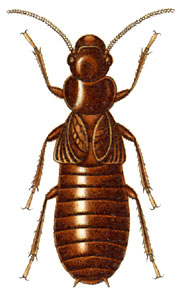
 What is the creature on the left? If you said, "cockroach", give yourself a lump of coal. But if you said, "termite", give yourself a PEZ dispenser with your favorite cartoon character. It is in fact a specimen of Mastotermes darwiniensis, a large and primitive termite that lives in Australia (they get all the cool critters). It looks like a roach because termites evolved from roaches, and this particular genus contains primitive members that still resemble their roach cousins in many respects. On the flip-side, roaches of the wood-eating genus Cryptocercus have many termite-like features, including obligate gut flora and parental care of nymphs. The termites that we're familiar with -- the little white things that eat houses -- are simply the nymph stage of an otherwise roach-like insect, and Cryptocercus nymphs look an awful lot like termites themselves.
A biologist going by the name of "Mr. Darwin" has a great post up about the evolution of termites from roaches, and the various lines of morphological, molecular, and fossil evidence we have. And there is a cool picture of cute little Cryptocercus nymphs feeding from their mommy's anal secretions. Go check it out.
What is the creature on the left? If you said, "cockroach", give yourself a lump of coal. But if you said, "termite", give yourself a PEZ dispenser with your favorite cartoon character. It is in fact a specimen of Mastotermes darwiniensis, a large and primitive termite that lives in Australia (they get all the cool critters). It looks like a roach because termites evolved from roaches, and this particular genus contains primitive members that still resemble their roach cousins in many respects. On the flip-side, roaches of the wood-eating genus Cryptocercus have many termite-like features, including obligate gut flora and parental care of nymphs. The termites that we're familiar with -- the little white things that eat houses -- are simply the nymph stage of an otherwise roach-like insect, and Cryptocercus nymphs look an awful lot like termites themselves.
A biologist going by the name of "Mr. Darwin" has a great post up about the evolution of termites from roaches, and the various lines of morphological, molecular, and fossil evidence we have. And there is a cool picture of cute little Cryptocercus nymphs feeding from their mommy's anal secretions. Go check it out.Transitional Species in Insect Evolution
What is the creature on the left? If you said, "cockroach", give yourself a lump of coal. But if you said, "termite", give yourself a PEZ dispenser with your favorite cartoon character. It is in fact a specimen of Mastotermes darwiniensis, a large and primitive termite that lives in Australia (they get all the cool critters). It looks like a roach because termites evolved from roaches, and this particular genus contains primitive members that still resemble their roach cousins in many respects. On the flip-side, roaches of the wood-eating genus Cryptocercus have many termite-like features, including obligate gut flora and parental care of nymphs. The termites that we're familiar with -- the little white things that eat houses -- are simply the nymph stage of an otherwise roach-like insect, and Cryptocercus nymphs look an awful lot like termites themselves.
A biologist going by the name of "Mr. Darwin" has a great post up about the evolution of termites from roaches, and the various lines of morphological, molecular, and fossil evidence we have. And there is a cool picture of cute little Cryptocercus nymphs feeding from their mommy's anal secretions. Go check it out.
10 Comments
Erik · 24 December 2005
Found your site via Mike Berube's--bravo!
'Rev Dr' Lenny Flank · 24 December 2005
Cockroaches make great pets, by the way. I've kept a colony of _Blaberus discoidalis_ for years.
After you hold them for a while, they sotp and use their feet to carefully clean themselves off, like a little kitty-cat. Apparently, they don't like all the oils and other gunk that gets on them from human skin.
Check out:
http://www.geocities.com/lflank/roaches.html
Arden Chatfield · 24 December 2005
Ooo! I get to be the first to say it!
If termites are descended from cockroaches, how come we still have cockroaches?
Ugh, now I need a shower...
Steve Reuland · 24 December 2005
Lenny, I'll happily trade you all of my Periplaneta americana, which taken up residence in my house without me even asking them.
My roommate, who is not the insect lover that I am, declared war on them last summer. Victory went to the palmetto bugs.
'Rev Dr' Lenny Flank · 24 December 2005
'Rev Dr' Lenny Flank · 24 December 2005
Steve Reuland · 24 December 2005
They can have the Earth. The kitchen, however, is mine. :)
Fernando Magyar · 25 December 2005
If as according to the conclusion of Darwin's Blog "Termites are highly modified, social, myopic, wood-eating roaches." Then it might be argued that those non specialists (like myself) who may have identified the illustration of "Mastotermes darwiniensis", as a roach instead of a termite should be awarded two Pez dispensers instead of a lump of coal. Unless of course the coal dates from the Carboniferous and actually contains a fossilized cockroach or two, now that would be a good reason to be baaad or wrong.
Bayesian Bouffant, FCD · 25 December 2005
That doesn't appear to be a Biblical insect. It's got 6 legs, not 4.
MrDarwin · 25 December 2005
Steve, thanks for the exposure and comments. Although I'm now a botanist, insects were my first love (I have an undergraduate degree in entomology) and I've tried to keep up with the literature on insect evolution. My interest in insects, cockroaches and evolution goes back at least as far as third grade, when I did a science project illustrating the evolution of insects (which I derived directly from trilobites, based on the resemblance of some wingless cockroaches to the extinct arthropods--although in retrospect it was somewhat misguided, I don't feel so bad because it turns out some early entomologists made the same mistake!). As an undergrad at Cornell in the early 1980's I took classes with David Grimaldi, author of the book "Evolution of the Insects", who was a grad student at the time. I didn't know him well, but it was evident that David was incredibly gifted, and not just intellectually--he was (and is) a great artist, and did many of the illustrations for his book.