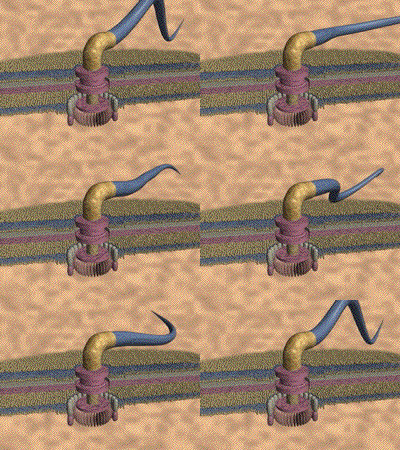
 William Dembski has just blogged about a short comment I made this morning on The Thumb answering someone’s question about whether or not a detailed evolutionary model for the bacterial flagellum would deserve a Nobel Prize. In that comment, I pointed to this long web article I wrote on the evolution of the bacterial flagellum (which is already badly in need of an update), but I said that, no, such a model would clearly not deserve a Nobel, because it would be entirely routine and conventional — simply the application of the current paradigm (modern evolutionary theory) to fill in one more little gap in our knowledge of evolutionary history. Although creationists don’t realize it, discoveries showing how complex system evolved come out all the time in the scientific literature. (A number of examples are linked from my comment here.)
Dembski’s post in reply is entitled “To Explain the Flagellum � Just Look Up All the Homologies.” There are numerous dubious assertions in Dembski’s short post that would take all day to write up, but I just want to focus on one limited point for the moment. Will the ID advocates admit that they made a mistake in asserting that, except for the 10 proteins of the Type III secretion system, they other 30-40 parts of the flagellum were “unique”?
Dembski first mischaracterizes the evolutionary argument for a complex system like the flagellum as merely looking up related (homologous) proteins.
This is wrong: Taking my flagellum evolution essay as an example, in addition to reviewing the homologies (something no IDist has ever done — they regularly show their ignorance of the literature on flagellum homologies, see below), it also includes a review of relevant biological analogies, a quantitative analysis of passive and active bacterial dispersal, a step-by-step analysis of function at each stage and the transitions between the stages, and a review of the literature on the types of molecular steps that would be involved in the transitions — origin of new genes with new functions, origin of new protein-protein binding sites, origin of multiple-proteins-required systems, etc. By showing that all of these micro-processes have been observed to occur in the lab and/or in the wild, and showing that the origin of the flagellum can be broken down into a series of such micro-processes, and showing that function is continuously maintained throughout, I showed that a reasonably detailed model for the evolutionary origin of the bacterial flagellum was perfectly plausible.
I invite readers to check out Dembski’s hilarious 2003 reply to my essay — he mostly does a page-count analysis, and then chokes out the latest last-ditch, if-all-else-fails ID argument, “Not…detailed…enough!” (This is often soon followed by, “And we’re not going to give you any detail at all about our ID hypothesis, either!”)
Dembski also concludes today’s post with the emergency backup IC argument:
The problem is not a matter of identifying similar parts, but of coordinating them into novel, functional wholes. No literature search of preexisting components will resolve this problem.
(Dembski, "To Explain the Flagellum � Just Look Up All the Homologies")
This is yet another instance of IDists making an unacknowledged retreat (here is another recent example, from Behe) from the original irreducible complexity argument.
IDists originally claimed that IC systems that were missing parts would have no function, and therefore partial systems would be unselectable by natural selection, and therefore gradual evolution couldn�t produce such systems. This is precisely why Dembski himself, just back in 2003, highlighted what he thought was a great argument against Ken Miller’s essay on evolution of the bacterial flagellum:
It follows that the TTSS does not explain the evolution of the flagellum (despite the handwaving of Aizawa 2001). Nor, for that matter, does the bacterial flagellum explain in any meaningful sense the evolution of the TTSS. The TTSS is after all much simpler than the flagellum. The TTSS contains ten or so proteins that are homologous to proteins in the flagellum. The flagellum requires an additional thirty or forty proteins, which are unique.
(Dembski (2003), "The Flagellum Unspun")
Dembski is not the only one to make this argument. In 2004, DI Fellows Scott Minnich and Stephen C. Meyer wrote in an allegedly peer-reviewed article (see my analysis) for a conference proceedings volume,
Natural selection can preserve the motor once it has been assembled, but it cannot detect anything to preserve until the motor has been assembled and performs a function. If there is no function, there is nothing to select. Given that the flagellum requires ca. 50 genes to function, how did these arise?
[…]
Additionally, the other thirty proteins in the flagellar motor (that are not present in the TTSS) are unique to the motor and are not found in any other living system. From whence, then, were these protein parts co-opted?
Both of these essays are late enough in the history of ID that they have included backup arguments just in case those protein parts are found (many of the homologies are documented in the big flagellum essay, and although I’m pretty well convinced that most of the IDists never read the essay in any detail, perhaps the general idea reached Minnich and Meyer). Regardless of the emergency backup argument, both Dembski and Minnich and Meyer thought that “look at all those unique parts” was a pretty spiffy argument.
Behe (1997) shows an example of the original IC argument, in bold form, and shorn of emergency backup arguments:
Without any one of a number of parts, the flagellum does not merely work less efficiently; it does not work at all. Like a mousetrap it is irreducibly complex and therefore cannot have arisen gradually.
It is clear that IDists have tacitly given up on this simple version of the IC argument for the intelligent design of the bacterial flagellum. They have not, however, ever admitted that they were wrong about the original argument, “flagellum = multiple-required-parts = subset of parts can’t function = no selection = can’t evolve.” Questions like, “do subsets of flagellar parts have other functions, or not?” are the kinds of simple factual questions that are easily checked, and IDist errors on these questions are common, widely copied, and easily explained. On the flagellum, the ID people should have found the homologies out for themselves years ago, before the ID critics got around to doing it for them, forcing the ID advocates to drag the goalposts further back. This kind of basic, endlessly copied mistake, easily explained to anyone willing to pay close attention, is why ID has no chance in science, with well-informed science teachers, or in a real courtroom (the Kansas Kangaroo Court was, of course, something entirely different).
To conclude, I would just like to get the answer to one simple question from Dembski. Dr. Dembski: do you now concede that your 2003 statement, “The TTSS contains ten or so proteins that are homologous to proteins in the flagellum. The flagellum requires an additional thirty or forty proteins, which are unique” was incorrect, and that, in fact, systems homologous to flagellum subsystems (in addition to the T3SS) are known which do have selectable function?
128 Comments
PvM · 12 June 2005
Great job Nick at exposing the scientific vacuity of Intelligent Design. ID is retreating quickly into its gaps and front loading now that their 'Icons' have come crumbling down. No wonder Dembski is 'returning to theology', there is no future in science for his arguments.
I can't wait for Intelligent Design to be placed on the witness stand. Is Dembski not one of the planned expert witnesses in the Kitzmuller case?
He is becoming a liability I would say...
Jon Fleming · 12 June 2005
Nick (Matzke) · 12 June 2005
I fixed the link, thanks.
Mike Klymkowsky · 12 June 2005
Unfortunately, given that ID creationists are not scientists, but rather anti-scientists, it is clear that they feel no allegiance to the standards of honesty, rigor, objectivity, testability or self-criticism to which the scientific community is committed.
(I reflect with some melancholy at the number of beautiful hypotheses I have had to discard, because of annoying experimental results).
First and foremost, they see no need to be critical of the evidence for their own hypothesis (which is surprising, since they appear to have only one). They clearly do not feel that they have to make useful predications about the natural world (which is lucky for them, since it might well end up with them espousing atheism).
Science's cultural acceptance is due in large measure to its ability to produce tangible, testable, and useful insights and results.
Perhaps we might suggest that they return to the debate when they have developed a prayer-based antibiotic with a cure rate approaching that of atheistic- (that is science-based) drugs. Or maybe a race, to see which approach first leads to a reproducible cure for cancer (oops, I believe they may have already lost that one).
While I firmly believe that arguing with creationists is a futile, I applaud your diligence at not letting such drivel go unanswered.
Guts · 12 June 2005
PvM · 12 June 2005
Yawn... Nelson, you're missing the point. Even if you contest a few of the homologies under the argument 'your essay is riddled with errors', Dembski's retreat is really the topic. See this link for homology data
Alex Merz · 12 June 2005
What's up with that idiotic flagellum animation? How is it that the motor's rotor is rotating, but the hook is not?
Guts · 12 June 2005
Pim as usual your comments and link are completely irrelevant.
Nick (Matzke) · 12 June 2005
Steve · 12 June 2005
PvM · 12 June 2005
Nelson without Mike Gene's "hand holding" seems to be somewhat of a fish out of the water :-)
My links were as relevant as your comments my dear friend and I also addressed your confusion as to the topic of the thread.
Of course, Matzke has shown that his prediction seems to have found supporting evidence. Perhaps you can take up the project Nick has suggested to you?
Stuart Weinstein · 12 June 2005
Alex writes: What's up with that idiotic flagellum animation? How is it that the motor's rotor is rotating, but the hook is not?
If what you mean by the "hook" is what I think you mean, the "hook" from which the flagella is extended may be a "protein" sheath or some such thing. It doesn't have to rotate with the "gears" or the flaglella..
Course, I'm just a geophysicist, and feel free to tell me to mind my own business..
Timothy Scriven · 12 June 2005
I would still maintain that such a discovery would be worth a nobel prize on the grounds that it would perhaps be the most detailed and meticilous model of evolution in action so farproduced. It's true it would have little practial import on the rest of microbiology but it would have much value as a inspiration for further research.
A detailed explanation of the fallgela would hence be valuable as a archetype, a plan for further plans of a similar sort, I would hold that it would be on those grounds deserving of a nobel prize. I am not a microbiologist, in fact I am a high school student, so please don't take my comments too seriously.
Timothy Scriven · 13 June 2005
this is probably the closest I'll ever get to celebrity so I might as well put down my thoughts on my comments. Firstly I'd like to respond to that "Pastor" guy who attacked my spelling. The post was written at 10:30 at night, for the medium of a blog, by a 17 year old whose not even doing biology as a subject, give me a break!
Secondly I'd like to respond to his claim that the problem has already been solved. Yes the basic fragments have been created by they still need to be synthesised. In addition a lot more detail would need to be added. Mr Pastor also claimed ( to my memory) that such solutions are everyday. They probably are in other areas of biology but I've been led to believe by no less a rationalist authority then Daniel Dennet that such explanations are rare in microbiology. I think the good pastor fails to understand what I suggesting, not just a brief basic solution but a meticulously detailed minute step by minute step analysis.
To my very limited knowledge nothing like this exists in the literature. Indeed I've heard a lot of you guy's at panda's thumb claim that such a thing is impossible and that creationists are unrealistic to demand it, raise the bar for yourselves! I think it could be done. There would be no guarantee that the outlined path was the one the flagella actually took but as a theoretically demonstration of the conceptual failure of "Irreducible complexity" it would be priceless, science education would be saved, at every school board hearing it could be presented in slide show form. As I understand it the rules of the Nobel prize mean that it would not be eligible to actually win ( and besides, as Nick reminded me there is no Nobel prize in biology) but I never said that such a explanation of the flagella would have a chance of winning, only that it would deserve to win.
Alex Merz · 13 June 2005
Stuart, the hook rotates. The first experimental demonstration that the flagellar motor is rotary was obtained when a mutant bacterium with the hook but without the flagellum was attached to a glass slide by anti-hook antibodies. The attached bacteria rotated with respect to the slide.
If the motor is turning, the hook is rotating. The animation is completely wrong.
Alex Merz · 13 June 2005
To be clear: someone clearly put a lot of effort into the flagellum animation, but apparently could not be bothered to take a little time to get the biology consistent with what was known thirty years ago.
Pastor Bentonit · 13 June 2005
'Rev Dr' Lenny Flank · 13 June 2005
Hey Paul, are you ever going to answer my questions? Why is the ID movement called the ID movement if, as you say, there isn't any ID theory?
Where can we see a public repudiation by Ahmanson of any of the nutty extremist ideas he's held for the past 20 years? What parts has he repudiated, according to you, and why. More importantly, what parts has he NOT repudiated, according to you, and why NOT?
PvM · 13 June 2005
Lenny: Nelson refers to Nelson Alonso not Paul Nelson
Glen Davidson · 13 June 2005
Dembski (with Nelson) demonstrates his obtuseness and ignorance yet again. Well gee, "designers" do use "design components" in fairly novel productions. Of course they do, dim, dim Dembski, which is why we don't just say that something was "designed by humans", rather we attempt judicial, psychological, and scientific explanations for "human design", instead of simply believing that "intelligence" is the cause of "design".
Dembski's mindlessness begins long before his resort to "ID" for biological organisms, in that he has not a clue that "design" is not really a scientific explanation per se, but that "design" is a placeholder for what we don't yet know about how and "why" certain organisms produce certain things. That is to say, Dembski's essentially in the scholastic tradition throughout, who thinks that shortcut words like "intelligence" and "design" are answers to questions, which is why the obtuse fellow doesn't even have any curiosity about intelligence and its evolution. To be sure, he might "want" intelligence to be a "Ding an sich" (to use Kant's phrase), or he might simply not be sophisticated enough to recognize what science and philosophy do. Either way, though, it's the same in the end, that he's too ignorant to ask why humans copy designs. And evidently he is both too prejudiced and ignorant to ask why God would stupidly co-opt "designs" that are not obviously suited to become the new "design". Again, if I were religious I think I'd take his view of God as the most offensive of all his thuddingly idiotic claims.
This is a different sort of projection than the usual psychological projection--Dembski wants to force his lack of understanding onto society. It is in this way that the mindless one could become the Newton of information science--by dumbing down everything and everyone else to his level.
Of course Dembski's too dishonest and/or ignorant to consider homologies properly. Contrasting with homologies found in organisms, intelligent folk know why languages (at least European languages) have a much broader range of sharing of "design traits" than do typically genomes, which is because minds can transfer useful and/or intriguing words between languages. Horizontal gene flow is much more restricted than is word flow in the typical case.
Something as obtuse as Dembski's "understanding" of biology is, cannot follow the meaning of homologies, however. Designers of limited intelligence (like humans) use designs without regard for origin (aside from copyright law, custom, etc.), while evolution is restricted to using inherited information plus a limited amount of variation and horizontal transfer.
How does anyone even as ignorant as Dembski know that anyone quoting or even paraphrasing Isaiah 7:14 is ultimately dependent on the Bible for that string of words? This is because, in spite of all his prejudice and lack of scientific understanding, Dembski knows that something with as many specific points of correspondence as a Bible verse has derive from the original source. This is true even of "human designs", that in fact it requires a sort of "evolution" for there to be even a derivative line of text that shares a considerable correspondence with Isaiah 7:14.
This is also true of even 10 proteins of the flagellum, as well as the ones that Dembski appears to be ignorant of (why doesn't anyone ever write of what Dembski shows that he knows? Surely he must know some things, but clearly he's mostly blithering in areas where he evidently knows nothing of note). They must have derived from the apparent source with which they share many specific correspondences (the true story behind "specified complexity"), and this would be so even for a "designer" kludging together a system.
The trouble is that the appallingly ill-educated Dembski doesn't have the slightest evidence that some homologies, like those of Death Valley pupfish, are due to evolution, while others are due to some "designer" who is far more limited in scope than are even human designers.
Of course he needs this idiot savant "designer" to "explain" why the doofus is both so very intelligent as to be able to "design" a working flagellum, while being far too unintelligent and/or perceptive to use new parts and designs, or even to borrow "designs" outside of the bacterial lineage, in order to do so. Note again the likely projection of Dembski's very narrow education and intelligence and near-total lack of imagination onto his "God". His "God" fits into his almost complete lack of understanding of science, thus he invokes this "God" without any regard for science or for the likelihood that a real God might surpass Dembski's prejudice and ignorance.
But anyhow, even Dembski probably would admit that pupfish share so much genetic information because of their relatedness to each other. Dembski turns around and claims that flagella share data with other protein complexes due to a "designer", without a smidgeon of evidence that the same explanation doesn't apply across the genomes of organisms.
That he doesn't feel the need to validate his different interpretation of data from the same source indicates his utter lack of regard for science and its careful treatment and interpretation of data. To him, similarities mean one thing in pupfish morphology, quite another thing in the flagellum. As such he's pseudoscientist of the first order.
Ronald Newland · 13 June 2005
I am a strong advocate of evolutionary biology and its teaching and consider myself a secular humanist. I say this to assure you that I have a sincere question.
I have been reading Ernst Mayr's recent book "Toward a New Philosophy of Biology: Observations of an Evolutionist". Possibly spurred by this a thought occurred to me that was new to me. It concerns the irreducible complexity bogus issue and how to argue against it.
It occurred to me that evolutionary science readily admits that there are objects in the universe that were not created by the physical evolution of matter initiated by the Big Bang and that were not created by biological evolutionary development either. I refer to human designed and created artifacts. Anthropology uses the regularity of found objects as proof of human, as opposed to natural, origins. For example, is a seeming spear point regular enough to put it outside the possibility of natural, non human, origins? We are, of course surrounded by objects that could not exist without intelligent design by humans and they are all much simpler, less complex, than life, usually by a very wide margin. For example, the comb I carry in my pocket, if found by an anthropologist, would unhesitatingly be attributed to human intelligent design.
All this is by way of preface to the problem that occurred to me. I ask this sincerely as one who is a natural materialist and atheist. How does one counter an argument put forward by intelligent design advocates that goes as follows?
How can you maintain that such simple uncomplicated objects as my pocket comb or a pencil, among multiple thousands of other examples, are evidence of intelligent design when you deny that the many orders of magnitude more complex object called the human brain does not require intelligent design to account for it?
I await your refutation anxiously,
Ronald Newland
Wislu Plethora · 13 June 2005
Glen Davidson · 13 June 2005
Flint · 13 June 2005
I think Ronald Newland asks a good question. So once again, I suggest that if Dembski (or I) were to land on an alien world where we saw nothing familiar, we would have no database of experience against which we could decide if any particular thing we saw were designed, natural, or something else. We might very well not be able to identify the proper boundaries of the thing either. The question of whether we could even identify an alien, much less distinguish one of their artifacts from whatever might be natural on that planet, is probably unanswerwable. We would probably march right up to the nearest zorrgle and try to communicate, while the actual aliens did the equivalent of rolling on the floor laughing.
Even watching zorrgles reproduce might not be sufficient. Plenty of inorganic things reproduce in various ways. And so I would expect we'd need to answer Ronald's question the hard way: By having thousands of specialists collect millions of data for decades, to build the base of knowledge necessary to generate best-fit explanations with a high likelihood of being correct.
And incidentally, this is why Dembski has never even tried to apply his Explanatory Filter to anything remotely ambiguous, nor has anyone else. Dembski's Filter works ONLY when the answer is already known (on the basis of substantial evidence if by scientists, on the basis of declared religious doctrine if by Dembski), and not before. Indeed, there are objects archaeologists exhume fairly commonly, which may or may not be artificial. Was this rock a tool? A tool to do what?
So there is no glib answer to Ronald's question. We know the comb is artificial because of specific knowledge we have about combs. We know the brain evolved because of specific knowledge we have about the evolution of brains. We do NOT know about zorrgles for lack of any specific knowledge about them at all.
Steve Reuland · 13 June 2005
harold · 13 June 2005
Ronald -
"How can you maintain that such simple uncomplicated objects as my pocket comb or a pencil, among multiple thousands of other examples, are evidence of intelligent design when you deny that the many orders of magnitude more complex object called the human brain does not require intelligent design to account for it?"
I don't understand your logic. There's no limit on how simple a human designed object can be. Are you seriously suggesting that we take the most simple possible human designed objects (which would be far, far less complex than pencils and combs) and conclude that everything more "complex" must have been magically "designed"?
Why do you think that something "complex" had to be "designed" in the first place? Can't you think of complex things that clearly arise spontaneously? Since human designed objects are not necessarily characterized by greater "complexity" than natural objects, why do you use "complexity" as a test for "design" at all?
How do you measure complexity in this regard? What is the threshold of complexity at which you conclude that something was "designed"? Who is the designer? How does he or she design? How can we test your answers? If you use terms like "specificity", "complexity", "organized", or "ordered", please define these traits and explain how to quantify them.
Steve Reuland · 13 June 2005
Glen Davidson · 13 June 2005
I tend to believe that many alien objects would be identifiable as "designed".
There is one very crucial factor in identifying design, however, and it is one that the IDists attempt to obscure. And this is that we can identify design only where we don't have a non-design explanation for something. Take a cube, for instance.
Suppose we find a nearly perfect cube made out of limestone just sitting in the desert. I mean a chunk like those being used in fine Egyptian palaces. Do we believe that it was designed? Certainly so, and if it was a large block of genuine limestone found on glorph, we would have good reason to suspect that it was "designed" as well.
But suppose I find a nearly perfect cube of iron pyrite? Do I have any reason to suspect that it was designed? In fact it could have been, and yet if the tool marks have been rubbed off one could not tell the difference.
With life it's different, though, because we have the strong genetic evidence for evolution by natural selection (as good as textual evidence between Biblical manuscripts), and we have no evidence that life can be designed. It's the method that is known to produce new forms of life that IDists oppose, only hoping to replace it with a "method" not know to be capable of producing life out of other life at all.
That is to say, we almost certainly could tell if organisms on another planet were indeed organisms which have evolved, or if they were mere machines. We can distinguish distinct "intelligently made" artifacts from evolution quite readily. We never look at fish bones from the archeological record that retain cellular level complexity with having been designed. So our "Newland" troll is misusing his analogy, in that we have no problem differentiating between life and design at the present human level.
Maybe highly advanced aliens could make life indistinguishable from evolved life. First, I'd like to know why they'd bother, but maybe they would. Secondly, it would be nothing fundamentally different from our making cubes as good as the cubes sometimes found as "natural crystals"--it would just be much better mimickry than we are now capable of effecting.
Ronald Newland · 13 June 2005
Thanks you both for your replies. I am indeed as I described and am not a troll. I haven't read any posts by anyone else here and I apologize for that. I know it is proper etiquette to read before posting.
I really meant my question a a simple one and not with hidden traps of any kind.
My comment about anthropologist was not meant to be obtuse. It is a common scientific problem in this field to try to decide if an artifact was created by man or not. Another way of asking that is, "does it exhibit any features that are not likely to have been caused by non human forces?"
I did misspeak at least one place as was pointed out. Of course, science views all matter and objects as ultimately being caused by the Big Bang and subsequent evolution of the cosmos. But, it is common to divide the cosmos into living and non-living, the living being created by organic evolution. I was just pointing out that another way of dividing the matter of the cosmos is into non-human designed, organically evolved and human desiigned. These are three mutually exclusive and exhaustive categories.
One comment said that we know the comb is artificial. But this is just another word for human designed. I think that supporters of evolution should be a little more precise in their description of the types of "things" in the universe so as not to allow for attacks by IDers such as I tried to describe.
Ron Newland
Flint · 13 June 2005
Glen Davidson · 13 June 2005
Henry J · 13 June 2005
Re "Why is the ID movement called the ID movement if, as you say, there isn't any ID theory?"
Cause if they called it something else, adding the "-iot" suffix wouldn't have the same effect?
Flint · 13 June 2005
Well, allow me to reiterate my disagreement with Glen Davidson. We can NOT identify artificiality without a lifetime of experience with our environment, its nature and its constraints. Consider a newborn human child, just old enough to focus its eyes (itself a learned ability). Put something in front of the child, and the child sees it. Move the object to one side, and the child *does not follow it*. Even the recognition that the object is a "separate thing" is learned knowledge.
We recognize that a comb is artificial and man-made for one reason and one reason only: because we know that men make combs, and that no other known process, either organic or inorganic, produces combs of that type. I emphasize: know other KNOWN process.
So what Glen Davidson is talking about is our ability to distinguish natural from designed (in the sense of an intelligent designing agent) within the very well-understood context of our own environment, with which we have all of recorded history to use as a database of comparison. And I agree that backed with this ample body of knowledge, our ability to avoid false positive and false negative identification errors is impressively good. But it's good ONLY because we know the context so very intimately.
I'm beating away at this dead horse because our knowledge of the nature (supernature?), purposes, methods and techniques, and goals of the "intelligent designer" are as unknown to us as my hypothetical totally alien planet, and perhaps even unknowable to us in principle. And on the basis of ignorance this broad and deep, we can make no statements whatsoever about that that Designer may have done or might be doing.
And it's this sheer ignorance that permits "theistic evolution" to exist. Anything no conceivable evidence might exist to support or refute, permits any belief about it at all.
Glen Davidson · 13 June 2005
Glen Davidson · 13 June 2005
Henry J · 13 June 2005
I wonder if "made by life" might be a more basic concept than "made by an intelligence"? After all, anything made by humans was made by life.
Then again, since an evolving gene pool has some of the attributes of intelligence (it can try different things, react to its environment, and remember results of previous trials), would it be too much of a stretch to say that an evolved species was designed - by the gene pool of its ancestors?
Henry
Henry J · 13 June 2005
Re "2LoT will come into play and make any evolved life very complex indeed,"
Why would 2LoT be a cause of life becoming complex?
Henry
Guts · 13 June 2005
Flint · 13 June 2005
Glen,
We are talking entirely past one another. I don't know how to get us on the same page. All I can say is, I do not share your optimism that our current general understandings can be accurately extrapolated in detail. I confess that if I were to find Paley's watch on Pluto, I sincerely would not be able to identify its history. I would guess it was a manufactured item, because on Earth this would be obvious. So I would be extrapolating my Earthly experience and hoping it applied closely enough.
But if I confronted you with a zorrgle and asked you to identify whether it was life, or created by life, or neither, I think you would be mostly guessing, and your probability of guessing correctly wouldn't be as high as you prefer to think. I may be wrong.
Glen Davidson · 13 June 2005
Glen Davidson · 13 June 2005
steve · 13 June 2005
'Rev Dr' Lenny Flank · 13 June 2005
Flint · 13 June 2005
Glen:
You may be right, but I can't escape the suspicion that There are more things in heaven and earth, Than are dreamt of in your philosophy. You remind me of the proclamation someone once made (which I could remember, I think the president of some university) that science had basically completed the skeleton and fleshed out all there was to be known. All that remained for scientists to do was to grind out the details. Ironically, this speech was made only a year or two before the Year of Einstein, 1905.
Is it necessarily the case that given conditions more or less as we're familiar with them, natural processes will produce more or less comparable results given enough time? How far can these results vary in the "less" direction before we could not properly identify them without some considerable study? While I don't wish to denigrate what we have learned with so much effort, I can't help but consider it local knowledge. The universe presents us with an endless supply of surprises, some quite totally unexpected, and I expect this to continue. I lack your confidence that our local knowledge will be all that portable.
'Rev Dr' Lenny Flank · 13 June 2005
'Rev Dr' Lenny Flank · 13 June 2005
Nick (Matzke) · 13 June 2005
Nelson/Guts,
Well, I'll take the published alignment in Figure 5 of Pallen et al.'s article over your unsubstantiated assertions. Or perhaps Pallen et al. is "riddled with errors" also?
The alignment and BLAST hits, plus the fact that both F0-b and FliH are extended dimers, plus the fact that both are membrane-associated, plus that both associate with homologous ATPase hexamers (a hexameric nature, let us not forget, that you once denied with scorn because it was inferred from homology, until experimental confirming evidence was found, at which point you totally changed your tune and denied your previous scorn), all make for a reasonable case for homology between FliH and F0-b. The features that Mike Gene points out that distinguish F0-b actually vary among different F0-b proteins -- e.g., they can have 0, 1, or 2 membrane-spanning helices.
Your failure to be able to come up with any proteins both universally required in flagella, and unique to the flagellum, is noted. There might be one or two, but it is a short list at best.
Guts · 13 June 2005
Guts · 13 June 2005
Actually I should apologize for saying that Matzke's article is "riddled with errors". There is a lot that I would call errors and a lot that I disagree with, but it isn't fair that I throw those words out there without myself being an expert in genetics or flagella (not yet anyway) and because there is a lot in the article that is quite useful to anyone studying these systems.
Raven · 13 June 2005
Guts · 13 June 2005
Raven · 13 June 2005
Guts · 13 June 2005
Russell · 14 June 2005
bcpmoon · 14 June 2005
Toby · 14 June 2005
I'm fairly new round here - how exactly is the current IC argument any different from any other argument from ignorance?
I mean, I know sod all about flagella, but I know a bit about logic. Assuming something didn't evolve because you can't understand how it did is a logical fallacy. Biology doesn't even enter into it.
'Rev Dr' Lenny Flank · 14 June 2005
Flint · 14 June 2005
mrwizard · 14 June 2005
"Anthropology uses the regularity of found objects as proof of human, as opposed to natural, origins." Ronald Newland
Um. Sort of. Long ago and far away I was an English Lit/Anthro major. (i.e. unemployment) There was a cautionary tale one instructor used to illustrate the danger of this very assumption. In the '70's (or maybe 60's) a North American location was found which seemed to be covered with tools very similar to those being found by the Leakeys in Africa. Speculation immediately led to the possibility of very early humans on this continent.
Until someone took a closer look at what happens when you scatter a lot of the right types of rocks of the right size around the surface of a pasture and let cattle tromp all over them for maybe a century. . .
The appearance of human origins should be supported with more than just regularity.
Toby · 14 June 2005
I do agree that if you are Behe, and unencumbered by such inconveniences as critical thought, you can ignore all the logical fallacies you want.
And I applaud Lenny Flank for repeating those questions, because if any IDer ever claims to do science those questions are key. Without a testable theory of ID, any further discussion of biology from an ID perspective is hand-waving.
Flint · 14 June 2005
Toby:
Granted there is no science involved with ID. But ID has been defined not in the hopes that people will learn anything new, but rather in the hopes that people will adopt the "right" set of religious beliefs.
The main purpose of science is probably to satisfy human curiosity. We are a curious species. Granted, we can turn our understandings into labor saving (and life enhancing) technology, but mostly we're just curious. The main purpose of religion is to calm our fears, and this is much more primary. It's also much more indirect: our fears are not calmed if we only pretend to believe in special protection through the magic dispensed by a Sky Daddy, because we'd know better and the pretense wouldn't hold. Instead, we'd more likely shake our heads at the comical childishness of this notion.
And this in turn means we must internalize these beliefs deeply and indelibly, so that we are so entirely sincere that we can lie through our teeth and never see any need to admit it to ourselves. And to do this, we recognize that we must start the process as young as possible. While it's true that such training does not always "take" perfectly, those exposed young enough very often go through a rebellious period but later in life get "born again", while most of those who attempt to acquire belief later can never quite eliminate all doubt that their doctrine is, well, basically silly.
And THIS means the religious perspective must be reinforced in public schools, and the most corrosive knowledge neutralized or hidden, because most children attend public schools where they are rapt (or at least present) minds ready to Hear the Good News. So ID isn't scientific hand-waving at all, it is religious doctrine reworded in an attempt to co-opt the reputation of science in the service of God. And this means it does not matter if everything they say is a deliberate lie, provided that the lies are believed during those years when indelible faith gets hardwired into our neurons. Once the child is old and experienced enough to realize they are lies, it's too late. They CAN'T be lies! God says so!
Flint · 14 June 2005
Toby:
Granted there is no science involved with ID. But ID has been defined not in the hopes that people will learn anything new, but rather in the hopes that people will adopt the "right" set of religious beliefs.
The main purpose of science is probably to satisfy human curiosity. We are a curious species. Granted, we can turn our understandings into labor saving (and life enhancing) technology, but mostly we're just curious. The main purpose of religion is to calm our fears, and this is much more primary. It's also much more indirect: our fears are not calmed if we only pretend to believe in special protection through the magic dispensed by a Sky Daddy, because we'd know better and the pretense wouldn't hold. Instead, we'd more likely shake our heads at the comical childishness of this notion.
And this in turn means we must internalize these beliefs deeply and indelibly, so that we are so entirely sincere that we can lie through our teeth and never see any need to admit it to ourselves. And to do this, we recognize that we must start the process as young as possible. While it's true that such training does not always "take" perfectly, those exposed young enough very often go through a rebellious period but later in life get "born again", while most of those who attempt to acquire belief later can never quite eliminate all doubt that their doctrine is, well, basically silly.
And THIS means the religious perspective must be reinforced in public schools, and the most corrosive knowledge neutralized or hidden, because most children attend public schools where they are rapt (or at least present) minds ready to Hear the Good News. So ID isn't scientific hand-waving at all, it is religious doctrine reworded in an attempt to co-opt the reputation of science in the service of God. And this means it does not matter if everything they say is a deliberate lie, provided that the lies are believed during those years when indelible faith gets hardwired into our neurons. Once the child is old and experienced enough to realize they are lies, it's too late. They CAN'T be lies! God says so!
Glen Davidson · 14 June 2005
Glen Davidson · 14 June 2005
steve · 14 June 2005
Flint · 14 June 2005
Glen:
What you lack in depth, you more than make up for in hostility. Do you really think you "win" when you dismiss others' points by labeling them "lame" and "won't deal with facts" and "pseudoscience" and "out of context" (that's a howler, since the context was dead-on accurate), and "sci-fi" and "ignores science" and "uninformed" -- wow, what an impressive list. You are a master at the game of "let's have a discussion." We can play "Let's disagree with Glen and watch his mind slam shut."
Meanwhile, you have completely missed what I was driving at, not surprising if your goal is to dismiss and insult first, and think never. I didn't say science was local knowledge, I consider the actual outcomes of understood forces and processes to be local results. I agree that science as a method would help us understand how alreadly-known processes could (and surely would) produce unexpected effects. My claim is that initially, and before any study, those effects might not be readily identifiable. Our intuition is informed by lifelong experience with a set of known effects. But evolutionary processes are contingent, and as Dawkins and others have demonstrated, very little of potential morphospace is occupied. Probably very early forms set up a bias. The earliest experiments that "worked" would necessarily set up a bias. That bias may well be very different every time it occurs.
There is a very good reason why Dembski refuses to apply his explanatory filter to any useful real-world example. The range of what is possible dwarfs the range of what has actually occurred within our experience. A world may not need to be as totally alien as I described, to produce objects unidentifiable within the categories so far presented: produced by life, or produced by nonliving forces. Indeed, (consider viruses), our definition of life is itself hazy: to the best of my knowledge, nobody has ever defined life such that someone else can't point to what is obviously NOT life, but that meets the definition exactly. And this has interesting implications: it's easily possible to imagine processes entirely consistent with science, where opinion as to whether they are living processes would be split 50-50. And the mechanisms of evolution themselves require conditions not guaranteed to occur everywhere.
Prediction can be a slippery idea. Given our knowledge of meteorology, would we have predicted tornados? Sure, AFTER we observe them, and AFTER a great deal of analysis and computer modeling, we can understand that our theory does not DISallow them. And in this sense, we can say that our knowledge "predicts" them. But we'd never have anticipated them. And in fact, tornados occur only very rarely, only under ideal conditions, and only in small parts of the planet. It wouldn't take much of a change (which may happen, the climate being so variable in the longer term) to eliminate them altogether.
So imagine that you had never seen a tornado and didn't know they were even possible (there's a great deal our climate and weather models does not disallow that doesn't actually occur). You go to another planet, and you see a tornado. Is it alive? Is it an artifact of conditions deliberately created for the purpose by alien intelligences? Would your science really answer these questions?
steve · 14 June 2005
Glen Davidson · 14 June 2005
Glen Davidson · 14 June 2005
Glen Davidson · 14 June 2005
Glen Davidson · 14 June 2005
One minor correction. I meant as usual on this thread your "science" has been "unworthy", Flint, which is a shame since you typically do better. Unfortunately you appear unwilling to concede anything to evolutionary prediction when I bring it up, though, hence the bad blood at present.
Steve may be better usually, too, but I really am appalled at what he wrote about SLOT. If one doesn't know about a subject one does best to not start making statements against someone who does.
Aaron · 14 June 2005
"How can you maintain that such simple uncomplicated objects as my pocket comb or a pencil, among multiple thousands of other examples, are evidence of intelligent design when you deny that the many orders of magnitude more complex object called the human brain does not require intelligent design to account for it?"
IMO, combs and pencils are no more (and no less) intelligently designed than beaver dams, coral reefs, and stromatolites. If one posits that human thought is a purely materialistic process capable of "designing" art, architecture, and household appliances, doesn't it become reasonable to believe that evolution is a purely materialistic process capable of "designing" ecosystems, organisms, and biospheres?
Glen Davidson · 14 June 2005
Ron Newland · 14 June 2005
Lenny Flank obviously has much to learn about evolutionary theory. He made this statement:
Humans are the product of the Big Bang. Human brains and hands are the product of evolution. Anything produced by those human brains and hands is, by definition, products of biological evolutionary development.
How confused can one person be. Evolution produces living matter. My comb is not living matter. It was designed by a human.
My point in a nut shell was this. There are objects that cannot be produced any other way, that science knows of, than by intelligent design. My pocket comb is one of millions of such objects. I was trying to enlarge the arena of refutations that those who defend evolution can use against IDers. A defender of evolution, which really does not need defending in the community of clear thinking people, but alas there are other types of people that have power and need enlightening, could say that yes we admit that ID must be invoked to explain certain objects. But that does not prove the divine origin of ID. We know that humans designed and created many objects and we a certainly not divine or supernatural.
Ron Newland
SEF · 14 June 2005
Flint · 14 June 2005
Glen:
There, there, I hope you feel better now. Don't cry, everything will be all right. Mommy still loves you.
Glen Davidson · 14 June 2005
You could have read the next sentence, SEF: "So the asymmetry of the 2nd law, and the need to pump heat or entropy "uphill", as one would for water".
Yes, the author of the site knows that water can move uphill. Slight mis-statement that some would pounce on notwithstanding.
Seething Pool · 14 June 2005
Hi Ron,
Might I recommend Dawkins's "Extended Phenotype" before jumping to any conclusions regarding who is confused as to the "products" of "biological evolution". Certainly, natural selection operates upon far more than the morphology of a living organims: their behaviours, endeavours, and constructions are also fair game, and these therefore can be properly considered "products" of evolution as well. Though it is perhaps a bit abstract (although I wouldn't say it is indirect), it isn't too difficult to see how selection acts upon the "design" of beaver dams, spider webs, bowers, etc. ad nauseum (are these products of 'intelligent design' like your comb?). The comb might take a bit of a broader perspective, unless perhaps one considers a human population riddled with lice, or, likely more applicably, one in which one sex really dug the coiffed look in a mate. ;)
Glen Davidson · 14 June 2005
Ron Newland · 14 June 2005
Thanks for your reply Seething Pool. Certainly there is a sense in which what you say is true. But, I was speaking of the theory of biological evolution. It involves, of course, living matter, chance mutations of the genome, and differential reproductive success depending upon the ecological niche the living matter is in.
This says it far better than I can:
"The major tenets of the evolutionary synthesis, then, were that populations contain genetic variation that arises by random (ie. not adaptively directed) mutation and recombination; that populations evolve by changes in gene frequency brought about by random genetic drift, gene flow, and especially natural selection; that most adaptive genetic variants have individually slight phenotypic effects so that phenotypic changes are gradual (although some alleles with discrete effects may be advantageous, as in certain color polymorphisms); that diversification comes about by speciation, which normally entails the gradual evolution of reproductive isolation among populations; and that these processes, continued for sufficiently long, give rise to changes of such great magnitude as to warrant the designation of higher taxonomic levels (genera, families, and so forth)."
- Futuyma, D.J. in Evolutionary Biology, Sinauer Associates, 1986; p.12
The artifacts that humans, or, of course, any other beings that evolve, make are a result of them applying their intelligence to a particular design. They are a result of the intelligent design of humans. They (the artifacts) did not evolve.
Ron Newland
Alex Merz · 14 June 2005
Seething Pool · 14 June 2005
Ron: Of course, based on the definition you provide, you are technically correct. But I don't think it helps the categorization scheme you are attempting to craft, not to mention the entire thrust of your argument as I see it. If you are proposing that "Intelligent Design" includes ANY non-living construct formed by the natural biological processes of all living organisms, shaped through extensive and varied iterative "trial and error" attempts, and honed by selection to arrive at better local solutions through known natural processes, then your purported aim (i.e., to help defend against proffered ID arguments) is of rather limited use: no self-respecting proponent of "Intelligent Design" would posit (has posited) a "Designer" with the mental faculties of a spider, barnacle or amoeba, not to mention one whose creations are directly selected by purely natural phenomenon, since we already have a name for THAT theory (hint: they don't like it).
Wislu Plethora · 14 June 2005
OMG, here we go with the 2LoT confusion. The law can be expressed quite simply, and in one short sentence: Entropy will never decrease in a closed thermodynamic system. In this sense of the word, "entropy" is defined as the amount of thermal energy present in a closed thermodynamic system that is not available to do work. "Entropy" was sloppily co-opted by information scientists who thought they saw a parallel, but, like most humans, didn't understand 2LoT or thermodynamics in general.
Glen Davidson · 14 June 2005
Seething Pool · 14 June 2005
A follow-up to Ron: I guess I really don't understand what you're getting at. Isn't your goal to nest the "biologically evolved" category within either the "designed" or "non-designed" categories, or at least recognize that others try to do so? You seem to acknowledge that IDists try to craft the argument as follows: we have an in-group of known "intelligently designed" artifacts (but outside of contemporary human-designed technology, they aren't specific, though you would seem to include spider webs, beaver dams, various animal nests/dens and presumably snail 'love-darts', to name a few) and an out-group of non-"intelligently"-designed artifacts (but here they REALLY aren't specific, and I get the feeling most of them really don't believe this out-group exists -- EVERYTHING was designed), and when we compare living organisms against these groups, they more closely resemble the undefined (and exhaustive by any mealy-mouthed definition of 'complexity') "intelligently designed" in-group as opposed to the undefined (also exhaustive in terms of complexity, but possibly non-existent to most IDers) "not designed" out-group. Do you really believe we need a "better" defense to this "argument"?
Glen Davidson · 14 June 2005
For those who do care about learning, this link covers some of the issues of entropy and information briefly, and links to something by Elsberry and Shallit:
http://www.talkorigins.org/indexcc/CI/CI010.html
Wislu Plethora · 14 June 2005
Try this: Entropy, Disorder and Life. It's very simple, and even Glen should be able to understand it.
qetzal · 14 June 2005
Glen Davidson · 14 June 2005
Apparently it is not dumbed-down enough for the mindless Wislu Plethora, since of course the article has no mention of information whatsoever. It could be that he, like many creationists and IDists, confuses order with information, but then he's obviously too ignorant to be mucking around in these matters.
Couldn't deal with Shannon information, little uneducated one? Just made a meaningless link that you didn't understand, while of course not responding to my sources or considered knowledge. You'd make a good IDist, Wislu, you're so incapable of discussing science.
Glen Davidson · 14 June 2005
Alex Merz · 14 June 2005
Flint · 14 June 2005
Glen Davidson · 14 June 2005
Sure, Merz, those were honest questions. Having shown that you're ignorant, you try to salvage your pride by insisting on definition of terms that did not and do not need defining in science as normally understood. Learn something instead of only whining and continuing on with your smarmy indolence and ignorance.
CD318 · 14 June 2005
Glen D.--
You yourself say there are multiple definitions of information. Which one are you using? Answer or continue to talk nonsense. Your call.
Glen Davidson · 14 June 2005
Glen Davidson · 14 June 2005
Alex Merz · 14 June 2005
Which definition of information are you using, Glen?
qetzal · 14 June 2005
'Rev Dr' Lenny Flank · 14 June 2005
steve · 14 June 2005
Qetzal, using a relationship like
ds = dQ/dt
and others, depending on what's applicable, you can easily use SLOT with open systems as long as you track the movement of the relevant variables across the system boundary. Glen's problem was he was claiming SLOT when he should have just said something was statistically extremely improbable.
steve · 14 June 2005
To anybody else who's watching, and doesn't know what the hell is going on, Glen said a long stretch of DNA would not randomly mutate to become identical to another gene, according to SLOT. Now the fact is, it won't mutate to become identical, because the odds against that are enormous, via simple statistics. You can use thermodynamics on the system under certain circumstances, for instance, you can calculate the dS (change in entropy) under certain changes to the sequence, if you know the dU (energy change) per sequence change. But if you want to use SLOT, you need to state a little more about the system, such as establishing some kind of boundary, and knowing what sort of equilibrium the system is in, what the dQ (influx/outflux of heat) is, or the PdV and VdP (pressure and volume change), or in quantum systems, what items are indistinguishable and obey different statistics, etc.
steve · 14 June 2005
steve · 14 June 2005
Sorry, make that 13. Forgot about that dinky 300-level astro class last fall. Damn technical electives.
qetzal · 14 June 2005
steve,
Thanks. In fact, I understood that point when you first made it.
steve · 14 June 2005
Sorry. I have a tendency to sound pedantic at times. I was a math tutor for a few years to pay for school, and I am now programmed to explain things from the basics.
steve · 14 June 2005
BTW, one result of tutoring is, I understand that it is pointless to explain things to people who don't want to understand them. i see with creationists all the time, it's no use to debate them, to try to explain things to them, because if they don't want to understand it, they won't. Take those several exchanges with Heddle over the last 10 months. He knows, somewhere, that you can't get a probability estimate without some info about the distribution. You can't gauge the unlikeliness of a result in an interval, merely from the size of the interval in some arbitrary measurement system. He knows that. But he refuses to understand it w/r/t his ID arguments, because it undermines his beliefs.
Guts · 15 June 2005
SEF · 15 June 2005
Pastor Bentonit · 15 June 2005
Glen Davidson · 15 June 2005
Glen Davidson · 15 June 2005
Flint · 15 June 2005
Glen Davidson · 15 June 2005
Flint · 15 June 2005
Glen Davidson · 15 June 2005
qetzal · 15 June 2005
Glen,
As I already said, and will say again, it was never my intention to attack you. I bent over backward to emphasize that in my second post, and went further to apologize for giving you the impression that I was attacking.
Your response, in #35346, was rather less than gracious. I am not surprised.
Regarding your suggestion that I revisit the actual discussion where it turned bad, I did. The first unambiguously perjorative comment, in my opinion, is yours - #35149. I realize that in your opinion, you were attacked first, but it didn't read that way to me at the time, and it still doesn't.
Regarding the thing with steve, I was never trying to argue the accuracy of any of steve's comments on 2LoT, precisely because it's not a subject I'm expert in.
I also didn't say I agreed (or disagreed) with his comments. I can understand his points (or at least believe that I do), even if my subject knowledge isn't strong enough to judge whether he's correct.
My whole point with steve's comment was that you ridiculed it, and then cited a link which contained the same statement, almost word for word. Your attitude was, how could anyone even say such a thing? How appalling!
Well, if your own link says such a thing, I think it's going a bit far to say it's appalling. Even though the link does, in fact, go on to explain a way around the issue. (And even then, it uses language that repeatedly reinforces the point about the formal limits of 2LoT.)
Don't you think it might have been more conducive to polite discussion to simply say (to steve), "Your comment is only formally true. You should know there are ways to apply 2LoT to open systems. If you don't, try this link."
Again, my comments were not directed to the merits of anyone's arguments. I think you came off sounding like a rude jerk when there was no call to do so. I think you continue to sound that way in your recent reply to me. I think you are quick to take unwarranted offense at others, loathe to consider whether you over-reacted or misunderstood, and disinclined to give others the benefit of the doubt. And I think it obscures the merits of your arguments.
But that's all I will likely say on the matter. I agree with you that it's a good idea to bring this to a close. You are welcome to have the last word if you wish.
Flint · 15 June 2005
Glen Davidson · 15 June 2005
Glen Davidson · 15 June 2005
steve · 15 June 2005
steve · 15 June 2005
But now let's talk about something interesting. Flint speaks of heuristics. If someone asked me for the 10¢ explanation of the truth of ID, I would use that word. I would say,
"We have some heuristics which help us recognize things other humans produce. They are rules of thumb. A few religiously motivated people look at living things and those heuristics suggest design. The heuristics are imperfect rules of thumb, which can't be made into a perfect algorithm. The appearance of design is sometimes just an appearance. Evolution can produce that appearance, and that's one thing that makes it so shocking and beautiful. In the last decade or so some people have tried to make those rules of thumb into a perfect algorithm, and failed badly. The scientific community thinks they're cranks, when it thinks of them at all."
Comments?
Flint · 15 June 2005
steve:
I would change the emphasis a bit. Religiously motivated people have it on the Word of God that life is designed. Genesis is not ambiguous about it. The claim that evolution can produce the appearance of design is not very relevant. Evolution does not happen according to this doctrine, and "produces the appearance of design" for the simple reason that it IS design. God said so.
So the change of emphasis is away from conceding this appearance, in the direction of ID *using* that appearance in an effort to dress their religious doctrine in the trappings of science. And the algorithm for detecting design in life works so perfectly there's no reason ever to apply it.
My "alien world" was an effort to illustrate the limitations of our heuristics; how heavily they depend on experience taken so fully for granted we forget we even apply it.
Glen Davidson · 15 June 2005
Alex Merz · 15 June 2005
Henry J · 15 June 2005
Re "Evolution does not happen according to this doctrine, and "produces the appearance of design" for the simple reason that it IS design. God said so."
There's also the point that saying evolution (or some part of it) is impossible contradicts the view that God can do anything he/she/it wants. (And I am under the impression that this view of God is typical of Creationists.)
Henry
Flint · 16 June 2005
Henry,
Yes and no. God can indeed do anything He wants, but this doesn't imply He wants to do everything possible. He said in so many words how He did it. Evolution doesn't contradict what God CAN do, but rather what God told us He DID do.
Henry J · 16 June 2005
Flint,
Or what the writers of those parts of the Bible told us God told them.
I don't see that the Bible said "how" any of it was done though, just in what order. And it's way oversimplified if it were meant as anything like a technical description.
Henry
'Rev Dr' Lenny Flank · 16 June 2005